It’s 1975 and I’m nine years old. I’m lying on my back in Reservoir Park, a small city block of grass and oaks next to the University of Utah. In my head is a song that trips and travels as I run and play with friends. It’s a vision of sound, a strong impression of bright sun and moving clouds, a feeling on my skin, a growing chill in the air. Is it October? The song is a constant rhythm of consciousness and motion, a life in itself but also within me, as if I’m one of its many, many tributaries.
For some things there is no accounting or quantifying: How much beauty? How much devotion? How wide the smile of god?
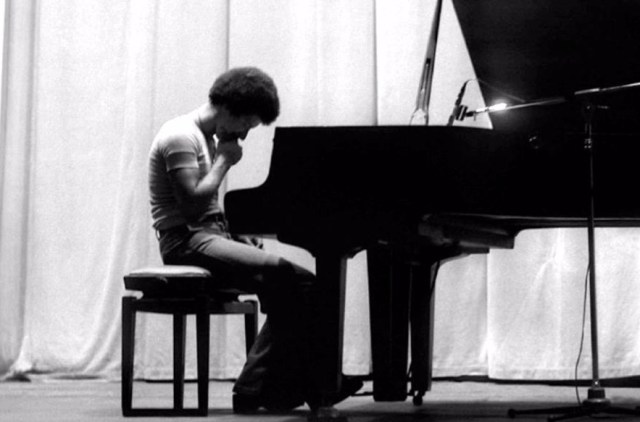
There are many details about the conditions under which Keith Jarrett performed his concert in Köln in January 1975, from the context of his blossoming solo and collaborative career on the heels of his epic work with Miles Davis, to the third-rate piano he was given on which to perform the show, to the fact he was exhausted and in a significant amount of physical pain for his hour-plus improvisation in front of a sold-out Opera House crowd.
Ultimately none of these details matter. The Köln Concert is a river, and, if there are miracles in my life, it’s that such depths continue to transport me.
soundstreamsunday presents one song or live set by an artist each week, and in theory wants to be an infinite linear mix tape where the songs relate and progress as a whole. For the complete playlist, go here: soundstreamsunday archive and playlist, or check related articles by clicking on”soundstreamsunday” in the tags section above.
I began writing this post several months ago, in January, carried along on the brief rush of excitement that comes with a new year. “2015! How about noting a bunch of anniversaries of great albums?” And, in fact, one of the great strengths of Progarchy.com is the sense of music history and the awareness of anniversaries: “Forty year ago….thirty years ago….twenty-five years ago…twenty years ago…”, as opposed to the dominant model out there, which is “Forty minutes ago…thirty seconds ago…twenty tweets ago…” But then life overwhelmed me and the burst of focused energy dissipated for a while. Now it’s back. Best strike while the vinyl is hot—or something along those lines.
The idea here is very simple: I listen to hundreds of new albums every year, along with hundreds of older albums that I come back to for various reasons; but how much of that music has real staying power? And what, in the end, makes a person return repeatedly to This Album rather than That Album? Sure, of course it is because of impeccable taste and a rare instinct for timeless music. (Duh.) But there is a wonderful mystery to it all, for so much of what resonates in a particular album comes from accidental things: the time, the place, the event, the moment. Certain songs bring back great memories; certain songs make you want to jump off a cliff (yes, I’m looking at you, Olivia Newton-John’s “Physical”).
But it isn’t simply a matter of nostalgia, which can only go so far; it is, I hope, more often a matter of discovery, of hearing something new—or, in some cases, hearing something old and suddenly hearing it. Really hearing it.
My criteria is this: what albums from 60, 50, 40, 30, 25, 20, and 10 years ago do I still listen to now on a regular basis? And never tire of hearing? And why? With that, here goes!
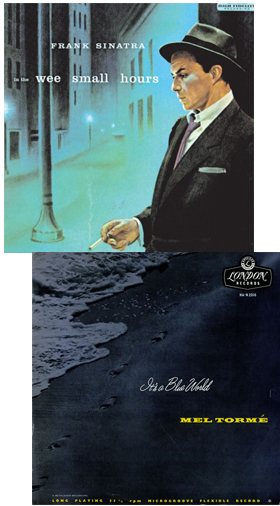
1955: In the Wee Small Hours by Frank Sinatraand It’s a Blue World by Mel Tormé. I was not raised on Sinatra’s music; quite the contrary—I was raised on decent hymns and mediocre to rotten “Christian” music; I hardly paid attention to Top 40 pop and rock until I was in junior high. And I didn’t really listen to Sinatra or Tormé until a dozen years ago. Prior to that, I simply didn’t “get it”. Then I did. Why? I’m not sure. But since then, I’ve collected some 1300 Sinatra songs. The Chairman of the Board produced many classic albums, but this one is my personal favorite: dark, lush, aching, beautiful, gut-wrenching, perfect. I sometimes fall to sleep listening to it, especially when it’s 2:00 in the morning and I’m wide awake. Sinatra had the rare gift of making you, the listener, believe The Voice was singing only to and for you. It’s impossible to describe; it simply has to be heard and experienced. And don’t forget: Sinatra is the God Father of Prog. Really. Sinatra, by the way, was born a hundred years ago this year.
Tormé did not have the edge or darkness of Sinatra, nor did he ever plumb the depths of emotional despair as did the legend ten years his senior. But Tormé had range, talent, and genius to burn, not just as one of the greatest vocalists of the 20th century, but also as an accomplished songsmith (he penned 250 songs or so), fabulous arranger, top-notch drummer (and decent pianist), novelist, biographer, author, actor, screen writer, consummate showman, and collector (guns, cars, movies, etc.). It’s a Blue World is a lush, impeccable set of songs, likely influenced by Sinatra’s Wee Small Hours. While Sinatra packs an emotional punch, Tormé thrills with pure beauty and dazzling musicality, all delivered with an effortless ease that reminds me of watching Roger Federer play tennis at Wimbledon. Bing Crosby, asked late in life to name his favorite musicians, named only one vocalist–Tormé–saying, “Any singer that goes to hear this guy sing has got to go and cut his throat.” For a taste, check out Tormé singing Duke Ellington’s “I’ve Got It Bad, And That Ain’t Good”. Continue reading “60 Years, Twelve Albums, One Man’s Favorites”→


 It’s 1975 and I’m nine years old. I’m lying on my back in Reservoir Park, a small city block of grass and oaks next to the University of Utah. In my head is a song that trips and travels as I run and play with friends. It’s a vision of sound, a strong impression of bright sun and moving clouds, a feeling on my skin, a growing chill in the air. Is it October? The song is a constant rhythm of consciousness and motion, a life in itself but also within me, as if I’m one of its many, many tributaries.
 Progarchy