It was, in retrospect, what people call a “pivotal album.” The Colour of Spring, Talk Talk’s third full-length release, appeared initially to be a straightforward development from the band’s previous recordings – artfully crafted pop delivering global hits – and yet pointed bravely towards something unexpected, something decidedly un-pop. One could see the footprints the band had left along the trail from their 1982 debut single, “Mirror Man”, to the 1986 release of this, their biggest selling record, but there were also signs they were heading into new, uncharted territory. Life’s What You Make It was the calling card, a bold burst of vibrant, optimistic acceptance, driven by a rolling piano line and drums inspired by Kate Bush’s Running Up That Hill, and Living in Another World stood proudly beside it, distinguished by Traffic’s Steve Winwood’s exuberant organ cameo. But April 5th and Chameleon Day were intimate, lingering slices of abstract sound that were as baffling as they were haunting.
I’ve offered my “Talk Talk” testimony so many times, it’s probably getting a bit ridiculous. To sum up, I really, really, really, really, really (well you get the idea) like Talk Talk, and I have since the spring of 1987, when I first encountered them by chance. Further, I would have to rank “Spirit of Eden” as one of my two or three rock albums of all time.
Phew.
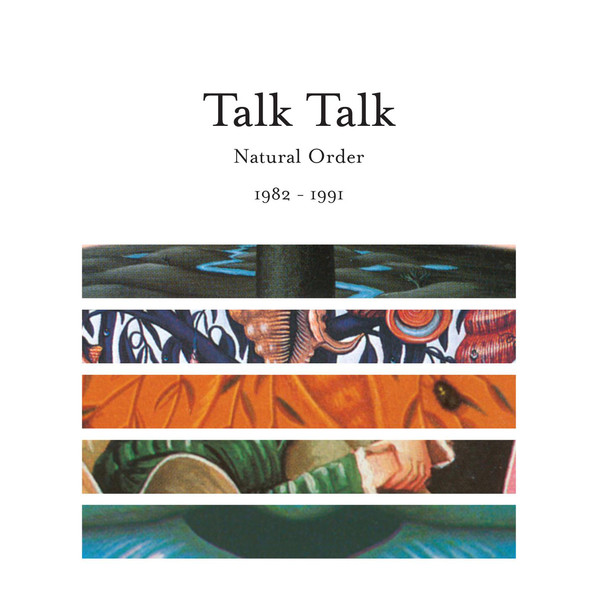
So, much to my surprise the other day, I saw that Mark Hollis had emerged from his seemingly J.D. Salinger like-life (may Salinger rest in peace) to release, under his official direction, a Talk Talk compilation. It’s entitled “Natural Order,” and it just arrived.
Most of the others, frankly, from “Natural History” to the remixes to . . . . Well, let’s face it, Talk Talk just can’t be broken into parts. The albums come as a whole. I don’t just plop “Colour of Spring” or “Spirit of Eden” or “Laughing Stock” into the CD player when dropping the kids off at school or running to the supermarket to get milk. No, these last three albums require attention and love. Listening to them casually would like roller skating through the Field Museum in Chicago or jogging through the Nelson Museum of Art in Kansas City. Continue reading “Nascent, Nascent: The Natural Order of Talk Talk”→
In the spring of 1987, while browsing the new music at the Hammes Bookstore at the University of Notre Dame, I fortuitously came across an album called “The Colour of Spring” by a group I had previously dismissed as nothing more than a trendy New Wave band with the bizarre name of Talk Talk.
Though I knew next to nothing about Talk Talk or their music, I was quite taken with the cover, a James Marsh painting of a number of butterflies and moths with a variety of surreal designs on them. Judging the album by its cover, I decided to take a chance and make a spontaneous purchase.
After a listen to “The Colour of Spring” back in my dorm room in Zahm Hall, I was a convinced Talk Talk fan, and I’ve been ever since. Indeed, I’d never heard anything like the music or the lyrics.
In the opening track, Hollis sings with astounding conviction:
“Try to teach my children/To recognise excuse before it acts/From love & conviction to pray.”
In the concluding song, Hollis again brings in a religious theme–this time of the nature of evil, and the power of good to overcome it:
“As bad as bad becomes/It’s not a part of you/Contempt is ever breeding/Trapped in itself/Time it’s time to live”
With at least fifteen musicians and two choirs performing on the album, including Traffic’s venerable Steve Winwood, “The Colour of Spring” is complex, religious, and dramatic. It was made by musicians who clearly love what they do and who enter into music as fully as humanly possible. Even to this day, I feel chills when I hear the album. It’s not lost any of its quality, even after twenty-two years.
Two years later, in the fall of 1988, when I was working at as a classical host and a rock DJ at WSND-FM, Talk Talk released its fourth album, “The Spirit of Eden.” Now regarded as the foundation of the post-rock movement, the album might be one of the finest non-classical albums ever made. Intense, moody, and deeply meaningful, the “Spirit of Eden” captures and propels the imagination for a little over a 40 minutes. Costing an outrageous sum of money to produce, taking 14 months to make, and employing 16 musicians and a choir, the “Spirit of Eden” simply confused the music industry.
In a radio interview (available on the Talk Talk facebook page), Hollis acknowledged that the lyrics—based on the notion of creation and destruction, on the loss of real and traditional communities in the modern world, and on the disturbing absence of silence—have a profound meaning for him. In the middle of the opening 18-minute song, Hollis sings:
“Summer bled of Eden/Easter’s heir uncrowns/Another destiny lies leeched upon the ground.”
Another song, “Wealth,” rewrites the famous “Prayer of St. Ignatius of Loyola.”
Talk Talk’s final album, “Laughing Stock,” has a similar feel to “Spirit of Eden,” in terms of music and lyrics. On the fifth track, “New Grass,” Hollis sings:
“A hunger uncurbed by nature’s calling/Seven sacraments to song/Versed in Christ/Should strength desert me. . . . Lifted up/Reflected in returning love you sing/Heaven waits/Someday Christendom may come/Westward.”
After twenty-two years, Talk Talk released its first live DVD. Recorded July 11, 1986, in Montreaux, Switzerland,” the band—Mark Hollis, Lee Harris (drummer), Paul Webb (bassist), two keyboard players, and two percussionists—offers the small Swiss audience every single thing they have to offer over roughly 90 minutes. The concert, consisting of 15 songs (fourteen listed, but the best song by far, the 1 minute 30-second long “Chameleon Day,” receives no official notice in the packaging) is nothing short of inspiring and heady, and the music—even the earlier poppier stuff such as “My Foolish Friend”—has an organic, impressionistic, jazzish, progressive feel.
Some songs unexpectedly come to life in fascinating ways, such as “Does Caroline Know,” a relatively weak studio cut. In concert, though, it stuns and comes off as a progressive rock epic.
Every person on the stage seems to be enjoying himself immensely, each a professional and artist fully in sync with every other person. Harris, especially, plays with such steady ferocity that I feared his drum kit might collapse during the concert. It didn’t, and Harris played with passionate verve throughout. He clearly holds the varied instruments and musicians into a centric and cohesive whole.
But, most importantly, Hollis sings as though he is standing before the court of God, afraid to squander any precious talent bestowed upon him. As strange as this might read, he appears as though he is full ecstasy. I mean ecstasy in its original sense—not as something sexual, but as something divine.
He seems the perfect medieval saint, enraptured by the Divine. There are moments during the concert when he walks back to a bench/seat in front of the drum kit and simply collapses. Yet, even in these down moments, he is fully and completely one with the music, if his body movements, swayings, and motions are any indication of the state of his soul. Indeed, from roughly the third song to the end, he seems to be completely immersed in the art and intensity of the music.
At the end of the concert, when Hollis says: “Thank you very much. Good night. God bless. Thank you very much,” he seems to mean every word of it.



 Progarchy