

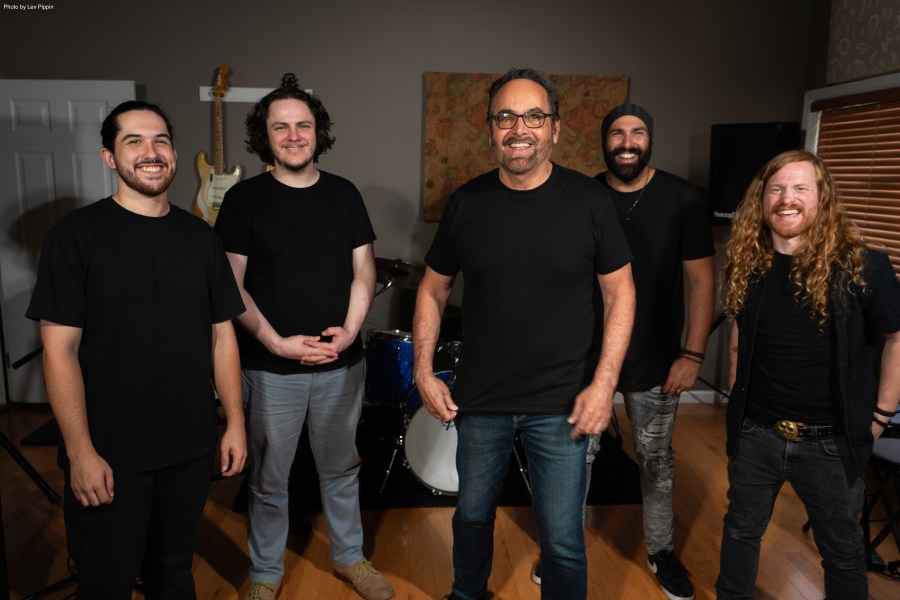
Justifiably one of our Artists of the Decade, Neal Morse has been prolific as ever in the past few years: a two-album rock opera on the Biblical tale of Joseph, made with an all-star cast [The Dreamer and The Restoration]; solo albums like 2020’s Sola Gratia and the new Late Bloomer; album/tour cycles with Transatlantic [The Absolute Universe] and the NMB [Innocence and Danger]; plus the new semi-acoustic trio with Nick D’Virgilio and Ross Jennings, as heard on the albums Troika and Sophomore. When I connected with him recently, the focus was on his new band The Resonance, their new album No Hill for a Climber (out November 8th) and his upcoming cycle of Morsefest weekends in the US, EU and UK. Due to audio glitches beyond our control, we can’t post the whole conversation, but the excerpts below capture Neal’s excitement about the new release and his upcoming shows, his candor about the challenges of putting an album together, and his enthusiasm for delving deep into the creative process.
How the new album project came together:
‘I was looking out at 2024, and I didn’t know what I would be doing aside from the Late Bloomer album; I’d already written all the songs. And then I had Morsefest London and we had Cruise to the Edge with Flying Colors. But aside from that, I didn’t have anything else booked for the whole year.
And I was talking about it with my wife. And she said, there are all these really great local guys that I’ve played with at different events – Christmas concerts, church gigs, things like that. It was her idea that I’d try to make a prog album with those guys. At first, I was like, “well, maybe we could do a few writing sessions and see how it feels.”
But the thing that really attracted me to it was the fact that everybody’s local. I read about The Beatles in the old days; they were all living around London, some of them only ten minutes from the studio. So, if somebody was inspired with a song, they could just get on the phone and meet at the studio very often, while the fire is hot, so to speak. There’s something really inspiring about that for somebody that’s creative. If you get inspired by an idea, it can be a bummer if it takes a really long time to work on it or come to fruition.
I really enjoyed this; there was a lot more freshness happening on No Hill for a Climber for me. Some of those things I just had the idea right before we got together to work on it. And I actually wrote quite a bit of the stuff in the room, and I also wrote some of the stuff by myself.
There’s great players of all shapes and sizes [in Nashville]. And really, those musicians: they might be playing country cause that’s what pays, but secretly they love Mahavishnu Orchestra or something! I’ve found that to be very common. Same in Christian music. These guys really love prog, actually! And it was great to get together with some young people with different ideas. There were ideas they had that would never occur to me!’
About the members of The Resonance
‘Chris Riley I’ve known for about ten years. I first met him at Morsefest, actually. I can’t remember when I met him next, but over time we became friends; he began to play bass at City On A Hill Church in downtown Nashville, the church where I was pastoring at the time. And he’s come to all the Radiant Schools, these week-long schools that I have here. And so I started to hear his progressive rock music, which was really amazing! At the Radiant School, when we’d listen to each other’s music that the students were all writing during the week and also had brought in stuff they’d written. When Chris’ music would be playing, everybody would come running like, “What is that?” And he’s a multi-instrumentalist, a really interesting artist, I think. Kind of a left-field guy. He’s the guy that helped me do the soundscapes on the Joseph albums, some of the really weird ones. He’s really out there. Expect the unexpected with Chris Riley!
Philip Martin is a young guy that I’ve known most of his life, because we’re friends with his parents. And I got to watch him develop as a musician, as a person. He was getting better and better at the drums, and so I asked him to start playing percussion; he’s been the percussionist at Morsefest for many years now. So, Philip’s been percussionist at Morsefest and also playing with me – you might recognize him in some of the videos I’ve done; he’s been in other things. He’s really blossomed as you can hear on the album. The drumming’s pretty great, I think!
Andre Madatian is a music teacher and a guitar player that I’ve known for about 10 years also. And he played a guitar solo on the Joseph album that I really, really liked. Anyway, he’s a really pleasant guy to be around, and when I was talking about who might I make a record with – whenever he comes to play, he just brings so much to the table. And so I thought, “Well, let’s have preparatory writing sessions,” and the rest is history, you might say.
[The vocalist] was the wild card. When we were writing this music, we were hearing, I was hearing particularly these high vocals in certain sections. In fact [ballad] “Ever Interceding”, when I wrote it, I wrote it in D, knowing that I can’t sing it! The bridge starts on an A and I can’t get anywhere near that, really. But I didn’t want to change the key and lower it for me; it didn’t feel right.
So, there we had all these songs, but we didn’t have a singer. And we were delivering the album in May and it was mid-April! And I was talking to the singer that was a friend of Andre’s that he said was just awesome and came highly recommended. Well, I talked to him for a week; he said he was going to come over the next week. And around the end of April, he says “Hey, I’m busy; can we talk about June?” And I said, “No; I’ve already got a time line on this!” And Rich [Mouser] is set up to mix. We’ve gotta deliver this thing!
So I started making some more calls, and a mutual friend said, “Oh, I’ve got the guy, this Johnny Bisaha. He’s gonna be amazing!” What’s so incredible to me, I think we met right at the end of April; he came over the first week of May, I believe, and did all his vocals on the album in two days. In the eleventh hour he came and just hit it right out of the park. And he’s also just another pleasant, great guy to be around, and that’s important too.’
Where the album title came from:
‘Well, it’s not a concept album, so it’s not telling a story; it would be like Close to the Edge. “No hill for a climber” – I was reading a book called Demon Copperhead [by Barbara Kingsolver], and that was in February. We were flying to see my daughter and her husband in Colorado, and I was reading that. And I said, “What a phrase!” I don’t know if you ever do that, if you’re reading and a phrase will jump out at you. “That’s a cool saying! I’ve never heard that – no hill for a climber.”
So I was just sitting there on this airplane flight, and I started singing it to myself. I got up and I started walking up and down, cause I didn’t want to wake up the person sitting next to me! So, I’m walking up and down the aisle singing into my phone real close, hoping it’ll come out with all the noise. Quite a bit of the sketch of that chorus came right out on the airplane.
And then I sat down and started reading the book again. And a little while later, I started hearing the thing that comes afterward. So I get up and I’m walking around the airplane again! I got up a few times on that one flight. My wife finally said to me, cause she was sitting with the baby elsewhere, and she said “Man, what’s with you? What’s going on? Have you gone crazy?” I said, “I don’t know, man; God’s giving me a lot of stuff – I want to make sure I don’t lose it!” I knew it was good.’
About the opening suite, “Eternity in Your Eyes”:
‘Some of what I wrote, I would say that’s got some of the most Spock’s Beard-type stuff in it. Some of it’s quite reminiscent of Spock’s Beard – even the sounds. The bass sound – we actually ran four tracks of bass to achieve the sound that we got! I’m really happy with it.
There’s so much to say about it. It originally was not a particularly long piece. I had written the verse and the chorus for “Eternity in Your Eyes” on piano. Part of my job as producer was to listen to the other music that the other guys had written and figure out where to place it or how to use it. And so I had the idea to start off that piece – as it grew; after we added Chris Riley’s demos, the “Northern Lights” part and the “Hammer and Nails” section. Cause I listened to his demos, and he had this really long piece; I don’t remember how long it is, it’s like 40 minutes long. And I asked if we could take those parts out and put them in “Eternity in Your Eyes”. And he was just like, “Oh, yeah, sure, yeah.” And I was like, “Oh, great!” Cause I loved those sections.
So then the challenge was to figure out how to get into there from “Eternity in Your Eyes”, and then how to get out! And once we did that, I listened down to the whole thing and went, “You know, we need something between those two parts!” [Laughs} I was in the mountains in Gatlinburg, Tennessee for a few days, and I had the idea to put in a jam in the middle. I was like, “man, there isn’t enough stretching out and soloing!” One thing I really liked that Transatlantic did was that they would stretch out parts and really get into a long solo section that starts off small and builds up. I’ve always really liked that, but I don’t always remember to put those into the things I’m working on.
Anyway, I had the idea to put in the jam thing, but then going from the jam into “Hammer and Nails” didn’t really work. So then the idea to put in a little bit of the chorus. And now that it’s becoming this longer piece, it makes a lot of sense to put in a little bit of the chorus in there, to tie it all in. And then it was one of the other guys that had the idea to have Johnny sing it! Then once Johnny came in, it was, oh! We need him to sing on more than “Ever Interceding” and “No Hill”. So let’s have him sing a verse of “All the Rage”, and let’s put him in the bridge of “Eternity in Your Eyes” – you see what I’m saying? As it was developing, all of these things were changing. Right up until the last minute, actually.
Everything you put in changes the perspective of the whole piece. Cause when you listen down, you want to feel the flow. And that’s the greatest challenge of the long pieces is getting the flow right. It’s not easy! [Laughs] It doesn’t usually just happen perfectly out of the gate. There’s a lot of consideration and cutting and pasting and putting in. But as long as you step back from the canvass and go, “Yeah! Yeah! It’s working; I think we’ve got it, [British accent] by Jove!”’
About “Thief”, the second track and second single:
‘Yeah! I don’t know where these things come from. I was just taking a nap one afternoon; and I woke up with this strange “Thi-e-e-e-f” [Demonstrates words and bass line]. So I had this idea for the beginning. And this is one of these times where collaborations really kick in. I had the beginning, which was weird and kinda spooky, and it was like, “Where do I go from here?” I tried a bunch of things; I finally went into a 6/8 thing. [Demonstrates} “Everything you touch turns into lies”. I was very happy with that; it sounded kind of like Queen. And then I had the idea [demonstrates], “My Lord’s gonna fight” and I wanted to go into something big – but I everything I tried, I tried a lot of different things and nothing was working for me.
So I called up Chris Riley; that’s the great thing about having everybody local. Chris just came over that night and he listened to it. “Oh, yeah, cool! What about this thing?” That middle part of “Thief” is actually something that Chris Riley brought in to the Radiant School about 3 years ago [demonstrates] with the ascending bass and the organ. He actually laid that into the computer, when we were just sort of getting it out. Cause I didn’t really remember how that went.
And I knew I wanted to peak it out and have it stop, wait and go “Thief!” Cause that’s the way my mind works. My original idea was that we’d do some blistering fiddly bit and then stop. But I thought, “I don’t know; it seems like I’ve done that a lot.” Then I had the idea, “What if we all just freak out? We’re just going along and all of a sudden, everybody just starts going out, playing random, crazy stuff? And then stopping all together!” And of course, obviously, that’s what we wound up doing. That’s actually one of my favorite moments on the album. [Laughs] It’s so crazy! When we first tracked that, it was Philip Martin and me playing bass. It started out with just bass and drums and everything else was layered on on top of it.’
About “All the Rage”, the first single:
‘I was looking for a chorus; I wrote that one by myself, so I had the opening that I thought was good, proggy but yet a little rock riff. It’s in 4/4, you know? [Chuckles] I had the whole thing up to the chorus, and I kept trying different choruses.
And when I came up with that “all the rage” thing, that was what fed the whole lyric. “You’re all the rage, but you won’t turn the page.” The whole lyric sort of fell out of that. It’s a challenge to write stuff that’s progressive yet short yet accessible. And we tracked that together in the room, just rockin’. And I think you can feel that; that has a good fresh feel about it. And the tempo’s changing; if you notice, the last chorus is quite a bit faster than the other choruses. But I think that’s what gives it life. I think it has a lot of good feel to it.’
 Progarchy