The Death of the Artist in Everybody’s Collection

Dan Flynn pays tribute to the greatest album cover artist ever, Storm Thorgerson, in “The Death of an Artist in Everybody’s Collection“:

His greatest critical if not commercial triumph may have come not with his pre-fame friends in Pink Floyd but with a similarly experimentally minded artist. Peter Gabriel didn’t name his early albums. Hipgnosis’s cover art did. The singer’s third solo effort, officially titled Peter Gabriel like the two albums preceding it, unofficially became “Melt” because of the arresting black-and-white image of the singer manipulated to look as though his flesh dripped off his face. Thorgerson created that one, as well as “Scratch,” in which Gabriel’s fingernails leave a trail of white streaks. Thorgerson’s car appears on—what else?—“Car” by Gabriel. Akin to The Beatles’ “white album,” Gabriel’s early releases go by the names the cover graphic bestowed upon them rather than their proper titles. …

If cassettes and CDs supplanting vinyl didn’t signal the end of cover art, then certainly digital downloads did. The LP record awarded Thorgerson a canvass a foot long by a foot wide. Steve Jobs reduced these visuals to roughly the size of a Starburst candy. Small is the new big. Something gained, something lost—what we reclaim in shelf space we miss in aesthetic beauty.

Storm Thorgerson understood visual for people who understood aural. He also knew when to die. Cover art, like the vinyl discs they protected, play about as vibrant a role in contemporary pop culture as the Victrola. Album art is sadly gone. So is the man who most excelled at creating it.

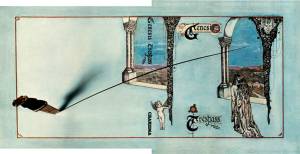
Genesis, TRESPASS

genesis trespassby Chuck Hicks

By way of introduction, I grew up in and around Southern Appalachia.  I’m as conversant on Roscoe Holcomb, Flatt & Scruggs and the Stanley Brothers as Robert Fripp, Crack the Sky and Spock’s Beard.  I grew up hearing pop, psychedelic and folk/country stirred together.  When I was 8 years old Tommy James’ “Sweet Cherry Wine,” with its church organ, quasi-religious lyrics and Leslie speaker-distorted background vocals helped shape my standards for genre-bending music.  It was fairly inevitable that I would fall in love with progressive rock.  But I have a peculiar need to find harmony in disparate styles.  That in part explains my choice for a first submission to Progarchy.

+++++++

The most memorable mental picture I have of early Genesis came from a set played on Belgian TV: Steve Hackett, with black beard and aviator spectacles, sitting at Peter Gabriel’s hand, ripping through the furious instrumental break of “The Musical Box” on his black Les Paul.  After whipping the pick up the neck Hackett dropped his hands to his knees and sat like a classical musician at rest, his section of the piece done.  I’d never seen anything like his demeanor in a rock band.  Hackett could have just played with the London Philharmonic.

It’s easy to forget that Steve Hackett was not the first Genesis lead guitarist.  A year earlier his “seat” was filled by Anthony Phillips, classmate of Peter Gabriel, Tony Banks and Mike Rutherford at Surrey’s exclusive Charterhouse School, a place where future gentlemen were groomed.  Among many distinguished Old Cartusians was Ralph Vaughan Williams, collector of English folk songs and hymns who melded them into memorable classical pieces like Norfolk Rhapsody and the fantasias on “Greensleeves” and a Theme by Thomas Tallis.   To listen to Phillips-era Genesis is to be reminded of Charterhouse manners and influence, which included things like mandatory chapel attendance and respect for the ancient traditions of England.  The medieval, the rural, and the sacred surrounded the lads as they turned their attention to becoming pop song writers in 1967.

Continue reading “Genesis, TRESPASS” →