The Cautionary Barrett

This is an important month for admirers of the late Syd Barrett.  The artist’s birthday falls on January 6, and his first solo album The Madcap Laughs was released January 3, 1970.  These anniversaries occasion an opportunity to ponder what Barrett left in the cautionaryvery short slice of time that shattered musical conventions.
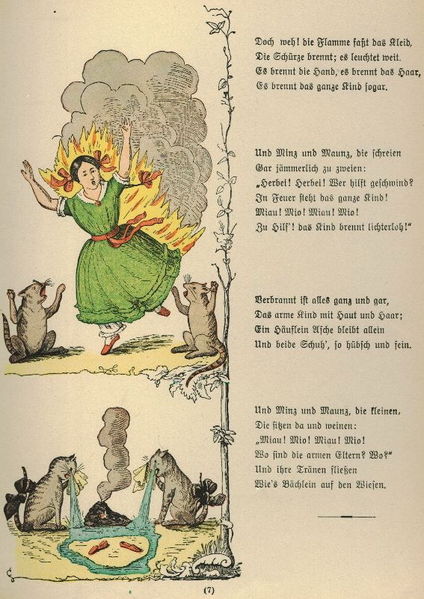
What Barrett accomplished on guitar is legendary in itself, taking the lowly Danelectro 59-DC and, with a Zippo lighter or a ball bearing for a slide, creating entirely surreal soundscapes scarcely resembling anything on the blues records he enjoyed as a youth.   But it was Barrett’s lyrics that gave substance to his melodic adventures.  As we might expect from a native Cantabrigian, Barrett’s verse was informed by sundry literary figures.  One Russian fan site conjectures  influences ranging from C.S. Lewis (“Flaming” and “Scarecrow”) to Tolkien (“The Gnome” and “Dark Globe”).  Known references include James Joyce’s verse for “Golden Hair” and Hilaire Belloc’s Cautionary Tales for Children on “Matilda Mother.”  I would like to expand upon the latter, as Syd Barrett’s oeuvre seems to be one large cautionary tale, reflected both in his artistry and later, after his crack-up and expulsion from the Pink Floyd, in his personal life.

Cautionary tales are written or recited for young audiences.  Syd Barrett’s music clearly displays infectiously playful, childlike elements.   The Piper At the Gates of Dawn has been characterized as consisting of two main features: extended pieces that included free-from passages (“Interstellar Overdrive”) and shorter, whimsical pop songs.

Of the latter it has been suggested that these include certain dark elements.  A good example is “Flaming.”  The melody and the vocals pack the giddy spontaneity of adolescence — a sense of being swept up in infatuation for the first time.  Listening to this song is to be transported back to age 13 or 14.  The subject to whom the song is directed can neither see nor hear Barrett, but he can see and hear her.  Using buttercups and dandelions to heighten a sense of euphoria, Barrett sings

Too much? I won’t touch you — but then I might.

Later we discover this conversation involves “travelling by telephone” — the preferred medium of exchange for adolescents for the past 60 years (the only difference today being wireless texting).  But the notion of Barrett inserting himself as the agent of sensory overload, of shattering the playful possibilities with a very direct and perhaps unwelcome advance — this is the tension that drives “Flaming.” Continue reading “The Cautionary Barrett”

Yes, A Floydian Rush to Jazz!

I’ve been buried with real work and real reality, but I do have grand designs for review posts of the new Soundgarden CD, “King Animal”, which released today, and Stephen Lambe’s book, Citizens of Hope and Glory: The Story of Progressive Rock, which I’ve almost completed reading (very short review: 4.5 stars out of 5, recommended). In the meantime, in my unrelenting quest to show the many wonderful connections between prog and jazz, here are three covers of prog classics, performed by the trio, Bad Plus (band site).

For those who aren’t familiar with Bad Plus, the trio—Reid Anderson, Ethan Iverson and David King—has made its name by being, in two word, distinctive and controversial. Part of their distinct (and controversial, to some) approach has been to cover tunes that aren’t a part of the usual jazz canon. For example, have you heard many true jazz covers of ABBA’s “Knowing Me, Knowing You”, Heart’s “Barracuda” (with singer, Wendy Lewis), or Black Sabbath’s “Iron Man”? No, I didn’t think so. And those covers, in my opinion, are excellent; they not only get your attention but they reveal aspects and possibilities in the original songs that weren’t obvious before. And it is done with a winning mixture of intensity, fabulous interplay, respect for the material, sly humor, and some “out there” moments. The Guardian puts it well when it describes the trio in this way: “If the Coen Brothers put together a jazz trio, perhaps it would be like this, the comic and the dramatic rolled together.”

And how about the fact the trio titled its 2007 album, “Prog”? Fabulous! Here, then, are Bad Plus covers of Rush’s “Tom Sawyer”, Pink Floyd’s “Comfortably Numb”, and Yes’s “Long Distance Runaround”:

A Prog Awakening (Part 1)

I suppose it is inevitable that kids encounter music first through the filter of parents’ or siblings’ tastes. That was certainly true in my case. In the early 70s, the meagre set of records owned by my mum and stepdad was my only window onto the world of music. I remember several LPs by Elton John and Rod Stewart, the odd one or two by The Beatles and The Stones, also The Carpenters, John Denver, Mama Cass…

At some point, I began to assert my musical independence and sought out new sounds. At that time in the UK, the main channels for hearing new ‘popular music’ were Radio 1 and the TV show Top Of The Pops. Like most kids, I listened to ‘The Charts’ and had little awareness of anything else. Glam rock and disco had no appeal, but then punk and ‘New Wave’ came on the scene. Like many young people of that era, I found the energy and non-conformist attitude of these new genres incredibly exciting. For the first time in my life, I starting buying my own music: 7″ singles by The Clash, Buzzcocks, The Stranglers, Siouxsie & The Banshees…

Yet the signs were there that I would soon move on to other things. In amongst all that punk were singles by rock acts such as The Who, Queen and Nazareth. Further clues were to be found in my fascination with three albums from my stepdad’s otherwise middle-of-the-road collection. The first of these was a cassette of Pink Floyd’s seminal Dark Side Of The Moon. I forget when I first heard this, but it was before I started buying singles: probably 1975, certainly no later than 1976. I used to sit in the corner of the living room with headphones on, bewitched by the stereo sound effects as much as the epic qualities of the music. I hadn’t realised just how well-crafted music could be until that point.

The second of these intriguing albums was a Focus ‘greatest hits’ compilation – one of Polydor’s ‘Rock Flashback’ series. The cover was awful – fluorescent yellow with the band name spray-painted in green above a skewed, oddly-tinted band photo – but the music more than made up for that. There was so much to enjoy here: Jan Akkerman’s incredibly fluid and inventive guitar playing, Thijs van Leer’s unhinged, operatic performance on Hocus Pocus… In its own way, this was every bit as exciting as the punk that would very soon inspire me to start buying records. Focus remain a favourite of mine to this day, and Sylvia would almost certainly feature as one of my ‘Desert Island Discs’.

And the third of these influential albums? None other than Tangerine Dream’s Atem, completely unlike anything else in my stepdad’s collection. I suspect he saw it going cheap somewhere and bought it on the strength of the artwork. I doubt that he liked what he heard! He played the track Wahn for me, probably in the expectation that I would be shocked by its weirdness. I certainly found it challenging, but it was also strangely compelling. It was a tentative start to what would eventually become an infatuation with TD’s 1970s and 1980s material.

The transition period for me can be roughly dated as late 1978 to early 1979. Before that period, I was a chart-listening, single-buying slave to musical fashion who occasionally managed to reach beyond such superficiality and touch something deeper and more meaningful in music; after that period, I considered myself a serious music fan – album-focused, interested in seeking out new music for its own sake rather than its popularity, ready for the transcendent experiences of witnessing my favourite bands performing live.

That daunting leap from punk to prog was made via the convenient stepping stone of hard rock, principally in the form of Led Zeppelin and Deep Purple. The first rock album I owned was, in fact, Zeppelin’s The Song Remains The Same – a present from Christmas 1978, I think. I no longer recall the precise chronology of my musical discoveries, but I still remember all of the vinyl LPs that were added to my burgeoning collection over that period from Christmas ’78 to my fourteenth birthday in July ’79: the first post-Hackett Genesis album, And Then There Were Three; Pink Floyd’s Wish You Were Here; Paris by Supertramp; Mike Oldfield’s Exposed; and 2112 by Rush. The latter, in particular, had a profound effect on me. I think Side 1 of 2112 was probably my first encounter with a true prog epic. Rush have been one of my favourite bands ever since.

Coming up in Part 2: My own musical ‘Cambrian explosion’ of 1979-1981, and my first gigs…