

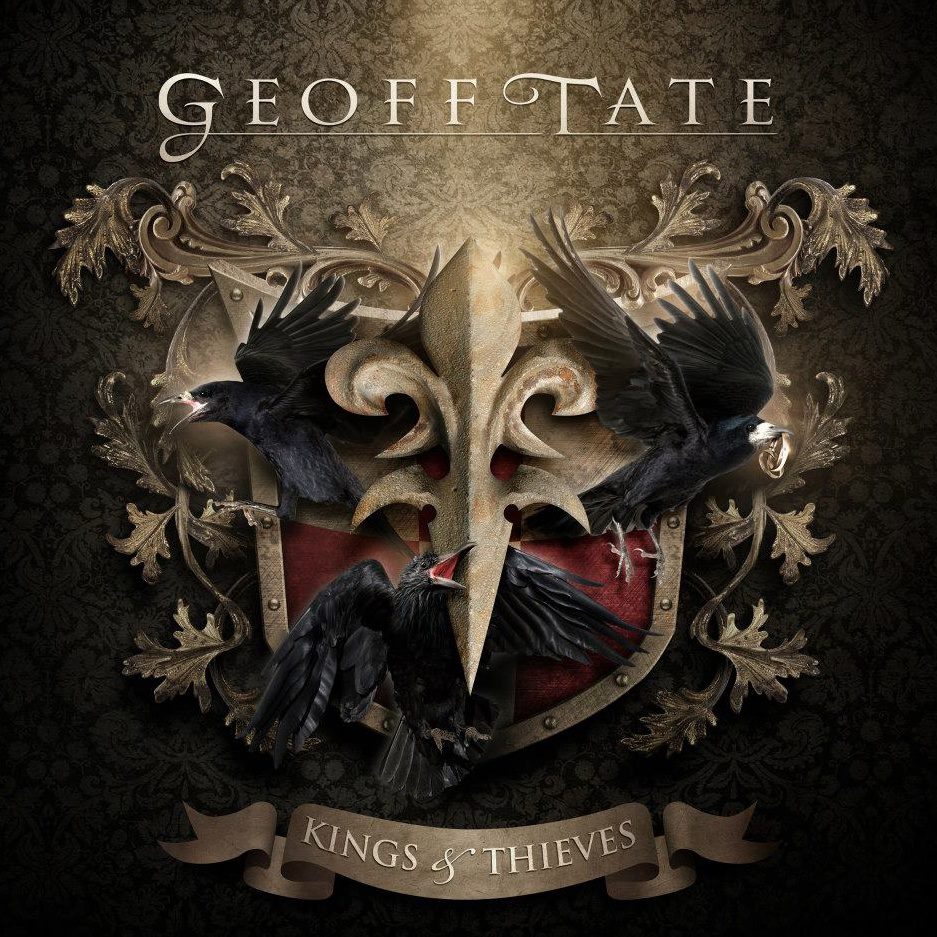
 Kings and Thieves / Geoff Tate – Review
(Insideout Records, available Tuesday, November 6, 2012)
Received wisdom from the now far-distant era of grunge has things playing out thus: hair metal, riding high through the 80s in various forms, from NWOBHM to G’n’R, was coffin-ed by Nirvana and their Seattle brethren, who brought the music back to rock basics in 1991 with a DIY ethic and no-frills aesthetic. But like a lot of stories that have been settled on for historical convenience, the Grunge-Killed-the-Metal-Star fable is over-weighted by victim and victor alike. Hair metal had been killing itself slowly starting about the time of Aerosmith’s remarkable reinvention as an AOR band, blazing a suspect trail based on power balladry that had a lot of us ready to impale ourselves on our air guitars. Add to this that grunge, if not so-called, had been healthy and growing for years in bands like Husker Du and Pixies.
I think if grunge, as made popular by Nirvana’s pop nugget Nevermind, did anything for metal it was to make it healthier in the long run, and Geoff Tate’s album, which is a solid rock record, is a good case in point. I’m not going to pretend to know a lot about him, as my familiarity with his band Queensryche pretty much begins and ends with “Silent Lucidity” — one of the aforementioned power ballads that chased me, screaming, to the edges of mainstream metal in the late 80s — but I’m impressed with this record, and have probably missed out on more than I’d like to admit. Technically gifted vocalists like Tate have a natural advantage in hard rock, where the bar can sometimes be very high (Paul Rodgers, Rob Halford, David Coverdale, Chris Cornell, Ronnie James Dio), and with a good lyric and a good riff can continue to make great records for years.
That’s certainly the case with Kings and Thieves’ opener, “She Slipped Away,” complete with a classic rocking opening progression reminiscent of the Eagles’ “Chug All Night,” an anthemic chorus, really nice guitar soloing, and a well worn, but true, take on relationships and highways. Here and in other tracks (“In the Dirt,” particularly) I’m also struck by a real Peter Murphy-ish sound, part of which is Tate’s vocal tone, but also in the song structures, which want to tend toward pop even as they’re definitely coming out of metal (in Murphy’s case, goth). It’s as if there’s a desire for rebirth or newness, and even when this fails, as it does in the playa’ attempt of “The Way I Roll” (the man’s no Eminem or Kid Rock, and he shouldn’t feel he needs to be) I have to admire that he’s going after it.
The low-end grind of “Take a Bullet” and “In the Dirt” makes for awesome, straight-up hard rock perfect for the open highway. Tate knows how to make his voice match a lyric and a lick, and carries it off even when he’s lyrically pushing things a bit (“She’s got moves like I’ve never seen, rides me hard like an exercise machine” … really? Smell the Glove, anyone?). This record is like all those hard rock albums that came out on the various Columbia subsidiaries of the 70s — it’s like a Nugent record, where you’d get a handful of duff tracks but the rest rocks out enough to make you want to flash the horns, and between it and the next record you’d get enough great tracks for your one-band mixtape.
For those wanting a return to 80s power glory, look no further than “Tomorrow,” with its Kashmir-ish break and vocal choruses of “Tomorrow starts today…sometimes love is not enough….” This is a bow to fans from back in the day, but Tate can really pull it off, convincingly and refreshingly. Kashmir, interestingly, is referenced again in the next song, as “Evil” recycles another part of that indefatigable Zep riff, but it’s hard to care, because Tate really brings it to the mic. “Dark Money,” with its stab at privilege and eco-political power, is an odd moment, not terribly well-matched by the absolute rock star howl that Tate can whip up (kind of like if Ian Gillan led Deep Purple through a ditty about the gas crisis of the 1970s). “Glory Days” may suffer from the same problem, but again, is buoyed by Tate’s delivery and a crack band, which is really together throughout the album. It’s a guitars and drums forward record, live sounding, with a rumbling bass lending metal grind to the tunes. Pianos and synths illuminate when necessary, and keep me thinking, this is a really tastefully produced rock record that fans of classic Queensryche and hard rock in the new millenium can enjoy.
The last two tracks, “Change” and “Waiting,” make well-chosen closers, bringing it down a bit, showing how Tate and company influenced the metal side of grunge (Pearl Jam or Alice in Chains would be at home here), and making me appreciate how much classic metal and hard rock really benefited from the shifts that happened a generation ago.
Craig Breaden, November 2012
 Progarchy