The Best 15 Albums of 2012, The Greatest Year in Prog. Ever.

IMG_3725by Brad Birzer, Progarchy editor

One of my greatest pleasures of 2012–and there have been many–has been listening to massive quantities of progressive rock, mostly for pleasure.

Being a literary and humanities guy, I’d contemplated rejecting the entire numerical ranking scheme.  Rather, I thought about labeling each of my best albums with various qualities of myth.  These albums achieved the level of Virgil; these of Dante; these of Tolkien, etc.  But, I finally decided this was way too pretentious . . . even for me.

Below are my rankings for the year.  Anyone who knows me will not be surprised by any of these choices.  I’m not exactly subtle in what I like and dislike.  Before listing them, though, I must state three things.

First, I loved all of these albums, or I wouldn’t be listing them here.  That is, once you’ve made it to Valhalla or Olympus, why bother with too many distinctions.  The differences between my appreciation of number 8 and number 2, for example, are marginal at best.

Second, I am intentionally leaving a couple of releases out of the rankings: releases from Echolyn, The Enid, Minstrel’s Ghost, Galahad, and Kompendium, in particular, as I simply did not have time to digest them.  Though, from what I’ve heard, I like each very much.

Third, I think that 2012 has proven to be the single greatest year in prog history.  DPRP’s Brian Watson has argued that we’re in the “third wave of prog.”  He might very well be right.  But, I don’t think we’ve ever surpassed the sheer quality of albums released this year.  This is not to belittle anything that has come before.  Quite the contrary.  I am, after all, a historian by profession and training.  The past is always prologue.  Close to the Edge, Selling England by the Pound, and  Spirit of Eden will always be the great markers of the past.

Ok, be quiet, Brad.  On with the rankings.

Continue reading “The Best 15 Albums of 2012, The Greatest Year in Prog. Ever.”

Rush to be inducted into the Rock and Roll Hall of Fame

From RollingStone.com:

The Rock and Roll Hall of Fame has officially announced next year’s inductees: RushPublic Enemy, Heart, Randy Newman, Donna Summer and Albert King will all join the class of 2013, with Summer, who passed away this May, and King, who died in 1992, earning the honor posthumously. Lou Adler and Quincy Jones will both receive the Ahmet Ertegun Award for non-performers.

“It’s a terrific honor and we’ll show up smiling,” Rush’s singer and bassist, Geddy Lee, tells Rolling Stone. “It made my mom happy, so that’s worth it.” Lee is especially happy for Rush’s army of hardcore fans. “It was a cause they championed,” he says. “I’m very relieved for them and we share this honor with them, for sure.”

More from the Q&A with Geddy Lee:

I’m sure some small percentage of your fan base will say, “They should protest the whole thing by staying home.”
I never got too hot and bothered about the subject, and I don’t think that’s a very gracious way to respond to an honor. 

Axl Rose stayed home last year, and the Sex Pistols refused to come, too.
We’re nice Canadian boys. We wouldn’t do that. 

It’s a pretty eclectic lineup this year. Are you fans of the other inductees?
I certainly have worked with Heart and I know them well. I’m very happy for them. I have great respect for Albert King and for Randy Newman. I don’t know the music of Public Enemy very well, but I know they have a very strong fan base. They’ve certainly played a role in the development of that style of music for sure, so it’s a nice group.

To be frank, I am disappointed that Deep Purple is not included in that group. Certainly Heart and Rush would not sound the way we sound without Deep Purple. 

I’m sure they’ll get in soon.
Yeah, I hope so. 

I keep saying this to everyone, but I can’t picture the jam at the end of the ceremony.
Yeah, that’s for sure. What do you jam to? “YYZ?” I don’t know. [Laughs] That’d be pretty fun. 

Read more!

Momentum (Best of 2012 — Part 3)

Momentum

Another one of the albums in my Top Ten for 2012 is Neal Morse’s Momentum.

Brad Birzer appends a useful album overview to the end of his epic CWR review of Neal Morse’s career:

Not a concept in the way several of his other albums are, Momentum most resembles his penultimate album with Spock’s Beard, “V.” As with its 2000 counterpart, Momentum has six songs. The first five are eight minutes or less long, with the last song being a 34-minute epic.

With skill and passion, Morse’s new album considers [in “Momentum”:] the pace of modernity and our reactions to it, [in “Thoughts Part 5”:] the necessity of appearing deep in conversation, [in “Smoke and Mirrors”:] how to weather deception in this world, [in “Weathering Sky”:] how one interprets his calling in the world, and [in “Freak”:] the way a powerful spiritual figure would be perceived should he arrive bodily in the present day (I’ll leave it for the reader to discover the identity of the protagonist in the track, “Freak,” as Morse deftly leaves the identity a mystery until the very end of the song) in his shorter tunes.

The epic is, well, epic. As the title, “World without End,” suggests, the thirty-four minutes explore the motivations of a person, and especially whether he or she is trying to shape the ephemeral or the permanent and timeless.

I have to admit that one of my favorite moments on the disc is when the title track glides on into the killer guitar solo that is expertly framed by an ecstatically swirling keyboard flight path:

Go listen to 3:10—4:10 on the album track…

Indeed, that is definitely one of the best minutes of prog we have heard all year.

(Note: 2:49—3:18 in the video below has the killer guitar solo, but omits the awesome keyboard/guitar dogfight. But I am not complaining: I love that I heard the Single Edit version first by watching it as a sneak peek on YouTube; and then, even though I had already fallen in love with the song, when I downloaded the album itself, I got the extra thrill of hearing the suddenly-new keyboard/guitar dogfight now added to the end! It was a unique experience unparalleled by any previous prog preview encounter!)

Continue reading “Momentum (Best of 2012 — Part 3)”

A Couple of Links

Over at In The Studio.net, there is an interview with Yes on the occasion of the 40th anniversary of Close to the Edge.  It’s about 20 minutes long and well worth a listen.  Hat tip to Paul Watson who previously posted about this on the BBT Facebook page.

On YouTube, I stumbled across an interview with Neal Peart regarding Clockwork Angels, and thought it would be a good companion to the post below regarding the same album.  Its about 43 minutes in length, but like almost any interview with Peart, you can be sure it’s interesting.

Clockwork Angels (Best of 2012 — Part 2)

Another one of the albums in my Top Ten for 2012 is Rush’s Clockwork Angels.

Stories like “Xanadu” and “Cygnus X-1” were what first enthralled me. So it is a dream come true to have a full-blown concept album from Rush after all these years. And with an accompanying novel, no less.

“Though Rush has often embraced huge themes and stories, sometimes over several albums, this is the first time the band has attempted a full concept. The story, nearly sixty-seven minutes long, follows the journey of a young man finding his own voice in a society ruled by indeterminate god-like fates (the Watchmaker and the Clockwork Angels), a rule-based conformity but peopled by a number of eccentric persons and subcultures,” writes Brad Birzer.

The story seems to be ever ancient (obviously it’s an epic remake of Red Barchetta, and Subdivisions, and [insert your favorite Rush song here]), yet ever new: “a very Calvinistic set of gods attempt to control all through mechanized precision, while alchemy, rather than science, has progressed. The album is divided into twelve songs, each represented by an alchemic symbol positioned at each hour of a twelve-hour clock.” (Brad Birzer on the story)

Brad also notes:

What is especially fascinating is that Rush—in music and lyrics—has with Clockwork Angels created an all-embracing mythos, referencing their own works and music going back to the band’s very first album. There are hints, some overt and some not, from albums across the past four decades, and the protagonist must—as with Aeneas and a number of other classical heroes—experience, survive, and outwit the gods.

In Clockwork Angels, though, the hero realizes one very vital thing: the divine will always control time. The gods might not control our individual fates—despite what the priests and politician tells us—but, in the end, Chronos devours all. But, within that given time in the world, man can do many things, and he can even dream and pursue the highest of all things.

In other words, Neil Peart continues to inspire. As Brad has noted elsewhere, “Neil was the big brother who introduced us to the literature our teachers seemed to have misplaced: classical myth, Voltaire, Coleridge, Twain, Dos Passos, Hemingway, Rand, Tolkien, Eliot, and others.”

Brad’s tribute to Rush there hits the target:

In the late 1970s, 1980s, and 1990s many of us lovingly thought of ourselves as the younger brothers of Peart. He was the genius kid with integrity, who always walked through the halls with two hilarious, equally smart (if not overtly intellectual) and infinitely loyal friends. One of his friends had parents who had survived the Holocaust camps of the Nazis. The other friend had folks who had escaped the prison camps of the Communists. Now, the three were free to express themselves in any way they so decided on this side of the Atlantic.

These three confidently confronted the world as a perfect trio, unbreakable and ever mutually re-enforcing and inspiring.

We looked up to all three as those who could understand our failures and successes, our desires and our alienation, our rejection of conformist culture and our drive to better ourselves.

Going where I want, instead of where I should
I peer out at the passing shadows
Carried through the night into the city
Where a young man has a chance of making good

A chance to break from the past
The caravan thunders onward
Stars winking through the canvas hood
On my way at last 

Also on my 2012 list is Oceania. Like Brad, fan boy Billy Corgan also knows how to pay appropriate tribute to Rush.

Oceania (Best of 2012 — Part 1)

The Smashing Pumpkins

One of the albums in my Top Ten for 2012 is The Smashing Pumpkins’ Oceania.

Volcanic bass guitarist Nicole Fiorentino and Rush fanboy Billy Corgan deliver some especially mind-blowing musical moments. The title track invites us to go swimming in 9:07 minutes of heavy prog wonder, in which we encounter an acoustic guitar island and then ride out more waves with multiple distorted guitar solos.

But every track is a keeper. In the album order, my four fave tracks are “Quasar” (which rocks things off with an appropriately heavy mystic quest, as the chorus sings out the Tetragrammaton—YHWH—until meditative bliss is encountered), “The Celestials” (complete with a heavenly epiphany—see next paragraph below), “My Love is Winter” (an incredibly melodic mind-grabber that builds the tension expertly in a prolonged way and then attains delirious resolution after teasing us delightfully with the extended musical deferral), and “The Chimera” (for its epic monster riffing).

“My Love is Winter” was the divinely lovely song that stayed with me most when away from the headphones; but “The Celestials” is perhaps my upper-echelon selection for epic greatness. It opens with an awesome sing-along acoustic guitar enticement. Then it blasts into rock trio orbit at 1:16 as the bass (oh yeah! dig the bass!), the guitar, and the drums prepare for the jump to light speed. And wham, at 1:52 we launch into hyperspace and the whole world suddenly accelerates and then magically slows down as, now outside time, we cosmically survey it all via the synthesizer’s lens. Powered into crazy warp speed by the ripping guitar beginning at 2:22, then eventually, at the edge of the universe, at the three-minute mark, the horizon of spiritual enlightenment is crossed as the music invites us to contemplate the spiritual master’s most divine insight (sung in harmony with the guitar): “Everything I want is free.”

Wow.

“Everything I want is free.”

Give somebody this album as a gift for Christmas.

May the music help you swim in the ocean of love. Ride on!

Oceania

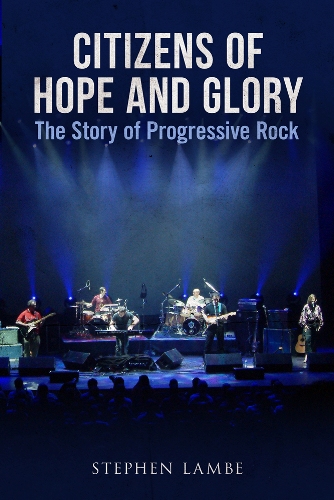
Detailed review: “Citizens of Hope and Glory: The Story of Progressive Rock”

Citizens of Hope and Glory: The Story of Progressive Rock (Amberley Publishing, 2012) by Stephen Lambe

Ten years ago, my wife and I had the pleasure of spending a day in Belize as part of a week-long Caribbean cruise. Our tour guide, oddly enough, was from Germany; he and his family had moved to Belize some twenty years prior. I’ve never been a tour guide, but I assume it must be challenging in many ways: dealing with difficult and clueless tourists, recounting the same information again and again, trying to find the right combination of being informative and entertaining, and being the leader of the tour while not making the tour about yourself, but about the country, the culture, and the sites. This tour guide was exceptional: he was informative and detailed without being obsessive about every nook and cranny; he had a passion for his adopted homeland but also a knowing sense of objectivity; he mixed together trivia and humor and history with ease; he helped us experience Belize with the knowledge that we were in capable hands. It made for a delightful day.
Stephen Lambe, author of the recently published book, Citizens of Hope and Glory: The Story of Progressive Rock, reminds me of that tour guide. Now fifty years old, Lambe is something of a late-comer to prog, although he states so with a certain British dryness. He begins with with a wink and wry sigh: “To my constant irritation, I missed it. I was born in 1962, so by the time I had had my Prog epiphany in 1978 it was all over.” Only two sentences in and you have a nice phrase to insert into your next musical conversation: “Prog epiphany”. Lambe recounts how hearing the 1971 Yes album, Fragile, “blew my mind”; that was in 1978, as punk was rudely clawing and pawing its way onto the musical throne, albeit briefly.

And so the tour begins, with Lambe making it quite clear from the start what he hopes to accomplish—and what he will not try to do, for this or that good reason. It’s a small thing, but also significant. Having written a couple of books myself (and trying to finish a couple more at the moment), I think certain books—especially non-fiction works intended to educate and inform on a particular topic—should state from the start what they will and will not do. Lambe’s book is the third book I’ve bought that is dedicated solely to prog music. And, without naming the other two, I’ll simply note that this is the first of the three to be straight up about what the reader will find between the covers. (The other two are collections of essays, and are more academic in tone; they are mixed bags at best.)

What parameters does Lambe set? First, he focuses mostly on “symphonic” prog groups, with some mention of progressive metal, electronic music, and certain pop/rock groups, such as Talk Talk, XTC, Kate Bush, Tears for Fears, Elbow, and Radiohead, that have embraced many elements of prog without themselves being or becoming prog. Secondly, Lambe uses almost no quotes from either musicians or other publications. “I have chosen”, he states, “to make this book a personal history … in the hope that my experience and opinions will strike a chord with other fans of the genre. This book contains fact and opinion. … In the end this is a history of Progressive Rock filtered through my own tastes and experiences and I hope it is all the better for that.”

Some readers might be put off by such a statement, and I can appreciate their concerns. Lambe the tourist guide has spent over thirty years living in the land of Prog, and he has definite opinions about the sights and sounds therein. Personally, I like the approach. It reminds me of the similar tack taken by the exceptional American music critic, Will Friedwald (just a year old than Lambe, by the way), whose books on Sinatra and other popular and jazz singers from the early and mid-twentieth century are opinionated, informative, occasional quirky, often humorous, and never dull. Granted, Lambe is not the writer Friedwald is—but few people are. But Lambe, like Friedwald, is both knowledgeable and reasonable; he has his preferences, but he never pontificates, lambasts, or chides. On the contrary, he is agreeably positive; his occasional criticisms are almost always along the lines of noting that Album B is simply not quite as good as Album A by the same artist—and here are some reasons why.

Third, Lambe points out that since he is English, he tends to focus on artists from the UK, especially when he writes about the 1970s. Fair enough, especially since England in the 1970s was the center of the prog universe. The book is a chronological history; it does not try to be cute and jump around needlessly. Over the course of the book’s ten chapters, Lambe highlights about sixty essential prog albums, what he calls “pivotal albums”. These are not necessarily the “best” prog albums, he takes pains to note, but are a good, solid start to any prog library. Groups that receive substantial attention from the ’70s include Yes, Genesis, King Crimson, Gentle Giant, and Emerson, Lake and Palmer. Later groups include Marillion, The Enid, Twelfth Night, Rush, Magnum, Dream Theater, and Porcupine Tree, among many others. Due attention is given to American and European bands, including groups from Poland, Italy, and Germany.

Lambe is at his best when he makes connections, highlights influences, shares his personal experiences, and places bands and albums within both immediate and larger contexts. Here is a good example of his approach, about halfway into the book, in the chapter, “The 1980s: A Short-Lived Revival”:

Much more of a surprise than the last gasp of Yes was the seemingly sudden emergence of King Crimson. Towards the end of the 1970s, Robert Fripp had been increasingly active. This included an excellent solo album, Exposure, and work with Daryll Hall, Peter Gabriel and his own band, The League of Gentlemen. Working largely in the USA, he had managed to re-invent himself as a pioneer of the New Wave rather than a Progressive Rock dinosaur. In 1980, he set about forming a new band.

This time, Fripp had a different style of music in mind, something informed by the post-punk pop of Talking Heads (from which band he stole innovative guitarist and vocalist Adrian Belew), the intricate minimalism of Steve Reich and the rhythmic complexity of the old King Crimson. With a rhythm section comprising Tony Levin (on bass and the strange Chapman Stick) and Bill Bruford (drums), the band began rehearsing in Britain before taking a short set on tour in small British venues. I caught this tour at Keele University and was very impressed, although despite playing Crimson classics ‘Red’ and ‘Larks Tongues in Aspic’, they had less an hour’s worth of material. They were called Disciples at that point, although it was no surprise when they changed their name to King Crimson.

The resultant album, with its striking, minimalist cover, is a masterwork. It mixes Talking Heads-style vocals and song structures with a Prog style that few people had heard before. Belew sounds like he is having a whale of a time, his vocals clearly heavily influenced by David Byrne of his former band, but his melodic sense superbly utilized. His inventive guitar playing dips in and out of Fripp’s more intricate patterns. Bruford and Levin sound like they were born to play this music, with Levin’s intricate and inventive Chapman Stick work particularly impressive. But Fripp was the boss, and his remarkable guitar patterns are what make Discipline so memorable.

Of the ten chapters, six are devoted to history, groups, and albums; the other four are about the important relationship between technology and prog, the various aspects of live performances, prog art and design, and the content of prog lyrics. I would have preferred, if push came to shove, for the latter four to have been grouped together as the second part of the book rather than be dispersed among the historical chapters, where they break up the narrative flow. As it was, I skimmed some of those four chapters; however, I’ve no doubt they will prove informative to readers interested in those specific topics, especially musicians, producers, and others actually involved in creating music. The Epilogue, “Darlings of the Press at Last?”, notes that “Progressive Rock is a specialist genre once again, with an aging audience. However, the success of Porcupine Tree, Dream Theater and Elbow should give us all hope. Wherever there are people are willing to put in a little work to get more than a catchy tune and a trite lyric out of music, then Progressive Rock, in some form, has some hope for survival.” I suspect that most of the contributors and readers of Progarchy.com agree completely.

Lambe’s book is, I think, a near perfect introduction to progressive rock for nearly anyone interested in the topic. Passionate, obsessive prog fans who have spent years reading and collecting and communicating may find it a bit “101” at times. But even they will likely appreciate how Lambe has put together a cohesive narrative that makes many connections and fills in many holes without losing sight of the forest for the trees. This is a tour worthy taking, with a very adept and enjoyable tour guide. Highly recommended.


Yes, A Floydian Rush to Jazz!

I’ve been buried with real work and real reality, but I do have grand designs for review posts of the new Soundgarden CD, “King Animal”, which released today, and Stephen Lambe’s book, Citizens of Hope and Glory: The Story of Progressive Rock, which I’ve almost completed reading (very short review: 4.5 stars out of 5, recommended). In the meantime, in my unrelenting quest to show the many wonderful connections between prog and jazz, here are three covers of prog classics, performed by the trio, Bad Plus (band site).

For those who aren’t familiar with Bad Plus, the trio—Reid Anderson, Ethan Iverson and David King—has made its name by being, in two word, distinctive and controversial. Part of their distinct (and controversial, to some) approach has been to cover tunes that aren’t a part of the usual jazz canon. For example, have you heard many true jazz covers of ABBA’s “Knowing Me, Knowing You”, Heart’s “Barracuda” (with singer, Wendy Lewis), or Black Sabbath’s “Iron Man”? No, I didn’t think so. And those covers, in my opinion, are excellent; they not only get your attention but they reveal aspects and possibilities in the original songs that weren’t obvious before. And it is done with a winning mixture of intensity, fabulous interplay, respect for the material, sly humor, and some “out there” moments. The Guardian puts it well when it describes the trio in this way: “If the Coen Brothers put together a jazz trio, perhaps it would be like this, the comic and the dramatic rolled together.”

And how about the fact the trio titled its 2007 album, “Prog”? Fabulous! Here, then, are Bad Plus covers of Rush’s “Tom Sawyer”, Pink Floyd’s “Comfortably Numb”, and Yes’s “Long Distance Runaround”:

Great Moments in Prog — Part 3


Temple blocks! Cowbells! OK, citizens, let’s go exit stage left (see video below), for “The Trees”… where things really get interesting at 1:46; the tension starts to build at 2:24; and — whoa! — now, here we go at 2:52! Alex’s amazingly effective solo starts at 3:08. And then, one of my favorite “great moments in prog” happens from 3:25 to 3:54.

The rest of the song is appropriate election commentary.

Peart fans: check out the drum part analysis starting on p.43 of Neil Peart: Taking Center Stage – A Lifetime of Live Performance Book. And this book has all the info you need in order to build your own replica of the drum kit used in the song!

First Ever Progarchy Competition begins NOW

Image
Photo courtesy of Cracked.com.

I’m happy to announce our first ever Progarchy competition.  The prizes: cds of Rush, “Clockwork Angels”; Big Big Train, “English Electric Part One”; and The Reasoning, “Adventures in Neverland.”

The contest (brain child of my friend, Seth James): 1) come up with the best name for a prog band.  2) come up with the most absurd name for a prog band.  Do not use names of actual bands (past or present).  These must be original.  No need to distinguish, however, which is best and which is absurd.  

The judges will be the Progarchists, and we will announce the winner on the Ides of December.

So, to enter, just comment below–name of the band and a way to get ahold of you.  Competition ends on December 8, 2012.