
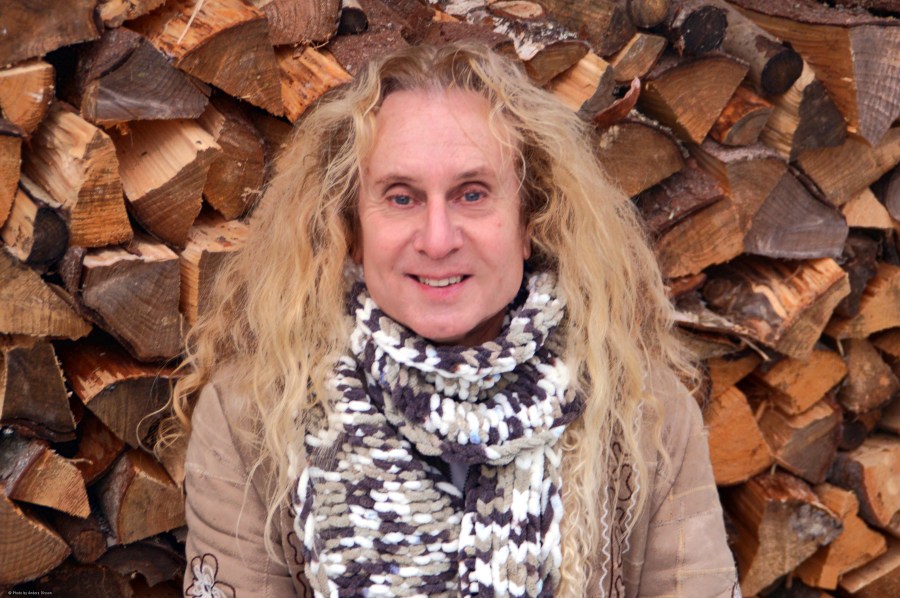
Born in California and raised in Sweden, singer/songwriter/multi-instrumentalist Nad Sylvan is a music lifer who formed his first band in 1968, toured for the first time in 1975 and signed his first record contract in 1983. With three eclectic solo albums already under his belt, Sylvan’s 2008 collaboration with keyboardist Bonamici Unifaun caught the prog community’s ear; it’s a stunningly fine pastiche that goes beyond superficial gestures to embody the musical soul of Genesis’ progressive period. One thing led to another from that point: Sylvan joining Roine Stolt and Jonas Reingold in Agents of Mercy; his ongoing gig with Steve Hackett, providing a visually and vocally flamboyant focus for multiple Genesis Revisited tours since 2013; and the deliciously Baroque solo albums on Inside Out that constitute his Vampirate trilogy (2015’s Courting the Widow, 2017’s The Bride Said No and 2019’s The Regal Bastard).
Nad’s new effort Spiritus Mundi sees him joining forces with guitarist/songwriter Andrew Laitres to set poems by W. B. Yeats — including visionary classics such as “The Second Coming,” “Sailing to Byzantium” and “The Stolen Child.” This is a fresh, winning album, focused on Laitres’ acoustic guitar, shimmering orchestral colors — and Sylvan’s voice, ably navigating the spry melodies, inhabiting Yeats’ weighty words with grace, power and panache.
Nad Sylvan spoke with us last in 2019; after seeing him in concert with Hackett three times, it was delightful for me to chat with him about Spiritus Mundi and related topics. Recovering from a long day of shipping out preorders (roughly five times the amount he anticipated), Nad was nonetheless thoughtful, charming, and engaged throughout. The audio of our conversation is below, with a transcript following.
So, let’s talk about the new album, about Spiritus Mundi. How did you decide on a direction after you finished the Vampirate trilogy?
You got that one right! Vampirate — good! It’s my own invention; think of the vampire and the pirate combined into one character.
Well, to make a long story short, I was approached by Andrew Laitres, who I’ve done this record with. About two and a half years ago. And he asked me if I would be interested to track my voice for a song of his that was gonna go on one of his solo records. And that was a song called “The Lake Isle of Innisfree,” which turned out to be a bonus track on The Regal Bastard, my previous album.
So I asked him, “could I use this for this album?” ‘Cause I thought, it just went so well, it sounded so good, and I thought, “what a nice thing to use as a bonus track.” And so he granted me permission to do that!
So after I’d finished the trilogy, I immediately came to “where am I gonna go now? What should I do now? I feel like doing something completely different.” And then before you knew it, you had the pandemic as well come along. And I thought, well, spiritus mundi means sort of “the spirit of the world,” if you like. And that’s very much what we’re concerned about these days, more so than ever. It’s also a quote from the first song, “The Second Coming.” Where he sings about spiritus mundi. And it sounds so lovely, and it’s got some power behind those words. And I thought “why not use that as a title?”
And so I asked Andrew, “would you be keen to make a full album with these lyrics of Yeats? Let’s write these songs together.” I don’t have any prestigious thoughts about “I have to do everything.” I’ve already proven that I can write, ‘cause I’ve done three albums already. So he was enticed to go along with my idea, and then we started to work together – I would say it kicked off December of ’19. So during the whole pandemic, as I returned home from the tour with Hackett about a year ago – I would say mid-March of 2020 — I’ve been completely absorbed by this work. And it comes down to everything, even the artwork I’ve done for the album, so I could totally focus on this record, and I think it shows. It just sounds and comes across as being a bit more mature this time.
Well, that was one of the things that struck me, that you’re using Yeats’ poems for lyrics, because that strikes me as an amazing challenge. They’ve been set to music almost since the moment they were originally written.
Yeah, I know, but this was Andrew’s idea, you see. I wasn’t even that familiar with Yeats’ poems; I’ve heard of him. But once [Andrew] presented all his demos for me, I’d cherry pick: “Oh, this sounds nice.” And we started to mold the songs together, like “maybe this bit should be restructured” or “maybe we should change these chords” or stuff like that. It was very much a combined work effort. So, yes, Yeats has been covered by The Waterboys, back in the late 80s, I believe. But I didn’t even know that! I just thought, “what lovely poems! Let’s do it.”
Continue reading “Nad Sylvan: The Progarchy Interview” Progarchy