
Spin up aural reader’s aid here or here.
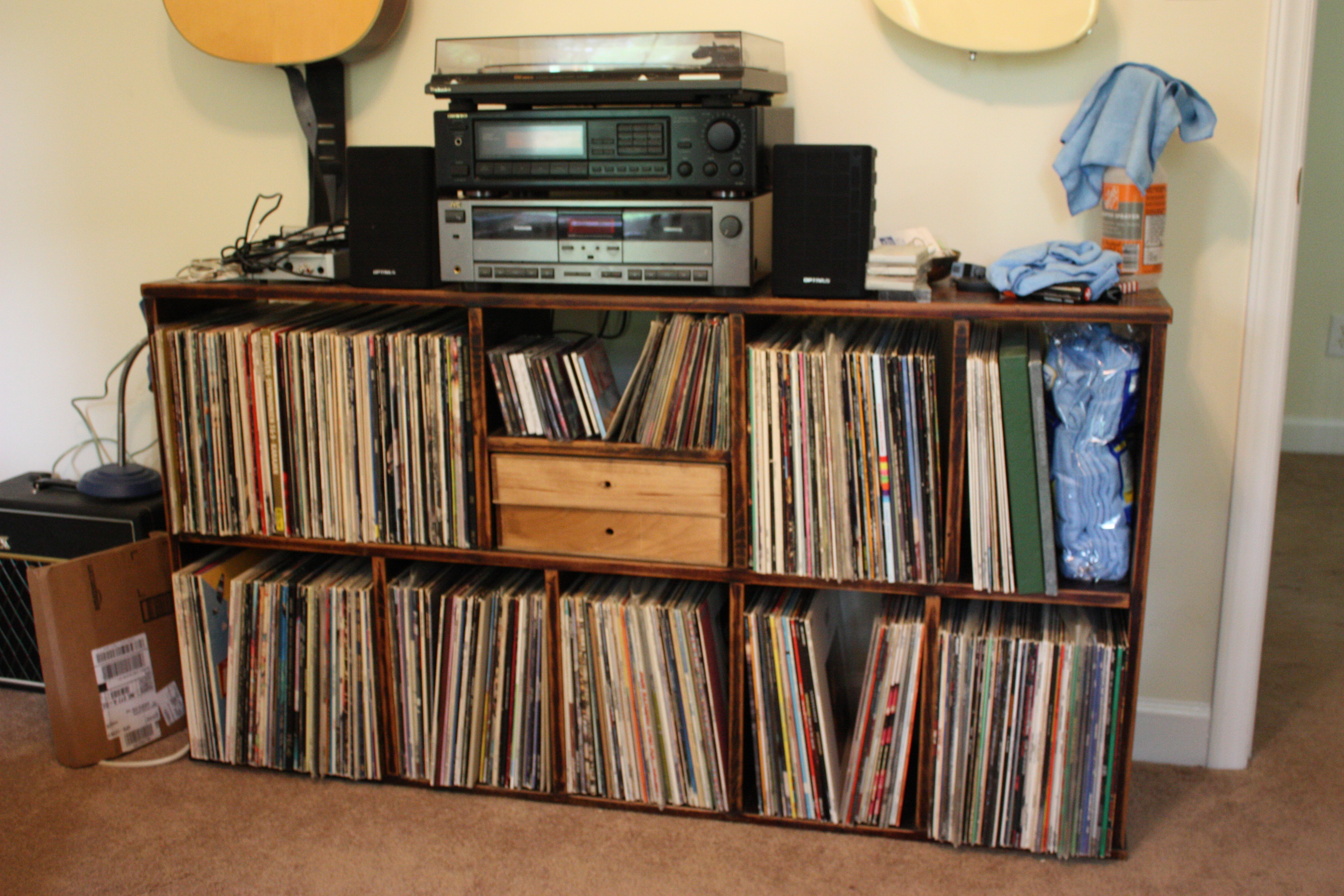
Years ago, before I was old enough to know better, I gave myself a gift: I didn’t sell, trade, or give away my LPs. Not that I treated them that great. They spent a season or two in a damp garage, and then were loaned for a decade to my nephew, to do with what he would — he just wasn’t allowed to get rid of them. That nephew is now getting close to graduating from college, and last fall my wife and kids and I moved just down the street from his parents, who graciously stored (and moved, on occasion) those four or five hundred LPs longer than anyone should have to. So I’ve now recovered them — although I think, and my sister isn’t denying it, that there may be another box of records lurking somewhere — and put them in the old cabinet my dad built for his LPs back in the 1950s. I’m going through them slowly, alphabetizing, cleaning, playing. It is a satisfying process, and a relief from the digital melee life has increasingly become. What was once cutting edge technology now appears quaint, matched up against things like randomized online playlists and noise-cancelling headphones. A side of an LP takes some patience and some tolerance: pop and rumble can lead to madness or joy, depending on the baggage one’s ready to let go of.
The increased hipness of vinyl amongst the cognoscenti (such as they are) is for me a mostly marvelous thing. It means I continue to have access to old records, and in some cases to newly minted ones, and also to things like styli and cartridges and cleaning tools. I’m jazzed, too, that this seems driven by an impulse towards the physicality of the medium — music has always been something in the ether, but the grooves in a phonodisc, as a mechanical representation of sound, not to mention the marvel of the gatefold sleeve, is a very tangible and human-scaled thing. It is not digital and it is not nano, and for many of us its immediacy has beauty and warmth. However, I’ve found that the new vinylistas have inspired a kind of fetish cult, something I relate to to some extent, I’ll admit, that worships the process over the music. The revival is a retro-geek early tech adopter kind of thing, except in this case the technology is a Rube Goldberg version of something the digital crowd (which I’ll own to being a part of as well) thought they’d exterminated. Like I said, I get this and relate to it, but mostly, my return to the LP has been an experience in nostalgia — a reliving of the days where I would put on a record without a lot of fuss and listen to an album side — and an awakening to an appreciation of the sound that I never would have been able to define in the era before compact discs.
That sound is not quantifiably better, as some would have you believe (IF you have a $3,000 turntable, IF your stylus fits the disc, IF your preamp and amplifier are tube-driven, and on and on and on…). It misses a point, rarely addressed, that music is mastered for vinyl differently, that equalizations are important at that stage to avoid mechanical failure, that is, the needle popping out of the groove. You’re left with a high-end that can veer towards sibilance with wear or if the disc was not mastered well, but also with muscular, defined lows that lend rhythm sections a rounded bounce. The rest, really, is all mojo. This is different for everybody, but for me it is a combination of a couple of things: the vision of the lazily spinning phonodisc, like a river unwinding its story, touches my sense of the real and palpable. And then there’s the presence, that constant background, made up of rumble and clicks and pops, instantly identifiable, unavoidable, reflecting a mechanical process that is not perfectly replicable. Replicability is the stuff of the digital world, the download, the OS. That the LP, with all its noise and uniqueness, seems to coax from me an emotional response that approximates a sense of comfort and familiarity, is something I’m still attempting to wrap my head around. Maybe it’s better that I can’t fully articulate it.

As real worlds and humans are imperfect and usually a little cracked, so is the world of my LPs and my own behavior with regard to them. I am enjoying them immensely, finding deep joy and satisfaction in what they hold and in the memories I have of when I first bought and played them, when the world, not that long ago, was more analogue and still just that much more slowly paced. I am also…digitizing them. Ha! Ironies abound, as friends have observed. I am converting full sides of LPs, taking care NOT to break them into their constituent songs, as a deliberate attempt (as a midlife crisis?) to recapture the original experience I had with many of them. So yes, progress is slow but more and more my iPod is playing back crackle and pop and Rush.
 Progarchy
Craig
Vinyl listening from a sound quality perspective is simply just different to me. I have never seen it as better and sometimes it can be appreciably worse. I agree there is a lot of baloney spoken about the wonders of listening to an analogue rather than digital recording. Sometimes I am disappointed at the lack of clarity in sound and sometimes I am very surprised and pleased. I am lucky enough to have quite an expensive hi-fi set up and a dedicated room. I have been quoted as saying that I am a vinyl ‘junkie’ but this is more for the physical experience…the artwork; the gatefold sleeves; identifying whether its a ‘porky prime cut’ (!). But most of all I like the length of the experience i.e. at less than 25 mins a side and usually 40-45 mins in total, this is a perfect listening time for my lifestyle. And of course with vinyl you get a far better sense of structure to an album; the beginning and the end that is near impossible on a cd, especially those with all the extra tracks at the end (I don’t really like that at all !)
Well I will get back to my turntable now.
Continue to have fun in your nostalgic trip
Ian 🙂
LikeLike
Hi Ian,
You’re right — one of the things I’m noticing is the marked difference in sonic quality among the albums. Fleetwood Mac’s Rumours and Gerry Rafferty’s City to City, about the same vintage and I believe early or first runs of both, sound terrific. Part of that is production — they’re both spacious — but part of that has to also be the way they were mastered. Then there’s my Allman Brothers record, which was printed in Canada and has an entirely different mix than any other copy I’ve heard! One thing I’m finding interesting: a small sample of vinyl copies of recent releases can’t hold a candle to my older records from the 70s or 80s. I’m wondering if that is a product of introducing digital into the signal chain, whether at recording or mastering, or if it’s a tendency towards over-compressing the signal in recent years. I also think your point about the record length is a good one (triple disc sets — Yessongs — notwithstanding!). Artists were required to self-edit a little more, I think.
Cheers!
Craig
LikeLike
Graig,
Soon after CDs hit the market, I remember reading an interview with Andre Previn where he said he missed the initial pop and hiss of the needle dropping onto the lp. It conjured up for him the image of an audience settling down for a performance. (I like your collection – Roxy Music and 801 Live! Avalon was the very first CD I bought.)
LikeLike
Sorry, Craig; I know your name starts with “C”.
LikeLike
Thad, the Roxy and 801 albums are relatively recent acquisitions (does 15 years ago count as recent?), which I’m sorry I didn’t discover earlier. They’ve become favorites and I’ve never heard either one in their digital form!
Love the Previn anecdote.
Craig
LikeLike