


As is more than well known, U2’s latest album showed up in every single person’s iTunes library, wanted or not. A cursory google search reveals how angry this gratuity made a whole lot of folks out in the world. The complaints run as follows: if rock is free, it’s not rock; pulling out guys in their fifties to celebrate the latest piece of technology is just tacky; the music is terrible., etc., etc., etc.
My reaction to these reactions is so strong, my head (and maybe my soul) really really really want to explode. Really.
Admittedly, I’ve not kept up with U2 as well as I once did.
For what it’s worth, I was rather obsessed with them from 1982 to 1987. My love of U2 never came close to equaling my love of Rush, Talk Talk, Yes, or even Thomas Dolby at the same time, but I still knew about everything there was to know about the four guys from Ireland.
To this day (September 12, 2014), I think October and The Joshua Tree are two of the greatest rock albums ever made, “New Year’s Day” a contender for the greatest rock song ever written, and “Under a Blood Red Sky” second only “Exit Stage Left” as the greatest live album of all time.
I still can’t listen either to October or The Joshua Tree (the latter especially) without becoming emotional. The first time I listened to The Joshua Tree, I cried and cried. Perhaps not very manly, but certainly very human. Bono’s voice and lyrics spoke to my lifelong desire for social justice.
As strange or paradoxical as it is seems to me now, I can state with some certainty that while Neil Peart’s lyrics taught me to love myself, Bono’s lyrics taught me to love that which is not myself.
I thought Rattle and Hum a great rockumentary, and I continued to defend—sometimes vehemently—U2’s music post “Rattle and Hum.” I couldn’t do that now. While I think post-Rattle and Hum U2 is very, very good, it’s not excellent. U2 enjoyed a streak of genius from Boy to The Joshua Tree. After 1987, though, it did great things but not brilliant ones. The song with Johnny Cash on Zooropa and Fez from No Line on the Horizon still show that old brilliance, but the glimpses of genius have become rarer as U2 has aged.
I’m sure there are reasons for this, though I’m not sure I could identify them easily. I do think that U2’s social justice made much more sense in the Cold War than it does in the post Cold War period. By this, I don’t mean that Social Justice is less important than it was in the 1980s. It’s ALWAYS important. It’s just that the social justice U2 espoused was anti-Cold War, a focus on problems that did not fit into the Cold War scheme of things. With the Cold War over, U2’s position seems less full, somehow watered down. In hindsight, I think their positions were necessarily anti-Cold War as opposed to a-Cold War. The troubles of early 1980’s Ireland or South Africa just don’t hold the kind of gravitas they once did.
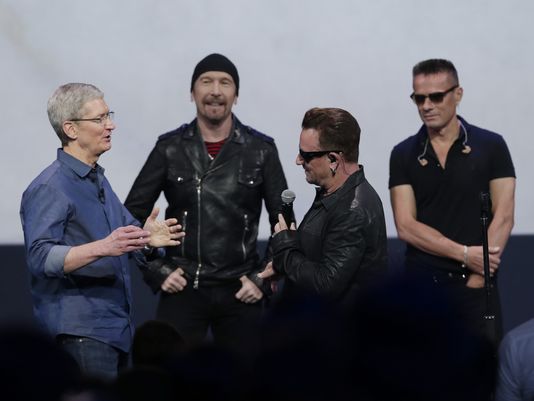
This is all a very long way of saying to U2 and to Apple, thank you. When I look back at my 1980s, Steve Jobs stands next to Bono as heroes. Both spoke for excellence in the human condition. I have no problems with the two being connected, in my memory or in the actual present. Do the guys of U2 looks like they’re in their fifties. Three of the four do. The Edge still looks young. But, hey, who cares? Age is utterly and completely relative. Do I at 47 act like I did at 22? Thank God, NO! Wouldn’t it be much worse if U2 spent their money on plastic surgery rather than advocating aid for the poor in Africa?
And, I really, really like the new album. Is it The Joshua Tree. No. Is it even Actung, Baby? No. Is it good? Yes. Bono’s voice still sounds excellent, the lyrics are quite strong, and, perhaps most importantly, the music is completely earnest. No gimmicks, no fads, no tricks—just four older guys making music.
Thank you, Tim Cook. Thank you, four guys from Ireland.
[P.S. This is my 500th post at progarchy. Tempus fugit.]
 Progarchy
Well said, Brad.
I was glad that Bono explained the deal they had with Apple regarding the album, and his own thoughts on the idea of free music and what it means to reach people.
“It’s really just a question of your honesty.”
There was a time, in the foggy distance of the past, when along with R.E.M., U2 constituted the only “alternative” rock on radio, amidst the hair bands, the watered down R&B, the blues revivalists, and the burgeoning idea of “classic rock” (all good in their way). To my 17-year-old self that was pretty important, and it still means a lot to me. I think U2 should be making their way in their own way, and if that means they’re aligned with Apple, certainly as important as any music publisher ever was to music, as part of phone marketing campaign, well, that’s their choice. It really is just a question of their honesty, and that is something I’ve never questioned.
LikeLiked by 1 person
Well stated on your part, Craig! Thank you. There was a time (in fact, for most of western civilization) when artists of every kind always had to find patrons. Tim Cook is just following an old tradition, and it’s win-win as far as I can tell. Plus, Apple and U2 have a long relationship.
LikeLike
Brad,although I have no “wisdom” filled analogies to fill MY comment with……….and although I DO agree with your statements in this article………..I’m simply GLAD You SPECIFICALLY wrote,that U2’s “Under a Blood-Red Sky” album was “SECOND” (let me say again,was SECOND) to THE BEST Recorded “LIVE” album in this UNIVERSE!!! Which of COURSE,is the STILL UNDEFEATED “Exit…..Stage-Left”!!! Haha. For THAT statement ALONE………I find this article……….EXEMPLARY!!! Lol. ~Peace~
LikeLiked by 1 person
Drew, thanks! Glad to have your good words. And, yes–EXIT STAGE LEFT has to be the best live album ever. Especially side one of album 2. Perfection itself. Strangely enough, The Cure’s Show would be in my top five–especially the last 30 minutes of the album.
LikeLike
Nice job, Brad! The new album has given me pause to consider how great the trifecta of “The Unforgettable Fire,” “The Joshua Tree” and “Actung Baby” all are. That’s not a knock on the new album, which on the surface sounds pretty good. Then again, the “surface” – read: the hits – is about as deep as I’ve dug when listening to U2 for the last 15 years or so.
Since my teenage daughter often is on the receiving end of Daddy’s ramblings about music, her excitement that a new album by a band as famous as U2 just landed in her iCloud account has given me the opportunity to show her the U2 I remember – I quickly jumped on to YouTube, found the “Where The Streets Have No Name” performance from Sun Devil Stadium as seen in Rattle & Hum (those synths! that orange backlight! that shimmering, delayed intro from Edge!), and now she’s listening to WTSHNN alongside the new album (and One Direction – that one’s on her).
As a former U2 fanboy and a current Apple fanboy, and knowing U2 was paid and are the beneficiaries of Apple’s new campaign, I can’t see a reason to complain. U2 wins and Apple wins by again locking arms with a huge band and in the process, welcoming millions more new iTunes users (and their credit card data).
LikeLike
If 1987 is your cutoff for U2s greatness, then you’re excluding Achtung, Baby and All That You Can’t Leave Behind? Madness, I tell you, sheer madness! Has a band ever challenged itself and it’s listeners more than going from The Joshua Tree to Achtung, Baby? Bono infamously described “The Fly” as ” the sound of four men cutting down the Joshua Tree with a chainsaw.” That’s how committed they were to changing their sound and the did it brilliantly. Then we have the lush and beautiful All That You Can’t Leave Behind, an uplifting record that saw the fruit of The Joshua Tree growing in New York with grace.
I won’t even mention Yessongs when in come to the best live albums. I’ll just put on sides 2 and 6…
LikeLike
Yessongs is wonderful, Brian. You’re absolutely right. And, my first introduction to real, sustained prog. It’s a top five for sure. As to u2, I just never liked post The Joshua Tree as much as it and before. But, it’s relative. There are things on Actung, Baby–especially the last three songs–that I really love.
LikeLike
I was surprised at the virulent reactions to U2’s free release of the album on iTunes. There’s something going on here that’s more than criticism of the music. Maybe the self-appointed cultural gatekeepers (Rolling Stone, etc.) finally see that their influence has slipped away?
LikeLike
Yeah, I agree completely, Tad. What are we missing? You’re probably right about the gatekeepers. But, I’m seeing a lot of ordinary rock lovers ticked off as well. I don’t get it! I’m really enjoying it. And, that it’s free? So great.
LikeLiked by 1 person
I think if ITunes had made the records available without automatically putting it in everyone’s library there would have been less of a donnybrook. Free is good, forced is not. I imagine I would not have like to have a Nickleback record force fed to my feed!
LikeLike
I don’t know Nickleback, but I can only imagine.
LikeLike
Great article. Finally one without harsh negativity. I too share your love of the ’82-’87 era U2. Sure, Achtung and All… have some special moments but The Unforgettable Fire is it for me. That album is how I’ll always remember U2.
The only thing worrying about this trend in music launching is that if Apple boss of the like don’t dig a band’s music, their chance of having a career in music is dismal as we all know concerting is where the money is these days. Very sad.
LikeLike
Interesting discussion. I wasn’t aware of the brouhaha. I like what I heard from the first single “Volcano” though I’ve only given it one listen. I’m looking forward to hearing the whole album. I think I can explain a bit of Brad’s love for October through Joshua Tree since I have a similar preference for those albums (though I actually felt that Joshua Tree was the beginning of the change for them). In the earlier years the band was on a mission. They had a powerful vision and a youthful naiveté that they could make a difference in the world with their music. Their records were intimate and yet global in scope and their live shows were like Rock Revivalist ceremonies. They were really the only band that successfully combined the power of rock with a genuine, artistic evangelism of something beyond hedonism.
But that focus is very difficult to sustain in the wake of such popularity and creates enormous pressure on the artists. Suddenly an entire record company and a large industry is dependent upon your success. And then there’s the whole “rock star” thing. Fame and fortune come with a price and their personal lives reflected this. Unfortunately once the mission was lost, the music seemed more ordinary. It’s not that it isn’t good, it’s just that it’s U2 minus the gravitas that made their music so powerfully transcendent.
LikeLiked by 1 person
Yup, very well put.
LikeLike
Thanks so much, Kevin. You said much better what I was trying to say. Thank you. Would love your thoughts on The Joshua Tree and why it was the beginning of the change. I find it–to this day–immensely powerful. Especially as a criticism of U.S. foreign policy in Latin America as well as against the dictatorships there as well.
LikeLike
Joshua Tree is a tough one for me. It’s a finely crafted record, with meticulous production, great writing and strong performances from the group. But Bono seems to have lost his intimate connection with the listener and has become more of a Mega-Church preacher. This was evident in the live performances as you and I have discussed in the past. The Unforgettable Fire tour was powerful yet still with a sense of reserve. The band just came out and played with abandon. The JT tour was like watching Michael Jackson & Band play U2. It was as much about the production values of the show and Bono’s overblown ego as it was about the music. I think you can hear that in the tone of the singing for the studio album too. Compare it to “Scarlet” from October and you can see what I mean.
LikeLike
There was a innocence that was lost, especially after Joshua Tree. But it was exactly that loss and how U2 dealt with it in the face of the star-making machinery that took them to a new level with Achtung, Baby which brilliantly reinvented their sound. They got smart and powerful enough to eventually lampoon the industry and their own success, personified in Bono as Mephisto. Later, they discarded that for a return to the more hearty sound of All That You Can’t Leave Behind and, to a lesser extent, How to Dismantle an Atomic Bomb. The mission was still there, but it was no longer the chiming intimate tone of their first records. It was now a more subtle mission of a mature band that had survived the machinery of success. The Elevation tour was as grace filled and transcendent as rock and roll gets.
LikeLike
Thanks, Brian. You have an excellent point (and beautifully stated). I need to go back and listen to some of the post Joshua Tree albums some more. I have all, though I stupidly left ALL THAT YOU LEAVE BEHIND back in Michigan. Appropriate given the title, I suppose!
Interesting take on Mephisto. That’s exactly what turned me away from Bono at the time. Again, all relative–turning a few degrees away, not 180 degrees. Your explanation makes sense, though.
I see in recent photos that Bono is wearing a rosary. Did he convert to RCism from Anglicanism?
LikeLike