
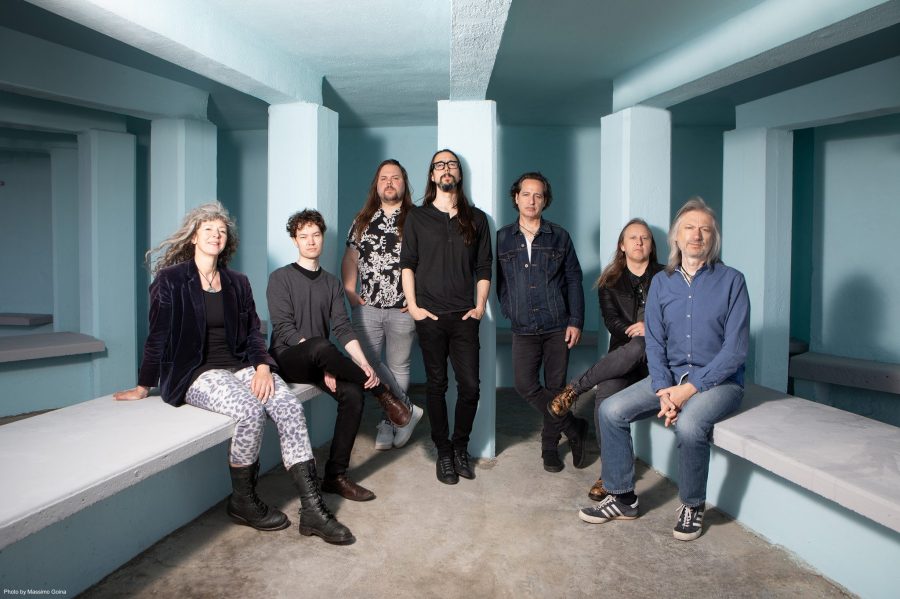
March 1st will see multiple firsts for Progarchy faves Big Big Train: the release of their impressive major label debut on Inside Out/Sony, The Likes of Us, and the sold-out opening night of their long-delayed US tour at Fort Wayne, Indiana’s Sweetwater Performance Theater. Alongside founder/bassist Greg Spawton and the rest of BBT’s international lineup, lead singer/multi-instrumentalist Alberto Bravin will spend the first half of the month barnstorming from Indiana to New Jersey, Boston and Buffalo, winding up onboard progressive rock’s annual floating festival, Cruise To The Edge.
While this will be Alberto’s first stateside jaunt with the band, he’s definitely paid his dues with BBT; since joining up, he’s toured Europe with them in 2022 and 2023, as well as collaboratively writing and recording The Likes of Us at his homebase of Trieste, Italy. When I spoke with him earlier this month, Alberto was candid about the challenges involved integrating into Big Big Train following previous singer David Longdon’s passing, but also grateful for his reception by the band (and its devoted fans, the Passengers) and unquenchably enthusiastic about the new album and the coming tour! Our video conversation is immediately below, with a transcript following.
So my first question is kind of a softball: what does it feel like to be the lead singer in Big Big Train?
It’s a great situation, musically and also personally, from a human point of view. Because it’s a great band with great people in it! It’s a really, really, really great honor to be the lead singer and be part of this family, actually. It’s two years [since] I joined the band, and I can call it family, because there are really great relationships inside the band and between us. So, this is great!
That’s lovely to hear; I’m so pleased. Going back those two years, when Greg Spawton and the band’s management reached out to you, what was your first reaction?
Well, I didn’t expect that, actually; it was completely out of the blue! Greg saw me with PFM in 2015 and he just wrote down my name at the time. Then I was in a list of people to audition. He wrote me an email and he asked me if I was aware of the band – and of course, I was aware of the band [laughs]; I was a fan! I knew what happened and everything.
And it was just a great honor to do the audition, and I didn’t have big expectation from that. It was just, “Alright, let’s try; let’s have the opportunity; let’s sing as best as I can. Let’s have fun, actually, and enjoy the situation.” I didn’t expect to become the singer, [laughs] actually!
Backtracking, how did you first hear of Big Big Train, that you became a fan?
I remember I was in Japan with PFM; I was in the Tower Records in Tokyo. And there was a Japanese newspaper with a photo of PFM, because we were playing there. So, I just got the newspaper, and inside there was a photo of, I think it was Grimspound; that was the album. And just the cover — I said, “Whoa, this is a cool cover – I need to dig deeper on this band!” And I fell in love with it.
The main reason is that Big Big Train always had great songs, I think. They are in the progressive world, where you have all the instrumental madness or weird time signatures or whatever, but the basic thing of the band are the songs. They have great melodies; they always had great songs and great lyrics. So that was the first thing that I really fell in love with. I’m a Beatles fan, and I love songwriting. And I could hear the songwriting behind these incredible arrangements, the vocal harmonies and all the keyboards and Mellotrons and 12-string guitars. The great thing is that most of the songs, you can play them [with just] guitar and vocals, and they still sound like those songs. That’s the magic there.
That makes a lot of sense, because it was the songs that grabbed me, a little further back before that time. And I share your Beatles fandom! So I get where you’re coming from with that. Now you seem to have had – I read in the tour program, you’ve had a real variety of musical experience before this. I understand you trained in opera, as well as in modern singing. And you play multiple instruments; you’ve led your own band; you joined PFM, which definitely has a reputation in the prog world. So, after those two years you’ve talked about — two tours and time in the studio with Big Big Train — what do you think are the particular strengths you bring that slot in with how you describe this band, this songwriters’ collective, and the music that comes out of it?
I think from day one, me and Greg – there was chemistry, just human chemistry, and so we started right away. When they were looking for a singer, they were looking just for a singer, actually. They didn’t expect to have a songwriter or [laughs] a control freak like I am! [Laughs] They needed a singer, but they had the whole package here! And [laughs] now they have to deal with it!
From day one or after a week [that] I was into the band, I was asked if I was writing stuff, and I said, “Well, yeah, I also write songs and musical parts.” We shared a couple of things, and I think Greg liked it.
We started to really dig into the music and worked together on the music, on the lyrics. So, I just brought my – it’s not really a style; I mean I don’t have a style! [Laughs] It’s just the vibe or whatever. But the important thing is that I was a fan of the band. I know really well the Big Big Train sound, and I don’t want to change that, because it’s a wonderful mood and vibe and color that the band have. So, I don’t want to change that, but just make it a little bit, maybe – new, my own! Because I’m into the band and I’m into the songwriting of the band.
Let’s move on to that new album; I’ve been able to hear it a couple of times. One of the things I’ve noticed; when I saw some interviews with Greg, he said, “This time, it’s personal.” It’s less about third-person storytelling and maybe more about first-person experiences and reflections. If you’re comfortable, what sort of experiences have you brought from your life that have fed into these songs?
Big Big Train always talked about – not always, but most of the time, they talked about historic facts or legends or people. This time, actually, it was totally natural; I think we realized that after we finished the album, “Oh, this time it’s really more personal!” We didn’t think about it! It wasn’t thought out; it was just a natural thing.
One example: I wrote the song called “Love Is The Light”. That song is about a dark period that I had, dealing with depression. So, to actually be able to talk about it and put it in music and those lyrics – it’s a really deep experience, and really helpful!
We played it live on the last tour; I made the demo of the song, then we recorded it in the studio, and then we rehearsed it for the live situation. But the first time there was an audience in front of me and we started the song, I just realized that I was playing and singing a really personal thing of my life! So that just clicked, and I said, [laughs] “Oh, OK; let’s see how it goes!” And it was an incredible feeling, incredible emotions. And I think people really, really react on that. If you feel it in a genuine way, and you know what you’re talking about, I think the audience can feel it too. Then it’s pretty strong.
I can imagine, especially with the intensity that that band’s audience brings to hearing you guys live.
Oh, yeah; oh, my God! I mean, the people that we have, it’s actually incredible! We have people coming to see us in Europe from all over the world. And they’re coming to the US from Europe to see the gigs! We have people that came to all the 18 shows that we did last year. It’s amazing; they are really the foundation of the band! I mean, without them we can just play in our rooms! [Laughs]
Makes sense. So, you mentioned “Love Is The Light.” There are definitely some themes in the music and the lyrics that connect across the songs on The Likes of Us. You have “Light Left In The Day”, which is kind of an overture. And some of those themes really go all the way through to “Last Eleven”, which was the first new song that we heard with you singing the lead vocals. How would you sum up the common threads on this album?
Glad you noticed [laughs] all the themes coming and going during the album! At one time, we had a couple of songs there – we chose the setlist of the album. And there was no reprises. I think “Last Eleven” had the reprise that is on “Beneath The Masts” at the beginning. At the beginning of “Beneath The Masts” there is a part that is the end section of “Last Eleven”, because it was Greg’s song and he doubled up this kind of thing.
But then, actually, most of the reprises happened in the studio. The overture was an idea I had; I called Greg and I said, “I think we are missing something. We have all the songs, but there’s something missing.” And I had the idea: “Why don’t we write an overture, with all the things?” And Greg said, “Oh, yes, you do it!” [Both laugh]
That was quite an adventure! And actually, I started from the end, and then it went backwards – it was a weird songwriting system. I don’t know how I did it!
But actually, a lot of stuff happened in the studio. We were lucky to be in a real studio together, and we recorded the album together in a room. So, that situation allowed us to just throw ideas to each other. Sometimes, there was a solo part and I’d say, “Wait, wait, stop, stop, stop! Why don’t you start with this line that’s from the other song?” Or, there’s a violin thing: “Can you do this, so it’s another reprise from another part of the album?”
Because the album is not really a concept album; there’s no story through the songs [but] there’s the general theme of all the songs. And I think finding these little connections – like in the overture, you have all the themes, like in a classical piece of music. You have the overture that presents all the themes of the opera, or the classical piece. It was really fun to put little snippets in the songs. I think we will ask people if they can find all the little pieces! [Laughs]
Alright, quiz the Passengers, that’s the way to go! And it’s interesting, because I had the privilege of talking with David Longdon before he passed on. And one of the things that he said in that interview was something along the lines of, “Well, what I say and do bounces off Greg, and what Greg says and does bounces off me.” So it sounds like there was that kind of interplay with everybody in the studio.
Hmm, yeah. The situation that we had in the studio was incredible! Being able to play together in a room. I was talking yesterday and we were talking about the budgets. Now, because we have the technology to, we can do albums just at home, and just send files through emails, and it gets mixed and it’s done. It’s the normal way; nothing wrong with it. Of course, it’s cheaper! Having everybody coming – because we are an international band, because we have Nick D’Virgilio from the US, and I am from Italy, and the UK, and Sweden and Norway. So ,it’s really complicated logistically; it’s really complicated to organize and put everybody in a room!
But that process, it’s incredible! Of course it is expensive, because you have to pay for everybody to stay there and pay the studio and all the things. But on the other side, you can do the thing really, really in a quick way. You’re there, and if you have an idea, you can just say it and you do it! Or, “Can we play this part slowly?” and you just play it slowly. There’s no email involved! [Laughs] I don’t have to ask the drummer to play the song again and send it to me again – and then I have to send it to another, and it’s a month that’s past!
So that way you can actually do an album in one week. And also, the artistic limitation that you have is a great thing! Because we were there; what you’re listening to on the album, there’s no big overdubs or stuff we cannot play live. That was one of the rules that we put [in place]. We go to the studio; we have two hands each. That’s it! [Laughs] No more hands! And vocals, we are lucky that we have five vocalists, actual singers in the band. So, everything that you hear, it’s five vocalists; not more than five vocals.
There is an artistic limitation on that, and that is pushing you to do your best and try to make it work with what you have there. Recording at home, you can do a lot of stuff; and you can add a lot of stuff, replacing and doubling, whatever you wanna do. So, you finish and you have like 300 tracks! [Laughs] And so then you have to choose what to delete, what to keep – it’s an infinite work! This way was actually the best way possible. And I think we’re not going back, if it will be possible; we will not go back to the remote recording.
Yes, there is an organic feel to the album; it’s a band playing live in the studio. Now [there’s] one more track that I wanted to ask you about. As I understand it, you provided the spark for the big historical epic “Miramare”, the second single – both in terms of both the narrative and the music. How did you and Greg and the rest of the band work together to that finished product? Because I really enjoy this album; it’s a very strong contender in the Big Big Train tradition. But that track struck me as something really special.
Well, thank you! I wrote that song for the album; it was like, “Blank page! Let’s write a song for the album.” So, I wrote the instrumental; and I think we will release on the Passengers Club a demo of the song – my demo, where I’m playing all the things. It’s just a demo with everything; the drums are programmed and everything else is played. And actually, it sort of sounds [like] what the last result is, in terms of the arrangement.
So I did the instrumental things, and then I was mumbling – is that what you say? Like singing in broken English, throwing lines.
So, just syllables.
Yeah, exactly! Just “la la la” or whatever. Because you have the idea of the vocal line, you do it, and sometimes you finish the phrase with the words. So, some words, they’re still there in the actual song.
So, I did that with the vocal arrangements, and I said to Greg – it was the first time we were talking about it – I said, “If you like this song, why don’t you write the lyrics on it? You already have the vocal line, so why don’t you write the lyrics?” And he said, “Oh, that would be fun! So, what are we talking about?” [Laughs]
And so, I had in mind this story – it is an historic fact, but it’s actually personal. Because it’s a story from my town, my city. Since I was a kid, I knew the story, and I can see the Miramare Castle; it’s one of the symbols of the city. It’s in my childhood and all my life! So, it is personal, actually.
And I told Greg, “well, there is this really interesting story about this couple and the castle. And the castle has a garden in it.” And he said, “Ooh, this is interesting!” And so, he just went on Amazon and he bought four books about the Hapsburgs and the Miramare Castle and [laughs] whatever. And after, I think, a week, he just wrote those beautiful lyrics. And I sang it again on the demo and it just worked! It was an incredible experience. Then we said, “I think we can do this [laughs] again in the future!”
It does come across as a real collaboration.
Absolutely, it is! It is.
We’ve talked about the Big Big Train audience; we’ve talked about the band and the synergy you have with them live, whether in the studio or on stage. So, here’s perhaps a sensitive question: what are the challenges of fronting the band live, especially when you’re digging into the back catalog, all that music that David helped create and performed?
Initially, it was really hard. The first tour that we did in 2022, that was tough. Because, of course, I didn’t know, the band didn’t know, and the audience didn’t know what to expect. We had no idea how the audience will react with me singing those songs. Psychologically, it was a little bit tough; emotionally it was hard, because it was the first time we performed those songs live.
But I think the band and management really did a great job presenting the new band in a slow way. There was, “Alright, this is the guy who is the guy” and “This is ‘Last Eleven’”, a demo of the song; “This is the new vocalist.” And then we did the tour.
I remember the first gig that we did; we did a warm-up gig. It was in front of 300 hardcore fans [laughs], so that was really tough to do. And I remember I prepared so much for that! We did the first song, and actually, after the first song, everybody was standing and clapping and smiling or crying or whatever was happening there! And I looked at Greg, and I think I said, “I think we got this; I think we can do it. Let’s do it!” And so, we did, and everything was pretty good.
The last tour in 2023, in August and September we did the European tour. That was a little bit – not easier, but a little bit more relaxed from my point of view. Because the people knew me a little bit better from “Last Eleven”, from a couple of videos of the live situation, a couple of interviews or YouTube or social media. So, people had the chance to know me a little bit better. And we also recorded the album; we were finishing the mix of the album. And so, our head was on the new stuff also. I just went there onstage and just enjoyed the performance, and tried to be me, trying not to make a cover of the songs, but just make my own interpretations. And just enjoy the show.
And I think people were OK with this, and they enjoyed themselves. It was emotional, of course! Because those songs are incredible! And it’s just beautiful to be able to sing them; it’s great. Yeah, I enjoyed it; it was a great experience.
Cool! Now, have you performed live in the US before?
Oh, yeah, with PFM a couple times.
So, you have a vibe for what US audiences are like.
Oh, yeah! [Laughs]
So what kind of hopes or expectations or hopes for these concerts that will be coming up early next month?
I think they will be great! Big Big Train never played in the US, but I think we have an audience there. And it’s the first time. So, we will really look forward to doing it. And we have Nick D’Virgilio, that wanted to play in his country with Big Big Train, of course. So, there will be a great vibe and a lot of fun.
And then we play the Cruise [To The Edge]; that’s an incredible experience; I can’t wait to be there! [Laughs]
My wife and I have pretty upfront tickets for the Fort Wayne show, so we are absolutely looking forward to it!
Oh, great! Cool! Are you from there?
We’re from the Midwest; we’re about three hours away from Fort Wayne, in Michigan.
[Laughs] So you’re near – for the US! It’s around the corner!
Yes, we couldn’t miss the chance. So Progarchy, this website, we’ve been Big Big Train fans for pretty much our entire existence. We’ve eagerly been anticipating this album and this tour. Anything else you’d like to say to us and to your fans in the US?
I am, and the band is, really proud of the album; we tried to do our best. And the title, The Likes of Us, it’s really talking about “us” as a band and “us” as the audience, too; everybody that is in love with Big Big Train. It is about personal situations, but situations that everybody, maybe one time in their life they experienced.
So, we are on the same – well, actually, like on the Cruise, we are on the same boat here! It’s the first album with me and with the new band. So, we tried our best to make the most beautiful music that we could. But we are together in this situation; we don’t know what to expect, and people [laughs] don’t know what to expect! We are proud; it was an incredible journey to record the album and to write the songs together with the band. And we can’t wait to play the songs live and try to play to all the people that we can.
I echo that, certainly. We are looking forward to having copies of The Likes of Us in our hands; we’re looking forward to being in that same space with you, ’cause you know how magic can happen in a space like that. I just wish you all the best with this album and this tour, and it’s been really great talking to you. So, thank you so much!
Thank you; it was a great pleasure.
Alright; you take care, and we’ll see you in Fort Wayne.
See you in Fort Wayne. Have a nice day; bye!
You too; bye!
— Rick Krueger
 Progarchy