
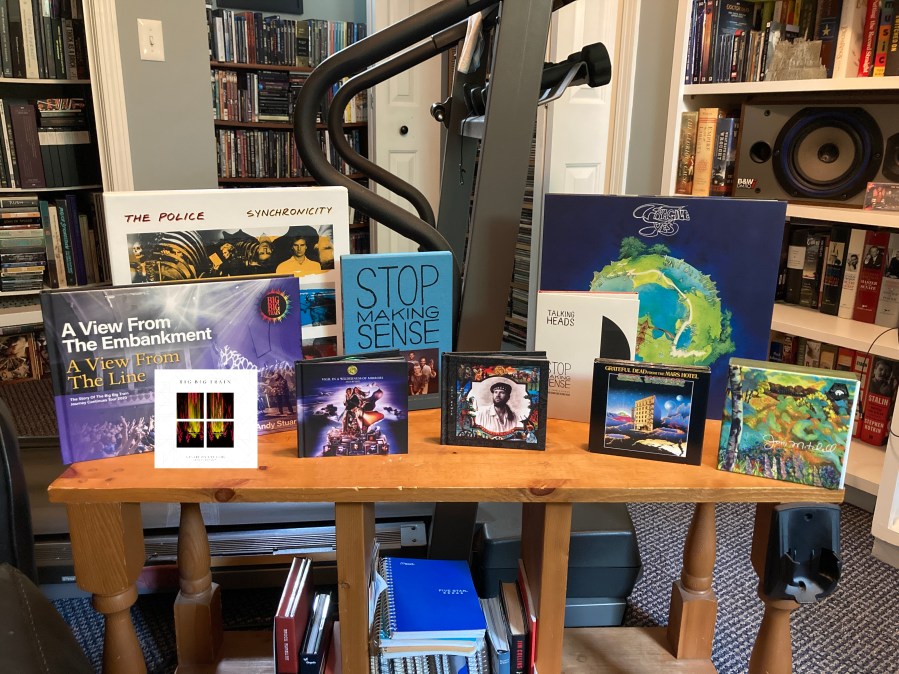
Like a man named Will said, summer’s lease hath all too short a date – so I decided it was time for a lightning roundup of the season’s box sets! Purchasing links are included in the artist/title listings below, with streaming and video samples following each review.
Big Big Train, A Flare on the Lens: Officially released on September 13th, only promotional audio was available for review, so I can’t tell you how the closing night of BBT’s 2023 European tour looks on BluRay – but it sure sounds like dynamite! With all the animation and verve they displayed on this year’s first American jaunt, Greg Spawton’s mighty crew (joined by guest guitarist Maria Barbara and the obligatory brass quartet) tear into a similar setlist packed full of drama and pathos. New vocalist Alberto Bravin is particularly impressive, getting right to the heart of fan favorites like “Curator of Butterflies” and “A Boy in Darkness” along with epic standbys “East Coast Racer” and “Victorian Brickwork”. But everyone’s at the top of their game, culminating when Nick D’Virgilio and Rikard Sjöblom join Bravin up front for a devastating yet joyous medley of “Leopards”, “Meadowland” and “Wassail” in honor of the late David Longdon. Amply documented here as well as in Andy Stuart’s mouth-watering tour diary/photobook A View from the Embankment, A View from the Line, and on new album The Likes of Us, BBT’s rebirth is a genuine cause for celebration.
Fish, Vigil in a Wilderness of Mirrors and Internal Exile: In the wake of his stormy departure from Marillion, lead singer/lyricist Fish (AKA Derek Dick, rock star and Scottish nationalist) was unsurprisingly eager to prove his worth as a solo act. 1990’s debut Vigil In a Wilderness of Mirrors was as emotionally direct and lyrically convoluted as ever, built around the charged concept of climbing “The Hill” of success — a goal unrelentingly pursued despite the Stateside seductions of “Big Wedge”, the obsessions holding “The Voyeur” captive, the damage documented in “The Company” and “Family Business”. Internal Exile, released the following year after legal troubles and a label change, steers toward individual songs; highlights include delicate ballad “Just Good Friends”, comfortably numb polemic “Credo” and the Highland-inflected title track. Fish’s dramatic declamation is the focus throughout; it’s as riveting as always, though the music (mostly by sidekick Mickey Simmonds) can be a bit pedestrian, lacking the organic interplay and inspired unconventionality that marked Marillion’s response to his heady, hearty words. Each album is available as 2-LP Vinyl Editions, 3-CD Standard Editions (with bonus demos and live versions) and Deluxe Editions (with another disc of live versions and surround mixes on BluRay).
Grateful Dead, From the Mars Hotel: It took a looong time, but somehow I’ve finally tuned into the Grateful Dead’s wavelength (and without the use of illegal substances, mannnnn). Having zeroed in on the band’s “stoned electric bluegrass” period of the early 1970s, this latest 50th anniversary reissue is right up my alley – and it has more appeal even now than you might expect. Made in the midst of the Dead’s doomed attempt at running their own record label, there’s a delicacy instilled in the music, a humble yet unflinchingly honest cast to the lyrics. The social commentary of Jerry Garcia and Robert Hunter’s “U.S. Blues” and “Ship of Fools” is more bemused than bitter; tinged with Keith Godchaux’s harpsichord, “China Doll” is an exceptional ballad, and the awestruck love song “Scarlet Begonias” stayed in the band’s onstage repertory for decades. Plus, there’s Phil Lesh’s extended workout “Unbroken Chain”, one of the few Dead songs of that vintage to feature the bassist’s charmingly down-home vocals. Add a live set that handily covers the group’s career to that date, featuring well-chosen country covers and mesmerizing jams, all blasted through the band’s Wall of Sound to a University of Nevada audience the year of From the Mars Hotel’s release, and you have an exemplary package. 1971’s Skull and Roses (first encountered in my older brother’s record collection) and Europe ’72 remain the quintessential Dead in my book, but this isn’t far behind.
Joni Mitchell, The Asylum Albums (1976-1980): Let the record show that Mitchell carried a torch for jazz for decades, ranking Miles Davis right up there with Beethoven long before her music slid into the smoothly swinging grooves of 1974’s Court and Spark. With Hejira (1976), haunting meditations on love and wandering like “Coyote”, “Amelia” and the title track lit out for more expansive territory, simultaneously anchored and uplifted by fusion genius Jaco Pastorius’ free-floating bass work. 1978’s Don Juan’s Reckless Daughter stretched further into abstraction, with the side-long tone poem “Paprika Plains” swathed in rich orchestral colors, instrumental “The Tenth World” and the grooving “Dreamland” enveloped in Latin percussion, and Pastorius’ Weather Report compatriot Wayne Shorter swooping in with unmistakably lateral sax work. And in collaboration with a dying genius, 1979’s Mingus (instigated by composer/bassist Charles Mingus himself) saw Mitchell pay tribute to the era epitomized in the closing “Goodbye Pork Pie Hat”, with words as inspiringly bopping as the tunes. Add the live double album Shadows and Light, with Mitchell backed by then-young guns like Pat Metheny on guitar and Michael Brecker on sax, and you have a remarkably unified overview of her farthest out, yet most eccentrically open period. (Volume 4 of Mitchell’s Archives series, focusing on unreleased and live music from these years, is released October 4th.)
The Police, Synchronicity: With their musical roots in psychedelia and jazz-rock as deeply buried as their spiked hair had been bleached, The Police somehow conjured up infinite space in the tight confines of a New Wave power trio. As their lustily reggaefied early hits gave way to vaunting musical ambition and portentous social comment, Sting’s keening voice and indisputable ear for killer hooks pulled in more and more of middle America, to the point where their fifth album and the resulting tour were guaranteed smashes. Having the darkly irresistible “Every Breath You Take” – a brooding update of “Stand By Me” laced with Andy Summers’ Bartok-inflected arpeggios and Stewart Copeland’s sparsely driving backbeat – as the lead single didn’t hurt, either. But the album as a whole still lives up to the hype, sweeping you along from the whizz-bang two-part title track (parked at either end of Side One) through the deranged howl of Summers’ “Mother” to the four masterful ballads (see above, plus “King of Pain”, “Wrapped Around Your Finger” and “Tea in the Sahara”) that make Side Two of Synchronicity the most consistently rewarding of The Police’s career. Bonus discs of b-sides/alternate versions and studio outtakes, plus a complete live show on the CD set (true to the excitement I saw and heard for myself at Detroit’s Joe Louis Arena that summer) make for a mouthwatering super-deluxe package.
Talking Heads, Stop Making Sense: The year after the height of Policemania, my post-college roomies and I couldn’t get enough of the Stop Making Sense soundtrack; one of the first CDs we got our hands on, its in-your-face digital sound gave Talking Heads’ neurotically artsy punk-funk a welcome makeover. Then we saw the film itself at the local art house cinema, and watching the nonstop kinetic energy of the expanded band working live sealed the deal. This may still be the most fun concert movie I’ve ever experienced; seeing hip-swiveling bassist Tina Weymouth, bubbling percussionist Steve Scales, criminally underrated P-Funk veteran Bernie Worrell on keyboards and the rest of the expanded band in action, you catch the sheer delight of making music, the shared enjoyment as they build the groove, then lock in and take the crowd with them into orbit. Then there’s David Byrne, sticking out like a sore thumb but completely at home as he growls, yelps, dad-dances and jogs his way through the dada wig-outs “Burning Down the House”, “Life During Wartime”, and “Once in a Lifetime” — an uptight geek cosplaying James Brown and loving every minute of it. On my Faves of 2024 list already and unmissable, whether as a deluxe BluRay of the film from A24 (linked above), LP and CD/BluRay soundtrack-only sets from Rhino, or via streaming on your home screen.
Yes, Fragile: It was a bit of a surprise last autumn when Rhino launched a new super-deluxe series of Yes albums (with, uh, The Yes Album); after all, omnipresent prog remix wizard Steven Wilson had already worked his audio magic on the core of the band’s catalog, beginning just a decade ago. Nonetheless, there’s an undeniable thrill to this new LP/4CD/BluRay set, marking the historic moment where Rick Wakeman parked his umpteen keyboards in the vicinity of Jon Anderson, Steve Howe, Chris Squire and Bill Bruford and epics ensued. (No less than Jack Black’s called Wakeman’s break on “Roundabout” the greatest keyboard solo of all time – for everyone except Keith Emerson fans like me, that probably clinches the argument.) But of course, there’s much more to Fragile, with solo tracks cleansing the sonic palette between landmark odysseys “South Side of the Sky”, “Long Distance Runaround” and “Heart of the Sunrise” (the last referenced on the Big Big Train set above). And this set includes the original Eddie Offord mix, fresh album and instrumental remixes by Wilson, rarities aplenty (including the towering cover of Simon and Garfunkel’s “America”, where Howe sees Wakeman’s work on “Roundabout” and raises it with a thrillingly countrified solo) and previously unreleased live tracks. It’s not my favorite Yes album, but it’s hard to diss such an heaping helping of proggy goodness; can we have an super-deluxe Close to the Edge next, please? (By the way, stay tuned for a review of Anderson’s hot new solo album True coming soon!)
— Rick Krueger
 Progarchy