Cosmograf – new beginnings

WAHDID

I first came across Robin Armstrong and his musical project Cosmograf back in 2011 when one of his songs was featured on a Prog magazine sampler.

It was the stand-out track on that particular compilation as it had that certain something which usually draws me in: interesting  instrumental and sound effects, thoughtful lyrics and astonishing emotion. The track was called Into This World and into Armstrong’s bucolic, wistful world of past memories I was duly enticed. This was beautiful, soul-stirring and thoughtful.

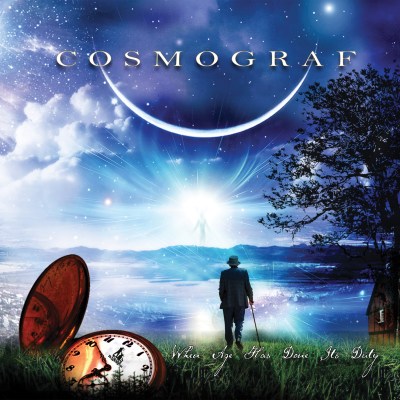
The song opened his third self-made Cosmograf release,  When Age Has Done Its Dutyfor which he had enlisted some top talent to help him tell his very personal and poignant story.

Now, nearly seven years later, the perfectionist that he is, Armstrong has made some significant “improvements” to the album and has reissued it as as 2018 remix edition.

For my part, this is great news because along the passage of his subsequent superlative four albums (The Man Left In Space, Capacitor, The Unreasonable Silence and last year’s The Hay-Man Dreams), Armstrong has attracted legions of new fans and many may not have managed to get hold of a copy of  “Duty”.

The opportunity to re-issue the album came after all the original physical versions sold out. Armstrong left his record company, he went independent and the album rights returned to him.

Robin Armstrong

As Armstrong explains on his website:  “It’s considered by many to be a seminal work in the Cosmograf catalogue, so rather than just re-issuing it I thought it would be better to completely remix and master it and address some of the issues that were less than perfect on the original recording.

“Many of the original guitar, bass and vocal parts have been re-recorded, new string arrangements added, and a more dynamic low volume level master produced. I’m really pleased with how it’s now sounding.”

And so he should because the new features have only enhanced what is a truly remarkable album.

What marked out this album was the way Armstrong took his own very personal story and, using some of his musical influences, shaped a collection of diverse songs into a memory board of observations and emotions.

Central to these are his childhood memories of staying with his Uncle Harry and Auntie Mollie in the rural English county of Shropshire, an area of the country which lies between Wales and the industrial West Midlands, renowned for its unspoiled natural beauty.

What he delivers is a cradle to grave concept. which goes way beyond those childhood memories and delivers his own testimony to life and. in particular, growing old, a journey which he depicts with great tenderness and sorrow.

Going back to the beginning, Into This World is still an astonishing opener, the ticking clock and telephone ringing bringing about the anticipation of new life into this world that comes through the sound of a baby crying.

The song is given as a meditation on the meaning of life through a series of  homespun truths.  To the new mother, “Your life will change to the sound of an infant voice” and to the new arrival, “The years will soon pass, the seasons will change, follow your heart, explore your own range.

For musical style, look no further than Steven Wilson, one of Armstrong’s heroes, another artiste who looks at the complexities of seemingly simple strands of life and makes them extraordinary.  There’s a melancholic piano and searing guitar solo in there too to heighten the poignancy.

Those childhood memories reach an early peak on the acoustic loveliness of Blacksmith’s Hammer, starting with the physical sound of eponymous hammer (which I always thought had the lightness of touch as found on ELP’s Lucky Man).  This is further uplifted by light and airy electric guitar passages, gorgeous vocal harmonies and Steve Dunn’s underpinning bass lines.

Armstrong has re-recorded the acoustic guitar in the haunting  On Which We Stand, co-written with guitarist Simon Rogers  (Also Eden, Ghost Community). It features a church-like organ and more close vocal harmonies. Roger’s soaring guitar and a huge ELP-like synthesiser further heighten the rural picture it paints.

For pure retro nostalgia, Bakelite Switch has it all. That recurring clock-ticking motif reappears, along with the sound of a brass band, as Armstrong recalls some of his memories of childhood. Bob Dalton of It Bites provides the heavy duty drums as the song begins to gather momentum.

However, there’s a darker side to this song as Armstrong begins to drill down into the realities of getting older through lyrics such as:

“Your busy life will lead you to forget, where your life came from, what is right and wrong.”

There’s also a blistering guitar solo from Luke Machin. It’s hard to believe he was delivering such fantastic fretwork seven years ago as he began his apprenticeship with The Tangent, his own band Concrete Lake/Maschine and, later, Kiama. 

Armstrong’s music influences appear in a countdown sequence reminiscent of David Bowie’s Space Oddity,  the lyrics taking on a Floydian turn at one juncture with a mention of  “The lunatic is on the grass,” followed by a Beatles’ reference,  the brass band re-emerging to bring it all to a close.

The recurring clock and a short speech in the manner of Prof Stephen Hawking do little to prepare you for the heart-wrenching anguish of Memory Lost. It features, to my mind, one of the greatest single vocal performances from Huw Lloyd-Jones (Midnight Sun, Unto Us, Also Eden) which will tear the fabric of your soul. It’s a song which will move anyone who witnesses the onset of age and its challenges in either their nearest and dearest or their friends. As Armstrong explains, it is about his Aunt battling on with life after the passing of his Uncle when all she has left to sustain her is her memories of their time together. It’s will simply break your heart as it does mine every time I hear it.

The wonderfully named Tom O’Bedlam recites Matthew Arnold’s poem “On Growing Old” to start the title track When Age Has Done Its Dutybefore the understated melody line, comprising piano and mellotron, gives space to the extraordinary voice of Steve Thorne who all but delivers last rites in the song:

Prised from her home, in a poor state of health, The time had come to face her death.

But the Farrier (Uncle Harry) is there waiting by her bed. The moment of passing comes, depicted by a church organ and followed by a searing guitar solo from Armstrong.

Changing the mood again, Armstrong introduces an electro-synthesiser and an insidious beat, together with the heavy guitar riffs of Lee Abraham (Galahad), for White Light Awaits, his voice taking on a seriously sinister edge as he menacingly asks:”How do you feel, does the light hurt your eyes, is the change a big surprise?

Finally, the tranquillity and peace returns on the beautifully chilled  Dog On The Clee, in which Armstrong refers to himself as “the boy from down south.”

I love this album now as I loved the album then. It is Armstrong’s voice you hear throughout, musically, lyrically and above all, vocally and what a voice it is. Some may cite the likes of Messrs David Longdon, Steve Hogarth and John Young as the outstanding contemporary prog vocalists but listen to Armstrong and he deserves to be mentioned in the same breath. He is a consummate story teller, able to inject pathos, drama, nostalgia and pain into his intonation and delivery.

The 16 page accompanying booklet, including the stunning original artwork from Graeme Bell, provides the stories behind the songs, some of which I have touched on here.

I looked up my original review of this album, written for another music website, and it alluded to him sounding like Van Der Graaf Generator and Pink Floyd. Listening to it now, yes, the influences are in there but this was the album which shaped the unique Cosmograf sound, so no comparisons are required: only compliments on how Armstrong has created his own special place in the current prog landscape.

Copies of the album are available from the Cosmograf website  here.
 

2017, another great year for prog passionistas!

Jargon 2
From Athens with love – Jargon of Verbal Delirium


2017 – what a year it has been for prog. Against the backdrop of some highly perplexing and disturbing events across the world’s stage, but, to quote the title of Paul Stump’s excellent assessment of prog, The Music’s All That Matters.

On a personal note, it has been a particularly challenging year, having early on developed a stress-related condition due to pressures presented by a previous employer, which led to an emergency operation and a month’s recuperation.  This was coupled with seeing a parent being subsumed in the clutches of dementia. However, equilibrium was restored in the latter part, thanks to the kindness, belief and support of many people both inside and outside the prog bubble.

Though prevailing conditions resulted in me missing several high profile happenings, including HRH Prog in March, 2017 has continued to astound and astonish with the quality of the music being produced, and also the wonderful community of people. This is the tribe that cherishes and follows prog in individual capacities from the fans and supporters, to the writers, the promoters, the merchandise sellers, the record label owners and of course, the artistes themselves, most of whom make scant financial returns on their considerable investments of time and energy. As was originally stated, the music is all that matters.

Without further ado, here are the highlights, and some of the lowlights, which made 2017 another great year for us prog passionistas.

Top Albums:

1) The Slow Rust of Forgotten Machinery – The Tangent. As one of prog’s most outspoken savants, Andy Tillison brings profound political and social commentary into the narrative of this musically outstanding album. This is a clarion call to wake up and see how our perceptions of the world are being manipulated. Some stellar musicianship peaks on Dr Livingstone (I Presume), co-written by his brilliant fellow Tangential collaborator Luke Machin. Thoughtful, profound with hints of jazz and dance-trance, it also features some extraordinary hard hitting artwork by DC Comics cartoonist, Mark Buckingham.

Continue reading “2017, another great year for prog passionistas!”

As the Cadogan Crow flies..


Telescope and crow

It’s a Saturday afternoon in late September and we’re heading to London by train on the second leg of an epic journey that has been gathering speed for several years. The destination tonight is located within the traditional haunt of the once fêted Sloane Rangers, the well-heeled, young members of the Chelsea and Kensington jet set. But tonight, Sloane Square and its environs are the temporary haunts of another social group, better known as Passengers or, for two nights and one afternoon only, the Cadogan Crows.

The Passengers, sorry Crows, have flocked here from every corner of the globe, the furthest travellers coming from Australia and America, with a sizeable contingent winging its way from Europe – Norway, Switzerland, the Netherlands, France, Spain and Italy among the represented nations.

It’s not a global sporting occasion which has set their compasses and sat-navs to SW1 but the re-emergence on the live stage of one of the UK’s best known unknown bands, Big Big Train.

Since they graced the stage of Kings Place, London, in August 2015, the anticipation of more Big Big Train live dates has frequently reached fever pitch. However, the fans have had to make do with a double live album recorded at those London concerts plus three new studio albums that have significantly moved on the stories they are renowned for telling. Instead of the verdant beauty of Upton Heath, the ethereal loveliness of Curator of Butterflies and tales from the coalface in Worked Out, there have been freshly mined tales to explore.

Talisman

The talisman for these new tales is a crow, which, by custom, is a bird of omen and by a happy co-incidence, often enjoys the collective name of “a storytelling”. The flight starts with Folklore, released last year, which was joined this year by its companion piece Grimspound, the eponymous name of the crow, and finally by The Second Brightest Star, which acts as the coda to this particular musical chapter.

Also, maybe by design or perhaps another happy co-incidence, the Cadogan Hall, the venue which Big Big Train has chosen for this particular leg of the live journey, is just a short crow’s flight from the River Thames, which features so prominently on the recently released London Song EP.

The imposing Byzantine Revival-style hall has an interesting history, having originally been built as a Christian Science church, hence its impressive stained glass windows.  It nearly became the palatial home of former Harrods owner, Mohamed Fayed, until Cadogan Estates Ltd bought the building and turned it into a concert hall. In fact, its prog credentials include Marillion’s Live From Cadogan Hall DVD, which was recorded here in 2010.

As the hour approaches, there’s a sizeable crowd assembling outside in the intermittent drizzle. It’s one of those moments when you realise that around 75% of the fans there probably know each other personally or have spoken at some juncture on Facebook. At one point, I look up to see a Facebook friend, previously unmet, who regularly thrashes me at online Scrabble!

Handshakes, hugs, selfies – the sight of so many people of a certain age, some meeting for the very first time but conversing like old friends, is a significant part of what this evening is all about – and all united by one band. If any adjudicator for the Nobel Peace Prize is in the vicinity of SW1 this evening, they may find some worthy contenders for bringing together people in the spirit of peace, love and understanding.

The hall’s expansive foyer is soon consumed by the swelling tide of concert-goers, many of whom are immediately drawn to the expansive merch desk running along almost one side of it.

Mementos

The desk is in overdrive for most of the evening as thoughtfully-crafted mementos and souvenirs literally fly off the table. Umbrellas, car air fresheners in the shape of the last two albums, aprons, mugs, concert tee-shirts and of course, the ever growing collection of albums, available on CD and vinyl, all find new owners. My own personal choice is an exquisite hand-painted pendant depicting the cover of The Second Brightest Star. Alas, the pendants have all been snapped up within an hour on the Friday night. Continue reading “As the Cadogan Crow flies..”

Magenta – the stuff of legends

D00_0280

Very few prog bands have sailed through nearly two decades of music-making with flying colours quite like the Welsh Magenta.

With prog’s Captain Prolific, Rob Reed, still holding a strong and steady course at the helm, Magenta’s band of sister and brothers are united in their overwhelming desire to create some of the most mellifluous, melodic prog around.

Never afraid to steer into previously uncharted waters, Magenta’s canon of work now includes seven studio albums, the newest being We Are Legend, which is released on 27 April.

Again, this is completely new territory for a band that is now so adept at giving us memorable figures and concepts within their specific landscape, but more about that later.

I truly believed they had reached the zenith of their considerable powers when they released The Twenty Seven Club in 2013, an album depicting six musical legends- Morrison, Joplin, Hendrix, Jones, Cobain and Johnson, all of whose lives came to tragic ends at that Bermuda Triangle age of 27.

Continue reading “Magenta – the stuff of legends”

The original Air-force

Under the Bridge Curved Air
Darryl Way, Ian Eyre and Sonja Kristina join forces again.

Well, you have had an insight into some of the more surprising musical influences of my very early days. ‘Tis time now to indulge more in the “business end” of the music that shaped my life by singling out my first favourite band.

Of course, there were the Beatles, the Dave Clark Five, the Who, the Zombies and the Moody Blues, whom I remember from their early appearances on TV.

However, it took a holiday in Majorca at the tender age of 12 to ignite the quantum leap into the world of prog. During that holiday, I met an “older man” aged 15 called Andy from Oxhey in Watford, to whom I still owe so much if only I knew where he was now.

He talked about Jimi Hendrix and also a band called Curved Air who had just released their debut album, the seminal “Air Conditioning”, that year. It became one of the must-play albums on Radio One in the days when it entertained thinking listeners by playing prog and heavy rock, Pete Drummond and the late and very great Alan “Fluff” Freeman being the main cheerleaders.

It was through their shows that I heard the album’s stunning opener “It Happened Today” and the extraordinary “Vivaldi”.

Here was a band whom I could really learn to love, that arthouse electronic edginess, the hints of West Coast psychedelia and folk, the doomy  lyrics, the classical backdrop on which the songs were lovingly arranged, that searing violin and of course, that incredible smoky voice.

The songs seemed to be about love and loss, pain, destruction and depression – quite a heady brew but with an intoxicating sonic drama, which verged on the visceral and the intellectual, they got inside my head, and thankfully, they have never ever really left.

However, it was not until the following year that I was able to fully appreciate the wonders of the band, when their second album “Curved Air II” was released.  It is a particularly special album because it was the first one I ever bought – from the proceeds of six weeks’ babysitting.

It gave a chance to finally see on the album cover what the band looked like and of course, they were magnificent and provided my first and probably only real female role model, Sonja Kristina. The lady was the quintessential hippie goddess with her outrageously beautiful face, long, straight hair and overt sensuality, seized on by many a callow youth of the day. These callow youths are now men of a certain age, who still sigh at the very mention of her name.

But Sonja always had that streak of rebellious independence and “don’t mess with me” attitude, which transcended any cute girliness. She was a real woman – and then some. And that sultry voice with its unique vibrato could only really be successfully paired musically with a violin. Darryl Way was her perfect foil. He was able to seamlessly move the violin’s melody lines alongside her vocals.

Francis Monkman was the keyboard/guitar player, a classically trained musician who later moved to Sky and composing film scores, notably for “The Long Good Friday”.

Ian Eyre was the bass player for the first two albums, replaced by Mike Wedgewood, but it was the drummer with the amazing name, Florian Pilkington-Miksa, who became a particular favourite. In fact, a very dear friend remarked recently on how much he now resembles my beloved husband, something which I had not quite previously computed.

It was fair to say Florian was of this young teenager’s first pin-ups because he was so strikingly handsome in an ethereal kind of way. We had the most extraordinary of meetings in the 80s but I shall come to that later.

I loved everything about Curved Air – the way they sounded, the way they looked, the way they seemed to break with tradition in creating music which came from a feminine dynamic, Sonja Kristina taking an autobiographical look at her world through songs such as “Young Mother” and the surprise hit single “Backstreet Luv”. Monkman provided the whole of side two of “CA II”, rounding off with the stunning “Piece of Mind” based on T.S. Eliot’s epic poem “The Waste Land”.

Their third album “Phantasmagoria” somehow passed me by back then – probably because they might have been superseded by Yes by then! However, it did produce the haunting “Melinda -More Or Less”, Sonja Kristina’s beautiful folk song about a lady using induced fantasy to blot out the spectre of her reality.

It was a radically different Curved Air which emerged the following year for “Air Cut”, with all the original band members apart from Sonja having now departed. Into the ranks came guitarist Kirby Gregory – simply known as Kirby. To replace Way and Monkman, a wunderkind called Eddie Jobson was recruited and there are no prizes for guessing where he ended up. It was an interesting album with Sonja Kristina’s tales of seemingly mythical beings and fantasy worlds. It was a heady brew with “Metamorphosis” providing the band with yet another epic showstopper.

The band continued and, by then, I was only following them from afar, even when a certain Stewart Copeland became their drummer for a year, and subsequently married Sonja Kristina.

Remember I mentioned a close encounter with one of the band members? It happened not today, but back in the 80s when I was recovering from an extremely damaging marriage. To cut a long story short, my then ex was a clairvoyant-medium who went horribly off the psychic rails and psychologically, he left me in a very bad place.

However, I had found some good friends by then and we all set off for a day in West Sussex to attend some low key New Age gathering. In the car on the way over, I suddenly had one of my occasional premonitions that told me “I would meet someone there that I know”. Well, I thought it might by my ex but we kept on going all the same.

When we got to the village hall where it was being held, we were ushered into the kitchen to get a cup of coffee. There we were introduced to a couple already there: “This is Christine, and this is Florian.” Well, imagine coming face to face with one of your musical pin-ups in such extraordinary circumstances.  I tried to stop the knees from trembling but I did manage to blurt out that I knew who he was and he was quite taken aback that I did recognise him as the drummer from Curved Air.

And they say the best things in life are worth waiting for and indeed they are for the one thing I had not done up until now was to see them play live.

Fortunately, they are still going strong, playing venues across the length and breadth of the land, and in Europe. So when it was announced they were playing right on my doorstep at the Brook in Southampton about four years ago, cometh the band, cometh the fan.

I was accompanied that night by that lovely prog gentleman Sean Filkins and his delightful “A” team, wife Amanda and daughter Abigail.

It was a stunning night if only to finally hear all those soundtrack songs of my youth being played. Apparently, Abigail was very impressed that I knew all the words to the songs!

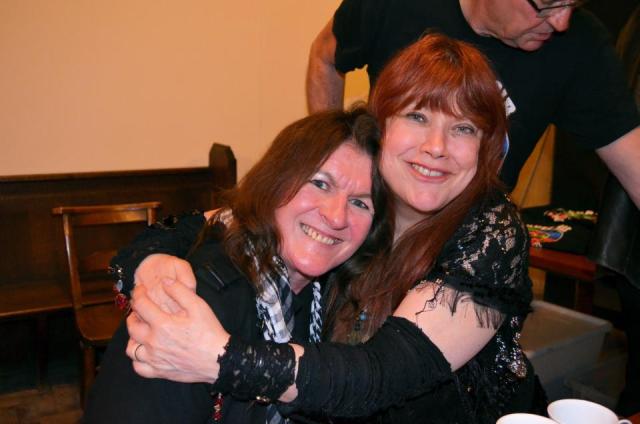
Best of all, I finally got to meet my heroine, who now resembles a gorgeous gypsy queen with her long flaming locks and black lace dress. And Florian remembered our encounter back in the 80s!

I have seen them several times since, including at the High Voltage and Summer’s End Festivals, and at Farncombe Music Club, the venue for our wedding party, where they played the whole set without Florian, who fell ill that night and was unable to perform.

The whole Curved Air cycle came full circle last September, when, on the 45th anniversary of its release, the band took to the stage at Under The Bridge in London to play all of “Air Conditioning”, something which had not been done for many a decade.

The first part of the set was a selection of songs old and new, including some from their most recent album “North Star” released in 2014.

It was the sheer joy of experiencing “Air Conditioning” in a live setting and realising the album had not lost any of its power and excitement in the ensuing years.

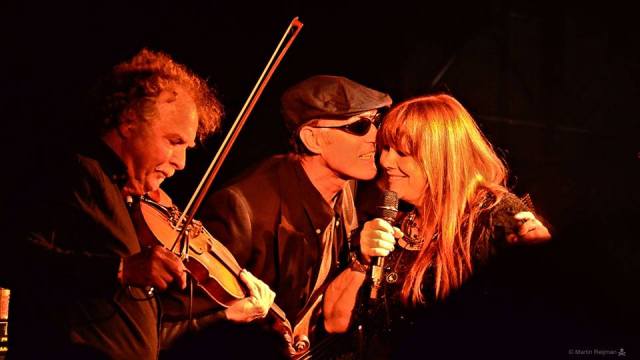
Perhaps I should mention that Curved Air’s current violinist Paul Sax is one of the most electric forces of nature in prog, his whole demeanour that of a wild gypsy violinist.

For this evening and one evening only, he was joined by Darryl Way. who flashed and burned his way through the most extraordinary version of “Vivaldi”. To see a musician play with such incredible virtuosity and passion on a piece fashioned when he was still young enough to be at art school or music college is simply remarkable. And I do not mind saying a few tears were shed, especially when Sax joined him for a sizzling rendition of “Everdance” from “CA II” for the encore.

Ian Eyre, the original bass player, also made an appearance to help celebrate this wonderful landmark in the career of a band that simply keeps on burning brightly.

They’ll be coming here to my current home town of Basingstoke in November and next year they will be one of the bands lighting up the Cruise to the Edge.

I cannot see the Curved Air Everdance ending any time soon – not while Sonja Kristina continues to weave her wonderful sorceress magic onstage, surrounded by the ever-changing, evergreen band of musicians, bringing new nuances and subtle light and shade to their very distinct and special brand of prog.

*All photographs by Martin Reijman

Curved Air – It Happened Today 1971

Curved Air – Vivaldi

Curved Air – Back Street Luv 2015


Paul and Darryl (2)
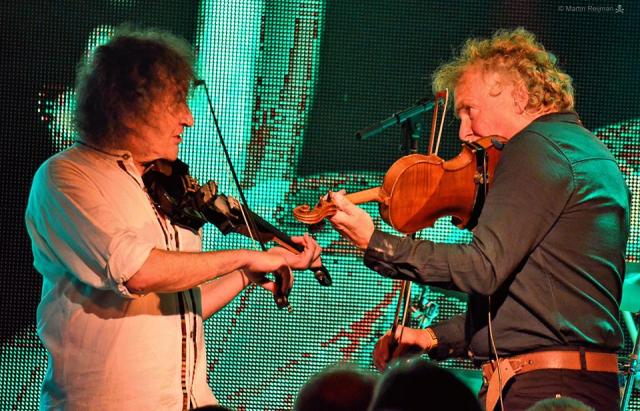
Paul Sax and Darryl Way, duelling violins.

.

Sonja Kristina (3)
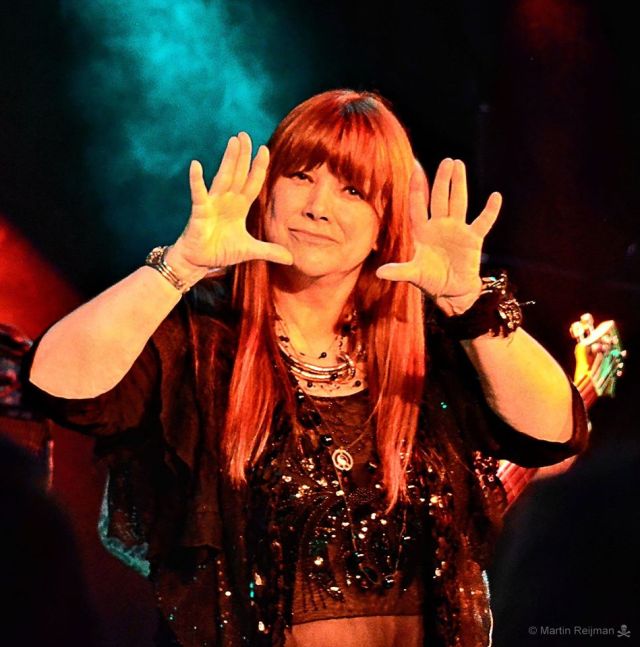
The one and only Sonja Kristina.
A&S
WAith my heroine.

From the beginning……..

Our esteemed Progarchy editor has invited me to offer some thoughts and insights about how music has shaped my life; so hang on to your hats as there will be much to impart – but not all at once!

Where did it all begin? That’s an interesting question as my first memories are of bands like the Beatles and the Rolling Stones, circa 1964. Even then, the Beatles were the good guys and their single “She Loves You” was the first record I ever owned when I was six. The Rolling Stones were cast as the bad guys and quite honestly, I never really took to them until much, much later when I finally came to understand the more darkly adult themes within their music.

I was brought up on hip new television programmes such as “Ready Steady Go”, “Juke Box Jury” and of course, the iconic “Top of the Pops”, which was then a cutting edge programme very much in its infancy.

However, it was my parents who gave me the first taster of some of what was to come. My Dad, who has always been a huge jazz/big band fan, had a sizeable collection of 78s by artistes such as Glenn Miller, Duke Ellington, Woody Herman with “The Woodchopper’s Ball”,  Stan Kenton, Tommy Dorsey and Nelson Riddle. Although I did not have the same deep affection for his big band passions, Dad certainly did teach me how to appreciate and enjoy music- as he found out later to his cost when I became a teenager!

There were two bands that he particularly loved, who went on to influence me and indeed, many of our contemporary heroes.

One was The Four Freshmen, an American four piece vocal harmony band, very much in the jazz tradition, who also played their own instruments. Some of their renditions of standards like “Tuxedo Junction”, “Baltimore Oriele” and “Poinciana” were simply breath-taking in their harmonic complexity and beauty. It is no surprise then that they were a major influence on Brian Wilson, and their vocal style provided the foundations for all that is best in the Beach Boys. Both The Manhattan Transfer and Donald Fagin have also acknowledged the Freshmen as a major inspiration.

Perhaps this is why I have a great love of bands which specialise in close vocal harmonies. Crosby, Stills, Nash & Young, the Zombies, Yes, Queen and Simon & Garfunkel come immediately to mind along with the brilliant Fleet Foxes, and latterly, the great Moon Safari  with their vocalist/keyboard player Simon Åkesson’s amazing a capella side project, Accent.

My father’s other great musical love was the Jacques Loussier Trio, an outfit which puts an amazing jazzy spin on European classical music, led by the charismatic, celebral French piano maestro Jacques Loussier, who is also a pilot and wine producer.

I loved the way these three musicians could so effortlessly fuse two distinct musical styles to create a brand new modern-sounding idiom. They were, in fact, probably the first musicians I ever saw in concert at the Winter Gardens in Bournemouth and I must thank my parents for taking me along that night.

Never in my wildest dreams did I think I would hear of them again much further down the line. But it comes as absolutely no surprise that they are one of Andy Tillison’s major influences and you can detect that inspiration in The Tangent’s music, especially when the Maestro cuts loose his jazzier mojo.

To a lesser extent, the other group who I remember hearing very early one via my parents was The Swingle Singers. There are links with the Freshmen and Loussier yet again as this group were French-based and weave their close harmony vocal magic on European classics in very much a jazz style, with double bass and drums accompaniment, their most famous interpretation being Bach’s “Air On A G String”. And if you listen to the instrumental passage in ELO’s “Mr Blue Sky”, you will find them right in there too!

There were early classical influences too, such as Antonín Dvořák’s extraordinary Symphony No 9, better known as “The New World Symphony”, which was influenced by his experiences of America and its native music. The other piece which really rang true was “Vltava”, more popularly known as “The Moldau”, by his fellow Czech composer Bedrich Smetlana. This was the first time I ever heard nature pervading music with that incredible “river” effect achieved in the composition.

I have never had a chance to reflect on these beginnings but, writing it down now, it makes perfect sense and gives me a much greater understanding on why I now love the music of so many artistes, who use so much of what is best in classical and jazz, to give us this all- encompassing style we know and love as prog.

The Four Freshmen – Poinciana

Jacques Loussier Trio – Toccata

The Swingle Singers

Largo from The New World Symphony

The Moldau

“The pen is mightier than the sword; the music of the word is scored”

Folklore dance (2)

There’s a wonderful revolution currently taking place and it’s happening in unexpected places, like on hillsides in Winchester and deep in the Wiltshire countryside rather than in some huge faceless metropolis or swanky foreign location.

It brings together a lost tribe, a band of people who would not have known about each other’s existence without what communication philosopher Marshall McLuhan described in 1962 as “the global village concept”.

Fifty-four years later, McLuhan’s prophecy has been fulfilled with the global reach of Facebook gathering in self-proclaimed Passengers from as far afield as Australia, Sweden, Germany and Scotland.  But more about them later.

Continue reading ““The pen is mightier than the sword; the music of the word is scored””

Remembering Keith Emerson

Like millions of other fans around the world, the death of Keith Emerson was the most terrible shock, especially as he took his own life believing that his ability, through his incredible musical virtuosity, to bring of joy and pleasure to so many was at an end.

This is my tribute to an incredible talent and a legend who helped to shape the soundtrack to my life.

“Get off your Hammond and drink your milk!” *Remembering Keith Emerson*


Coming in the Air tonight

Curved Air in command Under The Bridge

The path down Memory Lane is a road much travelled, especially for music fans who remember the time when the world was a very different place, seen through the eyes of a young idealistic and very independent teenager. How those years seemed to melt away at Under The Bridge in London when the 45 years dividing 1970 and 2015 melded seamlessly together to the point where there was even a distinct whiff of patchouli oil in the air.

The venue is an unexpectedly spacious and welcoming music space, nestling under the east stand of that soccer shrine, Stamford Bridge, in west London. It’s a place a fellow gig-goer remarked was somewhere you went to on purpose rather than called in out of a passing, casual interest.

There were around 200 devotees assembled on Friday 4 September to hear Air Conditioning in its entirety, which, when first released in 1970, was recognised as being one of the early albums that defined the progressive rock genre and, for record collectors, the first ever “modern rock” picture disc.  Its creators, Curved Air, were also ground-breaking, consisting of a group of virtuoso musicians who fused classical leanings with folk, art house and electronica.

Fronted by prog’s original pin-up girl, Sonja Kristina, the years simply melted away at that faraway place in west London.

Looking at all those assembled and imagining everyone 45 years ago, you could picture the Afghan coats, cheesecloth shirts, flared jeans and long straggly hair, then the hallmark of youth rebellion.

Just the two original members of the band remain:  first and foremost, the flamed-haired Sonja, ever the enchantress, always the focus of attention with her smoky voice and sensuous movements, and  then there is the lavishly named drummer Florian Pilkington-Miksa, a slim, serious, bespectacled figure, who is one of my personal all-time prog pin-ups. He now acts as director of the band, ensuring no cues are missed at the start and the varying tempos are maintained throughout.

With them now are the solid, no-nonsense bass player Chris Harris, the elfin-featured, intense keyboards player Robert Norton, flamboyant guitarist Kirby Gregory who joined them on their 1973 album Air Cut and later wrote Stretch’s smash hit Why Did You Do It, and the ever-animated Paul Sax on violin.

It’s a formidable line-up for a band, whose other illustrious alumni have included Darryl Way (Wolf), Francis Monkman (later with Sky), Eddie Jobson (Roxy Music, UK,  Yes, Jethro Tull and Frank Zappa) and Stewart Copeland (The Police).

Having toured extensively together, the band’s a tight and well-regimented unit but, on this night, they are electrifying.

Kristina, always a dazzling, bewitching presence, clad in sparkling black, commands the entire stage, her voice sultry and seductive, happy to shake hands and engage directly with members of her adoring audience during the songs.

She looks relaxed and happy, the mistress of all she surveys around her. Touchingly at one point, Gregory puts his arm around her and thanks her for inviting him to join the band. There are smiles all around. It’s that kind of evening.

And the music itself? The band kicks off with the instrumental Spider which gives them a chance to warm up their musical chops before Kristina saunters on stage and launches into the traditional opener, Young Mother, still a startlingly powerful song with lots of mesmeric, swirling synths and searing violin courtesy of Messrs Norton and Sax.

The early part of the show is devoted to the new material from their excellent album North Star released last year, most poignantly Stay Human, which Kristina wrote about the current world conflicts about which she reminded everyone before launching into the song.

The new material namely Time Games, Images & Signs and Interplay are more sophisticated than their earlier material but this gives both Gregory and Sax the chance to stamp their distinctive marks. Interplay in particular is a jazzy little gem. In the middle of these modern renditions comes Kristina’s folkie classic Melinda More Or Less, on which she plays her trusty multi-coloured acoustic guitar to tell the story of her troubled friend, who lived in a dream world.

All the band’s heroines seem to have had a torrid time: witness Marie Antoinette and Emily-Jane, The Purple Speed Queen, but they are both part of the greater story.

Also from Air Cut came Easy, followed by the majestic Metamorphosis, a true prog epic which has now been given a whole new lease of life through Norton’s beautiful, delicate piano solo that the whole band stop to acknowledge – and admire.

Finally, cometh the hour, cometh the band and cometh the memories as a backdrop appears of Air Conditioning’s hypnotic album cover.

The band look slightly apprehensive about enormity of the task ahead, playing all of the album tracks but not necessarily in the right order. They start gently with the luscious instrumental Rob 1, Sax offering a beautiful expressive touch to the haunting violin part.

That paves the way for the glorious It Happened Today, still truly one of the outstanding opening tracks on any prog album.  Kristina attacks it full-on with Gregory, Pilkington-Miksa, Norton and Harris all rocking out before it melts into the gorgeous closing violin solo, again Sax totally owning the piece while Kristina wafts around the stage, beckoning us all to join them in this magical musical web now being woven.

The gentle melody of Screw belies the song’s seriously menacing lyrics, followed by the brilliant uptempo Hide And Seek, a nightmare vision of an apocalypse survivor, that still sounds powerful, and the equally doomy Situations.

For the first time live, the band tackle Blind Man, a quaint little ditty about one man and his dog, the staccato vocal phrasing from Kristina based on Donovan’s Hurdy Gurdy Man, so it is not an easy song to sing.

And what’s this? Dancing? It is hard to resist the wonderful rhythmic Stretch that motors along at a rapid pace while Propositions packs a punch, Kristina screaming, the guitar, keyboard and violin creating a wonderful jagged cacophony.

So to Vivaldi and yes, that really is the original violinist Darryl Way walking on stage, moustachioed and grinning. With Way now clutching a traditional wooden violin rather than the cutting edge perspex model of the early 70s, we were all suddenly transported back to our youth, with those frenzied opening bars then exploding into life as the rest of the band join in. Way’s touch is still remarkable, his solo as moving and intense as the original. Your humble reviewer finds herself retreating and weeping with the sheer emotion of the moment.

Then they are joined by Ian Eyre, sporting a jaunty cap, who was Curved Air’s bass player on Air Conditioning.

The band does not even leave the stage but plunge straight into the encore as prolonged cheering keeps them in situ up there where they belong.

Paul Sax and Darryl Way, the string dream team.

Air Conditioning duly delivered and sounding in terrific fettle, it’s left to Kristina to introduce their greatest hit, Backstreet Luv, followed by the frantic Everdance. Sax and Way are having a ball.  They work well side by side, the superb violinists that they are, each with their contrasting styles, Way the classicist and Sax the jazzy individualist, who have both brought so much to the band’s unique style.

This was a celebration rather than a concert, the night of shared happy memories epitomised by the bond that connects the band and fans.  For my part, it was also a celebration of where my prog journey originally started – on holiday in Majorca where an “older man” introduced me to Curved Air – and Jimi Hendrix.

So if anyone reading this knows a guy called Andy McCracken, who originally comes from Watford, now believed to be a practising Rastafarian living in Hertfordshire, possibly Hemel Hempstead, just tell him that Alison said thank you.

High The Memory Carry On – a personal tribute to Chris Squire

There is nothing like the passing of a musical hero to put your own life and mortality into some greater perspective.

First, it was Freddie Mercury, whose passing on 24 November 1991 was not unexpected as I had received an early tip-off that he was HIV positive.

However, the suddenness of Chris Squire’s untimely death yesterday aged 67, just a month after the news was released that he had developed a rare form of leukaemia for which he was receiving treatment, is a shattering, unbearable blow. Again, this horrible disease has claimed another high profile victim.

At the moment, while still recoiling from this hideous news, I feel a huge hole has been torn out of my musical, cultural and spiritual fabric.

Apart from family and friends, musicians have always been my closest “allies” and with the demise of Chris Squire, it has suddenly become almost too personal.

Let me explain.  I can still remember way back to 1971 and the first time I ever heard Yes.  A male school friend very kindly loaned me a copy of Fragile to listen to; and at the tender age of 13, my life effectively changed forever.

The opening track Roundabout always has been and will be “my” song.

As I tried to articulate in a group review for DPRP in 2013, my impressions of this timeless song were:

“Nothing could prepare you for what happened next. What happened was Roundabout. That sustained keyboard chord followed by a sharp acoustic guitar note and a delicate melody, repeated and built upon as the keyboard swelled up again. Suddenly, there it was, that gorgeous jazzy melody line with Steve Howe’s elegant guitar and Chris Squire’s bass thundering along like a giant juggernaut. Jon Anderson’s voice arrived, soaring upwards into the ethers, singing lyrics touching on romance, nostalgia, the elementals and emotion.

“Forty-two years after its release, this mini-masterpiece is still possibly the best prog opener ever, as well as being a landmark song. Constructed in several short movements, it is a chance for each band member to shine, from Anderson’s clear, pure voice, to Wakeman’s sonorous keyboards, Howe’s mannered guitar flourishes, Bill Bruford’s impeccable rhythms and of course, Squire’s earth-moving bass patterns.”

Then, to end one of the most momentous albums of my entire life, there came Heart of the Sunrise:

“So far, side two had not quite caught alight the way side one had erupted…until now. As Squire’s bass goes full throttle punctuated by Wakeman’s spacey keys, we have arrived at Heart of the Sunrise, which rivals Roundabout for having one of the best Yes intros of all time. The floorboards quake and the room begins to spin as the song starts unwinding until it reaches a quiet plateau when Anderson’s voice at its most angelic comes in with “Love comes to you and you follow”.

“The whole piece paints a series of aural pictures, dense, complex and dramatic, that twist and turn like the wind with “so many around me”. It is a multi-faceted piece about alienation and trying to find your place in the world, armed with just your dreams. It catches you unawares when it goes from smooth to frenzied, Wakeman’s slightly schizoid keyboards coming to the fore and then Anderson changes vocal tempo for the fast “Straight light” passage. It builds and builds to a heart-rending climax, Anderson stretching his voice to hit the magical last notes on “city” before the whirlwind intro is revisited for the sudden ending.”

I shall quit here because I could talk at length about the magnificent albums that followed in quick succession but somehow, that would dilute the message as Fragile, with its gorgeous Roger Dean artwork and accompanying booklet providing pen portraits of all the band, was the gold standard so far as I was concerned.

For my part, the zeitgeist of the early 70s, musically, culturally and sartorially, was all about Yes.  As a young teenage girl, it also had a lot to do with these five extraordinarily beautiful, long haired guys in their early 20s, attired in the obligatory cheesecloth shirts and loon pants, that left its indelible mark.

Then came an appearance on Top of the Pops performing Yours Is No Disgrace on the show’s album slot, Jon Anderson in shades and Squire, as I recall, shod in a pair of “poodle” boots, which signed, sealed and delivered it for me.

It is these early days which will stay with me forever, especially when by dint of my then tender age, I was not allowed to see them perform at Bournemouth Winter Gardens on the Tales From Topographic Oceans tour.

Instead, it was at the Gaumont Theatre in Southampton on the Relayer tour where I had my first live encounter with Yes, with another eight or nine times to follow afterwards. There would have been more, especially the Union tour, but you know how it is when life gets in the way.

But Union was incredibly important in other ways. It was The More We Live – Let Go,  a Squire/Billy Sherwood song on the album, released in 1991, which practically saved my life. Back then, I was trapped in psychologically damaging marriage to a man purporting to be “spiritual”, but in fact, he was insidiously destroying my life and there was no obvious way out.

However, when I listened to the album, especially this song, on my car cassette player, the truth was revealed through lines like: “The spirit of imagination can lead us through the dark; The more we see, the more we try, the more we show.”

I cried the first few times after I heard it because through the profundity of the lyrics and the unbelievably beautiful melody, I had discovered a way out from being close to the edge of the abyss.

It is not just from a personal perspective either. His body of work and the influence he has had on so many of the current crop of bassists cannot be underestimated. I can think of at least a dozen bass players of my acquaintance who would cite Squire as being the main reason why they took up this most unfashionable of instruments.

We so desperately need more musical role models like him, because simply put, Squire made the bass guitar sexy. Previously, it was there primarily to anchor the harmonies and establish the beat. But in the hands of the extravagantly creative and theatrically extrovert Squire, it became a musical kaleidoscope for previously unheard of or un-thought about melody lines and sonic seismic shifts. The Rickenbacker 4001 bass in his huge hands became as iconic and seductive as a Stratocaster.

However, I must fast forward the story again and recall one of the most memorable of all their gigs. This was the 35th anniversary tour in 2004 when I caught up with the classic Yes line-up at Wembley Arena. This was the night they went semi-acoustic with a heart-stopping rendition of South Side of the Sky and an amazing bluesy version of Roundabout.

To my mind, that was the defining moment that Yes finally came of age in terms of their maturity and ability to reinvent their music almost on a whim.

The hiatus in 2008,  resulting from Anderson’s near death experience, following respiratory failure, was a difficult one to understand. That  Benoȋt David then Jon Davison stepped in to fill the vocalist slot did render me somewhat perplexed and confused at the time, but with hindsight, the show had to go on. It has to be said though the last two albums, Fly From Here and Heaven And Earth. have left me somewhat nonplussed to put it mildly.

But no matter: the memory now lingers on as we revisit Birmingham Symphony Hall on Sunday 4 May last year when they brought us The Yes Album, Close To The Edge and Going For The One in one glorious sitting.

It was an event to remember. The band augmented by singer Davison was palpably on fire as they delivered the soundtrack of the lives of most people attendant that night. It was as if the decades had rolled back and here we were again, wide-eyed innocent teenagers listening  through our mega headphones in state of the art stereo to Starship Trooper, Siberian Khatru or Awaken once more.

That night, the Great Man was at the height of his powers, firing out salvo after salvo of thunderous basslines, one of the overriding definers of the Yes music – in stark contrast, it has to be said, to the high vibration vocal frequencies of the original singer and his two successors.

I never met Squire unfortunately: however, following the release of his delightful co-project, Squackett’s A Life Within A Day with Steve Hackett in 2012, I did conduct a joyous telephone interview with him for DPRP.

In typical Squire fashion, he misjudged the time difference between his home in Phoenix, Arizona and Winchester, United Kingdom, and called an hour late, only adding my already frazzled state. Then, when he did call, it took me ten minutes to steady my pen-holding, shorthand-taking hand!

But he was charming, affable and chuckled a lot, especially when I asked him about some of his sartorial successes and failures – with particular reference to the amazing “doctor’s outfit” he wore on the 90125 tour.

There is so very much more I could say about him but these are the initial thoughts which come under my personal “High the memory carry on, while the moments start to linger” file.

This is all about The Remembering of Chris Squire and his place not just at the zenith of the prog pantheon, but also in a very much wider musical context.

Our lives are now much darker places because of his passing, but this colossus of a musical lighthouse shone brightly for the best part of nearly 50 years for which we should be eternally thankful. We shall never see his like again, but his immortality is guaranteed.

My thoughts go out to his family, band members from all the Yes incarnations and the huge global community of Yes fans.

Acoustic Roundabout: https://www.youtube.com/watch?v=riE2xHDgODg

The More We Live – Let Go: https://www.youtube.com/watch?v=6ajxABx3Zn8

Squackett interview for DPRP – http://www.dprp.net/wp/interviews/?page_id=2587