Hugh Howey Is A Gracious Man – A Brief Interview

Following my review earlier today of Hugh Howey’s Wool Omnibus, I sent him a note letting him know I had posted it (this was really his idea — he encourages his readers to review his books and get in touch with him, so I had no choice).  He sent me a nice note back, thanking me for the comparison of Wool to Ayn Rand’s Anthem and feeling honored to be, in my review, in the company of that book and Rush’s 2112.  I asked if I could post his response, and he said sure but that he’d also be happy to give a more structured response or answer a few questions.  So here are my “oh my god I have to come up with questions for Hugh Howey” questions and his thoughtful responses.  Hugh Howey is indeed a gracious man.

You’ve told me that you’re a fan of Ayn Rand’s Anthem and Rush.  Do you have a favorite Rush record? What are some other musical and literary favorites?
My favorite overall album is Moving Pictures, and I think that’s because of my age. My older brother got into their music, and I wanted to be as cool as he was. I remember hearing those drum solos go on forever and thinking to myself that these guys must not be interested in being on the radio at all, and that made them even cooler. In a way, I think Rush became commercial without trying to. And that appeals to me. Wool was written and published in a way that never should’ve led to commercial success.
 
Anthem is one of the grandaddies of post apocalyptic fiction. It gets left out of many discussions because of the controversial life and philosophy of its author, but I think art deserves to be critiqued independent of the artist. I didn’t think about the underground nature of Anthem until you mentioned it, but now I want to go back and read it again.
In the world of the Silo,information technology and mechanical technology play a huge role, and are described in very readable detail without killing the narrative.  Can you describe how you approached your description of these technologies in Wool?
I don’t enjoy science fiction when it gets bogged down in the details of how things work. The great thing about end-of-the-world stories is that the technology is often less advanced than what we have today. That allows the characters to stand in the foreground, which is what draws readers in. My approach is twofold, really: I respect the reader’s intelligence to figure things out as they go, rather than blast them with info dumps. And I don’t have characters marvel over aspects of their own worlds that really ought to be banal to them. Science fiction can do this sometimes: characters appear to be wowed over things that are everyday. That always feels jarring to me.
When you wrote the first novella, did you have an idea of how Wool 5 would end?
Not at all. It was just the one story. But when I set out to write Wool 2, I sketched out the entire saga, which includes the SHIFT and DUST books. I didn’t want to fall into the trap of Lost, where the creator has no idea what’s going on, and the reader/viewer can begin to sense this. I wanted to foreshadow events miles in advance. 
There are elements of wool that seem particularly well-suited for dramatic interpretation.  Are we going to see a movie of Wool?
I hope so! Ridley Scott and Steve Zaillian optioned the film rights. The screenplay is in the pipeline right now. I’d say the odds are 1 in 10 that a film gets made, which is pretty damn good by Hollywood standards! 
What are you currently writing, and how can we keep up with it?
I’m working on the end of the SHIFT series. After that, I’ll start the third and final act, DUST, which is where things really go to hell. My website is a good place to keep up with my writing. I even keep my word count updated, so you can see how far along I am in any draft. I try to think of the things I wish my favorite authors would do, and then I do them. Just makes sense to approach things that way.
 
Best,
Hugh 

Hugh Howey’s Wool

ImageI just finished my Christmas reading, Hugh Howey’s Wool Omnibus, having bought it on special for $1.99 (for my Kindle) based on one of those Amazon emails:  “CBreaden, here are books we think you might enjoy!”  Always a leap of faith, going with this kind of marketing, but in a heat-haze brought on by recently finishing Joe Abercrombie’s Heroes and having nothing at hand I wanted to read, I took that leap.

About halfway through the collection of five novellas, I realized I needed to alert the prog world to it, thus uncovering my not-so-hidden geek love (limited as it may be) for sci-fi and prog rock’s connection to it.  I think like a lot of us I first fell under this spell with Rush’s 2112, which I didn’t hear until several years after its release but, when I did, quickly turned to Ayn Rand’s Anthem for the text on which Neil Peart based some of his story.  Rand’s most succinct novel, and to me her most powerful, coupled with Rush’s record, raised a fairly high bar.  Alternate worlds are frequently the stuff of prog, but only on occasion are they expertly wrought in song.

Wool immediately struck me as one successor to Rand’s Anthem, but with a less severe political bent, characters more like the regular people you and I know, and little reliance on metaphor.  What it has in common is a lean narrative and concise style, although the five novellas collected together in the omnibus are far longer than Anthem.  The similarities don’t end there:  like Anthem, Wool has at its center a people being kept from the truth.  It tells the story from the perspective of several characters among a large population who have for hundreds of years inhabited an underground “silo,” which as readers we understand to be an enormously deep, hugely broad, completely self-sufficient bomb shelter.  The only connection to the world beyond the silo is a series of screens that project images of the outside.  These images are produced by cameras mounted to the exterior above-ground portion of the silo, the lenses of which need regular cleaning due to the howling nuclear-desolate wastewinds whipping the landscape.  This task is given to individuals who commit crimes in the silo, which include having dangerous ideas like wanting to know what the outside is like or how we came to be in this blasted silo anyhow.  Okay, so maybe there is some metaphor.

What strikes me about Wool and Anthem, and the reason I bring Wool to Progarchy with a big recommendation to read it, is the imagination of an alternate world, not just by the author, but by his characters.  What happened outside the silo? What are our origins? Is what we see on the screens real? (Plato, anyone?) Howey’s characters are not unsubtle, one-dimensional creatures.  They struggle with these questions with both trepidation and reluctance for committing a crime, and for the mind-bending possibility embedded in “what if?”  This also strikes me as core to the experimentation necessary to successful, progressive music.

– Craig Breaden, December 27, 2012

P.S. Howey has been writing like a madman.  Initially, he self-marketed Wool, beginning in late 2011, almost entirely as an e-book on Amazon.  He’s now been picked up by print publishers, but continues to offer his books online for cheap.  He’s already two volumes in to the prequel to Wool.  Check his site here: http://www.hughhowey.com/. Buy his books here: http://www.amazon.com/Hugh-Howey/e/B002RX4S5Q/ref=ntt_athr_dp_pel_1

The Extravagant Shadows – David Gatten

ImageI had the fortune last evening, unbelievably as part of my job, to see what is only the third screening of David Gatten’s new digital movie, The Extravagant Shadows.  Gatten, who typically works in film, introduced his work and apologized in advance for its length.  At three hours, the movie is a departure for the filmmaker, who typically works in short films.  But “I play for keeps,” he said, “I put all my marbles in the circle.” I admire that.

Image
While I am unfamiliar with Gatten’s other films, so can’t bring to it the kind of context I would like, I was struck by its musicality and thought it appropriate I write about it on the pages of Progarchy.  It is a layered work, composed but also improvisatory, rhythmic and surprising.  And, while it is difficult to describe in terms of story or narrative, its physicality is fairly simple:  A song by Merrilee Rush — whose songs play at intervals through the movie, including her 1968 hit “Angel of the Morning” — plays over a blank screen, and as it fades out the frame is filled by a shelf of perhaps 10 or 11 books, their colorful spines revealing early 20th century editions of works by James, Dickens, Dumas, and others.  Into this static shot slides a glass panel, and we briefly see Gatten and the DSLR he used to shoot the movie.  The artist, and his tools, are present in this film, which subsequently became even more apparent, as a hand and a brush loaded with paint enters the frame, and proceeds to paint the panel.  Over the course of 175 minutes this panel is painted and repainted, bright and muted colors blending, contrasting, drying and cracking, revealing layers underneath.  Between new coats being applied text appears and disappears on the screen, stories and descriptions emerging, disappearing, running into one another, suggesting to me the magic realism of Borges or Pynchon.

Continue reading “The Extravagant Shadows – David Gatten”

Gilberto Gil Loves Us

Ah! We can see this for what it is: a masterful searching for rhythms and melodies, rooted in heritage, clothed in artistic progress, presented as gritty authenticity.  Heritage. Progress. Authenticity.  Three weeks ago, when I saw Gilberto Gil perform at Memorial Hall on the campus of UNC Chapel Hill, there WAS a master at work.  Over 50 years a professional musician, Gil shows no sign of slowing down.  Credited, with fellow Brazilian Caetano Veloso, for creating from a bewitching hybrid of bossa nova and rock’n’roll what became known as tropicalia, Gil is a living legend.  And he should be, for at age 70 he boogied and strutted with his audience and band for two hours, electric guitar casually over his shoulder, a set of musicianly masters in their own right, clearly in love with him, backing him up.

The only point of comparison I have for this is seeing Carlos Santana circa 1987 at the Dallas Fair Park Bandshell, where 5,000 Texicans and 4 white people shook their asses for a couple of hours while Carlos played hardly a hit and barely anything I recognized.  Revelatory.  Fast forward 25 years and the experience is nearly duplicated.  I do not discount the Latin commonality of these two experiences.  As with the Mexican roots of Santana’s music, in Brazil’s music fusions are perhaps most likely to occur.  African, Portugese, Spanish, and Asian musics have mixed with each other for decades if not centuries, and with rock thrown in I defy anyone not to call it progressive.  So much so, in fact, that Velosa and Gil were forced into political exile in the late 60s/early 70s, biding their time in London while things cooled down in the home country.  Music that matters, like your life depended on it.

Continue reading “Gilberto Gil Loves Us”

David Longdon’s Wild River

David Longdon, Wild River (2004)

Those of us who grew up in the era of 70s rock remember a time when American FM stations played everything under the sun, and didn’t bother too much with categories, straight-ahead, punk, progressive, or otherwise.  There wasn’t really a point, because whether it was Buddy Holly one moment or Yes the next, it just all kind of got lumped together as rock — a young art, then, with lots of potential.  I think this achieved a certain illumination in those of us tuned in, to the potential of finding complex worlds even in the simplest of songs, and fresh air in a 12-minute time-changing epic.  There’s a lot of discussion on Progarchy, veiled and explicit, about what prog is.  This is as it should be, because there are so many reasons for why music achieves progressiveness.  It can be a splatter-art dionysian revelry or a heavily-mannered architecture, but it is the intention that is perhaps similar in the various executions of the art, and why, as I mentioned in another review, prog is riskier, more failure-prone, than, say, old time music or country blues or punk.  It is duty-bound to ‘prog’-ress.

I believe one of the ironies of the story of progressive rock is its oft-pointed-to golden period, roughly the early- and mid-70s, when the storied and hairy pioneers of the genre rolled in semi-trucks over the land, painting broad swaths of sidelong vinyl canvas with twiddly squonks and noodly solos, periodically emerging with a real gem that actually sold respectable numbers of triple gatefolds.  Genesis, King Crimson, Yes, Supertramp, Rush, Barclay James Harvest, those semi-truckers ELP, and the hosts of second stringers who got enough traction with either the freakout crowd (Hawkwind, Gong) or the Middle Earthers (Uriah Heep, Gentle Giant) to keep working bands out on the road for decades longer than anyone would imagine.  Then, chapter two, punk raises its head, and the proggers flee their patch bays for the comfort of (often very good, and often quite proggishly weird) new wave pop, digestible without having to get up for a pee mid-song.  Yup.  For every Foxtrot there are thousands of copies of Abacab, for every Close to the Edge there are bins-full of 90125.  Shall I enumerate the ratios for Rush and Supertramp, too, to this crowd? I think not.  You hear me.  This eventuality was not a bad thing — the proggers were striving to keep their muse alive in an era of undeniably important cultural change — and I think it by and large says a lot about the survival instincts and musicianship of the first-stringers.  Yes, I will always wish Rush had another “Xanadu” in them, but am also glad they figured out how to edit.  Now to the irony:  the prog “revival” tends to focus on the lengthy suites favored by the hairy period of prog, rather than the pop songcraft that came with short back and sides.

David Longdon’s record Wild River fits into the song-driven, streamlined version of progressive rock circa 1980.  Not to say it’s retrograde, but rather that it is essentially a pop record with a prog pedigree.  Longdon, who joined Big Big Train as vocalist in 2009, has a vocal timbre very close to Phil Collins and Peter Gabriel, and in fact worked with Genesis as a possible replacement for Collins in the early aughts.  He did better finding Big Big Train, I think, and Genesis probably did worse in not choosing him.  In the interim, Longdon produced 2004’s Wild River, a lovely collection of succinct tunes that I find expressive and joyful, light (as in luminous), and full of the twists and turns that should keep close listeners tuned in.

“Always” opens the record with a briskly fingerpicked guitar, bass, and drums, and a nice Hammond organ.  Longdon’s vocal is fluid, jazzier than his closest comparisons Gabriel/Collins, and the song has “hit” written all over it.  It is like Seal’s best work, and is also reminiscent of that period in the early 90s when the pendulum was swinging from both grunge and synth pop to a more organic sound championed by producers like T. Bone Burnett.  The balance of the record lives up to these set expectations, with an earthy, upbeat acoustic approach brightening the songs.  The sex romp of “Honey Trap” is fun, nice and hooky, darkened by the mixed emotions of the narrator.  “Mandy” is where the mandolin kicks in (Mandy/mandolin?), but there is no forced quaint-ization because of it; flanked by organ, drums, and electric guitar, with a ska section in the chorus, it actually works. That said, a mandolin and an English singer always makes me think of the venerable and much-missed Ronnie Lane, who knew himself how to work these elements, and who I could see singing the hell out of this song.  Thankfully, Longdon does this himself, doing justice to a tune about, as far as I can tell, the politics of relationships (nothing new, but effectively and hazily wrought).  Here’s the thing: I’m one of those listeners who discerns the lyrics last — I’m just much more interested in how a song’s layers and textures fit together.  I listened to this song about five times and until I wrote this review I didn’t care what the lyrics were about, it’s just a great tune, where the vocal is another instrument.  Which is why I knew I was going to like this record.  It works as a musical piece first, and the lyrics work as lyrics should, a combination of poetry, narrative, and tune.  It’s a master working who can take a line like “You decide, my feet are on the ground,” and shape it to a melodic hook.  “About Time” adds strings and a creeping dissonance, again with a short ska section in the chorus (and again effectively done — this is not a worn device).  While comparisons fall short, I see a certain Nick Drake angle working here, with Bryan Ferry looking on.  The Englishness, in other words, is more than apparent, but that’s what this music is, and it works.  “Vertigo” boasts the line, “Vertigo, look out below, all my surroundings are spinning around, must be the masochist in me that wants another chance.”  I find this compelling rather than precious, and the arrangement is so variegated that I’m shaking my head:  this is a pop tune.  Broadway should be knocking at Longdon’s door, but he’s better than that, I think.  His are not vocal gymnastics for the sake of impressive technique.  He serves his songs.  And that’s perhaps what makes this album transcend.  To reference Bryan Ferry again, Longdon has the similar ability to create a soundscape that centers on his vocal but doesn’t depend on it solely.  The mid-paced title track sets the tone for the record and is its literal centrepiece.  “Life is a wild river, not a low cut stream, and I need to believe, I need to hang on, to hold on to someone,” Longdon sings, his British R&B working a ground often neglected since the death of Dusty Springfield.  It works as the album’s middle piece, and the followup track, “Loving and Giving,” is reflective, slowing the pace further.  But with “In Essence” the valley is crossed, the ground rises and the pace picks back up.  This is album crafting, and “This House” rocks out, harmonica hitting a soul note with a bullet mic vocal treatment and dirty guitar giving the lie to wallowing in one’s self-pity.  “This house doesn’t feel like a home anymore” might read like a pop-psych platitude, but Longdon sings it like the universal sentiment it can be, tapping into a commonality we can all relate to.  “Joely” goes to guitar and string quartet, with a hoedown fiddle, profiling what I imagine is a young woman whose life has gotten away from her:  “Joely, the world’s your oyster, Take a knife, open the shell, and sever the creature.” How can this sound so good? But it does. Progress. And then the spoken poem at the end….  Poetry. Narrative. Tune.  “Falling Down” follows, with a rubbery bass and a Gabriel-esque delivery, balances holding on to the past with working towards the future.  This may be the mate to “Wild River,” urging onward in the face of history — “I can’t say I’m not dissapointed,” Longdon sings, and I don’t know about you, but I can relate to this some of the time — dashed expectations happen, they don’t have to define our lives, but they’re there.  The final track, “On to the Headland,” is an optimistic last salvo, solo guitar and voice.  Lighters up, please.  We’re moving forward, damn the torpedoes.

I really like this record and I’ll be presumptuous and say you should too.  But be prepared to only find it on Big Big Train’s site.  Not on iTunes, not at Amazon, not at Emusic.  What the ?#@>????  There is no reason on earth this shouldn’t be out there.  N.B. David Longdon and BBT:  give it up, proggers. Great records deserve a listen.

[David’s album, Wild River, can be ordered here.]

Popol Vuh is Heavy

ImageWhat makes a heavy record? What is heavy music?

I still haven’t put my finger entirely on it.  There are landmarks to go by.  I think of the giant leap forward in production that Led Zeppelin achieved, where the drums and bass, really for the first time, were up front and PRESENT in a rock album, as Jimmy Page successfully married technology to sonic texture (it is amazing to think that a mere year and a half separated Zeppelin’s first from Sergeant Pepper’s Lonely Hearts Club Band, in so many ways a touchstone for “produced” music, art rock, and progressive rock, but still quite thin sounding).  Black Sabbath’s first, and then Paranoid, followed closely on the heels of Zep’s initial efforts, with Butler/Iommi/Ward’s dark conjurations so perfectly in tune with Geezer Butler’s lyrical mood and Ozzy’s keening wail.  Then there’s the heaviness of message or melody or harmony, the lay-it-on-you trips of musical philosophy, that can blow down the walls even with the simplest of acoustic setups.  I’ve never heard a punk-like shriek equal to Uncle Dave Macon’s banjo and voice records of the 1920s, or Charley Patton’s husky growl as it disappeared into the scratchy grooves of a worn Paramount 78.  You want heavy? Patton’s heavy.  Heaviosity is just what it is…I couldn’t tell you WHAT, but I know it when I hear it.

Successful progressive rock by definition is heavy music, as it seeks to differentiate itself from less self-consciously achieving music.  Like any artful endeavor, it can utterly fail in the attempt, by stating the familiar without stretching towards the unknown.  For instance, use of atonal or dissonant structures can only work as a dynamic shift between pieces (whether those pieces are albums or songs are parts within songs), in search of the sublime. As a repetitive reflex such devices are no more meaningful than a beautiful melody iterated too many times.  Even music that relies heavily on drones can only do so because of the periodic resolutions or tonal completions.

Heavy music is the sound we hear made sacrosanct, often unknowably but assuredly.

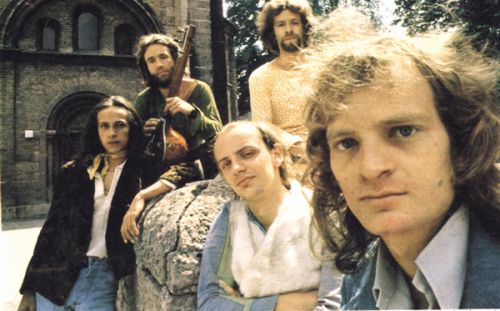
I came to Popol Vuh later than I should have, years, decades, after I’d tuned into instrumental, meditative music (in the form of classical and jazz music).  I was surprised when I did hear them that devotional music could be so obvious and compelling, and so far removed from the treacly mission-speak of Christian rock and its earnest minions.  I’d heard of the band for a long time, I couldn’t say how long, and knew they were vaguely associated with new age music in the same way that Tangerine Dream were.  That they were German may have sealed the deal to my overly threatened ears:  nope, not going there.  When I finally did listen, into my 30s by then, it was a revelation.  A true classic, 1972’s Hosianna Mantra, dominated my stereo on Sunday mornings for a number of months, and still periodically does, guiding me through a non-denominational liturgy of the soul.  Florian Fricke, Popol Vuh’s guiding genius and pianist, guitarist Connie Veit, and vocalist Djong Yun provide music to a common mass that knows no religious boundary.  I’d like you to hear this, in the title track, Hosianna-Mantra:

http://www.youtube.com/watch?v=Kf8PWspETtc&feature=youtu.be

Veit’s gliss guitar provides a fluid compliment to Fricke’s piano, with the oboe and Djong Yun’s vocal floating as one above clouds of melodic invention.  Intentional or not on the part of the musicians — and I believe it was, as Fricke had apparently experienced, not long before making this record, a rather intense religious conversion, part of which was abandoning his previous forays into electronic space music (equally wonderful, by the way) — it achieves a transcending spiritual glimmer, and is the single most compelling and inspiring expression of faith I have experienced in music.  This is heavy music that is full of light, illuminating a path that Fricke and his collaborators in Popol Vuh would continue to follow for a number of years with an astounding level of success, whether in the music they created for Werner Herzog’s films in the 70s or on their own records.

While Hosianna Mantra is often pointed to as Popol Vuh’s greatest achievement, it was a transitional record, heralding a string of albums where Connie Veit eventually left the group and Danny Fichelscher, a drummer and guitarist for Amon Duul II, joined, greatly influencing Popol Vuh’s sound.  Fichelscher’s rock chording, accomplished solo-ing, and pounding drums gave sonic muscle to Fricke’s explorations, darkening the clouds.  This is heard to greatest effect on the album Letzte Tage Letzte Nachte (Last Days, Last Nights), which at 30 minutes is one of the shortest progressive rock albums I can think of, and also is one of the heaviest records in my collection.  There’s an eastern non-blues, metallic, marching sturm-und-drang that Fichelscher brought from Amon Duul II, and combined with Fricke’s melodic sensibilities this creates an atmosphere of shadow as well as light, broadening the reflective palette, retaining the beauty while at times adding an edge of dread.  The first track, Der Grosse Krieger (The Great Warrior), inhabits this space, setting the tone for the rest of the album:

http://youtu.be/gdh-IhnhQd4

As on Hosianna Mantra, Djong Yun has a strong influence on Letzte Tage Letzte Nachte, but here it’s a harder rock turn, with her voice often joined to that of Renate Knaup, another Amon Duul II stalwart.  Where on Hosianna Mantra, “Kyrie” was churchlike, solemn in its beauty, here “Kyrie” becomes a Hindu chant, with an almost Allman Brothers-like instrumental outro.  The acoustic “Haram Dei Raram Dei Haram Dei Ra” continues the eastern om, leading into “Dort ist der Weg” (There is the Way), another dense electrical rock foray.  The album concludes with the title track, a duet between Yun and Knaup, its fingerpicked arpeggios, reverberation, and repeated line, “When love is calling you, turn around and follow,” suggesting the more meditative work of U2.

http://youtu.be/KpPPElUV9Hg

Popol Vuh is heavy, and Popol Vuh is no more.  Florian Fricke died in 2001, leaving a large and varied catalog of music behind him.  Never content to stay in one place musically too long, and shunning the commercial potential his music certainly could have had in the New Age market had he done so, Fricke shared with many other “krautrock” pioneers a deep concern that music remain art, that it achieve a transcendence beyond simply making music or a day’s pay.  He once said “Popol Vuh is a Mass for the heart” — his is a music well-described.

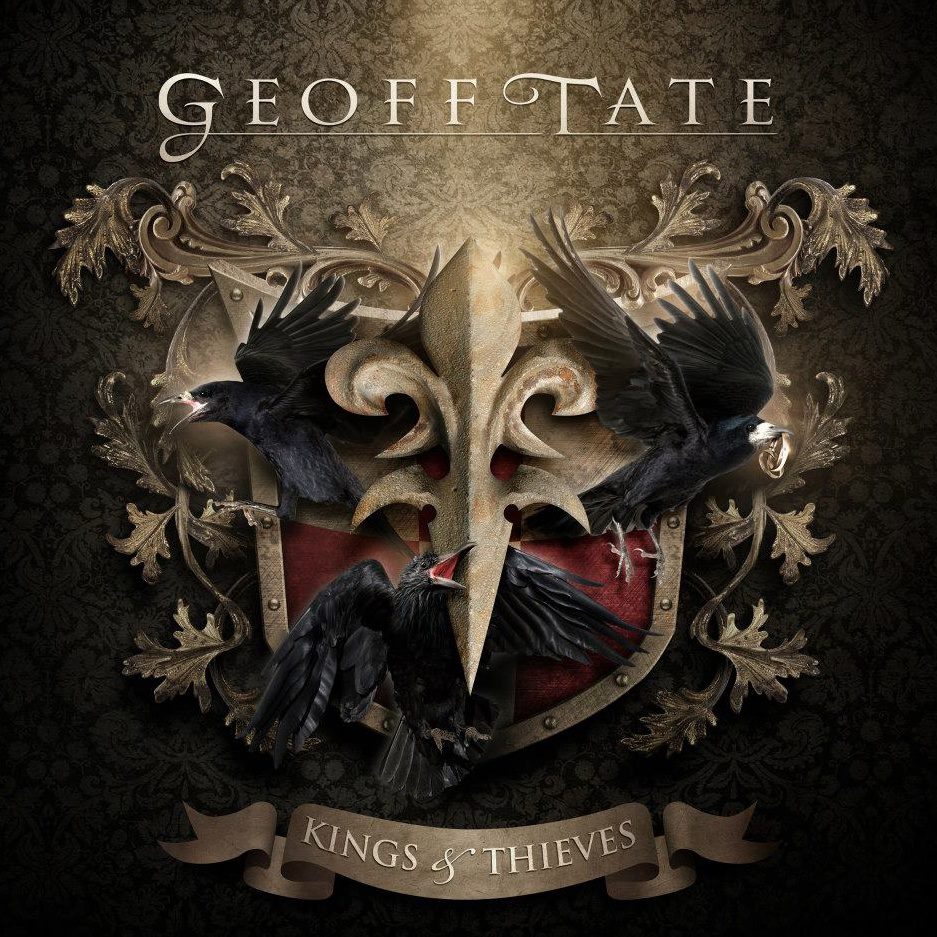
Kings and Thieves / Geoff Tate – Review

Kings and Thieves / Geoff Tate – Review

(Insideout Records, available Tuesday, November 6, 2012)

Received wisdom from the now far-distant era of grunge has things playing out thus: hair metal, riding high through the 80s in various forms, from NWOBHM to G’n’R, was coffin-ed by Nirvana and their Seattle brethren, who brought the music back to rock basics in 1991 with a DIY ethic and no-frills aesthetic.  But like a lot of stories that have been settled on for historical convenience, the Grunge-Killed-the-Metal-Star fable is over-weighted by victim and victor alike.  Hair metal had been killing itself slowly starting about the time of Aerosmith’s remarkable reinvention as an AOR band, blazing a suspect trail based on power balladry that had a lot of us ready to impale ourselves on our air guitars.  Add to this that grunge, if not so-called, had been healthy and growing for years in bands like Husker Du and Pixies.

I think if grunge, as made popular by Nirvana’s pop nugget Nevermind, did anything for metal it was to make it healthier in the long run, and Geoff Tate’s album, which is a solid rock record, is a good case in point.  I’m not going to pretend to know a lot about him, as my familiarity with his band Queensryche pretty much begins and ends with “Silent Lucidity” — one of the aforementioned power ballads that chased me, screaming, to the edges of mainstream metal in the late 80s — but I’m impressed with this record, and have probably missed out on more than I’d like to admit.  Technically gifted vocalists like Tate have a natural advantage in hard rock, where the bar can sometimes be very high (Paul Rodgers, Rob Halford, David Coverdale, Chris Cornell, Ronnie James Dio), and with a good lyric and a good riff can continue to make great records for years.

That’s certainly the case with Kings and Thieves’ opener, “She Slipped Away,” complete with a classic rocking opening progression reminiscent of the Eagles’ “Chug All Night,” an anthemic chorus, really nice guitar soloing, and a well worn, but true, take on relationships and highways.  Here and in other tracks (“In the Dirt,” particularly) I’m also struck by a real Peter Murphy-ish sound, part of which is Tate’s vocal tone, but also in the song structures, which want to tend toward pop even as they’re definitely coming out of metal (in Murphy’s case, goth).  It’s as if there’s a desire for rebirth or newness, and even when this fails, as it does in the playa’ attempt of “The Way I Roll” (the man’s no Eminem or Kid Rock, and he shouldn’t feel he needs to be) I have to admire that he’s going after it.

The low-end grind of “Take a Bullet” and “In the Dirt” makes for awesome, straight-up hard rock perfect for the open highway.  Tate knows how to make his voice match a lyric and a lick, and carries it off even when he’s lyrically pushing things a bit (“She’s got moves like I’ve never seen, rides me hard like an exercise machine” … really? Smell the Glove, anyone?).  This record is like all those hard rock albums that came out on the various Columbia subsidiaries of the 70s — it’s like a Nugent record, where you’d get a handful of duff tracks but the rest rocks out enough to make you want to flash the horns, and between it and the next record you’d get enough great tracks for your one-band mixtape.

For those wanting a return to 80s power glory, look no further than “Tomorrow,” with its Kashmir-ish break and vocal choruses of “Tomorrow starts today…sometimes love is not enough….”  This is a bow to fans from back in the day, but Tate can really pull it off, convincingly and refreshingly.  Kashmir, interestingly, is referenced again in the next song, as “Evil” recycles another part of that indefatigable Zep riff, but it’s hard to care, because Tate really brings it to the mic.  “Dark Money,” with its stab at privilege and eco-political power, is an odd moment, not terribly well-matched by the absolute rock star howl that Tate can whip up (kind of like if Ian Gillan led Deep Purple through a ditty about the gas crisis of the 1970s).  “Glory Days” may suffer from the same problem, but again, is buoyed by Tate’s delivery and a crack band, which is really together throughout the album.  It’s a guitars and drums forward record, live sounding, with a rumbling bass lending metal grind to the tunes.  Pianos and synths illuminate when necessary, and keep me thinking, this is a really tastefully produced rock record that fans of classic Queensryche and hard rock in the new millenium can enjoy.

The last two tracks, “Change” and “Waiting,” make well-chosen closers, bringing it down a bit, showing how Tate and company influenced the metal side of grunge (Pearl Jam or Alice in Chains would be at home here), and making me appreciate how much classic metal and hard rock really benefited from the shifts that happened a generation ago.

Craig Breaden, November 2012

Storm Corrosion – Review

Review – Storm Corrosion (Roadrunner Records, 2012)

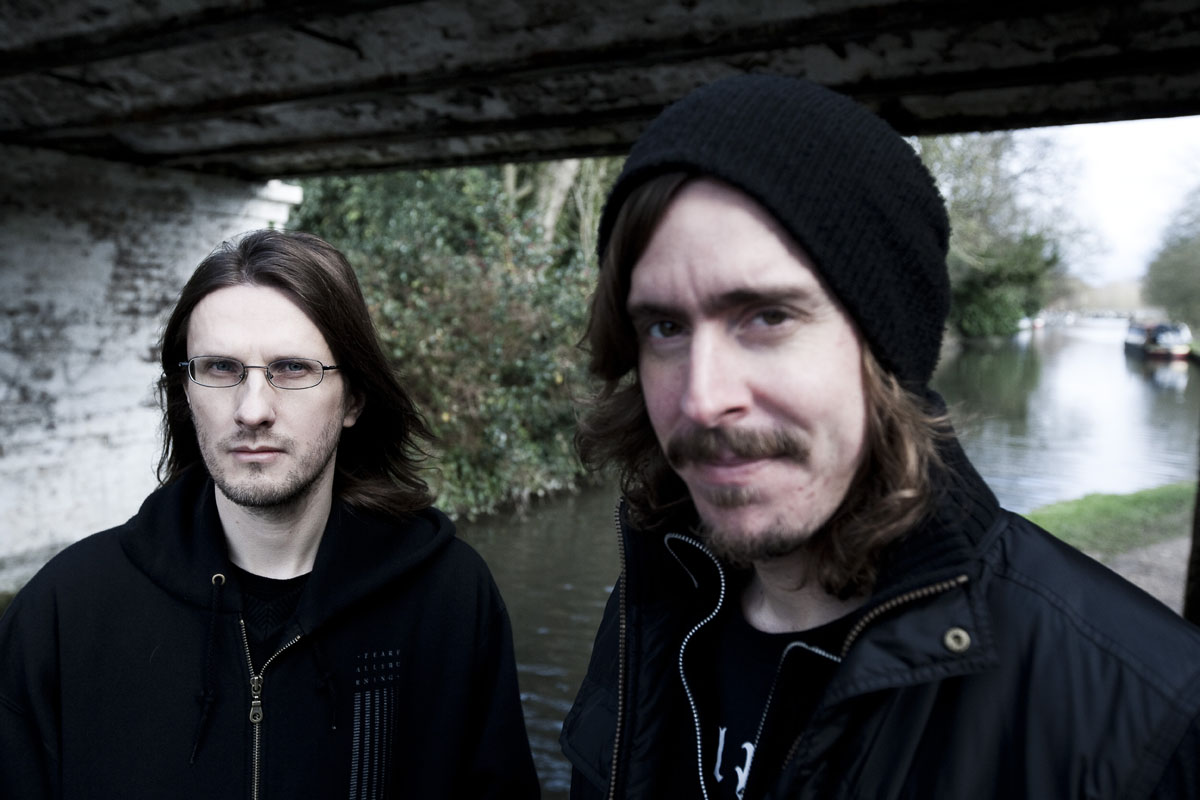
Mikael Akerfeldt is right, with a few qualifications.  On the website for the new Storm Corrosion album, a collaboration between Opeth frontman Akerfeldt and psych/prog stalwart Steven Wilson, Akerfeldt says, “It’s a demanding record. If you’re doing other shit as you listen to it, it’s going to pass by like elevator muzak. You really have to sit down and pay attention! If you allow it to sink in, it could be a life companion.”  Any fan of Opeth or Wilson (No-Man, Porcupine Tree) will be looking for reasons to like this album, but also hoping that it achieves a distinctiveness apart from previous projects.  And this is problematic, because Akerfeldt and Wilson have been collaborating since 2001, when Wilson produced Opeth’s fifth album, the landmark Blackwater Park, a layered, dense, progressive version of death metal (or death metal version of progressive rock).  Take a moment (okay, 9+ minutes — nothing about any of this music is succinct, nor, really, should it be) and check out Bleak from Blackwater Park:

http://www.youtube.com/watch?v=p8atiEPs0bQ

Wilson and Opeth, which around this time Akerfeldt began to make his own (at least from a fan’s perspective), really hit their stride with the dual albums Damnation and Deliverance.  Where Deliverance followed up on the electric, distorted heaviness of Blackwater Park, and utilized to great effect Akerfeldt’s signature take on the growled vocal delivery common in death and black metal, Damnation was the mindblower, indebted I think fairly heavily to the work Wilson was doing with No-Man.  It was a heavy album where the acoustic and electric guitars (Akerfeldt and fellow Opeth guitarist Peter Lindgren used Paul Reed Smith electrics, an important aesthetic and tonal detail that set them apart in their genre) are stripped of their distorted treatments, Akerfeldt’s beautiful straight-ahead vocal delivery is featured across the album, and the songs are minor-key, droney, melancholic, but melodic and dynamically arranged.  It’s heaviness comes from its complete approach, rather than its sonics alone, and for this it’s an incredible achievement.  To get the full effect of this record (and its companion Deliverance), you really need to check out the marvelous Lamentations DVD, which captures Opeth at Shepherd’s Bush Empire in 2003 (and, bonus, shows them working in the studio with Wilson). Here’s an amped version of Closure, originally on the Damnation album, from Lamentations:

http://www.youtube.com/watch?v=hodPV0XglVg

It is Damnation, and perhaps No-Man’s Returning Jesus (with its Talk Talk influences, something Storm Corrosion’s creators have also explicitly mentioned), that Storm Corrosion most closely resembles in character, it’s low-key, meditational approach standing outside the typical Opeth or Porcupine Tree record, but demonstrating the restlessness that underlies both Akerfeldt’s and Wilson’s work.  The record begins with “Drag Ropes,” which sets the tone:  fingerpicked guitars, minor-key arpeggios, strings and woodwinds, and cinematic snippets of lyric in service to the tune.

(The video for “Drag Ropes” is a darkly gothic theme — not unexpected, given the death metal connections I suppose — leavened and made creepier by animator Jess Cope, whose take on the song’s stripped-down lyrics is a story in itself, and is nothing like what my mind conjures as I hear the song.  See her take on it here: http://jesscopeanimation.tumblr.com/dragropes.  I like this because these songs are of a type best finished by the listener.)

I am reminded of Deep Purple’s lofty Concerto for Group and Orchestra, which I always rather liked (and I think Akerfeldt must have too, as the cover art of that record was duped for Opeth’s In Live Concert at the Royal Albert Hall).  The orchestra/group approach has come full flower here, but with far greater and personal effect, and the album’s title track is also redolent of that particular period of British rock’s embrace of the orchestra, this time a fair and beautiful reminder of Ray Thomas’s flute work for prime era Moody Blues.  The flute is replaced in the second half of the song by a vocal line that speaks to the vox-ness of this record.  Both Wilson and Akerfeldt are capable of affecting, fragile vocalizations, sometimes bordering on too delicate, an irony given Akerfeldt’s former Opethian growlings.  “Hag,” the third track, demonstrates the necessity of the softer vocal timbres in this record, while also reminding me most of Damnation, with its dramatic drum breaks and dynamic shifts.  These drums gave me a breathless pause.  They are low-fi, almost seemingly intentionally so.  Nothing these cats do is low-fi, and I searched my brain for a WHY until it lit upon a purchase:  it transported me to the drumming on Popol Vuh’s Letzte Tage Letzte Nachte.  Mikael Akerfeldt has claimed Popol Vuh as a major influence before, and explicitly in an interview regarding Storm Corrosion.  Not to stretch the point, but a good bit of this record has a Popol Vuh/krautrock thing happening, particularly the closing song, “Ljudet Innan,” a grand, drifting piece that opens with a jazz-ish vocal from Akerfeldt before some major drift that would be right at home on PV’s Affenstunde or Aguirre.  Getting there, we’re also treated to an instrumental piece, “Lock Howl,” that energizes us before the finale and reminds me why pacing is so important to an album, an LP relic often forgotten in the MP3 era.

I like this record and wish more like it were made today.  If Wilson and Akerfeldt were jazz musicians (which, from a musicianly point-of-view, they are), they would have just made this record 15 years ago, no big thing, then guested as leaders on each of their respective groups’ albums and collaborated every other year until they were 80.  That they’re associated with rock means they have to carry the weight of “supergroup” to any sort of collaboration like Storm Corrosion, which is something of a pity.  I don’t feel like this record is loaded with trying to live up to expectations, or an ego trip or anything else associated with supergroupness.  Beyond the whys and influences and connections this album has, if it were released anonymously, and I had no context to hang my thoughts on, I think I’d have the same reaction to it.  Yes, there is aural history here, a moogish mellotronish flutes’n’strings thing, but these are not derivative of 70s prog: they are necessary to the songs.  Storm Corrosion is a worthy achievement from two artists who have a significant history creating groundbreaking music, together and apart.  While the record has many touchstones, it is not the sum or product of a record collection, but an original and expressive statement of two consummate musician-composers who are rewarded by their ongoing collaboration.

Craig Breaden, November 2012

Krautrocksampler

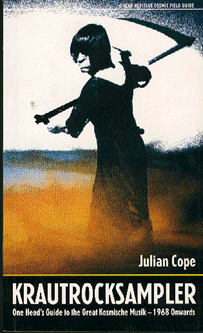
I first became familiar with Julian Cope’s music through his being associated with other cracked heads who worked in the wake of original famous British acid casualty Syd Barrett. He first came to prominence in the late 70s and early 80s, as singer for the Teardrop Explodes, one of those bands, like Simple Minds and Echo and the Bunnymen (contemporaries and both of which Cope alternately respects and dismisses in his excellent autobiography Head On), that at the time were constantly being compared to the Doors. I never got this point of comparison, though others couldn’t let go of it, to the point that Echo and the Bunnymen couldn’t either, to their detriment.  Following the collapse of Teardrop Explodes, Cope went solo and slowly seemed to disintegrate, Syd Barrett-like, into pastoral psychedelecisms.  Then came Peggy Suicide, a double album with a refreshed and matured Cope confidently leading his long-suffering and new fans on a garage pop narrative of environmental and political disorder at the twilight of the century.  It’s a masterpiece and I became a fan, seeking out his old records (Fried, the most immediate Barrett knock-off, became a favorite) and keeping a line on him.  I moved to New York in 1995, and one day I was browsing the book section of the Virgin Record Megastore in the heart of Manhattan, and happened upon Krautrocksampler by none other than Julian Cope.  I knew next to nothing about the genre, although I owned a Can compilation and had heard of some of the groups, like Popol Vuh and, of course, Kraftwerk.  But sheesh, I thought, this has to be good.  It was a beautiful, compact book, with glossy full-color photos and text everywhere.  The cover, as I later learned, was the same image adorning Amon Duul II’s album, Yeti.  I put down my $10 and walked out with a copy.  I couldn’t put it down.  Cope was a passionate writer, and this, a passionate subject for him, bubbled with enthusiasm, humor, serious asides, and deep observations.  I could see him writing it and not being able to keep up with the flood of thoughts and emotions.  Over the next months I spent hundreds of dollars on import CDs of krautrock legends, some of which, in Cope’s patois, was shite, some of which glimmered with genius.  I left New York considerably wiser, and considerably poorer, as regarding krautrock.

Fast forward a few years, and I’m in North Carolina, again perusing the music section of a book store, this one at UNC Chapel Hill, when I spy the Modern Antiquarian, by none other than Julian Cope.  Apparently in his spare time, Cope developed another passion, for British stone circles, becoming something of an authority.  Inspired, I got on Amazon thinking I’d find it cheaper, and I didn’t.  I think it may have already been out of print. And, as it turned out, so was Krautrocksampler.  The kicker was that people were selling their used copies of Krautrocksampler on Amazon for over $100.  Sheesh, I said again, if only I’d bought two copies.  Then I found the link below, and sold my copy for $175 (I am not kidding).

http://www.swanfungus.com/2006/10/krautrocksampler.html

You might call this copyright infringement, and “swanfungus” is quick to note the out-of-printness of the book, something Cope doesn’t seem to care about anymore, as his reason for posting.  I call it a public service.  The best book on music I have ever read.

Universal Yodel – Penguin Cafe Orchestra

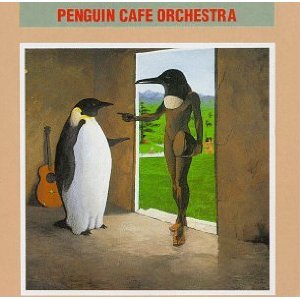
I’m reposting here an article on Penguin Cafe Orchestra I wrote for Perfect Sound Forever several years ago.  More work needs to be done on this band (and on EG Records, mentioned in other posts), but for now my intention in repurposing my article is to place it in the context of Progarchy, where connections might be made outside of the borders of Perfect Sound Forever.  First, an exercise in beauty:

http://www.youtube.com/watch?v=P6df-1tvYsg&feature=related

Jimmie Rodgers hopped the rails, and the world changed. The “Singing Brakeman” saw all that his green Earth had to offer – the rolling southern hills and delta country of the United States – and along the way picked up some blues to add to his bag of “hillbilly” songs. One of those might have come from bona fide ‘billy Riley Puckett, a blind guitar player who would come to fame with Gid Tanner’s Skillet Lickers, and who in 1924 recorded “Rock All Our Babies to Sleep,” a waltz-time favorite that spawned eleven more versions before Rodgers himself laid it down in 1932. Where Puckett might disappear into the scratchy crackle of just another hillbilly 78, however, he puts a hair-raising yodel at the end of each chorus. It is a compelling moment that may have spoken volumes to Rodgers, who mastered many “blue yodels” up ‘til his death in 1933, their popularity earning him the mantle of country music’s first true star.

Yodeling suited the new Babel of radio, and it is little wonder that Rodgers had as much influence on blues as he did on country music. To listen back to his songs today, it’s as if the turnarounds between verses, where the many-hued “yodel-ay-heees” speak to us in tongues, are a kind of reverent return to an original common language afforded by the luxury of recorded sound; it is a quality that errant British guitarist Simon Jeffes, nearly a half-century later, might have termed “imaginary folklore.” And, in Jeffes’ hands, the yodel would be transformed into an imaginary cultural cornerstone.

Disillusioned with both the academy and the avant-garde, Jeffes made a career of crossing borders. A first step occurred while traveling in Japan in 1972, when he heard a tape of African music that sparked an ecstatic experience revealing to him, “why it is we play music, that gut level sound of humans being human.” That same year, Jeffes had a feverish vision, again in a foreign clime, this time the south of France. He dreamt of a place, “where everybody was taken up with self-interested activity, which kept them looped in on themselves. It wasn’t like they were prisoners, they were all active, but only within themselves.” In response to the visceral African music he had heard on the one hand, and to this flattened dream-world on the other, Jeffes created a separate vision he termed the Penguin Café, where the “unconscious can just be,” and that would guide the musical output, over the next 25 years, of his Penguin Café Orchestra.

The Orchestra evolved slowly; its albums took time, starting with Music from the Penguin Café (1976), which tends to divide fans and critics. The product of an early association with its executive producer Brian Eno, it ably bears the stamp of the EG Records catalogue, and is at home beside Eno, King Crimson, and the galaxy of unclassifiable modern British musicians who landed at the label. Its electric instrumentation gives the album an unsettling quality that is almost conscientiously avant-garde. It shares, with its successors, absurd titles (a personal favorite, “Hugebaby”), a love of simplicity, and a fine timelessness.

The self-titled second album did not arrive until 1981, and is considered by many their definitive work. Like great records should, Penguin Café Orchestra captures its composer and musicians at a critical moment of prowess, an acoustic sensibility replacing the stiffer electric stance, its fantastically melodic themes performed concisely, and with intense discipline.Broadcasting from Home (1984) and Signs of Life (1987) continued that trend, and by the 90s their work was so associated with “themes” that Jeffes began undertaking soundtracks and scores (he had already gained some notoriety for arranging “My Way” for Sid Vicious and Malcolm McLaren). These included a ballet based on Orchestra music, Still Life at the Penguin Café Orchestra, and the soundtrack to the film Oskar and Leni. The scores included PCO standards arranged for larger orchestras, a development that would bear fruit on their last studio album, Union Café, featuring new pieces comparatively fleshed out, both in length and in orchestral depth. Their two live albums, 1987’s When in Rome (recorded, in actuality, at the Royal Festival Hall in London) and 1995’s Concert Program offer a nice comparison of this shift as well, the former capturing the simplicity of their earlier work, the latter making use of extended instrumentation.

Despite the consistency, progression and weight of their work, however, dial up Penguin Café Orchestra in your favorite record guide, and you will find a) Nothing at all (even Mark Prendergast’s sprawling and comprehensive Ambient Century presents naught but a great hole in the index where Penguin Café Orchestra should be); b) Befuddled hipster confusion, usually concluding with the unfortunate designation “New Age,” or, less typically, c) Jeffes’ own description of their music, as “imaginary folklore.”

For the sake of “imaginary context,” we can embellish a bit, adding that the Orchestra created music in a chamber setting that might, for temporary convenience only, be considered “hillbilly ambient” or “minimalist hot jazz,” echoing the displacement of its author’s life. For Simon Jeffes, like Jimmie Rodgers before him, hitting the road was a way of being. The roots of both men were in “this culture of slightly dispossessed people who live in the modern West but haven’t got one rooted home.” For all such dispossession the Orchestra itself remained remarkably cohesive over the years: Helen Liebmann’s cello informed nearly every composition with equal parts grace and rhythmic chug, Neil Rennie’s ukelele kept things skipping lightly, Gavyn Wright contributed on violin, and Geoffrey Richardson’s and Simon Jeffes’ filled in, or left out, anything that did or didn’t belong. The album art, by Emily Young, was another constant, importantly defining the band visually as at once fun, mysterious, and potentially rather dark.

Yodels are like that, too – silly, deeply communicative, shaded. Riley Puckett knew it, Jimmie Rodgers capitalized on it, and Simon Jeffes found an anchor in it. Starting with their second record, Penguin Café Orchestra, the group’s albums are littered with yodels. Some, like “Yodel 1,” “Yodel 2,” “Prelude and Yodel,” “Yodel 3,” make their intentions plain (although, as in most of the Orchestra’s output, vocals are absent, if not missed), suggesting a train on approach, making the bend, stepping down, energy released and restored. This from a clipped guitar, a plaintive piano, a lone cello, looping their themes like an acoustic Kraftwerk, so you can hear the creak of the wood, the incremental variations, and the chance that’s involved with every note. The Orchestra never gave short shrift to chance.

Although Jeffes’ British-ness reverberates through the group’s tendency to a pastoral loveliness, reminiscent of the orchestrations of Nick Drake’s best work, his vision in song is continental in scope, looking in turns to the avant-garde, “world” musics, and in particular to the repetitive power of the country blues. The simple “Telephone and Rubber Band” is at once cerebral and gut wrenching, moving from an exercise in making music out of a telephone signal to a woozy-bloozy, cello-driven resolution. Philip Glass getting his fingers dirty? A hillbilly Erik Satie, or drawling Raymond Scott? Waves of understanding now wash over us: it is all this and more, so as to avoid description rather than disturb the “unconsciousness,” and not dare look into the face of God, it is better to leave it as is. Like contemporaries such as Cluster or Popol Vuh, Penguin Café Orchestra risks remaining mute in history, having made a music that speaks many languages.

If folklore somehow comes from a common cultural expression, Penguin Café Orchestra might be ahead of the game in creating it, despite the “imaginary” quality of their folksong and perhaps because of their very anonymity in the literature. Their works appear often in commercials, themes for film, TV, and radio, and on others’ albums. That you are hearing the Orchestra’s “Perpetuum Mobile,” “The Ecstasy of Dancing Fleas,” or “Music for a Found Harmonium,” is perhaps less important than the unshakeable feeling you have heard this music before.

Annotated discography, excluding compilations:

Music from the Penguin Café [1976; Editions EG] | Adorned with an almost camp melody, the opening track on Music from the Penguin Café, “Penguin Café Single,” seems at odds with the rest of the album, and could almost come from their final record. A subtle electric glow (gloom?) shades the rest of the record, a series of vignettes including the brilliant “In a Sydney Motel,” one of the Orchestra’s very few vocal tracks; it straddles a Velvet Underground/Faust/Slapp Happy continuum, and wouldn’t sound out-of-place on any number of recordings being released today. The perennial from this album, however, is “Giles Farnaby’s Dream,” a “collaboration” between centuries-dead composer Farnaby and Jeffes, who creates an epic baroque hoedown akin to the Beatles’ “Piggies.”

Penguin Café Orchestra [1981; Editions EG] | The comparatively long “Numbers 1-4,” at seven minutes, is Penguin Café Orchestra‘s thematic centerpiece, so richly gorgeous as to distract the listener from the album’s overall musical severity, a tight discipline that is the record’s fountainhead. Yodels, airs, and breakdowns, and even a dervish version of “Walk Don’t Run” fill a space that’s at once contemplative and enormously positive. It is a delicate balance that was achieved over a three-year period of composition and recording.

Broadcasting from Home [1984; Editions EG] | A companion piece to Penguin Café OrchestraBroadcasting from Home shares many of that album’s characteristics. Opening the album, “Music for a Found Harmonium” rises from a drone like steam from the harmonium that was, in fact, found by Jeffes just lying on a Kyoto street, having been tossed out by its owner. It breaks into a Celtic dance, swinging so hard there was no way the Irish couldn’t take notice, as they did, in fact, when the group Patrick Street covered the song to great success on 3 Irish Times 3. The balance of Broadcasting from Home continues the feel, swaying through “Prelude and Yodel” to “Music by Numbers” and “Isle of View (Music for Helicopter Pilots),” with a graceful tilt signaling the complete comfort Jeffes and group felt with the material. There is even a brief return to the first album with “More Milk,” interpreting that record’s “Milk” within an almost African setting.

Signs of Life [1987; Editions EG] | A quieter, maturing record that hints at unease, Signs of Life follows the themes of the previous two albums with a more contemplative tone, its standouts including “Southern Jukebox Music,” the oft-heard “Perpetuum Mobile,” and the long, drifting, refreshingly uncharacteristic “Wildlife.” The opener, “Bean Fields,” and “Dirt” harken back to Penguin Café Orchestra‘s classic “Ecstasy of Dancing Fleas.”

When in Rome [Live, 1988; Editions EG] | This live album served, for some years, as the best introduction to the Orchestra; they remained fairly faithful to their originals, but stretched a bit.

Still Life at the Penguin Café Orchestra (the score to David Bintley’s ballet of the same name) [1990; Decca] | A successful reworking of Orchestra songs for a ballet based on the group’s music, Still Life at the Penguin Café Orchestra gave Jeffes the opportunity to arrange his music for a new setting, a development that would be felt on subsequent recordings.

Union Café [1993; Zopf] | Exhibiting in places a greater reliance on orchestration, perhaps the result of Jeffe’s score and soundtrack work, Union Café builds themes in similar fashion to the Orchestra’s best songs, with an added formality and elegiac beauty that moves much of the work here towards the realm of classical chamber music. The tracks are longer, perhaps reflecting composition for CD rather than vinyl, and at times one gets the sense the concise discipline exercised on early albums is, if not absent, less of a guiding principle. This may be a good thing, depending on one’s point of view. Songs like “Nothing Really Blue,” “CAGE DEAD” (occasioned by John Cage’s death, it uses the progression of the title as its theme, with a rhythm suggesting a Native American chant), and the frenetic, nervy “Yodel 3” show a band gleefully reworking themes, building anew, and most definitely moving forward. The solo piano of “Silver Star of Bologna” and “Kora Kora” are eye-opening glimpses into the gracefulness Jeffes achieved as a composer.

Concert Program [Live, 1995; Zopf] | A nice two-disc set that treats much of the material from Union Café, and older work, to an orchestral concert setting, with admirable success. This Orchestra is of a different sort than the one that played on When in Rome – richer and fuller – and therefore a worthwhile companion to the first piece, even where dealing with the same songs (which suggests these works might continue to benefit from future interpretation).


Originally posted on Perfect Sound Forever: http://www.furious.com/perfect/penguincafeorchestra.html