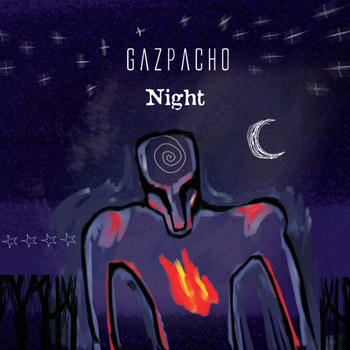
 [Progarchists, I published a version of this about six months ago, but I’ve revised it significantly since then. I’m also very much desirous of celebrating the re-release and bettering of a must-own (YES, a MUST-OWN ALBUM) album, “Night.” I honestly didn’t think this album could get any better. And, just to be clear, I rank it somewhere in my top ten albums of all time.]
Little things that make up her life
Watching them pick winners with her standing by
She read a tired pamphlet by a fire-starting freak
Campbell’s ice cubes, the drinks are unique!
But everything is cool as long as you dare
To bend a few taboos, to sacrifice pawns
Pockets filling up with gold
From the shades of his soul
Lost in the panic that she typewrote
Of lightbulbs that burn out in rain
And he saw his wife to be in someone
But she couldn’t see and she never cared
How small is your life
Is it too small to notice?
–Gazpacho, “Valerie’s Friend” (2007)
Nearly six years ago, I finally listened to a band I’d avoided for over half of a decade. Having been a part of various prog newsgroups (the “National Midnight Star” was the greatest of these in the 1990s), news feeds, and websites for the entirety of my adult life, I’d come across the name of Gazpacho numerous times, and the mention was always in a positive context.
For reasons which now elude me, I kept putting off purchasing one of their cds. I even consider their original patrons, Marillion, one of my favorite bands, and I have for nearly two decades now.
Still, even the praise and promotion of Gazpacho by Marillion didn’t convince me. From my poor memory, I was a bit turned off by the name, and I’d assumed they were merely a Marillion cover band and tribute band. “Gazpacho” is the name of one of Marillion’s songs from their album, “Afraid of Sunlight” (1995).
Then, almost half a decade ago, a friend I trust explicitly told me I had (yes, HAD) to listen to the latest album, “Night,” a single 53-minute song broken into five parts. It’s as much a suite as it is a song.
Well, I’m certainly a huge fan of concept albums and albums without any breaks in the music. To me, if something is worth saying, it generally takes much longer than the traditional 3-minute pop song allows. As I posted here recently, the only real flaw in The Cure’s 1989 “Disintegration” is the few seconds of silence between songs.
But, 53 minutes?
Was this too good to be true? Seemingly so. This would be akin to complaining to Costco that their 56lbs. (yes, I exaggerate. I think it’s 5 lbs., 6 ounces–but it’s huge and glorious!) of M&Ms for $8 isn’t enough.
Asking for more would just be sheer decadence and would probably require a quick jog down to the confessional at church.
With the prompting of my friend and my eagerness to hear a 53-minute song, I purchased “Night.” To say this changed my life would be too much. To say it reshaped my taste in music and set my listening standards to a new level would not be an exaggeration in the least. I was just on the verge of discovering Big Big Train at the moment I first listened to “Night,” and I think Gazpacho raised my understanding of what’s possible in music to a very high height.
“Night” is, to my thinking, a proper successor to Talk Talk’s “Spirit of Eden.” Musically, there are certainly similarities, and I’d be rather shocked to learn that the shadow of Mark Hollis, Tim-Friese-Greene, and Phill Brown did not over over the work of Gazpacho. Indeed, Talk Talk seems much more of a direct influence than does Marillion despite the name of the band.
“Night” has been in constant listening rotation now for as long as I’ve owned it, and I’ve never once gotten tired of it or felt I’d actually reached and understood it in all of its depth and breadth. As I’m listening to it now, writing this review, it’s almost as fresh to me as it was on the first listen or whatever number of listens yesterday’s was.
[I’m revising this article (November 21, 2012), which I first wrote about six months ago. As I’m revising, I’m listening to it yet again–it’s just stunning. So stunning, in fact, that heart is actually skipping a few beats. No, unlike with the 56 lbs. bag of M&Ms mentioned above, I’m not exaggerating.]
“Night,” for me, ranks up with the greatest post-classical albums of all time. Indeed, it’s in a league with “Close to the Edge,” “Selling England by the Pound,” “Grace Under Pressure,” “Hounds of Love,” “Ocean Rain,” “Skylarking,” “Spirit of Eden,” “Disintegration,” “Brave,” and “The Underfall Yard.”
From the first listen of “Night,” I was hooked. The piano, the violin, the voice, the bass, the drums, the guitar–everything just fits, and it does so beautifully. It also does so as an organic whole, one note and one idea leading mysteriously, yet perfectly, to the next.
I knew fully well upon the first few moments of listening to “Night” that I would have to become a Gazpacho completist. My prediction has come true, and I rather proudly own their seven studio cds and two live ones.
Rare for me, I even purchased the new re-release of “Night” from Kscope, despite already owning the original. The new version comes with new artwork and typically beautiful Kscope packaging, but it also has new drums, a few new parts, and three of the five parts of “Night” recorded life.
And, did I mention the lyrics? These guys know how to write, and they know how to integrate the lyrics with the music and the music with the lyrics into something profoundly and seamlessly whole and good.
Despite its brilliant intensity, the album seems to come to a fitting denouement at around forty minutes into it, when Jan-Henrik Ohme sings one of the best and most haunting lines in all of rock music: “St. John got gunned down with a cold 38.” My mind reels every time I hear this. Am I in Norway, on the island of Patmos, or in some twilight realm of progressive/art rock bliss?
And, so, I’ve concluded, listening to a Gazpacho album is akin to every poetic description of purgatory I’ve ever encountered. It’s not the perfection of heaven, but it’s also not the twilight and long defeat of this earth, or, in any way, the pains of hell.
A Gazpacho album is purgatory in the best sense: a journey toward perfection, offering brief glimpses of the most beautiful things possible, reaching for that which the Platonic Celestial King reached: the Good, the True, and the Beautiful.
For those of you have had the blessing of reading Dante’s Divine Comedy, you know exactly what I mean. No scene in literature touches me as much as Dante realizing he has escaped the Inferno and found himself staring at the stars of Purgatory. Listening to this album is akin to this.
The touch of its hand is memory
A kiss to lead the blind
In water I hear slamming of doors
St.Christopher beneath the rocks
An empty dream of summer fields of daisies
Perfect endings
–Gazpacho, “River” (2010)
Gazpacho-esque Eddas
Despite the name, Gazpacho hails from the glorious northern Kingdom of Norway, home of many, many good and meaningful things, including one of the finest writers to ever grace this earth, Sigrid Undset, and one of the kings who actually gives monarchy a fine name, the courageous Haakon VII.
Oh, and let’s not forget, some of the best stories (the Sagas and myths) ever written come from this land as well.
Sadly, I’ve only visited once, and that was way back in 1988. Still, the memories of the intense and stark beauty of the Norwegian landscape inspire me to this day, and I happily keep a map of Scandinavia (dated 1815) framed above my desk as a reminder of what wonders can exist in creation. Could I travel anywhere in the world at the moment, my first choice would be Norway and Sweden.
Interestingly, though we always associate the word with the Scandinavian mythic tradition, “Edda” is one of the most debated words in the history of Europe. No one is exactly sure of its etymology, but it’s generally agreed that it means “a soulful utterance” and is applied almost exclusively to northern myth. Whatever its history, it’s a stunning word, and the peoples of northern Europe (as the great English author and scholar, J.R.R. Tolkien, knew well) should be proud of it as an immense part of their cultural traditions.
Indeed, northern mythology is every bit as interesting, as complicated, and as developed as classical Mediterranean mythology. There are, understandably, similarities between the two polytheistic systems, but there’s a nobility and a will found in northern myth that is missing in the much more rationalistic and abstract realm of classical myth.
Whether the members of Gazpacho have intentionally embraced this northern Eddic tradition or not, it certainly seems to be in their very blood.
Formed in 1996 by Jon-Arne Vilbo, Thomas Anderson, and Jan-Henrick Ohme, Gazpacho has now released seven studio albums (recently adopted by Kscope Records) and two live releases. The seven studio: Bravo (2003); When Earth Lets Go (2004); Firebird (2005); Night (2007); Tick Tock (2009); Miss Antropos (2010); and March of Ghosts (2012). Each release is a delight, and while I find myself drawn back to “Night” more than the others, this is no small praise, and I find myself liking everything these men have produced.
Broken glass
The plan has failed
The silence knows
A man of faith
Everything that he knows, what a layman will do for diamonds
Fell on his knees gave in to sad overload
And all of the survivors shamed in the trench
Scrape up what’s left of his soul
Of his soul, of his soul
–Gazpacho, “Tick Tock” (2009)
Daughter of Night or of Zeus: Either way, mischief.
While the albums prior to “Night” are certainly artful and progressive, they are not part of a greater concept.
After “Night”, though, Gazpacho has produced three concept albums, each as progressive as progressive can possibly get. “Tick Tock” (2009) follows the story of a downed French pilot, trying to make it safety back to civilization in 1935. A number of separate stories comprise Gazpacho’s latest album, this year’s “March of Ghosts.” In a sense, at least thematically, this album best represents the very purgatorial idea of Gazpacho, literally following the souls of a variety of those who have passed from this existence.
Rather humorously (yes, I laughed for probably ten minutes solid), the lead singer describes his own theological beliefs on his Facebook page as “Frisbeetarianism”–the belief first proposed by comedian George Carlin that at death, the soul “goes upon a roof and gets stuck.” Admittedly, I’m a Roman Catholic. A pretty bad one, frankly. But, I love the idea of Frisbeetarianism.
With “March of Ghosts,” however, the restlessness of souls pervades the album. I live across the street from a very large nineteenth-century graveyard, and, in ways I could never describe, “March of Ghosts” fits perfectly with the sense one gets walking around the cemetery at any time of the day or night. There are haunted and restless feelings present, but there’s also a calm that really can be found no where else but in a cemetery and, maybe, on a Gazpacho album.
As much as I love the driving qualities of “Tick Tock” and the pervasive certain uncertainties of “March of Ghosts,” I find their 2010 album, “Missa Atropos” the most interesting and most daring of their post-“Night’ concept albums.
The story of Gazpacho’s “Missa Atropos” is exactly what the title states: a Mass written for one of the three Fates. Little recorded remains of her. A quick glance at Hesiod’s Theogony reveals only a conflicting story. In the same work, Hesiod claims that she is one of the seven children of Zeus and Themis, the god’s second wife (Lines 901-906), as well as the offspring (alone; no father) of the horrific Night (Lines 217-219). In each version, however, Hesiod recorded that the Fates determined what good and what evil should be given to every man.
The protagonist of Gazpacho’s story, however, struggles to accomplish the writing and completion of a Mass. To write it, he disappears into the solitude of a light house. The conflicting ironies in Gazpacho’s story are simply brilliant. A “Mass” is meant to be a communal celebration, and a lighthouse is meant to aid those who cannot see clearly. Here, a man turns away from the world in a project to connect this world to the next, thus bridging the horizon with the heavens. By residing in a light house, he also guides the desperate to a safe haven, a port, thus bridging chaos and order. But, he also writes a Mass to appease the Fate–who, by definition, should be unappeasable–and thus bridges determinism with free will.
Struck down in the middle of
a little life
Star spangled by the wayside
As the trains roll by
Mercy, what can you do?
Try to be a saint?
Leaving cannot heal you
First try it with a kiss.
–Gazpacho, “Black Lily” (2012)
Summa Gazpacho-ia
If you’ve had the opportunity to listen to the beauty that is Gazpacho’s music, none of the above matters much–you already know exactly what I’m trying to write, and probably in a better fashion that I can communicate.
If you’ve not had the opportunity to listen to Gazpacho’s music, well, I’m incredibly jealous. I’d give a lot to be able to listen to them again for the first time–it would be an experience akin to reading Eliot’s “Four Quartets” or Tolkien’s Lord of the Rings for the first time, again.
Those first times are intensely precious.
Yet, as with Eliot and Tolkien, each new listen of Gazpacho reveals even more depth and more width and more breadth. As with Eliot and Tolkien, I’m sure I’ve not comprehended it all yet, not matter how many times I’ve heard or read.
I’ve yet to hear a note or a lyric by Gazpacho that is out of place. While everything they do is unpredictable, it’s never chaos; it’s always justice and harmony–but arrived at through the most artful of ways.
So, yes, Gazpacho’s music is brilliant, stunning, shattering, and healing. It is, truly, in the most Dante-esque sense, purgatorial, a purging of our imperfections through fire, and a reaching, searching journey toward all that is perfect.
After Summa
Please take my advice. This is a MUST OWN (yes, I’m shouting at you!) album. In the U.S., Amazon.com has it for $4.95! What in the world? Well, take advantage of it. I can’t be held responsible for what happens after. If you have any love of music–and how would you have made it through nearly 2,500 words if you didn’t???–you will end up purchasing all of Gazpacho’s releases. Along with Big Big Train Matt Stevens, and The Reasoning, these are the absolute leaders of the new movement and embracing of progressive rock.
The official Gazpacho website is here.


 Just in case you missed any of this, we had yet another brilliant week at Progarchy. Dr. Nick and Alison Henderson reviewed the new Steve Hackett album, Genesis Revisited II (Insideout). Tad Wert posted about guitarist Michael Hedges. Chris Morrissey reviewed (briefly) one of his favorite albums of the year, the debut album from Flying Colors, and he posted about the excellence of Mike Portnoy. I had the great privilege of interviewing Blake McQueen of Coralspin. Ian Greatorex (doesn’t everyone want an ubercool last name such as Greatorex?) looked at the past of Beardfish. Roger O’Donnell remembered his time recording Disintegration with The Cure. Jazz legend, Dave Brubeck, passed away, the day before turning 92. Carl Olson offered a nice review of his career. Finally, our Englishman, turned-Kiwi, Russell Clarke, explained why Big Big Train allows him to remember, fondly, his homeland.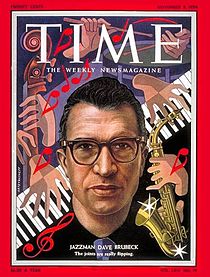


 Progarchy