Grateful for my beloved wife, son, daughter-in-law, grandchildren and siblings. Also a lover of theology, music, history, philosophy, classic novels, science fiction, fantasy and Looney Tunes.
To my astonishment, this appears to be the first Mastodon album reviewed on this website. How can this be? After all, this is a band that not only seasons their exceptionally math-y thrash metal with delectable flavors of sludge, stoner rock, prog and even hints of country. This is a band who came to my attention on David Letterman with the lead track from 2009’s Crack the Skye, an album-long narrative arguing the case for astral projection’s secret influence on the Russian Revolution. (And it wasn’t their first concept album, either — that was 2004’s Leviathan, based on — what else? — Herman Melville’s Moby Dick.)
After this — plus no-holds-barred follow-ups like 2011’s The Hunter and 2014’s Cthulvian Once More Round the Sun — I can’t help but ask again, where’s the love for Mastodon from Progarchy been all this time?
It’s not too late to hop on the bandwagon, though; Mastodon’s smoking new double disc effort, Hushed and Grim, is here to melt our minds and set our heads banging. Every single one of the fifteen tunes offer has at least two (and sometimes three) killer riffs pounded out by Brent Hinds and Bill Kelliher on guitar and Troy Sanders on bass, with Brann Dailor adding multiple layers of mayhem on drums. Sounds like a potentially stagnant formula on the surface, but given that the Atlanta-based quartet can spin on a dime through multiple textures, tempos, and time signatures in the course of a single song, the approach never fails.
And you never know what ear candy may show up in the midst of the prevailing heaviness — there’s the finger-pickin’ Americana intro to “The Beast,” the impeccable synthesizer solo on “Skeletons of Splendor,” the dream pop verses of the otherwise grunged-up “Had It All.” Hinds digs deep for his full-tilt solos, with a Southern-fried touch of Duane Allman peaking through every so often; Dailor’s playing calls to mind an alternate-universe Keith Moon playing with Jimmy Page instead of Pete Townsend. And the combined vocals (Sanders, Hinds and Dallor split the leads, with Kelliher as a harmony voice) provide kaleidoscopic colors to match the range of the music, from heavenly harmonies complementing 12-string textures to raucous, full-throated bellows over odd-time gallops. Producer David Bottrill (whose other credits include King Crimson and Tool) pulls all the elements of this sonic maelstrom together; the end product is marvelously stylish, delightful to listen to even as it knocks you flat.
But the music, as cool as it is, isn’t hanging out there on its own; the lyrics have a pungent bite as well. Mastodon are on a mission here, paying tribute to long time friend and manager Nick John, who died in 2018. Is the narrative here, kicking off with the vicious opener “Pain With An Anchor” and concluding with the epic “Gigantum,” a journey through the stages of grief? A depiction of dying from the inside out? Or yet another meditation on existence and mortality (for which I’ve proved a sucker time and again in the age of COVID-19)? Your mileage may vary with your interpretation — but boy, do Sanders, Hinds, Dallor and Kelliher bring the goods. The rage of “Sickle and Peace,” the devastated sorrow of “Teardrinker,” the desperate struggle of “Pushing the Tides” — all of it hits home. If you’re not cathartically drained after a listen to Hushed and Grim, you haven’t been paying attention.
As I think I’ve mentioned before, I’m not a big prog-metal head — but when it’s prog-metal as good as Mastodon, I surrender willingly. Check out Hushed and Grim for yourself below — and definitely catch them live if they come to your town! (I did back in 2015, and my ears might still be ringing.)
Glass Hammer, Skallagrim – Into the Breach: Fred Schendel, Steve Babb and company return with the second installment of their multi-part “sword and sorcery” epic, begun on 2020’s Dreaming City. The music rocks hard and heavy, evoking everyone from Deep Purple to Mastodon (and yes, a fair amount of Rush), with just enough moody, ambient keyboard work to cleanse your aural palate before the next round of crunchy power chords. All this marvelously matches the grimdark vibe of the titular hero’s melodramatic quest for his lost love. (And a surprise lyrical callback to an earlier GH album sets up tantalizing possibilities regarding just who that lost love is.) To top it all off, new vocalist Hannah Pryor proves a major discovery, surfing Schendel and Babb’s gargantuan riffs with zest, grace and power to spare. Every bit as involving as Dreaming City, this fine album is a blast in every sense of the term. Order signed CDs, downloads and merch direct from Glass Hammer’s webstore.
Steve Hackett, Surrender of Silence: enter one legendary guitarist, shredding! Hackett lets himself off the leash here, laying down both his wildest compositions and his most hardcore playing in quite some time. The tunes can actually be a bit undercooked, their influences not always fully assimilated (‘Hmm, Prokofiev . . . wait, Brubeck’s “Blue Rondo A La Turk”!?! . . . good grief, is that lick really “Theme from Exodus”???’). Nonetheless, Hackett’s swashbuckling solos atop Roger King’s widescreen orchestrations are irresistible as always; he and wife Jo serve up fresh sonic travelogues such as “Wingbeats” and “Shanghai to Samarkand”; and full-on burners like “Relaxation Music for Sharks” and “The Devil’s Cathedral” (featuring Hackett’s full band, including Nad Sylvan on vocals) never fail to thrill. Perhaps it’s not up to the towering heights ofAt the Edge of Light and Under A Mediterranean Sky, but Hackett’s latest is well worth your while. Order signed albums (CD, CD+BluRay combo, LP or LP+CD combo) direct from his webstore.
Isildur’s Bane& Peter Hammill, In Disequilbrium: Mats Johansen’s expandable international ensemble (including King Crimson’s Pat Mastelotto on drums this time) reconnects with Van der Graaf Generator visionary Hammill; two sprawling multi-movement suites result. The three-part title piece careens between hard-driving rock, off-kilter electronica, spastic percussion interludes and haunting chamber textures, as Hammill decries a post-pandemic world that was already primed for chaos. (“There’s no choreography, dance the Tarantella./In disequilibrium round and round forever we’ll go.”) In the four-part “Gently (Step by Step)”, Hammill supplies winningly vulnerable encouragement to face whatever the future holds; the band drapes his incantatory vocals in dizzying sonic collages that somehow always sound forlorn, no matter the timbre or tempo at a particular moment. This one definitely requires multiple plays to unfold its secrets, but it’s well worth the effort; the way IB’s devastatingly precise, multilayered processes track with the unpredictable contours of Hammill’s apocalyptic meditations must be heard to be believed. Order CDs and LPs (plus previous collaborations with Hammill and Marillion’s Steve Hogarth)at Burning Shed’s Isildur’s Bane store.
Tillison Reingold Tiranti, Allium – Una Storia: Perhaps Andy Tillison’s most light-hearted effort ever. Back in 1976, a teenage Tillison encountered (and sat in with) the obscure Albanian prog group of the album’s title at an Italian holiday camp — and it changed his life for the better. This lockdown-inspired “homage to a band whose day never came” easily goes beyond a mere tribute to Seventies Europrog, capturing the sheer joy and the heady freedom both Allium and the fledgling Tillison must have felt in those moments. Collaborating with Jonas Reingold (bass and guitars), Roberto Tiranti (vocals) and Antonio DeSarno (Italian lyrics), Tillison contributes some of his best, boldest keyboard work ever on three long, appealingly involved, frequently funky tracks — and plays all the drums! And you get both Tillison’s “Original Mix” (effortlessly conjuring up the period — I was roughly his age at the time) and Reingold’s “Respectful Remix” (which, bourgeois Philistine that I now am, I actually prefer). If you’re interesting in hearing the Tangent’s mainman just having fun, this is your ticket. Order CDs from Reingold Records.
Yes, The Quest: I’d argue that Yes, in any formation, hasn’t made an essential album since 90125. I’d also argue that, when Geoff Downes’ keys and Steve Howe’s sublime guitar really lock together, as on the opening “The Ice Bridge”, the results sound more like upper-mid-level Asia than the band they’re supposed to be in here. But if Yes fans can get past these discontents (as well as the numerous others they’ve accumulated over the decades), they may enjoy The Quest’s estimable (though not overwhelming) charms. Singer Jon Davison brings the requisite lyrical themes of self-actualization and environmental issues to the party; Billy Sherwood does his manful best to channel the spirit of Chris Squire on bass and vocals; and in the studio Alan White can still summon his classic drive, if not the power he had in his prime. The FAMES Orchestra add a dash of Time and A Word/Symphonic Tour luxury to the proceedings as well. While everything’s downshifted multiple gears from Yes’ most rambunctious, energetic — and it has to be said, creative — years this is an unquestionable step up from the appallingly bland Heaven and Earth, with its own modest appeal. I can see a track or two from this fitting nicely into the setlist when Yes finally can bring their long-promised Relayer tour to the Western Hemisphere. Order the album (in CDs, red LPs + CDs, CDs + BluRay combo, and CDs+LPs+BluRay deluxe boxset formats) from Burning Shed.
Collaborating as Three Colours Dark, vocalist Rachel Cohen and keyboardist/guitarist Jonathan Edwards made one of my favorite albums of last year. The Science of Goodbye remains a subtle, broodingly elegant debut, spinning a harrowing narrative of escape from both a toxic relationship and inner captivity. TCD’s welcome follow-up, Love’s Lost Property, doesn’t hesitate to ask the obvious questions: what now? How to deal with lingering pain? How to move forward? And in what direction?
The opener/title track sets up the premise. Standing with a ex-lover in the rubble of their broken relationship, Cohen wonders whether things could be different: “Versions of us/Love’s lost property is now in safer hands/Laws of motion proved/Let the light in, let the light in.” Kicking off with bittersweet lines from violinist Kate Ronconi and featuring stinging guitar solos from Tim Hammill and Dave Gregory, “Love’s Lost Property” looks back on the road taken and the damage done in a deliberate, leisurely unrolling musical arc.
“Dark Before Dawn” kicks into an uptempo, acoustic-driven shuffle, complete with countrified Gregory solo work and supple vocal harmonies, as Cohen encourages herself to move on, though the way is still uncertain. Pulled up short by the bitter memories of “Requiem” (beautifully cradled in a soundscape featuring Edwards on piano, Catherine Tanner-Williams on oboe and Andrew Coughlan on double bass), Cohen elegizes love lost in the soaring chorus of “Last Day on Earth” — then pivots to the reluctant but adamant kiss-offs “Wish I Wished You Well” (with more standout violin work) and “The Circus” (a masterclass in the art of the endless Floydian build-up).
As on The Science of Goodbye, it’s a cover that snaps Love’s Lost Property into sharp focus — in this instance, Duran Duran’s “Ordinary World.” Resplendent with Gregory’s 12-string and Ronconi’s lead work, it’s elevated by Cohen’s steely determination as she bites into the chorus (“But I won’t cry for yesterday/There’s an ordinary world somehow I have to find/And as I try to make my way to the ordinary world/I will learn to survive”) then soars into vocalese over violin licks. Then Gregory takes the whole thing even higher, and Edwards caps it off with a lyrical synth solo as the track fades. Whew!
Her journey’s path set, Cohen can move on at last in the emotional tour de force “Eye for An Eye.” Accepting herself, her former partner, the pain given and caused, and all the consequences, her vocals constantly grow in power and focus, feeding off and setting up Steve Simmons’ emotive saxophone work, Edwards’ cinematic synths backing and a wrenching Hammill solo. The whole thing builds to a shattering climax — then gracefully collapses into a “Reprise” of the title track, a perfect bookend to the album.
The shock of the new may have worn off for fans of Three Colours Dark, but the deep emotional content and musical gravity of this second effort are more than adequate compensation; Love’s Lost Property is another marvelously coherent song cycle that gets stronger as it unfolds. Cohen, Edwards and friends get full marks for their vivid, heartfelt portrayal of the comforting, wounding, uniting, dividing magnificence and terror of fallible love in a fallen world.
As previously promised, a look at the big reissues landing in the next few months — especially those available in one or more box set formats. Ordering links are embedded in the artist/title listings below.
Out Now:
The Beach Boys, Feel Flows – TheSunflower and Surf’s Up Sessions, 1969-1971: between their initial impact and their imperial phase as timeless purveyors of fun fun fun, Brian Wilson and his family pursued heaviness and relevance in a market that thought it had outgrown them — at least for the moment. This slice of the Boys’ catalog features less slick, more homespun takes on their timeless concerns (the same amount of girls, less cars, more daily life), with Wilson brothers Dennis (on Sunflower) and Carl (on Surf’s Up) taking the lead. The brilliant moments — “This Whole World,” “Forever,” “Long Promised Road,” “Til I Die” for starters — outweigh the embarrassingly dated ones, and music to make you smile is never too long in coming. Available from The Beach Boys’ webstore as 2 CDs, 5 CDs, 2 LPs or 4 LPs (colored vinyl).
BeBop Deluxe, Live in the Air Age:when Bill Nelson’s avant-glam guitar heroics didn’t generate bigger record sales, a live album was the next obvious move for this sterling British quartet. Better chart positions weren’t forthcoming, but 1977’s Live in the Air Age is an exquisite slab of BBD at work — Chuck Berry updated for the Apollo era, with a bit of Bowie/Mercury panache in Nelson’s vocals and blazing solos aplenty. Available from Esoteric Recordings as 3 CDs (adding the complete 1977 London concert) or 15 CDs/1 DVD (adding all surviving recordings from the 1977 British tour and a live television special).
George Harrison, All Things Must Pass: the quiet Beatle exploded on his first album after the Fabs’ breakup, immersing his radiant devotional compositions in Phil Spector’s patented Wall of Sound and drafting Ringo, Badfinger and the embryonic Derek and the Dominoes as his rock orchestra. The new remix scales back the symphonic swirl, brings forward George’s vocals, and gives the rhythm section a kick in the pants; just right to these ears. A serious contender for the single best solo Beatle album, well worth an immersion course. Available from the Harrison webstore in Standard (2 CDs or 3 LPs — limited colored vinyl available as well), Deluxe (3 CDs or 5 LPs), Super Deluxe (5 CDs/BluRay or 8 LPs) and Uber Deluxe (5 CDs/BluRay/8 LPs/various bespoke gimcracks/”artisan wooden crate” — you don’t wanna know what it costs) editions.
The Elements of King Crimson – 2021 Tour Box: the 7th annual compilation of tidbits from the Discipline Global Mobile archives, doubling as a concert program. This year’s selection of rarities focuses on the nine drummers that have called King Crimson their musical home (sometimes two or three of them at once). Studio snippets – like the one with Fripp, John Wetton on bass and Phil Collins on drums – live tracks, oddities, previews of coming attractions, and more. Available from Burning Shed or on Crimson’s current USA tour.
Lee Morgan, The Complete Live at the Lighthouse: never a mass media superstar, Morgan was nonetheless a jazz icon — one of the finest trumpeters of his day who played with heroes of the music like Art Blakey and John Coltrane, recorded more than 20 albums as a leader for Blue Note Records, and even managed to score a Top 25 pop hit with his funky “The Sidewinder.” This box (another product of jazz archivist Zev Feldman’s boundless energy) sets forth an entire weekend’s worth of recordings by Morgan and his dedicated, powerful 1970 band. Bennie Maupin on reeds, Harold Mabern on piano, Jymie Merritt on bass and Mickey Roker on drums bring the sophisticated, challenging compositions and spirited solos and backing; Morgan takes it from there, lyrical and fiery in turn. This is a great potential entry point if you want to explore jazz as a newbie, and a serious desert island possiblility for those already into the music. Available from Blue Note’s webstore as 8 CDs or 12 LPs.
Clive Nolan and Rick Wakeman, Tales by Gaslight: keyboardists Nolan (Pendragon, Arena) and Wakeman (Yes, Strawbs) box up their out-of-print concept albums Jabberwocky (with dad Rick W. reciting Lewis Carroll’s nonsense verse) and The Hound of the Baskervilles, adding a bonus disc collecting rough drafts of a 3rd album based on Frankenstein. Separate booklets and art prints for each of the 3 CDs included. Theatrical as all get out, and surprisingly good fun if you’re in the mood for Victorian-flavored melodrama. Available from Burning Shed.
Marillion, Fugazi: the band’s 1984 album, perceived as a “sophomore slump” at the time, is much more than a bridge between the feral debut Script for A Jester’s Tear and the early masterwork Misplaced Childhood, with plenty of gripping moments to recommend it. A new remix by Andy Bradfield and Avril Mackintosh compensates handily for the production nightmares recounted in this deluxe edition’s copious notes. Also includes a complete live set from Montreal; the CD/BluRay version adds bonus tracks, documentaries, and a Swiss television concert. Out September 10; pre-order from Marillion’s webstore as 4 CDs/BluRay or 4 LPs.
Van der Graaf Generator, The Charisma Years, 1970-1978: VDGG may have shared the stage with Genesis in each band’s formative years, but they were a thoroughly different beast. Peter Hammill’s desperate existential narratives and the wigged out instrumental web woven by David Jackson, Hugh Banton and Guy Evans made for a unique, highly combustible chemistry — bonkers dystopian sci-fi narrative over free jazz one moment, raggedly soaring hymns to human potential the next. This 17 CD/3 BluRay set collects the band’s 8 studio albums from the Seventies, adding extensive BBC sessions, a live show from Paris, all surviving television appearances “and more.” Now available from Burning Shed; the four newly remastered albums in this box (H to He Who Am the Only One, Pawn Hearts, Godbluffand Still Life) are available as separate CD/DVD sets for those wanting a lower priced introduction to this underrated band’s indescribably stirring music.
October:
The Beatles, Let It Be: the Fab Four’s star-crossed attempt to return to their roots – recording live in front of movie cameras – ultimately became their first post-break-up release, drenched with Phil Spector’s orchestral overdubs to cover the rough spots. With a new 6-hour Peter Jackson documentary on the sessions hitting Disney Plus Thanksgiving weekend, Apple unleashes a fresh stereo remix (the 4th in the series that kicked off with Sgt. Pepper’s 50th anniversary). Super Deluxe versions also include 27 sessions tracks, a 4-track EP and a test mix of Get Back, the proposed original version of the album. Out October 15th; pre-order from the Fabs’ webstore in Standard (1 CD or 1 LP), Deluxe (2 CDs with selected bonus tracks) and Super Deluxe (4 CDs/1 BluRay or 4 LP/1 EP) editions. (The companion book of photos and transcribed conversations from the sessions, Get Back, is released on October 12.)
Emerson Lake and Palmer, Out of This World – Live (1970-1997): a compilation of key live shows in ELP’s history: their 1970 debut at the Isle of Wight Festival; a career peak show at the 1974 California Jam; the 1977 full-orchestra extravaganza at Montreal’s Olympic Stadium; 1992’s comeback concert at London’s Royal Albert Hall; and a previously unreleased 1997 show from Phoenix, Arizona. Out October 29; pre-order from ImportCDs as 7 CDs or 10 LPs.
Joni Mitchell, Archives , Volume 2 – The Reprise Years (1968-1971): more archival recordings from the early days of Mitchell’s recording career. Home and studio demos, outtakes, unreleased songs, her Carnegie Hall debut and much more — a complete acoustic set recorded by a enraptured Jimi Hendrix, anyone? Out October 29; pre-order from Mitchell’s webstore on 5 CDs or 10 LPs (4000 copies only), The Carnegie Hall concert is available separately on 3 LPs (black or white vinyl).
Pink Floyd, A Momentary Lapse of Reason (Remixed and Updated): the 2019 remix of Floyd’s post-Roger Waters comeback from the opulent The Later Years box, now available on its own. “Sounds less like the 1980s, more like classic Floyd” is the party line here. Out October 29; pre-order from Floyd’s webstore in 1 CD, CD/DVD, CD/BluRay or 2 LP formats.
November:
Genesis, The Last Domino? Yet another compilation of Genesis’ greatest hits, fan favorites and core album cuts, released just in time for their first US tour in 14 years. No real surprises in the track selection, but the blurbed promise of “new stereo mixes” of four Gabriel-era classics is intriguing. Out November 19; pre-order from Genesis’ webstore on 2 CDs or 4 LPs. (The UK version of this compilation, out September 17, sports a slightly different track list.)
Elvis Presley, Back in Nashville:the King’s final sessions in Music City, stripped of overdubs a la last year’s From Elvis in Nashville box, that yielded material for three years worth of albums. 82 tracks encompassing country/folk, pop, religious music and Christmas music. Out November 12; pre-order from the Presley webstore on 4 CDs or 2 LPs.
In the Works (release date forthcoming):
Robert Fripp, Exposures: another exhaustive (and potentially exhausting) set from Discipline Global Mobile. This one promises to cover Fripp’s “Drive to 1981,” including his guest-star-heavy solo debut Exposure, the ambient Frippertronics of God Save the Queen and Let the Power Fall, and the egghead dance music of Under Heavy Manners and The League of Gentlemen. Tons of live gigs promised to supplement rarities and studio outtakes.
Marillion, Holidays in Eden: the new Marillion album (now officially titled An Hour Before It’sDark) may push this further back on the release schedule, but Steve Hogarth’s second effort with the boys (an intriguing effort that tried and failed to go commercial) is next up for the deluxe reissue treatment.
Porcupine Tree, Deadwing:a promised deluxe set in the vein of 2020’s In Absentia. Internet gossip flared up when Steven Wilson, Steve Barbieri and Gavin Harrison were rumored to have reset the band’s legal partnership earlier this year; who knows how or when the Tree may blossom again?
Renaissance, Scheherezade and Other Stories: coming from Esoteric Recordings, the folk-prog quintet’s finest hour in the studio, melding orchestral grace with an Arabian Nights theme for the half-hour title track. If this is in the vein of other recent Renaissance issues, hope for a multi-disc set with a bonus live set and a surround remix.
Robert Fripp, resplendent with mohawk, at August 28th’s Royal Package presentation.
A studio album is a love letter. And I enjoy love letters, especially when they’re from my wife. But live music … (looking to the heavens with a sigh) I’ll always go for the clinches.
Robert Fripp, King Crimson Royal Package presentation
King Crimson, Meadow Brook Amphitheatre, Rochester Hills, Michigan, August 28, 2021
Following an opening set from The Zappa Band that showcased Frank Zappa’s lifelong trademarks — smug, satirical vignettes enfolded in gleefully virtuosic workouts — King Crimson went straight for the clinches. The rock (as in the opener “Pictures of A City” and “Radical Action II”) rocked hard; the metal (including “Larks’ Tongues in Aspic Part Two” and “Level Five”) was remorselessly heavy; the out there material (“Neurotica” and “Indiscipline,” played back to back) went waaaaay out there; the more intricate music (the opening multi-part drum trio, along with “Discipline,” a welcome surprise in the setlist) shone with both precision and passion.
Left to right: Mel Collins, Tony Levin, and Jakko Jakszyk groove on “Neurotica,” as Jeremy Stacey and Gavin Harrison wait to pounce. Photo by King Crimson manager David Singleton.Click here to access Singleton’s online diary for the show.
To be fair, the genres — along with the era a song may have come from — are never that clear cut with this Crimson, even within individual pieces. The mid-section of “Pictures of A City” saw Mel Collins pushing at the boundaries of tonality with his sax solo, egged on by Robert Fripp’s banjo-from-hell guitar chords. Tony Levin’s inventive bass lines on “The Court of the Crimson King,” “Red” and “Larks Two” honored the original work of Greg Lake and John Wetton while adding his own spin to spur on Collins and Fripp. And the drum battle that opens “Indiscipline” turned into a comedic cutting contest, as Pat Mastelotto, Jeremy Stacey and Gavin Harrison moved from flashing their chops to cracking up each other with their contributions. (Harrison’s deadpan disco snippet got the audience laughing too.) By treating everything as brand new, the band gracefully transcends the multiple eras in which these varied musics were birthed.
With a shorter setlist than recent tours and fewer surprise choices in the mix, what stood out for me this evening were the ballads — “The Court of the Crimson King,” “Islands,” “Epitaph” and “Starless”. Even the two guys sitting in back of me who talked through a good chunk of the show shut up for them! Vocalist/guitarist Jakko Jakszyk stood and delivered, drawing old emotions and new insights from the lyrics as he sang. And the ensemble coalesced around him with palpable intensity, cradling the vocals, then conjuring up the ironic circus of “Court,” the serene seascape of “Islands” (kudos to Stacey for his luscious piano work), the bleak cultural devastation of “Epitaph.” The endlessly mounting tension of “Starless” was, as always, a high point — melancholy and uplifting at the same time, grabbing for the audience’s heart as it built and cracking psyches wide open as the double time finale took flight. After that, what could be the encore but a slamming “21st Century Schizoid Man,” complete with Levin prodding Fripp and Collins to even greater extremes and a kit-spanning drum excursion by Harrison?
The band takes a bow following “Starless.” Photo by King Crimson manager David Singleton.
I make no secret of my admiration for King Crimson; Robert Fripp and his various co-conspirators have formed my ideal of the questing musician’s life and work since I stumbled into a Frippertronics record store show back in 1979. And I’ve never hesitated to sing the praises of the current Crimson incarnation; their 2017 and 2019 tours yielded two of the best rock concerts I’ve ever attended. So it moved me that, with the COVID-19 pandemic delaying this show for a year and throwing numerous obstacles in their path, Crimson could return to the States and provide another genuinely awe-inspiring evening for the thousands gathered in this Detroit-area amphitheatre. Never say never; but if (as Crimson’s management has stated) this may the final time the band plays North America, I’m convinced that we shall not see their like again.
What new music and archival finds are heading our way in the next couple of months? Check out the representative sampling of promised progressive goodies — along with a few other personal priorities — below. (Box sets based on reissues will follow in a separate article!) Pre-order links are embedded in the artist/title listings below.
Out now:
Amanda Lehmann, Innocence and Illusion:“a fusion of prog, rock, ballads, and elements of jazz-blues” from the British guitarist/vocalist best known as Steve Hackett’s recurring sidekick. Available direct from Lehmann’s webstore as CD or digital download.
Terence Blanchard featuring the E-Collective and the Turtle Island Quartet, Absence:trumpeter/film composer Blanchard dives into music both written and inspired by jazz legend Wayne Shorter. His E-Collective supplies cutting edge fusion grooves, and the Turtle Island String Quartet adds orchestral depth to the heady sonic concoctions. Available from Blue Note Records as CD or digital download.
The Neal Morse Band, Innocence and Danger: another double album from Neal, Mike Portnoy, Randy George, Bill Hubauer and Eric Gillette. No overarching concept this time — just everything and the kitchen sink, ranging from a cover of Simon and Garfunkel’s “Bridge Over Troubled Water” to brand-new half-hour epics. Available from Inside Out as 2CD, 2CD/DVD or 3 LPs/2 CDs
Trifecta, Fragments: what happens when Steven Wilson’s rhythm section turns his pre-show sound checks into “jazz club”? Short, sharp tracks that mix the undeniable chops and musicality of Adam Holzman on keys, Nick Beggs on Stick and Craig Blundell on drums with droll unpredictability and loopy titles like “Clean Up on Aisle Five” and “Pavlov’s Dog Killed Schrodinger’s Cat”. Available from Burning Shed as CD or LP (black or neon orange).
As life in these United States opens up, my life finally seems to be settling down — at least for the summer. Which means it’s time to make up for the backlog of excellent albums (new and old) that I’ve heard since January, but haven’t written about here! Links to listen (to complete albums or samples) are included whenever possible.
New Albums:The Art of Losing (The Anchoress’ rich meditation on endurance) and the multi-versionadrenalin rush of Transatlantic’sThe Absolute Universenotwithstanding, most of the new albums I’ve loved so far have migrated towards jazz and classical — frequently with pianists at their center. Vijay Iyer’s Uneasy, made with bassist Linda May Han Oh and drummer Tyshawn Sorey, is a state of the art piano trio effort; blues and abstraction suspended in perfect balance and caught in an intimate, tactile recording. Canadian Bach and Mozart specialist Angela Hewitt shows off her range with Love Songs, a gorgeous confection of orchestral and art song transcriptions assembled in lockdown and performed with undeniable panache. The same goes for Danny Driver’s phenomenal rendition of Gyorgy Ligeti’s hypermodern 18 Etudes — virtuoso pieces whose serene surfaces turn out to be rooted in super-knotty counterpoint and off-kilter rhythmic cells. My favorite new album of 2021 to date? Promises by electronica artist Floating Points, spiritual jazz saxophonist Pharoah Sanders, and The London Symphony Orchestra, which manages to bring all of the above (well, except for the piano!) together in one glorious, 40-minute ambient epic.
Reissues: Big Big Train’s double-disc update of The Underfall Yardhas definitely had its share of listening time, between Rob Aubrey’s rich remix/remaster and the welcome bonus disc (featuring fresh recordings of the title track and “Victorian Brickwork” by the full band and brass quintet). With My Bloody Valentine’s catalog back in print, their masterpiece Loveless sounds as incredible as ever; crushing distortion and lush romanticism collide to channel the sublime. And Pete Townshend has masterminded a comprehensive Super Deluxe edition of The Who Sell Out, the band’s pre-Tommy high point. But my favorite reissues thus far have been It Bites’ The Tall Ships (especially the title track — what a power ballad!) and Map of the Past (a favorite of mine since its original release). With the then-unknown John Mitchell taking over from Francis Dunnery, IB sailed into the 21st century with their 1980s pomp intact, killer hooks, head-spinning riffs and all.
From the Catalog: All the good new stuff above aside, this is where some of my most fruitful listening has been happening this year — frequently inspired by other media. Watching the movie One Night in Miami led me back to Sam Cooke’s Portrait of a Legend: 1951-1964; the resulting dive into soul music ultimately brought me to Marvin Gaye’s classic concept album What’s Going On — 50 years old in 2021! Perusing various “best of 2020” lists turned me on to the avant-garde jazz of trumpeter Ambrose Akinmusere’s on the tender spot of every calloused moment and Maria McKee’s art-pop song cycle La Vita Nuova (inspired by Dante, no less). Jazz/fusion legend Chick Corea’s death prompted a deep dive into his catalog; new favorites included Return to Forever’s Where Have I Known You Before and the fabulous Five Peace Band Live, Corea’s long-delayed collaboration with guitarist John McLaughlin. And after long years of the album doing nothing for me, Radiohead’s The Bends finally clicked when I read Steven Hyden’s fine band biography This Isn’t Happening. (Curt Bianchi’s wonderful new book, Elegant People: A History of the Band Weather Report, is prompting a similar deep dive into that quintessential jazz/rock band’s catalog; I highly recommend their cutting edge debut album from 1971 and their 1976 masterpiece of groove, Black Market.)
So, yeah, it’s taken a while — but at least from my point of view, 2021 has already been a solid year for music — and the prospects for it getting even better are looking up!
2020 was going to be Big Big Train’s breakout year in North America. Building on ten years of increasing momentum, the road first paved on 2009’s The Underfall Yard (singer David Longdon’s debut with the band) had led to five more thrilling albums, brought to life in concert by a fearsomely talented septet (and the BBT Brass Ensemble). It was official — that spring, Big Big Train would tour the United States for the first time!
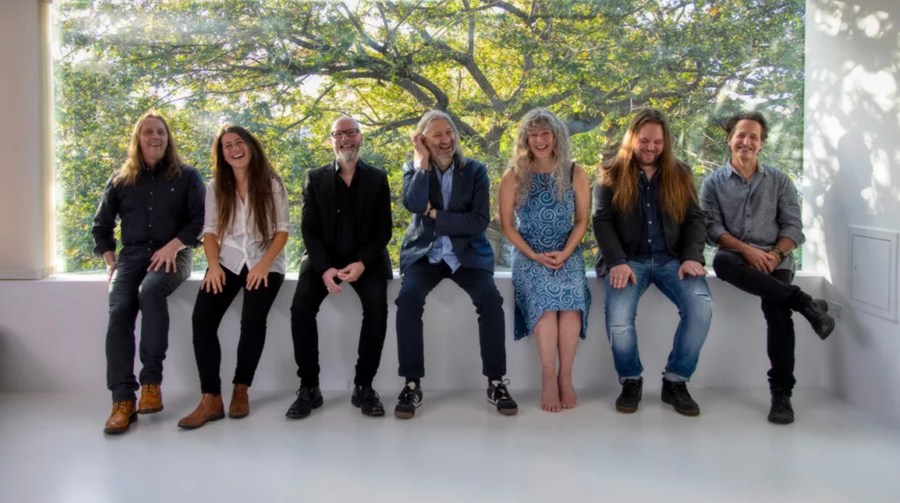
Then, as with so many other events, the coronavirus pandemic brought those big big plans to a screeching halt. Shows for 2020, then 2021 were inexorably cancelled; as the enforced period of inactivity lengthened, guitarist Dave Gregory, violinist Rachel Hall and keyboardist Danny Manners left the band. While the double album career survey Summer’s Lease and the live Empire served as worthy capstones to their era, BBT’s faithful Passengers couldn’t help but wonder: what was next for founder Greg Spawton, Longdon (both pictured above) and remaining compatriots Nick D’Virgilio and Rikard Sjöblom? Had the Train reached its final destination?
Fortunately, the answer was a resounding “Nope!” With Big Big Train’s brand new release Common Ground set for release at the end of July, followed by North American and UK tours in 2022, David Longdon was kind enough to join me for a Zoom chat last week. Obviously excited by both the new album and the prospect of returning to the stage, Longdon was generous with his time and his answers, open about the toll the pandemic took on him and his beloved country, and willing to “thrash through” the intricate lyrical and musical ideas on the record. A delightful mix of familiar and innovative elements, Common Ground is yet another BBT album of exceptional artistic ambition, power, beauty and grace, and David Longdon couldn’t be happier about it! A transcript of our conversation follows the video. Enjoy!!
So I wanted to start back last year, because the pandemic threw all of us into uncharted territory. One of the first impacts from our end, as a music fan, was that you cancelled your North American tour, Big Big Train’s first American tour. We had tickets for the Fort Wayne show, and we were disappointed, but we certainly understood.
But obviously, that enforced pause in playing live went on a lot longer. How did that feed into making your new album, Common Ground?
Well, everything ground to a halt, didn’t it? The world as we knew it just ground to a halt; the unthinkable happened! It’s such an extraordinary time. And it was very much like – I said so at the time — like living in like a Ray Bradbury book, or something like that. Or certainly a J.G. Ballard book, this apocalyptic times kind of thing. “It’s awful! Were we gonna make it through? Is this gonna be our equivalent of whatever saw off the dinosaurs?” That kind of stuff.
The news bulletins were horrendous. The death rates were going up, the R-rates in the UK, they’re looking at that. Each day the wave of fresh cases, and more worryingly, the rising death toll. It was going up and up and up and up. And of course, in the UK, we’d seen it coming over from Europe in the months leading to up to our first lockdown. And we knew what was coming, because we’d had correspondences from our European friends. Yeah, it’s the stuff of nightmares! Very uncertain times.
One of the things that I found as a comfort would be walking in nature, being in the natural world; I always take great comfort from that. I’d rather be outside than inside, particularly when things were starting to get a bit hairy, back in March last year for us. Yeah, it was horrendous!
So music, writing music and going for walks in nature were the thing that kind of kept me on the straight and narrow, really. It kept me sane. So that’s how I dealt with it. And through the first lockdown I was finishing off the record that I made with Judy Dyble [Between a Breath and a Breath].
I don’t see how what happened to the world in that time could have not had an impact on the record, really. And with losing three members of a long-standing lineup: again, some of that quite possibly came to a head as a result of being a real crossroads for the band and for the world at that time.
So yeah, the pandemic was a huge impact on the album. And the band. And the world. And everything!
OK. So you mentioned there were some changes thrust on you by circumstance – the band members leaving, for example. As you and Greg and the others started writing and recording. what changes were intentional choices?
OK. Well as I said to you, personally, from my writing point of view, rather than writing songs where in the past, something like “Ariel” I’d be researching The Tempest, I’d be researching the life of William Shakespeare. I’d be researching the life of Percy Bysshe Shelley, and collating lots of information to make the story and make it scan as a piece of music, I just felt like I needed to write in the real world, in the now of that time, if that makes sense.
I know that, inevitably songs like “The Strangest Times,” which is very directly about the pandemic, I know that will eventually be a time capsule of that period. But I can’t wait when it is! I’m looking forward to that being the case! I would say that in particular.
We are pleased to announce the dates for the re-scheduled 2021 King Crimson tour of the USA. This is also a good moment to publicly thank all those who have worked so hard to make this tour possible. The dates have changed on an almost daily basis over the last six months as rules and restrictions have changed.
The California Guitar Trio will be appearing as a special guest for the first leg of the tour. King Crimson will be accompanied by the Zappa Band for the whole of the second leg of the tour from 22nd August – 11th September, and also for the concerts in Concord and Los Angeles on 5th and 6th August.
There are currently Royal Package places available at all these concerts. The Royal Package gives priority seating at the front of the venue, early access, special merchandise, and personal insights and answers from David Singleton and one of the band members. Anyone with an existing place reserved last year, who now needs to move to a different venue or apply for a refund, should contact iona@dgmhq.com.
The Crimson Beast Of Terror has woken from its enforced slumbering and is venturing out to stomp flat the psyches of innocents not yet experienced in the hammering onslaught of King Crimson’s uncompromising pounding – bish! bish! bish! – before turning on a beat to jellify hearts with gut-wrenching passion and soul-squeezing epic unfoldings to remind us that we are all mere subjects in the unfolding drama of the universe’s unfathomable mysteries while simultaneously rocking out and having a great time bopping about with Tony and Bobby and Gavin and Jakko and Mel and Pat and Jezza too.
Tour dates are listed below; Royal Packages are available by clicking the appropriate link, and regular seats will go on sale soon. I look forward to entering the Court of the Crimson King for the 10th time on August 18 at Meadow Brook Amphitheater!
30th July 2021 sees the release of Common Ground, the self-produced new album from Big Big Train released on CD via their own label, English Electric Recordings, and on double LP in a gatefold sleeve via Plane Groovy. The album will also be available as a Bandcamp download and on all major streaming platforms.
Recorded during the worldwide pandemic in 2020, Common Ground sees the band continue their tradition of dramatic narratives but also tackles issues much closer to home, such as the Covid lockdowns, the separation of loved ones, the passage of time, deaths of people close to the band and the hope that springs from a new love.
Common Ground finds the band taking in wider musical and lyrical inspiration from artists such as Elbow, Pete Townshend, Tears For Fears, Elton John and XTC, as well as acknowledging their more progressive roots. As ever, Big Big Train will take listeners on a journey, be it waiting for the 5pm pandemic UK press conferences (The Strangest Times) to the library of Alexandria (Black With Ink) to the bottom of the ocean (Atlantic Cable).
Big Big Train has taken lyrical and musical inspiration from periods of history that are recognised as great leaps forward. Now with Common Ground, they are making such a surge themselves.
The title track is now available to stream at Spotify, Apple Music and YouTube:
Preorders for the Common Ground album and related swag are now available at:
The Common Ground tour will be Big Big Train’s most comprehensive set of shows to date and will conclude in the UK at the prestigious London Palladium.
For the UK tour Greg Spawton (bass, bass pedals), David Longdon (lead vocals, flute), Nick D’Virgilio (drums, vocals) and Rikard Sjöblom (guitars, keyboards, vocals) will be joined by Carly Bryant (keyboards, guitars, vocals), who contributes vocals to Common Ground, Dave Foster (guitars), who plays on two tracks on the new album, Clare Lindley (violin, vocals) and by a five piece brass ensemble led by Dave Desmond (trombone).
The band expects to announce North American tour dates shortly.
With all this in store after BBT was forced to cancel their 2020-21 touring, I could only think of the words of noted music critic, theologian and hobbit Sam Gamgee:
“Is everything sad going to come untrue? What’s happened to the world?”. . . “O great glory and splendor! And all my wishes have come true!”