Top 10 Albums of 2017 @asiageoff @NFO_official @schooltree @davekerzner @UnleashArchers @bigbigtrain @STYXtheBand @SonsOfApollo1 @HackettOfficial @StevenWilsonHQ

As a public service (to aid you in your early shopping efforts), here are my TOP 10 ALBUMS of 2017, with an extra two (by Big Big Train) added to the list, in order to round out the harsh edges of the traditional metric ranking system, making my list into the much friendlier imperial system’s dozen…

REVISED (January 2018): explanation here

Unforgettable Vinyl Gatefold Moments @rushtheband

Moments you will never forget… listening to Rush, A Farewell to Kings, for the first time.

Hometown homage: “I hate Winnipeg” @theweakerthans

Recent musings on commercial imperatives and hometown architecture:

“I hate Winnipeg,” sings the ironic refrain of the song One Great City! by Winnipeg indie band The Weakerthans.

In the last verse of the song, an “arcing wrecking ball” delivers the brutal sentiment on behalf of “our Golden Business Boy,” who “up above us all, leaning into sky,” tells a pious lie (“I love this town”) as he watches “the North End die.”

The lyrics refer to the statue gazing northward on the dome of the Manitoba Legislative Building. Popularly known as the Golden Boy, the “Eternal Youth” (his official name) surveys the architecture of Winnipeg.

In the poetic lyrics of The Weakerthans’ John K. Samson, the statue symbolizes the commercial imperatives of secular culture. Money and power rule the city, extracting profit from the weak.

The genius of the song consists in its many ironic contrasts between words and deeds. For example, money and power demolish the past, proclaiming love for “one great city” (on Winnipeg’s highway welcome signs) at the same time as they wreck it for further profit.

On the other hand, a humble artist writes a tune repeating, “I hate Winnipeg.” Yet with its wistful music and poignant storytelling, the song communicates his real love of home.

I feel how the example of sacred architecture, in the midst of a crude and rapacious secular culture, can instead cultivate for humans a real and lasting sense of home.

Without such beautiful architecture, utilitarian commercial interests will define the landscape of one’s hometown. The ugly skyline created by such cruel economic motivations contrasts ironically with real humans, whose nature will always seek to love the place where they live, just as The Weakerthans observe in their song:

And in the dollar store
The clerk is closing up
And counting loonies, trying not to say
I hate Winnipeg.

Concert Review: Heterotopia Live @schooltree

Lucky are the few to have seen the masterwork Heterotopia live!

Here’s an excerpt from an excellent review of Schooltree’s September 29th concert:

Ladies and gentlemen, I’m here to attest that Lainey Schooltree has chased that Holy Grail and brought it back to the land of the mortals in the form of [a] 100 minute epic called Heterotopia. She has kept her covenant with the ancient gods of progressive rock and delivered a work that deserves a place in the pantheon. After seeing Heterotopia in its embryonic state, I was especially excited to see how it translated in a proper live setting in its final form. Not only did it exceed my already high expectations, but I left having the sense that I had witnessed the launch of a significant work that demands to be judged on the global stage.

Decked out in goth chick glam, Schooltree herself seemed content to let Heterotopia speak for itself. And that’s exactly as it should be. While so many are eager to confer automatic legitimacy and priority to “womyn in rock” these days, Lainey Schooltree has simply thrown down a gauntlet of stone cold artistic achievement. Heterotopia is a musical monument that stands tall in the valley of its ancestors and demands to be judged alongside them. I may not have seen Yes, Pink Floyd and Genesis back in their heyday. But I did see Heterotopia at Oberon in 2017. As far as I’m concerned, that’s a perfectly comparable experience.

Heterotopia: Illustrated Libretto, 2nd edition CD @schooltree

The illustrated libretto book publication and the 2nd edition CD digipak are now both available for Schooltree’s incredible concept album, Heterotopia.

You can buy them online at schooltreemusic.com with Apple Pay (or pay by credit card). Don’t miss your chance to own this magnificent souvenir of one of 2017’s greatest artistic achievements!

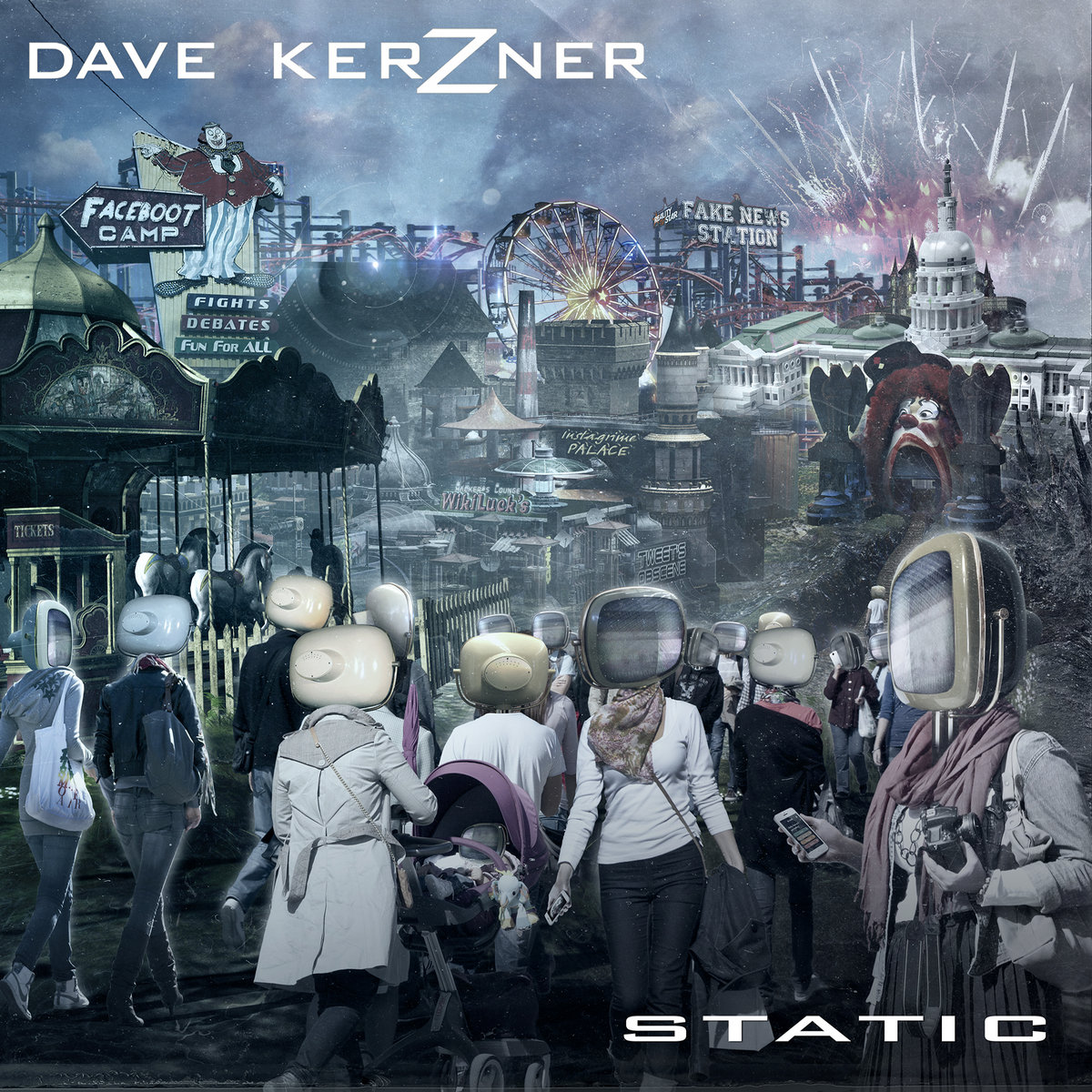
Album Review: Dave Kerzner, Static

Dave Kerzner is back! Static is his second full-length solo album. New World established his prog bona fides, with its sprawling sci-fi concept album deployment of Pink Floyd-esque music. On Static, Dave again deploys his uncanny ability to sound like David Gilmour, and there are even moments when he sounds like Roger Waters shrieking away.

But even though it’s easy to imagine if Pink Floyd were still making great albums today they would sound exactly like this, the amazing thing is that Dave is not a copycat. Although he has mastered vintage sounds — not just our favorite vocal stylings, but also the coolest keyboard sounds you will ever hear — he is not a purveyor of prog nostalgia.

The most remarkable thing about Kerzner’s impressive new album, Static, is Dave’s songwriting abilities. He has every detail perfected: melody, harmony, orchestration, developmental dynamics, and emotional impact. His excellent songs are truly a cut above the competition and they unmistakably show how true musical talent, shaped by all the best musical influences, can be put in the service of stunning original compositions. Above all, the song is the thing of note here.

Every track is outstanding, although the album really should be considered to be a ten-track opus. “Prelude” is nothing but a wispy introduction to the magnificent album-opening progfest, “Hypocrites,” which introduces a theme that will return at the end of the disc on the epic 16:52 finale, “The Carnival of Modern Life.” And “Quiet Storm” blends nicely into the rip-roaring “Dirty Soap Box,” where Steve Hackett and Nick D’Virgilio show up to set things ablaze. I also think that “Right Back to the Start” and “Statistic” are brief enough that they may be taken as two preludes joined to set up the superfunky “Millennium Man.” But however you do the math, whether ten or fourteen, the result is the same: the album is perfect prog pleasure, with incredible variety and richness.

Dave’s quieter piano ballads (like “Static” or “Trust”) best display the subtle charms of his sophisticated songwriting skills. And they don’t really deserve to be called “piano ballads,” because they never stay still in one genre for long, but rather slowly soar into another musical dimension. So much surprise and delight is offered by this album, I can’t recommend it highly enough. Trust me, you have many, many hours of listening pleasure ahead.

It’s hard to pick any track as a favorite, because they are all so good. But early loves of mine (in addition to the epic bookends of the album opener and closer) include “Reckless,” which has a jaw-dropping instrumental section that sounds like 1980s King Crimson, and “Chain Reaction,” which sounds to my ears like 100% Fun-era Matthew Sweet.

Dave Kerzner, Static
Progarchist Rating: A+   10/10   ★★★★★

Dave Kerzner – Lead & Backing Vocals, Keyboards, Guitar, Drums, Bass
Fernando Perdomo – Guitar, Bass, Drums, Backing Vocals
Derek Cintron – Drums
Randy McStine – Guitar & FX
Durga McBroom – Vocals
Lorelei McBroom – Vocals
Ruti Celli – Cello
Steve Hackett – Guitar on “Dirty Soap Box”
Nick D’Virgilio – Drums on “Dirty Soap Box”
Matt Dorsey – Bass on “Reckless”
Colin Edwin – Bass on “Static”
Ewa Karolina Lewowska – Vocals on “Static”
Alex Cromarty – Drums on “Chain Reaction”
Stuart Fletcher – Bass on “Chain Reaction”
Chris Johnson – Guitar on “Chain Reaction”

Produced by Dave Kerzner
Mixed by Dave Kerzner and Rob Aubrey
Mastered by Dave Kerzner

CD Cover and Booklet Artwork by Ed Unitsky
Artwork Concept by Dave Kerzner and Ed Unitsky
Graphic Design and Layout by Ed Unitsky


Nikki Stringfield, “Save Our Souls” @nikki_shreds

Nikki has released her second single of 2017. “Save Our Souls” can now be bought online from iTunes and Amazon. It is also available for viewing in its video version below. Rock on, Nikki!

HAIM: Valentine @HAIMtheband

This is a great rock ‘n’ roll movie.

Don’t believe me?

Watch it all the way through to the end…

A brilliant chronicle of the making of a brilliant album.

Weezer delivers song of the summer as next album preview

The White Album was a total triumph last year from Weezer, usually a hit-and-miss kind of band. It got me excited about what every-track-is-fantastic album they might come up with next.

And then when in March of this year I heard “Feels Like Summer” as an advance preview track from their next album, well, let’s just say I couldn’t even get past the 30-second clip. It sounded so annoying and dopey. (Sort of like the new Taylor Swift single, which is much worse.)

So imagine my surprise when this month Weezer released the second preview track, “Mexican Fender,” which is truly superb and everything you want in a rockin’ summer tidal wave of power chords.

The song is so good it even got me to give “Feels Like Summer” a second chance, and it turns out now I kind of like it. (It gets better as it progresses and more power chords get mixed into the contemporary sonic novelties.)

Maybe it’s because my own Stratocaster is a Mexican Fender, but I like the lyrics to the song a lot. Really clever and catchy, it’s a perfect song about summer love.

Note that the video (thankfully) has nothing to do with the lyrics and story of the actual song. But it is nonetheless kind of a hilarious cartoon that should get people listening to the song, by way of its amusing visual tale.

Better yet, turn up the music and close your eyes to do air guitar. Who needs video when you have such great audio? Either way, I think this is the song of the summer, perfect for those convertible top-down cruises by the bay. (But keep your eyes open while driving.)

As for album of the summer, my vote goes to Lana Del Rey’s Lust for Life, which finally ascends into perfect songwriting and delivers on the previously unfulfilled promise of all her earlier albums. Every track shimmers with transcendent moments. But that’s a topic for another post. Meanwhile, enjoy Weezer’s brilliant guitar sunsets…

What does eternity sound like? 16th-century PROG!

Prog goes back at least to the sixteenth century. Here’s proof:

From “Can Synthesized Music Touch Eternity?“:

The scholastics, typically dated from St. Thomas Aquinas in the late Middle Ages, believed in the unity of all truth. Not that all truth was knowable, but it is potentially integratable. Whatever was true in one discipline had also to be true in every other discipline; one truth, stretching infinitely vertical but also horizontally to infinite applications. Similarly, whatever was true in the course of time in this world is a reflection of a truth that God ordained to be so outside of time.

The model went as follows. There is the forward march of time, which is the world you and I know, experience, report on, and it is defined by struggle, triumph over nature, and a sad ending that comes with mortality, dust to dust.  On the other side of life, there is new life in a complete world that lives outside of time, birth, and death. It is the transcendent realm, a kind of place where we can live at one with God and in full knowledge of all that is true. This was Heaven.

This model implies a certain well-known geography, which is metaphorical but aids in understanding. Time is what you experience in life. Heaven is ascendant and transcendent. It is a realm somewhere up there that is out of time. And of course there is also Purgatory (which exists within time but is only known after death) as well as Hell, the eternal foil to paradise.

The highest goal of life on earth – and this goes for art, liturgy, learning, technology, science, commerce – was to reach outside of time and touch (or see or feel) that heavenly realm. Doing so, it was believed, would inspire us toward better lives because it would fire the imagination toward the goal of all our mental and spiritual actions, to love God and others ever more perfectly. Also, it’s psychologically and spiritually awesome to gain a glimpse of God or even to touch the Presence.

Eternity to Taste and Hear

This sensibility is embodied in Eucharistic theology, in which the faithful are granted the privilege of literally consuming the body of Christ. It is a way for time to touch eternity in the most tangible possible way, literally draw on the transcendent as a source of life and salvation. The art created in light of this sensibility was structured to achieve this very Eucharistic effect, to create visuals and sound that permit us some slight hint of access to the eternal.

What does eternity sound like? This was the task of the 16th-century masters to discover. And this task – which is not so much didactic as experiential – inspired vast creativity all over England and the Continent. There was Victoria in Spain, Tallis in England, Josquin in France, Palestrina in Italy, Di Lasso in the Netherlands, Isaac in Germany, and literally thousands of other musicians who contributed to the task. And their legacies are remarkable. Their music can still today transport your mind to another realm, exactly as the Scholastic model suggests.