Feeling The Noise: Homage to Lou Reed

At the Théâtre des Champs-Élysées in Paris, on the 28th of May in 1913, there was what many have characterized as a near-riot. The hostile and even violent reactions from the audience in the theater were in response to the premier of what was presented as a piece of music, but was perceived by quite a few in attendance as noise.  That it was presented as music was, in the estimation of a significant number of witnesses at the time, a joke at best, and completely tasteless and deeply offensive at worst.
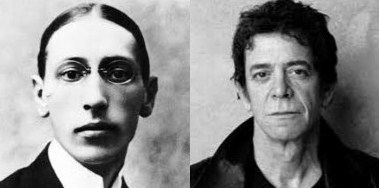
Stravinsky (1882-1971) & Reed (1942-2013)

The alleged music was Stravinsky’s The Rite of Spring.

The level to which the unrest of the crowd grew at the time was surely due, in part, to the fact that some members of the audience greeted the premier of the piece with great enthusiasm, responding with delight at its transgression of conventional musical standards of the time.  A joke is one thing, but the possibility of an obscene offense both intended seriously and taken as such by apparently demented listeners is quite another thing.

I’ve often played the first parts of the ballet’s music for students, asking those who don’t already know what it is whether they think there’s anything particularly strange or disturbing about it.  Nowadays, they find it beautiful at best, or simply boring at worst.
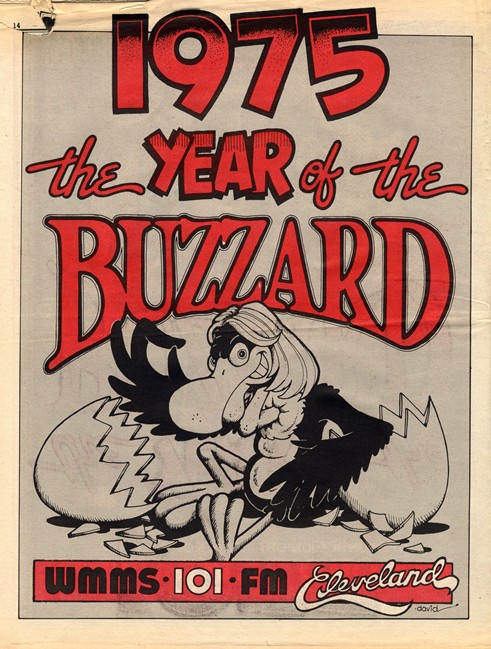
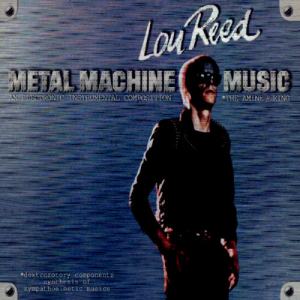
1975_Year_of_the_Buzzard_-_WMMS_print_adIn 1975, I was 16 years old, and not yet familiar with the story of the premier of The Rite of Spring.  I was generally aware of the work’s existence, and had at least heard it once, mostly because I had heard that Stravinsky was an important influence on some prog artists (at the time, especially on Yes).  But by that year, I was listening to WMMS out of Cleveland, Ohio (when we could pull it in; I was far enough away that reception varied a lot).  I remember one of the DJ’s announcing that the station had just received Lou Reed’s latest album, Metal Machine Music.  (The DJ may have been Denny Sanders, but I’m not sure; it could have been Kid Leo. I’d bet there’s someone else out there who heard it who remembers.)

The DJ, obviously deeply excited by what he was sharing, was lionizing Reed as a rock hero for having released MMM on the heels of a series of albums that had been (albeit to somewhat varying degrees) commercially successful.  He then played an excerpt from the album.  I don’t remember how long he let it play, but I don’t think it could have been more than about a minute.  Fading out the brief sampling, he returned to explain, with near-adoration, that this was a DOUBLE ALBUM and that it was ALL LIKE THIS!!

I knew who Lou Reed was, and had heard some of his music, including especially the Transformer and Rock ‘n’ Roll Animal albums.  Though I had not actually listened to any of the original Velvet Underground recordings yet, I was aware that they had, by the mid 70’s, already attained a sort of mythic status.
Metal_machine_music

It was clear to me at the time that the primary reason why the WMMS DJ was so deeply enthused was because he understood Reed’s new album to be a gigantic “F$@# YOU” gesture at his own commercial success, and an indication that he was not interested in “selling out.”  What I also remember from that first exposure to MMM is how much I liked — actually really LIKED — what the DJ had played.  I liked it AS MUSIC, while also fully realizing that what most delighted the DJ was the fact that most people would NOT recognize it as music at all (to say nothing of recognizing it as good music).

I didn’t buy the album at first (due more to priority-setting than anything else), but I don’t think that year was gone before I borrowed it from someone.  Now, here I will make a claim that some may doubt.  My memory can be wildly inaccurate at times.  But I do remember listening through the entire album, which is a little more than an hour in length.  Even if this memory is inaccurate, there have been at least two occasions since 1975 when I know for sure that I sat down and deliberately listened to the entire album. (To my own copy, by then.)

By the time of my second complete listen (or if you’re skeptical, my first remembered-with-certainty complete listen), Which I believe may have been in about 1979 (it seems to me that it was earlier in the same year as Pink Floyd’s The Wall), I had become familiar with the events of 1913, associated with the premier of The Rite of Spring.  Ever since the first moment I knew of the latter story, it has been connected in my musical psyche with Metal Machine Music.

Lou Reed, who left us just a few days ago, was a shadowy and uneven presence during my teen years.  It was not until I was well into my 40’s that I actually became interested enough in Reed generally to go back and listen carefully to his entire catalog, including all of the available VU recordings.  My appreciation for him became profound and deep relatively late.  It is sufficiently profound and deep that I cannot forgo an opportunity to pay him tribute.  But as I’ve thought in the last few days about how to do so, what I am most clearly drawn back to is the effervescence that washed over me when I first heard Metal Machine Music. The music that I most favored in those days was prog, though I was also enjoying a fair amount of what I was hearing from the Home of the Buzzard.  I knew that there were at least some indirect connections between Reed and prog, especially by way of Bowie and “glam.”  (Did you know that Steve Howe and Rick Wakeman are both credited on Reed’s first solo album?)

I now see that there is something very significant about this prog connection, in relation to how I experienced MMM.  The element of boundary-transgression, the “go to hell” attitude toward attempts to place it outside the boundaries of music (political, like so many contested boundaries), the positive reactions rooted in bohemian delight of transgression more than real appreciation for artistic value.  These elements have found numerous routes, more or less paved by now, into what gets called “prog.”  But what I come back to here more than anything else is the fact that I really LIKE this album, as transgression, yes, but also AS MUSIC.  It prepared me to take seriously some of the more extreme offerings by John Cage, the early minimalists (remember Steve Reich’s early tape-loop works?), and Alvin Lucier.  It stood side-by-side with work by Frank Zappa in opening my ears to a cornucopia of musical expression, all of it following Charles Ives’ advice not to expect sounds that are “pretty.”  (Reed’s well-known antipathy toward Zappa, by the way, is one of the things about him that I find difficult to forgive.)

For pushing me along toward this opening, I owe thanks to Lou Reed that could never be contained in a blog post.  I owe it to him to keep telling people how much I like MMM, as well as how much I came to appreciate and admire ALL of his output in recent years.  I owe it to him to recommend to you that you listen to Metal Machine Music, all the way through.  You may not be able to do it.  You may continue to think that both it and my recommendation remain no more than a joke.  Whatever.

But you may be surprised.  And if a few of you are, THAT is much closer to the homage that I want to offer to Lou Reed.

.
The Fierce and the Dead – Spooky Action (2013)

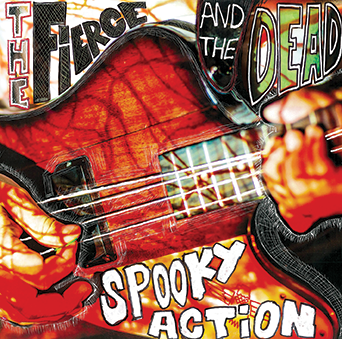
Spooky-Action-CD-Cover-FinishedOverSo, here is the eagerly-awaited new release from The Fierce and the Dead, their first on Bad Elephant Music, and it’s difficult to imagine a more appropriate title.  Whatever else might be meant by the title, the music that you’ll find here is quite rightly described as “spooky action.”

Those who were paying attention probably caught the effusive note that I wrote for Progarchy back in May, just after I had really discovered TFATD.  I was ushered into this sound-world from the antechamber of guitarist Matt Stevens’ solo recordings (apparently, just as Matt himself fell into TFATD).  Do you remember that scene from the Wizard of Oz, when Dorothy opens the door from the spooky (artfully unsettling) black-and-white Kansas landscape onto the spooky (attractive, but even more unsettling?) color landscape of Oz?  That first experience was, for me, that powerful, that attractive, and that blissfully unsettling.

Does Spooky Action live up to the expectation set by its predecessors?  No.  “Live up to” is (if I may resort to somewhat technical language here) totally lame.  What we have in the music of TFATD, and what shines as brightly as we might have hoped on this new set, is the spooky action that is music-making.  Not just writing songs and playing them.  Not just outstanding playing (though it certainly is that too).  The music that these guys make is a sort of alchemy, transforming sonic base metals into gold.  Gold, that is, of the sort that gives in just the right way when you give it a trial bite.

Naturally, a number of earlier influences make themselves known in these tracks.  As with earlier TFATD, I hear the sort of minimalist spirit that made its way so strikingly from Steve Reich into the early XTC.  I hear the grungy (not grunge, but grungy) soil-like qualities of early 1970’s King Crimson.  I hear collages of textured audio drawn from some of the same esoteric tomes consulted earlier by Sonic Youth.  But what makes the musical action here so spooky is the alchemical feel, the je ne sais quoi that makes the sounds you are hearing music in the deepest and richest sense.  Rhythmic complexity doesn’t come across here as contrived, as “lookie what we can do that isn’t 4/4,” but as a breathless invitation to join the band in an invigorating dip into a pool of ecstatic expression.  The making of music should be a spooky action, and here it is so.

Do any of the tracks on Spooky Action have weaknesses?  Limitations?  Faults?  I bet I could find some if I keep listening.  But some music gives up its weaknesses early on, and having listened to Spooky Action twice now, it gives with an open, immediate generosity and profundity that outshines about everything new that I’ve heard lately, except perhaps the  very different but equally enthralling sounds of Big Big Train.  If the first listens are considered as a surface, at which I splash tentatively, gently lowering my face into the liquid warmth, then I see no immediate evidence that it has a bottom.  There’s no measure for its depth available to the naked ear.

Having some familiarity with prior work by TFATD and by Matt Stevens, I suspect that one of the main ingredients in its depth is an overt avoidance of excess gravity.  (Hmm. Can an avoidance be overt?  I think it is here.)  This is music that reaches the depth and richness it reaches precisely because it does not take itself too seriously.  These guys are having fun, and that’s one of the keys to their achievement of a nearly perfect level of seriousness.  The shortness of the tracks (especially by prog standards) enhances the intensity of the fun but fierce and deadly seriousness.

At a time when a fair amount of good music is being released at a fairly steady rate, The Fierce and the Dead have already made recordings that stand out, and by my initial listenings, Spooky Action is no disappointment.  Matt Stevens, Kevin Feazey, Steve Cleaton and Stuart Marshall are an amazing unit.

Listen to it!  And in case you haven’t seen it yet, here again is their delightful video for “Ark”:

20 Looks at The Lamb, 7: Cages

My body is a cage that keeps me
From dancing with the one I love
(Arcade Fire)

lamb-picto-2 (cage)Descartes, widely touted as the father of modern philosophy, taught us to think that what we are most certain about, what we grasp most confidently and most tightly, is “in here.”  I know that I exist if I am thinking, he said, and this implies that I am a thinking thing regardless of what is “out there.”  It’s a picture that has been rejected by most recent philosophers, but it still casts its long shadow over Western culture.  It’s the picture that makes both The Matrix and Inception compelling.  I am my mind, and my mind is an inside that knows no outside, what Leibniz called a “monad.”  Even if I have a body, the body is outside, like a cage that imprisons me, from which I might hope to be set free in an afterlife.

Whatever life (in any strong sense) that I have, I have “in here.”  “I’ve got sunshine in my stomach. But I can’t keep me from creeping sleep.”  And worst of all, I might be truly alone.  Others are outside too.   Outside the cage, Rael sees his brother John (a name meaning “graced by God”).  It’s a cage not only because I am kept in, but also because others are seemingly kept out.

If my body is the cage, then it is so, so tempting to think that the “windscreen wiper,” the dick that the doc docks, might be some sort of key, but when it disappears into the ravine, isn’t it still radically unclear whether anything is really unlocked?

Bruce Cockburn reminds us that a cage is something that an animal might pace, that we catch ourselves “pacing the cage.”  And the cage in that context implies darkness, too:

Sometimes the best map will not guide you
You can’t see what’s round the bend
Sometimes the road leads through dark places
Sometimes the darkness is your friend
(Bruce Cockburn)

The cage is dark like a cave.  Rael’s cage, congealing after the cuckoo cocoon, is in fact a cave.  Here it’s difficult to avoid thinking of Plato’s cave, where prisoners are chained, watching shadows of reproductions of supposedly real things.  And the real things are outside.  Cages are joined together in a network, yes.  But John sheds a bloody tear and turns away from Rael’s cries for help.

When the cage dissolves, it’s still the body (another cage?) that revolves.

Palpating the texture of Rael’s story at this point, we find cages within cages.  But are any of them really cages?  They come and go (perhaps dreaming of Michelangelo?).

If I could change to liquid,
I could fill the cracks up in the rocks.
I know that I am solid
And I am my own bad luck.

Is it just too simple, too freaking trite, to suggest that we forge all of these cages ourselves, that we are our own jailers?  If so, perhaps it is even more trite, even more oversimplified, to think that I can find the keys to my own cages, all by myself.  The suggestion that there are others, that there may be an Other who must take part in our various releasements, may bring us back toward what I am broadly characterizing as “religious.”  I don’t mean that to be a narrow, highly controlled veering-back.  I don’t have a dogmatic agenda.

Or, maybe at one level, I sort of do.  If you pick up the idea that release from cages is necessarily tied to others, to An Other, then you are getting a major element of my drift.

But it’s only a drift, and I hope it carries you back to Rael’s story so that you may test it yourself.  In your own cages.

<—- Previous Look     Prologue     Next Look —->

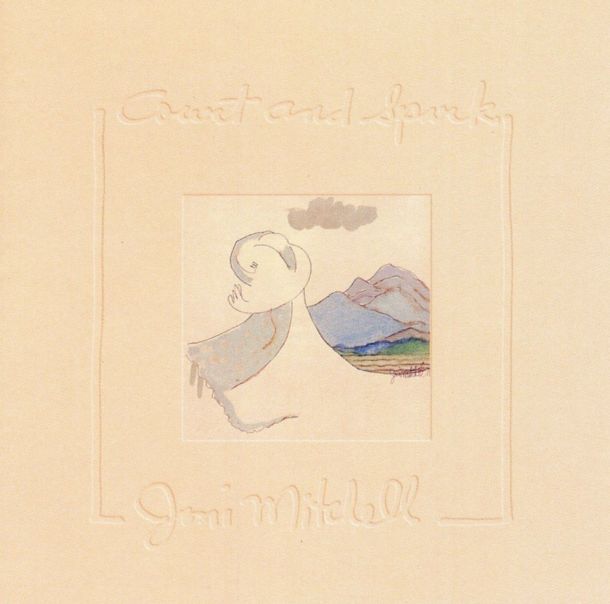
Remembering Joni Mitchell’s Court and Spark (1974)

1974.  Several strangers met.

Many people still remember the meeting, but I’m not sure they really remember it well.  They remember it as a meeting between two strangers, one of them a guitar-toting flower child, a “singer-songwriter,” and the other a hunched, bearded figure with dark glasses, deftly tapping a jazz beat on a crash cymbal.  If you remember it that way, I’d like to jostle your memory a bit.

Joni_Mitchell_-_Court_And_SparkThere are two ways in which the standard “folksinger turns to jazz” blurb seriously fails to capture what we can still hear when we listen to Joni Mitchell’s Court and Spark.  One failure is in counting strangers, for there were certainly more than two.  The other failure is that classification of Mitchell with a putative pantheon of “folksingers” or “singer-songwriters” of the late sixties and early seventies, many of whom were her friends and some of whom were her lovers.  It’s a failure if you leave it at that, anyway, if you take it to be all that’s required for the label on the file folder.  Joni Mitchell herself is a meeting of a fair number of strangers, and it will help us to see how this is so if we see how uncanny is the party at which these strangers met the year of Court and Spark‘s release.

On earlier efforts, Mitchell had indeed established herself as a “folksinger,” in a sense roughly equivalent to that in which Todd Rundgren had established himself during the same period as a “pop singer.”  Those who really knew, knew that she was already in danger of bursting with creativity with very limited patience for the boundaries on stylistic maps of the time.  She stretched hard against the walls of the “folk” bin, in much the same way as her fellow Canadian, Bruce Cockburn.  She also shares with the latter (and in fact, probably outdoes him in this) an urgent impulse to exploration and experimentation at the lyrical as well as the instrumental level.  It is possible to hear Mitchell’s lyrics superficially, and nod knowingly at the relational roulette and sexual Sturm und Drang, as if it’s all just the standard post-Woodstock angst, with one foot in the summer of love and the other having at least a toe in the bloody theater of Southeast Asia.

joni_mitchellBut listen again to this amazing album, which became Mitchell’s most commercially successful despite its refusal of a narrow category.  Listen to it as a party at which a number of strangers have met, doing what people do when they go to people’s parties.  Some hang back shyly and watch while others dance wildly wearing lampshade crowns, or collapse in tears into the laps of new “friends” whom they hardly know at all.  German philosopher-sociologist Georg Simmel wrote of how people must be “sociable” at parties, meaning that they must walk a sort of tightrope between taking both self and other either too seriously or not seriously enough.  The people at this party, they stagger across a zone of overlap between the two, never really walking the line.  This is what makes the entire album, with its sometimes unbearable lightness, a particularly serious musical work.

Listen.  The strangers here are hardly limited to two (and some of them may have more than one head).  Listen precisely as if it were “prog” in that deep sense that shakes the souls of many of us who hang out here.  The very fact that “jazz” is supposedly a large element is enough to guarantee that the lines between several more “popular” and more “serious” musical genres have always already grown faint and almost disappeared.  Sure, we can identify elements that are “jazz,” “folk,” “classical,” “torch,” and even a hint of “country.”  But when I listened again to this album this morning, from beginning to end, what I heard was a wondrous party at which the number of guests is really beyond counting.  Even the unifying effect of Mitchell’s mesmerizing voice is not exactly “unifying.”  It is its own creature, not reducible to styles or genres by which it has supposedly been formed.  It is willing to use words, phrasings, and sounds not according to a style, but according to the music.

Thank you, Joni, for the “prog” in you.

.

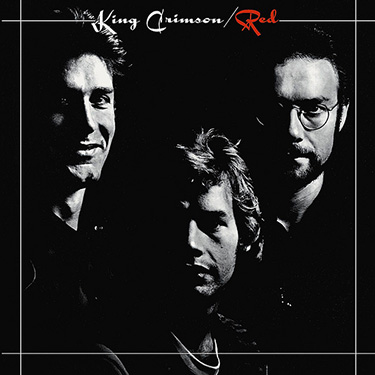
Remembering: King Crimson, Red (1974)

Red,_King_CrimsonIt has been observed more than once that Red was a “swan song” for the early 70’s King Crimson.  While Robert Fripp (like Frank Zappa) has always brought out the best in almost anyone he’s worked with, listening to Red now reconfirms my sense of a very singular musical chemistry — or perhaps the better word is alchemy? — that can be heard between Fripp, Wetton, and Bruford in this incarnation of KC.  There’s something essential that gels on this album, in fact, from all of the band’s previous albums, and (I’m tempted to say) remains an unavoidable benchmark for all subsequent work.

The title track alone is a paradigm for any proggish texture that would lean recklessly into a Zeppelinesque aesthetic.  It raises the hairs on the back of my neck in just about the same way as ‘The Rover” from Physical Graffiti (released only a few months later).

I have met a good number of folks who otherwise appreciate King Crimson, but whose main complaint about the early-70’s KC is dissatisfaction with John Wetton’s vocals.  It’s hard to say whence our various aural fixations arise, but I wish to be on record as claiming that Wetton’s singing on this album is essential to its textural perfection, and is (to my ear) the best vocal work that Wetton has ever done.

Go.  Get Red out and listen again.  You know you want to.

.

20 Looks at The Lamb, 6: Danse Not-So-Macabre

Considering castration, a certain strange displacement occurred.  It didn’t really strike me until after writing the fifth look, but it was indeed a displacement, and as I think about it since, it seems stranger and stranger.  Death is what is displaced, and the reason why its displacement is so strange is because it is normally simultaneously final and transitional.

The Death card in a Tarot deck is often understood as ending, loss, or conclusion, but also often as transition or change.

With shaving, biting and cutting given the symbolic pride of place, death — so often the BIG finality, or the BIG transition — turns out to be not that big a deal.  Its caricature in The Lamb is in “The Supernatural Anaesthetist,” with its disarmingly brief and casual lyric:

Here comes the supernatural anaesthetist.
If he wants you to snuff it,
All he has to do is puff it

— he’s such a fine dancer.

Here is a figure of death unlike the skeletal Death of Tarot, or the darkly robed Grim Reaper.  This guy sounds like someone you might like to get to know, or perhaps someone who would like to get to know you.  Think of Joe Black (Brad Pitt).  Or think of the bubbly and alluring Death of the Endless, from Neil Gaiman’s Sandman series.  This may be the better association, as “Anyway” voices the expectation that “she” is supposed to be riding a pale horse.  The anaesthetist merely “puffs,” presumably delivering a gaseous sort of sleep-inducing substance.  And dancing?  Why would he be a fine dancer?  Perhaps because (as in The Sandman) the delivery, though dark, is welcome and pleasant.

Is it even clear whose death has this unassuming harbinger?  Of course, the most natural reading is that it’s Rael’s death.  But the real death that soon follows is that of the Lamia.  I’m reminded of the Tarot reading at the end of The Gunslinger, the first volume of Stephen King’s The Dark Tower, when the man in black draws that ominous card and speaks to Roland:

Death, but not for you, gunslinger.

And at the end of the series, this pronouncement is repeated, with amplification:

Never for you. You darkle. You tinct. May I be brutally frank? You go on.

It is as if Death, normally THE big deal, becomes no big deal.  Rael “writes Death off as an illusion.”  Yet death does come for another, and in both The Dark Tower and The Lamb, the death of the other is an immense burden on the heart of the hero (Roland/Rael).  I’m not sure how much help this is, however.  The doors come before in The Lamb, and the doors come after in The Dark Tower.  Well, maybe so.  But in each case there are doors.

This may be no more than the obverse of the previous look.  I’ve urged you to listen to the ways in which the (in)scisions mark the liminal sites, the thresholds.  The cutting is so much more significant, more to be feared than death.  Death dances, and nonchalantly puffs.

But maybe we should also remember that, as Emily Dickenson pointed out, “The distance that the dead have gone / Does not at first appear…”

The only thing that seems clear to me here is that, if you try to see death as a major theme in The Lamb, it doesn’t quite work.  I’m tempted to say that you’d be dead wrong.  But that might be too strong.

Another poet (Eliot) put in the mouth of his magus: “I should be glad of another death.”

<—- Previous Look     Prologue     Next Look —->

20 Looks at The Lamb, 5: Two Doktors, How Many Blades?

Translating Sigmund Freud’s writings into English has left a formidable heap of wreckage strewn across the twentieth century.  We’re used to saying “Ego” and “Id” when he simply used ordinary German words for “I” and “It.”  Most relevant for this look at The Lamb, we’re used to hearing (if we hear this part of Freud at all anymore) about “castration” or the fear of it.  Castration means the removal of the testicles, but that’s not what Freud was talking about.  He was concerned about the removal of the penis, or the fear of its removal, or the child’s suspicion that it has been removed in the case of the female.  The association with the idea of cutting is always strong, and of course blades (swords) may be phallic.  A blade may shave as well as cut.  Incision by a blade is a cousin of biting, some teeth being known as incisors.  Here I want to call attention to the chain of associations in The Lamb that includes shaving, biting, and cutting.

Now, bringing up Doktor Freud seems (to continue speaking Freudian language) hopelessly “overdetermined” by the violent contests that comprise the history of psychoanalytic thought.  It is so often assumed that the legacy of Freud is somehow “settled” or finalized, that he has been refuted, or subsumed, or otherwise tamed by subsequent inquiry, whether that inquiry bears the honorific adjective ‘scientific,’ or rests upon some other authoritative revelation.  I take for granted here, without providing any explicit argument, that it is still worth paying heed to Freud, and that doing so still evokes insight that is not negated by the countless ways in which viewpoints associated with his name have been criticized.  I ask to be allowed to invoke his name only provisionally, not simplistically as an infallible authority.  I do not expect acceptance of any view according to which “biology is destiny,” noting in passing that even Freud himself arguably did not hold this as a dogma.  I take up a Freudian gaze here not so much as what we usually think of as explanatory theory, but more as a hermeneutic lens.  Try it.  I’m not looking for unqualified commitment.

One of the most important things to realize about shaving, biting, and cutting in The Lamb is that it is clearly not associated with death.  The images that accompany death are very different, suggesting the violence of an impact at first (“Fly on a Windshield”), but having much more to do with breath, with wind, with blowing or sucking in of air, and of course with transformation of one kind or another, with throwing into question the borders of the real (Rael).  More on that soon.  Shaving, biting and cutting, on the other hand, are all focused upon the bodily loci of love and sex.

The heart (also “the porcupine”) is shaved.  Flesh is bitten by the (snake-like) Lamia, and they in turn are eaten by Rael (whose blood has killed them).  And then there’s the visit to Doktor Dyper.  “Don’t delay! Dock the dick!”  This cutting is presumably some sort of treatment (“cure”?) for the curse of being a Slipperman (which came from having “tasted love”). The preservation of the member in a yellow plastic tube (“honey-pouch”) promises “safety” of some sort, safety which brother John is unwilling to risk when Rael’s is lost to the raven, and into the ravine.

Think of how all of this involves severing.  What (or who) is severed from what (or whom)?  It seems as though the severings (including that of John from Rael) are essential in leading to Rael’s ultimate experience of seeing his own face where John’s should be.

Shaving, biting, cutting, severing, removing, preserving (“pickling”).  And if Docktor Freud is taken at least as a reliable cultural iconographer, also borrowing two or four cents from Jacques Lacan, may we conclude that the forms of sexual severing (alienation?) in The Lamb are part of what clears the way for the Other as mirror?

I do not present this as a conclusion.  In order to understand why, think about how “It” is not a conclusion either.  “It” has always been my least favorite song on the album musically.  (See?  I am not WHOLLY uncritical of the album.)  “It” seems to act like a grandiose finale, and I’ve never thought it was really a successful one.  But as I’ve thought with Freud a bit here, it has occurred to me how completely apt this may be.

No conclusion, but suddenly a director shouts, “CUT!!”

<—- Previous Look     Prologue     Next Look —->

20 Looks at The Lamb, 4: Thing Type Sex

I’m counting out time,
Got the whole thing down by numbers…
Got my finger on the button…

Sure, I’ll do this first person, as if speaking for a “we.”  By doing so, I open it to an intractable vulnerability.  You may not identify with it.  You may think it foreign or strange.  You may think it objectionable, disgusting, sexist, or whatever.  But I’m betting some of you won’t.  I’m betting some of you will recognize bits and pieces of yourselves, or maybe even more than that.

Sexuality was a topic that wasn’t really broached directly in my youth.  We imagined that our parents had no idea how much we knew and did.  We certainly didn’t imagine what our parents actually had known and done, even before we were born, which was, like, before creation.  There were books to be read, if parents or nineteen sixties librarians allowed it, or if we managed to read them anyway, as we often did.  There was that polite near-silence among the “adults,” to be filled with contraband Playboy and Penthouse magazines.  There was that huge freaking mess of an ethical minefield where religious and moral expectations and performances made a strange shadow within which all sorts of things happened anyway, sometimes not reflected upon, or sometimes endlessly analyzed in a language that many of us would later recognize when Bill Clinton got caught in public (as my mother used to say, “in front of God and everybody!”) apparently trying to make out what ‘is’ is.

Sometimes when you hear a song, it’s as if you already know it very well.  That was me and “Counting Out Time.”  By the time I was initiated into the symbolic world of The Lamb, I was definitely a boy who was resting for his testing.  I knew what was meant by “digesting every word the experts say.”  I knew what Gabriel meant by “mankind handkinds.”  I’m strongly inclined to say that it was the first song on The Lamb that I REALLY understood.  I certainly felt like I understood it.  As adolescence progressed, it felt more and more like a chapter in my own story, including the disappointment and questioning.

It’s worth remembering how much it felt like my own story, precisely because of its just-so blend of a happy, upbeat sense of discovery with a dark, foreboding sense of objectification and abuse of women.  It’s worth pausing to study on its unapologetic privileging of male libido and its frankly expressed hope for an algorithm with which to elicit desired female response.   Hegel’s ideas regarding the importance of “lordship and bondage” find a musical conduit here, more subtle and deep than the more famous take by Cheap Trick: “I want you to want me.”  There was an uncanny waffling in that desire between the hope of dominance and forced (“automatic”?) submission on the one hand, and the hope of voluntary giving of self on the other.  “Just lie there still, and I’ll get you turned on just fine.”

genesis-counting-out-time-charisma-3The song is a profoundly deep meditation on a profoundly shallow gaze (regard) of a middle twentieth century pubescent male and his object, in precisely the Freudian sense of “object.”  Ah yes, I already did suggest that we might make a visit to Dr. Freud, but in this look I am only making an initial entry into the space of sexuality, and sexuality (like religion, evoked last time) will from now on be a constant companion.  But the point of this entry is the uncanniness, the discomfort, the vacillation between desire and disgust.  In my own case, I know that a twisted and destructive savor of sexuality haunted my adolescence, like an abusive partner that I would not leave, but would return to again and again.

In order to understand the comical but revelatory character of the other sexual images in The Lamb, even more important than a predictable Freudward nod, I would argue, is that we have a feel for the current running through it that is palpably misogynist on its face, and perhaps deeply misanthropic at its core.  It should remind us of the discomfort that arises when we realize that Nine Inch Nails’ “Closer” both is and is not about sex (and, for that matter, religion as well).

Some of you may have some other route to the sort of discomfort that I am calling for here, but I suspect that something like the route I have traced here is familiar to many.  The allusion above to Hegel suggests the notion that there is something painfully paradoxical at the center of human desire, made most palpable in its sexual manifestations.  The suggestion that arises here is that a desire with no possible fulfillment, an incoherent desire, might be a part of what I am.

There is more to come, but listen from there for a while if you can stand it.

<—- Previous Look     Prologue     Next Look —->

20 Looks at the Lamb, 3: After Supper

Foxtrot72

After supper comes dessert.  Pudding.  But “how can you have any pudding if you don’t eat your meat?”

Bringing up “Supper’s Ready” means rattling that dangerous chain of signifiers that includes Bible, religion, Revelation, apocalypse.  In the mid 1970’s, we knew about zombies, but there was not yet any strong popular associative tendril between zombies and apocalypse.  A more likely association, at least in my neck of the woods, was with Hal Lindsay’s popularization of dispensationalist theology in The Late, Great Planet Earth (1970) and other books (precursors to the more recent Left Behind series).

What comes after (ooh, we need a Terje Rypdal soundtrack here!), or the end (Doors?), in this case is the eschaton, the culmination, the “last things” in the argot of Christian theology.  The supper of the Lamb that is the last one.  Not “the last Supper” before the arrest of Jesus, but the LAST supper, when time shall be no more.  THE LAMB of the biblical Apocalypse, or Book of Revelation (please don’t add an ‘s’ to the end; in the biblical text, it’s THE REVELATION of the Christ, not a book of predictions!), it’s THAT LAMB whose Supper is ready on 1972’s Foxtrot.

Lamb74What comes After Supper, then?  What’s the dessert?  Selling England by the Pound (1973) would rightly be called pudding as opposed to dessert (arguably motivated in part by a desire to keep Genesis’ image veddy British), but what we’re worried about here is The Lamb, the one that Lies Down on Broadway.  Off to America with a vengeance?  No, I won’t chase any speculations of posturing in relation to The Pond.  The connection that stands out here is THE LAMB.  Having any knowledge of “Supper’s Ready,” how could one possibly avoid bringing to Rael’s story an ear prepared for the continuing adventures of that same Lamb, the true dessert course after The Lamb’s Supper?  If we consider this as one possible gaze (regard), what do we see?

“Religion” is such a problematic word.  It probably originally meant something like “binding,” and this probable meaning still seems to echo loudly when its friends and foes both react to the various ways, both good and bad, in which we might think ourselves “bound.”  But let’s use it for the moment.  Sure, we can find some religious themes in The Lamb, even besides the obvious figure of the title, but aren’t they much more subtle, more muted?  And isn’t the climax this time much more clearly in tune with Eastern religion, where “you are that” (Tat Tvam Asi)?

What does The Lamb have in common with “Supper’s Ready” that might be construed in “religious” terms?  I’ll cut to my chase.  One central figure, but in each case the canvas is made of relationships.  Lovers.  Sex partners (casual or not).  Siblings.  Others whom one wants to trust.  Others who might deceive, who might betray one’s trust.  Others who comically conform to stereotypes, or who fail to conform.  Others with whom one might belong, or with whom one (hopefully) does not belong.  Must experience be solitary and lonely, or can it be shared?  Can’t you feel OUR souls ignite?  Or do others end up as silent sorrow in empty boats?

Remember that, for some streams of Christian theology, God is the “Wholly Other.”  Mightn’t Otherness be considered THE “religious” question, or problem?  THE site of the opening of the “religious”?  If it is not Other, then I cannot love it.  If it is not Other, then neither calling nor command could issue from it.

Now step slightly to your left.  Keep that same basic gaze, but shift it over here, ever so slightly.  Here are lyrics that we might call “religiously loaded.”  There are lyrics about love and longing for an Other.  Do you see any line of demarcation, any dividing boundary between the two?  I don’t.  I suspect that one of the places this will eventually lead us is a meeting of two Doctors (Dyper and Freud); the lack of separation here has always been palpable as far as I can tell.  But that meeting will have to do with “sex,” which we will treat under a separate gaze (at least one).  The differences between the gazes is provisional and strategic.

The Lamb is a sacrificial figure.  It is The Lamb that is slain (lies down).  (Death is here, and will be a more vocal visitor in gazes to come.)  When The Lamb lies down, is it not with The Lion?

Suppose “religious” has everything to do with Otherness, longing and love.  Suppose, under the provisional shade of “religion,” that I (or You, or Rael) could not be God.  (Leave aside, for the moment, that heroic/pathetic voice in the Third Impression of “Karn Evil 9,” desperately intoning:  “I am all there is!”)  Suppose that dessert cannot be eaten alone, that pudding must be shared.

Suppose the Last Things are Others.  Listen to the Lamb, with Rael as background rather than foreground, with Others as the foreground.  Have you ever noticed how many there are, other than Rael, or how his story is as much a story about those Others?  About Otherness?  It is that which I am recommending here as a “religious” gestalt, a gaze at The Lamb that comes after Supper.

Some of the other gazes may spring from some of those Others, but perhaps it will be helpful to see them first from here.

<—- Previous Look     Prologue     Next Look —->

TFATD (A Quick Altar-Call)

TFATDThere are a lot of things I’m not good at.  One of them, in fact, is thinking of things that I AM good at.  I’ve been accused of being some combination of Eeyore, Puddleglum, and Charlie Brown.  More to the point I’m headed for here, I’m not very good at consistency, or at finishing things that I start.  Oh, don’t worry (if you care); I’m NOT finished with either Spock’s Beard or Looking at the Lamb.  And I guess I do have a SORT of good excuse because it’s the end of the semester, when academics are in even more danger of alcohol abuse than usual.

Anyway, I DID finish something that I started this week, and finished it the same day I started it.  It was definitely, as the stereotypical smoker reclining on the pillow puts it with a smirk, very good for me!

The Divine Ascension of The Fierce and the DeadWhat I both started and finished in the same day was listening to all I could access from The Fierce and the Dead.

Now granted, this is not of the same scope in listener-hours as my discovery a few years ago that I was liking everything I heard by Lou Reed, even the stuff Reed fans would say you shouldn’t like.  Or, some will understand how difficult it is to respond to queries regarding what Zappa one should sample first.  It’s nothing like that.  Still, it’s the first time I’ve done that with an artist for a while.  I mean, done it so voraciously.

I’ve complained here before about the “drinking from the fire hose” phenomenon.  (Was it Erik who brought that up?  Ian?  I forget.)  Lately, when it comes to the music to which I don’t seem to have time to pay attention, I’m tempted by the image of going for a drink at a huge waterfall with a disposable bathroom cup.

On VHS - The Fierce and The DeadBut here, in the rich and deep sense, is something.  It started with some ear-opening forays into Matt Stevens” breathtaking solo work, and now I’ve found the most wonderful dram of single-malt (neat).    I’ve not been so suddenly and deeply struck by the textures, the moods, the goosebump-inducing wonder of a band’s recordings since King Crimson.  I’ve confessed my newfound faith to my “current stuff guru” Birzer, who has bid me write.  Hence, I write, though with much more rough effusion than thoughtful creativity (for the moment).

If I’m slowly beginning to build my own small pantheon of current “prog-related” (sorry, I just can’t leave off the scare-quotes) artists, I’m ready to affirm the divinity of TFATD.  I gladly join those who look longingly toward autumn, and the promised Bad Elephant release.

.