
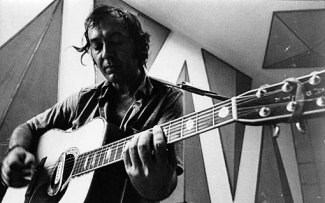
 …the next move, after Manuel Gottsching’s E2-E4, pulls the thread of that piece’s guitar work and comes up with Gabor Szabo at his funky six-string best, in Stockholm in 1972. From the album Small World (available as a compilation with its sister album, Belsta River, as In Stockholm), “Impressions Of My Country / Foothill Patrol” is a duel with Janne Schaffer — a Swedish guitar hero known mostly for his work with Abba. In 1972 Szabo, a serious jazz cat with a penchant for interpreting pop tunes (and riding that line between elevator music and the sublime), might have been primed to explore this Hendrixian territory. The previous year his “Gypsy Queen,” from the album Spellbinder (Impulse, 1966), had been adapted to round out Santana’s cover of “Black Magic Woman” on the album Abraxas. That song reached number four on the charts, while Abraxas went to number one. Szabo’s approach on Small World may have been, in no small part, influenced by Santana. The usually clean tones are fuzzed out, wah-wah pedals are employed, and there is a freer, funkier feel to the proceedings. Coming from Szabo, though, it’s no surprise, and his experimentation with tone and feedback in the 60s, coupled with the use of his native eastern European melodies, helped define a psychedelic sensibility that lent itself to the jam.
Category: jazz rock
60 Years, Twelve Albums, One Man’s Favorites

I began writing this post several months ago, in January, carried along on the brief rush of excitement that comes with a new year. “2015! How about noting a bunch of anniversaries of great albums?” And, in fact, one of the great strengths of Progarchy.com is the sense of music history and the awareness of anniversaries: “Forty year ago….thirty years ago….twenty-five years ago…twenty years ago…”, as opposed to the dominant model out there, which is “Forty minutes ago…thirty seconds ago…twenty tweets ago…” But then life overwhelmed me and the burst of focused energy dissipated for a while. Now it’s back. Best strike while the vinyl is hot—or something along those lines.
The idea here is very simple: I listen to hundreds of new albums every year, along with hundreds of older albums that I come back to for various reasons; but how much of that music has real staying power? And what, in the end, makes a person return repeatedly to This Album rather than That Album? Sure, of course it is because of impeccable taste and a rare instinct for timeless music. (Duh.) But there is a wonderful mystery to it all, for so much of what resonates in a particular album comes from accidental things: the time, the place, the event, the moment. Certain songs bring back great memories; certain songs make you want to jump off a cliff (yes, I’m looking at you, Olivia Newton-John’s “Physical”).
But it isn’t simply a matter of nostalgia, which can only go so far; it is, I hope, more often a matter of discovery, of hearing something new—or, in some cases, hearing something old and suddenly hearing it. Really hearing it.
My criteria is this: what albums from 60, 50, 40, 30, 25, 20, and 10 years ago do I still listen to now on a regular basis? And never tire of hearing? And why? With that, here goes!
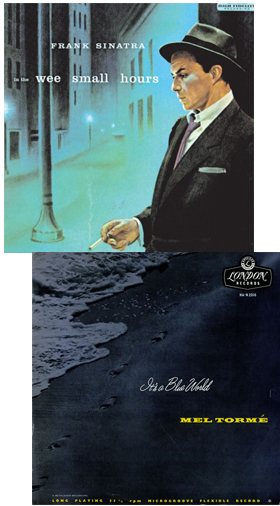 1955: In the Wee Small Hours by Frank Sinatra and It’s a Blue World by Mel Tormé. I was not raised on Sinatra’s music; quite the contrary—I was raised on decent hymns and mediocre to rotten “Christian” music; I hardly paid attention to Top 40 pop and rock until I was in junior high. And I didn’t really listen to Sinatra or Tormé until a dozen years ago. Prior to that, I simply didn’t “get it”. Then I did. Why? I’m not sure. But since then, I’ve collected some 1300 Sinatra songs. The Chairman of the Board produced many classic albums, but this one is my personal favorite: dark, lush, aching, beautiful, gut-wrenching, perfect. I sometimes fall to sleep listening to it, especially when it’s 2:00 in the morning and I’m wide awake. Sinatra had the rare gift of making you, the listener, believe The Voice was singing only to and for you. It’s impossible to describe; it simply has to be heard and experienced. And don’t forget: Sinatra is the God Father of Prog. Really. Sinatra, by the way, was born a hundred years ago this year.
Tormé did not have the edge or darkness of Sinatra, nor did he ever plumb the depths of emotional despair as did the legend ten years his senior. But Tormé had range, talent, and genius to burn, not just as one of the greatest vocalists of the 20th century, but also as an accomplished songsmith (he penned 250 songs or so), fabulous arranger, top-notch drummer (and decent pianist), novelist, biographer, author, actor, screen writer, consummate showman, and collector (guns, cars, movies, etc.). It’s a Blue World is a lush, impeccable set of songs, likely influenced by Sinatra’s Wee Small Hours. While Sinatra packs an emotional punch, Tormé thrills with pure beauty and dazzling musicality, all delivered with an effortless ease that reminds me of watching Roger Federer play tennis at Wimbledon. Bing Crosby, asked late in life to name his favorite musicians, named only one vocalist–Tormé–saying, “Any singer that goes to hear this guy sing has got to go and cut his throat.” For a taste, check out Tormé singing Duke Ellington’s “I’ve Got It Bad, And That Ain’t Good”. Continue reading “60 Years, Twelve Albums, One Man’s Favorites”
In Vaults by District 97
 There are times on District 97’s new album, In Vaults, when a “because it’s there” vibe rises like a Himalayan peak from the Plain of the Killer Riff: a successful descent doesn’t always follow the climb. But that’s what this band has signed itself up for, and the risk-taking on record plays, happily, with the irony of vocalist Leslie Hunt’s American Idol background. All the nonsense that is associated with Hunt’s alma mater plays a like a game of One of These Things Is Not Like The Other, as the singer, evidenced by her work with District 97, is about the last thing you’d expect to come out of the Idol scene but simultaneously the kind of artist you’d want to actually win. So, In Vaults is downright, and mostly satisfyingly, weird, something that maybe could only come out of a Chicago-based metal band with a conservatory pedigree and an Idol runner-up with some serious jazz chops. It is an exhaustive — at times exhausting — record that, despite its bumps and its occasional tendency for showing off chops over songs, brims with an energy that damns torpedoes and old dudes like me.
It’s no surprise that the band has been embraced by the likes of Bill Bruford and John Wetton, with whom District 97 has toured and recorded. King Crimson and Yes is in the lineage for sure, but Soft Machine, Opeth, and Abbey Lincoln all have a claim to some of the ground District 97 has planted its flag on. The lurching, Coltrane slabs of sound erupting from Jim Tashijian (guitar), Patrick Mulcahy (bass) and Jonathan Schang (gonzo drums) back-and-foreground Hunt’s jazz phrasing and hard rock smarts with an inventiveness that can move instantly from crushing doom metal to modal jazz and all stations in between, not least of which is strong affinity for pop melody in (often too) small doses. Rob Clearfield’s keyboards are like a less bitchy version of Roxy Music, less self-important than Kansas or ELP — for the volume of notes he pumps out, none seem wasted.
In Vaults ups the ante on District 97’s more melodically charged Trouble with Machines. This is a band not short on ideas, and Jonathan Schang’s songwriting is up for articulating a range of lyrical emotions over arrangements that don’t let up. There’s no getting bored, although there’s also little room to slip into a groove of any duration, something that would build tension in songs as long as these, and something I think the group would be really good at (when it happens in “Learn From Danny,” the moment really pops). What we do get, though, is a hyper-shifting Zappa-fueled jazz rock buffet that goes to new places on the shoulders of giants, so that in “Takeover” the nod to Zeppelin’s “Black Dog” is like Zeppelin nodding to Fleetwood Mac’s “Oh Well.” There is a lot going on in In Vaults, and District 97 is on to something fairly unique in the prog scene, matched really only by Seven Impale (and perhaps it is the youthfulness of both bands that accounts for this): a palpable search for that seam that both delivers the goods while not dwelling on long-worn paths.
 Progarchy