

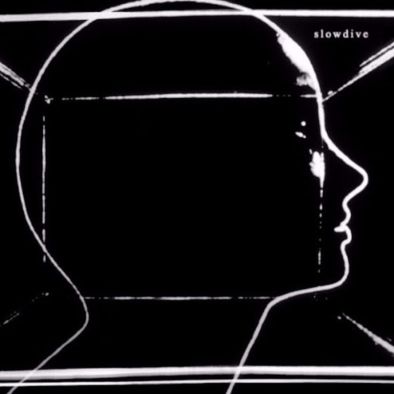
 Reviewing Slowdive’s eponymous new album, their first in 22 years, Clash’s Robin Murray made a statement bound to pique the interest of progarchists:
“It feels at times like early King Crimson, or Pink Floyd’s post-Syd/pre-Dark Side nexus. It’s the sound of a band forgetting who they were, and embracing who they could become.”
That second statement is undeniably true. Slowdive (released May 5 on the Dead Oceans label) is unmistakably the work of the same quintet that disbanded between 1995 to 2014. But it’s not a reunion record of rehashed old ideas. It would also be correct to say the band’s music has more in common with Floyd than, say, punk rock. Among their signature showpieces is a majestic, slow-burning cover of Syd Barrett’s “Golden Hair.” But Lark’s Tongue in Aspic? Other listeners can judge.
Guitarist/songwriter Neil Halstead grew up in a home where orchestral music was preferred to pop, and that influence is strongly apparent in tracks like the stirring “Catch the Breeze” (1991). While Slowdive can’t be classified as prog, their body of work has occupied spaces progarchists can appreciate: ambient, avant-garde, dream pop, and experimental, all under the broader classification of shoe-gazing. In this vein no other band sounds like Slowdive.
The cover art for Slowdive features a frame from Harry Smith’s 1957 avant-garde animated film, Heaven and Earth Magic. Composed of cut-out figures set in motion, the narrative includes a sequence involving a female patient sedated for a dental procedure. The darkened profile depicts her state of semi-consciousness, or perhaps heightened awareness. Or both.
Shoe-gazing refers not to the contemplative state of the listener (though it could) but rather the guitarists staring down at the array of effects pedals used to achieve other-worldly sounds. None are better at this than Slowdive’s Halstead and Christian Savill. On the new record that prowess is everywhere present.
But Slowdive also contains a refined attention to detail and form. The pace of the songs is faster. Nick Chaplin’s bass and Simon Scott’s drums thunder out front instead of being obscured by clouds of guitar effects, e.g. “No Longer Making Time.” And instead of a metronomic build-up common in earlier work there are tempo and time changes, e.g. “Don’t Know Why” and “Go Get It.” But as on previous records Rachel Goswell’s voice moves through the mix and around Halstead’s vocals like a spirit, e.g. “Sugar for the Pill,” the album’s emotional epicenter.
The closer, “Fallen Ashes,” may be a preview of things to come. Showcasing Scott’s abilities with laptop software, it embellishes and pushes a hypnotic piano riff to sublimity à la Jonny Greenwood.
Overall, Slowdive is familiar but with more sculpted contours and sharper pin pricks than in times past — a welcomed development.
All of this works from a context of two-decades’ old material still very much in view, still relevant, still captivating. I had the great fortune to catch Slowdive in Carrboro, NC at the next-to-last date on the North American leg of their current tour. Blending half the new album with old material, Slowdive overwhelmed the audience with canyons of sound.
I spotted a few fellow 50-somethings in the music hall. But more than a few of the audience weren’t even born when this Thames Valley gang first started making music as teenagers. Having fallen quickly out of fashion years ago with a press enamored to Britpop and cool Britannia, then beckoned back to life by an emerging cult following, Slowdive have a word for souls fearing rejection without redemption: No, this is what we do, and done well time will vindicate it.
After opening with “Slomo” from the new album the band followed with “Catch the Breeze,” with Savill, Goswell, and Halstead leaning toward the floor, wailing guitars swelling to orchestral heights.
The breeze it blows, it blows everything
And I, I want the world to pass
And I, I want the sun to shine
You can believe in everything
You can believe it all…
During the rapturous finale I glanced to my left. A couple of people were actually weeping. Heaven and earth magic, indeed.

 In 1984, it was impossible to turn on the radio and not hear something from Prince’s breakthrough album, the soundtrack to his movie, Purple Rain. A mega seller that actually deserved to be one, Prince was suddenly considered the main rival to Michael Jackson, the so-called King Of Pop. The movie made Prince a huge multimedia star. But there were things happening in Purple Rain foreshadowing the restless genius of Prince; things that indicated he was an artist who would follow his own muse, regardless of the commercial appeal.
 This contradiction became explicit with the next album’s closing song, “Temptation”, where Prince literally argues with God about his carnal desires vs. his spiritual struggles. Around The World In A Day, released two years after Purple Rain, confounded everyone. From its psychedelic cover to the summer-of-love sounding music within, it was the last thing anyone expected. Not surprisingly, it was a relative disappointment commercially, but after the passage of time, it is now seen as being years ahead of its time. There simply aren’t many albums containing songs as strong as “Paisley Park”, “Raspberry Beret”, “Pop Life”, and “The Ladder” all in one place.
 After Around The World In A Day, Prince made another movie, Under The Cherry Moon, which flopped, but the songs from it served to make another extraordinary album. Parade continued Prince’s psychedelic rock explorations, this time leavened with some spare funk (“Kiss”) and smooth balladry.
 1987 brought the release of the album many consider his masterpiece: Sign ‘O’ The Times. The Revolution were gone (except for a couple of live house jams), and once again Prince produced, arranged, and performed everything. A sprawling double album, Prince is all over the map stylistically, yet nothing is wasted. There are gritty R & B (“Sign ‘O’ The Times”), playful pop songs (“Starfish and Coffee”), roaring funk (“Housequake”), anthemic rock (“The Cross”), and just plain weirdness (“If I Was Your Girlfriend”).
 , anticipating virtual reality and the internet. By this time, though, he had long lost the huge fan base from the Purple Rain days.
 Progarchy