In The Soul of the World, Scruton observes that although Beethoven’s C-sharp Minor Quartet contains no particular story about human life, nevertheless somehow “all human life is there.” It is not merely pleasant to listen to. Rather, it addresses us with a challenge.
“There are no easy options, no fake emotions, no insincerities in this music, nor does it tolerate those things in you. In some way it is setting an example of the higher life, inviting you to live and feel in a purer way, to free yourself from everyday pretenses,” writes Scruton, “That is why it seems to speak with such authority: it is inviting you into another and higher world, a world in which life finds its fulfillment and its goal.”
Scruton notices that listening to music is in a way like dancing to it. Further, there is a difference between the dancer who understands the music, thereby translating it into expressive gestures that fit it, and “the dancer who merely dances along with it, without understanding it.”
Ian Penman writes in the London Review of Books (Vol. 36 No. 8 [17 April 2014] pages 11-12) about Kate Bush. It’s a fun read.
Like Kate herself, Penman’s essay is half bonkers. Even so, it does contain a spot-on description of what makes the song “Hounds of Love” so thrilling to listen to:
‘Hounds of Love’, though, is quite simply one of the most beautiful songs pop music has ever produced. It’s not just a song about abandon, but one that embodies feelings of anxiety and abandon, smallness and bigness, in its dizzying drive and texture and in Bush’s joyously unhinged singing. Her keening vocals suggest adult poise on the verge of helpless childhood fall. The whole song, but especially the line ‘his little heart, it beats so fast,’ still automatically reduces me to tears. The arc she makes of ‘hold’ in the yelp of ‘hold me down’ is truly overwhelming: at once pained and lost and powerfully erotic.
Listen to the closing minutes of ‘Running Up That Hill’, with its muted chorus of multi-tracked Kates: screaming, grieving, witchy, shattered, a sonic foam rising above the song’s jagged tribunal. It’s a very odd song indeed. At the very least, it claws and rubs at the dissolute line between ecstasy and abjection in a way that was, shall we say, uncommon in mainstream 1980s pop: ‘Tearing you asunder … do you want to know it doesn’t hurt me?’
Or listen to the way she enunciates the line ‘you never understood me’ in ‘The Big Sky’, her voice somewhere between a caress and a storm warning. Listen to the bizarre chorus she makes of her voice, how it conveys utter exhilaration at its own just glimpsed possibilities. Such wayward joys begin to explain why some of us were so entranced by her to begin with.
JASMINE GARSD, BYLINE: They started off as a heavy metal duo here in Mexico and they found it really hard to break into the music business, so they moved to Ireland where they no longer were playing heavy metal exactly. Right, Felix?
FELIX CONTRERAS, BYLINE: They switched over to something sort of similar, flamenco. But before you contradict me or argue with me about that, I mean think about it, heavy metal musicians have always had an affinity for flamenco musicians because of those fast guitar runs.
The first Rush album I bought was A Farewell To Kings – it was a cutout*, and I had heard they were a pretty good progressive rock trio. Geddy’s vocals turned me off initially, but Neil’s lyrics were very intriguing. The next album I acquired was Permanent Waves, because “Spirit of Radio” was all over the radio, and Geddy’s voice had mellowed a bit. That album remained in permanent rotation on my dorm room’s turntable for months, and I still listen to it often. Moving Pictures upped the ante even more, and Rush were becoming one of my all-time favorite bands. However, to my ears Signals was a letdown – the pervasive whoosh of synthesizers seemed to overwhelm Alex’s guitars, and the melodies weren’t as memorable as those in Moving Pictures. So I skipped Grace Under Pressure, convinced that Rush’s best days were behind them in the Permanent Waves/ Moving Pictures era. (In case you’re inclined to quit reading, in disgust at my ignorance of the greatness of Grace Under Pressure, I did eventually get it!)
In the mid-‘80s, I worked in record store, and we prided ourselves on listening to the cutting edge of everything new wave and postpunk: Cocteau Twins, The The, Simple Minds, The Smiths, R.E.M., The Cure, Talk Talk, etc. One day, our import buyer (who was the hippest employee in the store) was very excited, because it was the release date for Rush’s new album, Power Windows. I was surprised, to say the least, because Rush was not cool, like a 4AD band automatically was. But when he put it on the store’s sound system, and those glorious “Big Money” power chords poured out of the speakers, I was hooked. Rush was back! I played the cassette in my car constantly, and when the compact disc came out, I immediately got a copy. Power Windows was the first and only album of which I owned the cassette, the Lp, and the CD.
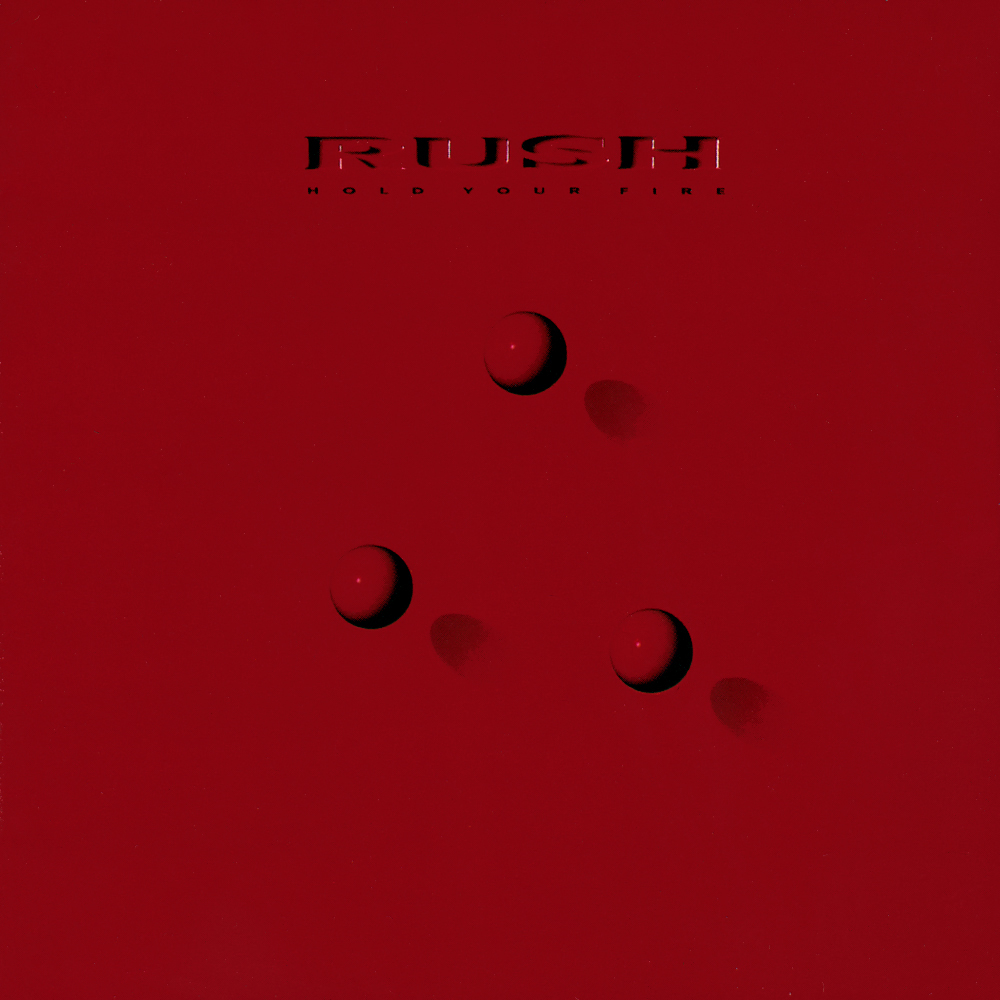
Which is my long-winded way of setting the stage for when I first encountered Hold Your Fire. The day before the official release date, I unpacked the box in which our store’s copies were packed, and gazed in admiration at the cover:
This was something unprecedented in Rush album cover art – instead of a meticulously detailed Hugh Syme painting containing visual puns, there were just three red spheres suspended over a red background. The obvious conclusion was that Alex, Geddy, and Neil were now reduced to the simplest, most perfect solid in geometry – polished and ready to bounce off of each other like billiard balls. Visually, at least, Hold Your Fire was sleek and minimalist. Peter Collins, who produced Power Windows, was back in the saddle, which boded well. I couldn’t wait to hear the music.
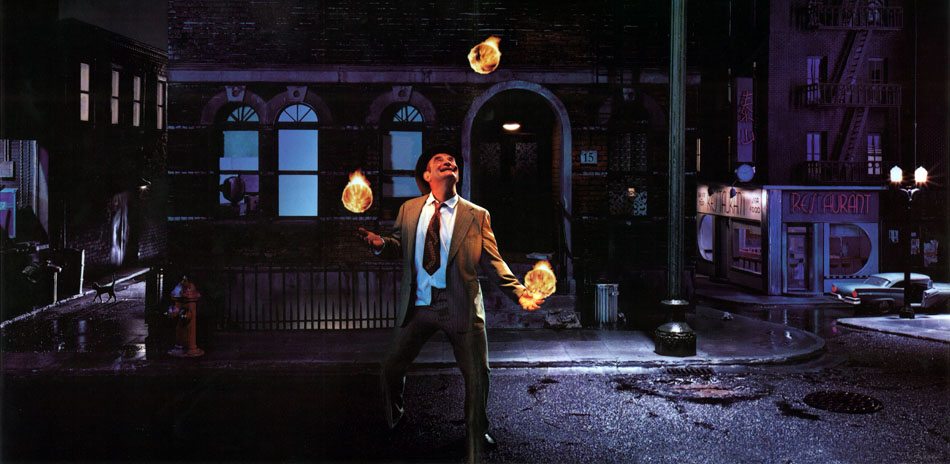
Inside the booklet, there was a spread that was more like what Rush fans expected: a man juggled three flaming balls (hold your fire, indeed), the building behind him vaguely resembled the façade in the Moving Pictures cover, in one of the windows you could make out the three vintage television sets from Power Windows, on the sidewalk stood the red fire hydrant from Signals, and the Chinese restaurant’s clock read 21:12 in military time (it turns out the restaurant’s sign reads Tai Shan, as well).
The first track, “Force Ten”, opens with a bone-rattling jackhammer and sampled choir, quickly followed by a straight-ahead drumbeat while the bassline leaps and bounds. Alex’s guitar is punk-like in its simplistic riffing – this is one of the most aggressive songs Rush has written up to this point in their career. Which makes the second track such a surprise. “Time Stand Still” features Aimee Mann, leader of the pop group ‘Til Tuesday, on vocals. Aimee Mann?? Once the shock of hearing someone besides Geddy sing on a Rush song, it’s clear this is actually a nicely constructed, interesting tune. Alex’s arpeggiated, brittle guitar sound is great in this context, and “Time Stand Still” stands the test of time as one of Rush’s most radio-friendly tunes. Neil’s wistful lyrics are very touching:
“Summer’s going fast- Nights growing colder Children growing up- Old friends growing older Experience slips away…”
“Open Secrets” is a bass/synthesizer dominated song with Alex providing some tasteful guitar filigrees as Geddy sings about how true communication is difficult between two people, due to their reluctance to be open and honest. As a matter of fact, the entire album’s theme is one of restraint. Where Power Windows was about power and the use of it, Hold Your Fire is about controlling that power – exercising restraint, in other words.
“Second Nature” begins with a nice keyboard riff, and slowly builds in intensity. Neil’s drums are excellent on this track, as he lends a touch of exotic rhythm to it. The song has a laconic pace to it, with lots of swirling synthesizer washes throughout.
Things definitely pick up in “Prime Mover”, which features some of Geddy’s finest bass work ever. In the same way New Order’s bassist Peter Hook often plays lead, Geddy carries this tune while Neil and Alex play over, under, and around him. This one of the strongest tracks on the album, and it benefits from a nice balance of keyboards vs. guitar/bass/drums.
“Lock and Key” was the first single off the album, and it’s a very good track. [Update: a Progarchy reader has informed me that “Force Ten” is actually the first single off of HYF. Thanks, Will!] Alex gets to rock out with some fat power chords and a fine solo, while Neil really shines on drums. This track will give your subwoofer a workout! The lyrics deal with how everyone keeps their “real” feelings under lock and key, in order to maintain civility:
“We don’t want to be victims On that we all agree So we lock up the killer instinct And throw away the key”
“Mission” contains the album title: “Hold your fire/Keep it burning bright/Hold the flame/’Til the flame ignites/A spirit with a vision/Is a dream with a mission.” Not one of my favorite tracks, but it is still an enjoyable listen.
“Turn the Page” is a whole ‘nother matter, though! This song is one of the best Alex, Geddy, and Neil have ever recorded. An unaccompanied bass riff starts things off, until Alex enters with some slashing guitar, and Neil lays down a rapid pulse. When the chorus begins, there is an atmosphere of time being suspended as Neil hits every other beat, then suddenly kicks it into overdrive with his patented bass pedal and cross-rhythmic work. After Alex’s solo, a stomach-churning bass synth explodes (at the 3:43 mark), and there is a mad dash to the end.
“Tai Shan” is an oddity – it has a too-obvious Asian influence musically, and the lyrics concern a fabled mountain in China where supposedly you are granted long life if you reach the top and raise your arms. It doesn’t exactly fit the tone of the rest of the album, though.
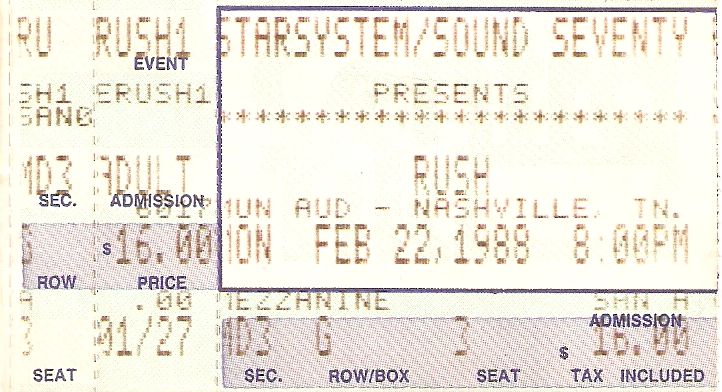
“High Water” closes things out on a relatively subdued note. A fitting conclusion to an album full of dynamic contrasts. By 1987, compact discs had become popular enough that Geddy, Alex, and Neil no longer felt constrained by vinyl’s time limitations. Hence, Hold Your Fire clocks in at a generous 50:30 minutes. It was followed by their third live album, A Show Of Hands. The DVD of that album is available as part of the Replay set, and it is an excellent summary of Rush’s “Synthesizer Period”. The Hold Your Fire tour was the first time I saw Rush live, so it holds a special place in my journey with Rush. After A Show Of Hands, Rush left their longtime label, Mercury, and signed to Atlantic. They eventually scaled back the keyboards, and returned to a more guitar-based sound. Hold Your Fire was the culmination of elements they had been developing since Signals, and they wisely stepped back from going down a synth-heavy pop/rock path.
Do I believe Hold Your Fire to be Rush’s finest album? No, I give that honor to Permanent Waves. However, I don’t think Hold Your Fire has ever gotten the respect it deserves. Rush plays relatively few songs from it on their tours, and it peaked at #13 on the charts when it was released. If listened to in conjunction with Power Windows, it completes what that album began. Enough time has passed to listen to it with fresh ears, and we can appreciate it for what it is: a successful attempt to craft a radio-friendly album filled with accessible songs. Sometimes you just have to have some fun!
* For our younger readers, a cutout was an Lp that the label deeply discounted because the title was overstocked. The label would cut a notch in the cover, and stores would sell it for 70% – 80% off the retail price.
“Turn The Page”, from A Show Of Hands:
[Ed. note–Tad’s is the first in a series of posts celebrating the fortieth anniversary of our beloved Rush]
The paradox of music videos is that they grew worse as their budgets grew better. Initially, too-literal visual interpretations of lyrics, cheap, clichéd images such as smashing glass, and singers earnestly acting as actors signaled disaster. Later, when the productions resembled, in budget at least, a typical James Cameron film, the pretentiousness clashed with the inherently kitsch format. Think “November Rain.” Aspiring to make an epic music video misses the point.
The jarring new Pixies clip for “Snakes” depicts paper-mache piñata people escaping encroaching predators. It is as off-kilter as the band that doesn’t once appear in it. The disturbing mini-movie makes more sense after a few viewings, which makes sense given that, unlike real movies, music videos aim for hundreds of repeat screenings. The surprise ending, positively Shyamalanian if not Hitchcockian, makes clues, meaningless upon first glance, exude meaning after repeat YouTube visits.
YouTube appears as a worthy successor to MTV. Surely its manner of monetizing—brief ads as payment for watching a clip—works better than the expectation that an inherently impatient demographic, clicker in hand, will waste two-minutes waiting for the songs to return. It’s also less one-size-fits-all MTV, and more user-friendly ’50s jukebox, in its all-request approach. Alas, no Martha Quinn or Triple J walks you through the process, and, like so much on the web, you must go knowingly in search of cool—cool isn’t going to come find you.
Still, making one of the best music videos ever after musicians have largely stopped making, and fans have stopped watching, music videos evokes the idea of a great radio serial broadcast in the 1980s or an eighteenth-century army going into battle with bows at the ready.
“Babe, I love you,” sings Dennis DeYoung in the hit song he wrote for the rock band Styx. It was 1979. “Babe” was on Cornerstone, the band’s ninth album. It went triple platinum, selling over three million copies.
The last time Dennis visited Vancouver was in 1981. Styx had just released Paradise Theater, their tenth album, which also went triple platinum, thanks to phenomenal songs like “Too Much Time on My Hands” and “The Best of Times.”
But in 2014, Dennis finally returned to British Columbia, with six other musicians alongside him to play a concert, “The Music of Styx,” at the Hard Rock Vancouver. One of them, on background vocals, was his wife Suzanne.
Dennis introduced Suzanne to the audience as the woman he sings about in the song “Babe.” He also pointed out that their marriage has lasted forty-four years. After all these years, the song still stands strong as an inspired testimony to true love.
Although he is himself sixty-seven years old, Dennis sang all the songs at this year’s Vancouver concert with the same stunning, mega-talented voice and passionate conviction that he had in his youth.
Dennis and Suzanne are both Catholics. Both half-Italian, they grew up in the same Chicago neighborhood. They met at the ages of seventeen and fifteen as visitors to a dance at Mendel Catholic High School.
Sometimes bands that openly wear their influences on their sleeves are derided for being derivative and lacking in originality—retro is both cool and a dirty word, it just depends what you are applying the label to.
Bonkers and Retro
‘Bigelf’’s – ‘Into the Maelstrom’ is so openly retro in style that on the surface it appears an easy target to shoot down as a pastiche. Straight off the bat, they hit you hard with a massively distorted rock guitar riff, down and dirty from the Sabbath vaults. This is pure unadulterated 70’s heavy rock, well produced but not tweaked with any modern edge or given the Muse tune-up that came about from the late 90’s onward. It’s rough and gutsy, a sheer wall of noise which sounds like a handful of sweaty leather clad guys, albeit with an androgynous smudge of mascara, grinding out the album in one go. Analogue mixing with old tube amps–everything real, down to the beat up guitars and whisky bottles lying around the studio. The truth may be far from this picture but the image the music musters has that old fashioned honesty about it.
The riffs from guitarist Luis Maldonado are for the majority of the album full of Tony Iommi inspired muscle. They chug out mercilessly behind a relentless pounding Portnoy beat, and yes at times he is very much comparable to Ward himself.
It’s only rock n’ roll but I like it…
Lightening the mood from the dark, doomy Sabbath sound is a layering of glam and synth-laden progressive rock with American Psychedelic weirdness. The former of these is the flavour of the Bowie Glam era evident in the vocal from founder member and writer, Damon Fox.
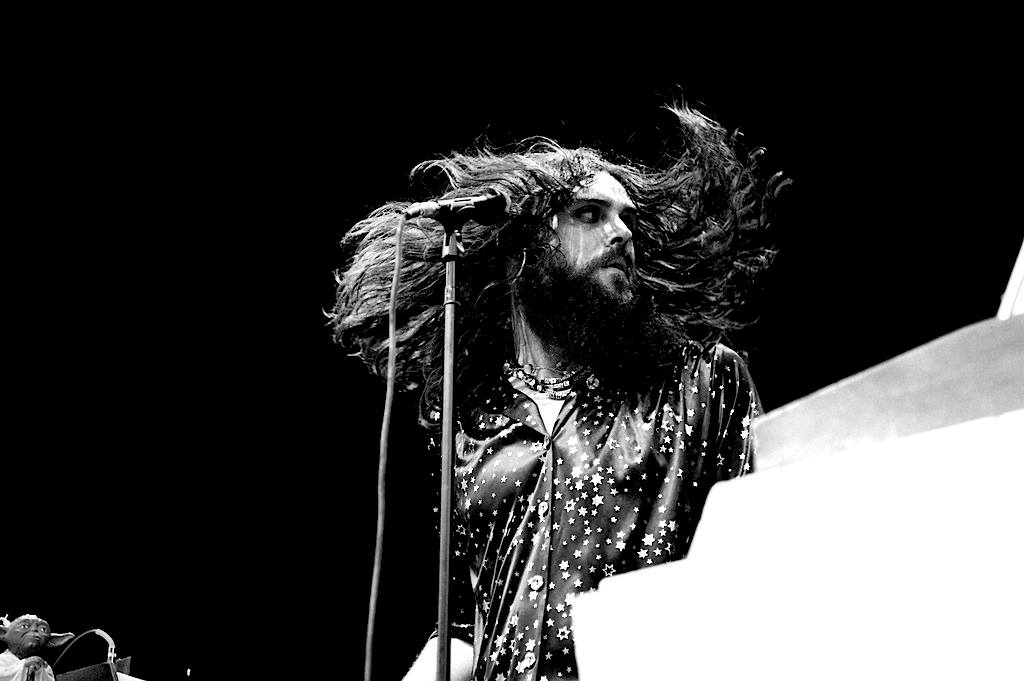
Damon Fox – A man out of time…
Thematically it’s all rather space-edged in concept—something that was all the rage in the early 70’s as the space race came to the peak of its popularity. The material ignores all the modern elements of rock music and focuses on far off sci-fi conceptualisation in sounds like the fantastically bonkers opener ‘Incredible time machine’ or in ‘Hypersleep’ and ‘Edge of Oblivion’–tracks that would have sounded perfect on ‘Rainbow Rising’, ‘Heaven and Hell’, In Rock and a whole host of classic rock albums from the era, not forgetting of course Ziggy Stardust and the Spiders from Mars.
If these are albums that sit in your battered vinyl collection or still adorn your old patched up denim that sits in the back of your wardrobe then this is the album will make you put it on and air guitar in your bedroom once more. It has the ability to do that and in the process the last 30-40 years melt away.
Each track has the ability to grab you from from the first play with catchy hooks, memorable choruses with some effective harmonies which give way to traditional guitar solos that are still as relevant and vibrant in the 21st century as anything from Gorman or Tipton glory days. ‘Already gone’ is an good example of this in the closing third.
Mixing up the sound further is a number of other bands such as ELO in the form of the big Beatle sound they perfected. Present in the song, ‘Theater of Dreams’ is a big belting dose of Jeff Lynne with a good splash of Cockney Rebel added for good measure.
The progressive start to the last song ‘ITM’ has tinges of King Crimson at times before breaking into some more solid Glam infused progressive rock. In this track the gloves are off and the music gets about as proudly overblown as it can for the last eight minutes. It’s not hard to imagine this live in concert, the drummer would be 20 feet above the stage on a riser and below guitarists would windmill the last chords through the fizz and smoke of a barrage of pyrotechnics. Famous live albums would follow from on afterwards – Live in japan, in a gatefold double LP—a classic for all time. Yes they are most definitely from another time and space.
The future – 70’s style!
All this may sound a tad indulgent, to bask in glow of a 70’s sounding rock band, an echo of a bygone era, not even the real thing. Yet it serves as a reminder of when rock was good. Stripped down, it’s truthful and unashamed at it’s flairs and sideburns and it’s head-down, pot-headed scifi weirdness. The world has moved on and through its digital, clinicalness it has lost some ability to charm and mystify simply like Alice in Wonderland or Dorothy over the rainbow. The feeling achieved from listening to ‘Into the Maelstrom’ can return you there and it’s a great reason to get this record. On vinyl of course!
Into the Maelstrom – Track Listing:
1. “Incredible Time Machine” 3:57
2. “Hypersleep” 5:38
3. “Already Gone” 3:29
4. “Alien Frequency” 4:15
5. “The Professor & The Madman” 6:00
6. “Mr. Harry McQuhae” 6:14
7. “Vertigod” 3:58
8. “Control Freak” 2:52
9. “High” 7:11
10. “Edge of Oblivion” 6:34
11. “Theater of Dreams” 4:02
12. “ITM” 8:10
• “I. Destination Unknown”
• “II. Harbinger of Death”
• “III. “Memories”
Yes will perform 1971′s Fragile in its entirety as well as every track from 1972′s Close To The Edge, followed by an encore of the band’s greatest hits and material off their new studio album, Heaven and Earth, which is due on July 8.
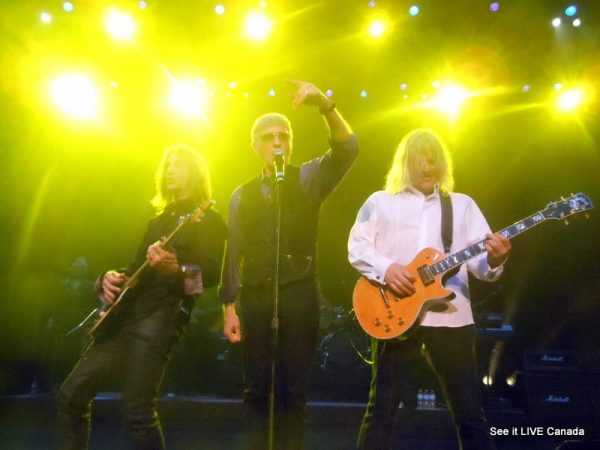
Bassist Chris Squire, guitarist Steve Howe, drummer Alan White, keyboardist Geoff Downes and singer Jon Davison will kick off the tour in Boston on July 8.
The 35-show run is currently scheduled to come to a close on August 24 at the Greek in Los Angeles.
YES Tour Dates – Summer 2014
JULY 2014
7/8 Blue Hills Bank Pavilion, Boston, MA
7/9 Radio City Music Hall, New York, NY
7/11 Toyota Oakdale Theatre, Wallingford, CT
7/12 NYCB Theatre at Westbury, Westbury, NY
7/13 Newport Yachting Center, Newport, RI
7/15 Warner Theatre, Washington DC
7/16 Hampton Beach Casino Ballroom, Hampton, NH
7/18 Seneca Allegany Casino, Salamanca, NY
7/19 Tower Theater, Philadelphia, PA
7/20 Carnegie Music Hall, Munhall, PA
7/22 Meadow Brook, Rochester Hills, MI
7/23 Hard Rock Live Northfield Park, Northfield, OH
7/25 Overture Hall, Madison, WI
7/26 Copernicus Center, Chicago, IL
7/28 Ryman Auditorium, Nashville, TN
7/29 Louisville Palace, Louisville, KY
7/30 Symphony Hall, Atlanta, GA
AUGUST 2014
8/1 Seminole Hard Rock Live, Hollywood, FL
8/2 Mahaffey Theater, St. Petersburg, FL
8/3 Bob Carr Performing Arts Centre, Orlando, FL
8/5 Bayou Music Center, Houston, TX
8/6 Verizon Theatre at Grand Prairie, Grand Prairie, TX
8/7 Arvest Bank Theatre at The Midland, Kansas City, MO
8/9 Paramount Theatre, Denver, CO
8/10 TBA
8/12 Ikeda Theatre at Mesa Arts Center, Mesa, AZ
8/13 Legends Theater at Route 66 Casino, Albuquerque, NM
8/15 The Joint at Hard Rock Hotel & Casino, Las Vegas, NV
8/16 City National Grove of Anaheim, Anaheim, CA
8/18 Humphrey’s Concerts By the Bay, San Diego, CA
8/19 City National Civic, San Jose, CA
8/21 Tulalip Amphitheatre, Tulalip, WA
8/22 Spirit Mountain Casino, Grand Ronde, OR
8/23 Thunder Valley Casino Resort, Lincoln, CA
8/24 The Greek Theatre, Los Angeles, CA
…
The 35-date summer tour will feature YES performing–in their entirety–1971’s groundbreaking album FRAGILE for the first-time ever and a repeat performance from last year’s tour of 1972’s CLOSE TO THE EDGE, followed by an encore of the band’s greatest hits and material off their new studio album, Heaven and Earth, which is due on July 8.
Kicking off July 8 in Boston, the tour will then stop at New York City’s Radio City Music Hall July 10 before making its way throughout the Northeast, hitting Wallingford, CT, Westbury, NY, Newport, RI, Washington, DC, Philadelphia, Pittsburgh and more. Among their many tour stops, YES will perform in Detroit, Madison, Chicago, Nashville, Louisville, Atlanta, St. Petersburg, Orlando, Houston, Dallas, Denver, Phoenix, Las Vegas, San Diego and San Jose before wrapping August 24 at the Greek Theatre in Los Angeles. …
During the encore on the upcoming tour, the multi-platinum progressive rock band–bassist CHRIS SQUIRE, guitarist STEVE HOWE, drummer ALAN WHITE, keyboardist GEOFF DOWNES and singer JON DAVISON—will also perform material off HEAVEN AND EARTH, their new studio album, out July 8.

 Some reflections on Roger Scruton on “The Sacred Space of Music“:






 Progarchy