The Enemy Inside: Outside the USA

A big thanks to Kevin Williams for his first listen (and heads up) to the new Dream Theater: “The Enemy Inside”.

The new track debuted over at USAToday.com, but if (like me) you are located in Canada, the streaming from SoundCloud will not work at that link.

So, over at the Dream Theater Facebook page, there is a link that takes you to a localized stream for non-USA countries: http://smarturl.it/theenemyinside

That link didn’t work for me (I got a “404 Not Found—The requested resource was not found” message), but I did track down the track for Canadian playback over here: Dream Theater – “The Enemy Inside” [Song Stream] [Exclusive Canadian Premiere].

The track is awesome. You’ll want to read Kevin’s excellent “first listen” review, to compare notes. Be sure also to listen to “On the Backs of Angels” at the same time, to compare your listening experience with his assessment:

The chorus is soaring – a perfect counterpoint to the thunderous verse sections – and it immediately grabbed me in the same way that “On The Backs Of Angels” did from “ADTOE.” It’s then followed by a keyboard riff very reminiscent of a run from “ADTOE.”

We’re looking forward to September 24!

Alex Lifeson and The Trees

It is entirely fitting that Rush guitarist Alex Lifeson makes his dwelling amidst The Trees:

Ms. Zivojinovich and her husband Alex Lifeson consulted Toronto-based architect Dimitri Papatheodorou, who quickly saw the potential: The house would sit on a natural belvedere, set back from the road and surrounded by pine trees.

“It was pretty obvious that the house wanted to align with the cosmos,” he says.

Now the rolling hills north of Toronto offer a tranquil setting for family gatherings, and the trees provide seclusion for Mr. Lifeson during downtime from a demanding schedule of touring as guitarist for the hallowed Canadian rock band Rush.

In Italian, belvedere means “beautiful view.” The home’s position on a ridge offers vistas of nearby farms from the second-floor master suite and family bedrooms. The principal rooms on the main floor are encircled by trees.

Be sure to check out Alex’s fine wine cellar as you take the visual tour.

The Musical Odyssey: A Long and Winding Road

Jane Monheit

Robert Sibley reflects on what the power of music has to do with nostalgia:

The word comes from the ancient Greek words “nostos,” referring to “homecoming,” and “algia,” meaning “grief or pain or suffering.” Hence, nostalgia reflects the desire “to escape pain by returning home,” or, as some etymological dictionaries have it, “to return home safely.”

What this suggests is that nostalgia can be a form of psychological therapy, a break from the madhouse vagaries of contemporary life — you know, terrorism, killer weather, crashing airplanes, exploding towns, rampaging gunmen. To listen to fondly remembered pop songs, whether on the car stereo heading to work or at a concert, nostalgia provides such a respite. …

One of the major narrative inputs for my generation was the Beatles. John Lennon, Paul McCartney, George Harrison and Ringo Starr were effectively members of what psychologists refer to as our “fictive kin.” We didn’t know them personally like we did family and friends, but their music — from ebullient adolescent love songs such as She Loves You and the drug-mediated experiments of A Day in the Life to the symphonic farewells of Let it Be and The Long and Winding Road (the Beatles split as a group in 1970) — made them an intimate presence in our lives. The Beatles, in short, provided the musical accompaniment for many of the most meaningful moments of our lives.

I still remember doing my homework at the kitchen table in our house in north Red Deer when I first heard that brief trill of drums that opens She Loves You, my head snapping up to look at the countertop radio as if to ask “what’s this?” An insignificant moment in a life, to be sure, but somehow embedded with epiphanic clarity in my memory. Of course, I’ll never forget working up the courage to ask Maxine Edwards for a dance at the local community hall as Lennon belted out Can’t Buy Me Love. And when I hear the lyric “Out of college, money spent/ See no future, pay no rent/ All the money’s gone, nowhere to go/ … oh that magic feeling” from 1969’s Abbey Road album, I’m once again on the veranda of a dingy seaside café in western Morocco, hypnotized by the endless wash of the Atlantic Ocean as I celebrate my 24th birthday. Sun, sand, sea and song; it was pure magic.

Is this “homesickness,” an inability to cope with the world? I think not. The Beatles once sang, “Once there was a way to get back homeward/ Once there was a way to get back home.” The way, I suggest, is in the song itself. Listening to the old songs is like visiting your hometown after a long absence. You know you’re not staying, but there’s a feeling of rejuvenation in visiting times and places past.

And there’s something truly rejuvenating about cover versions of songs, especially when they defy jaded expectations and are done well.

For example, Jane Monheit has a very cool, head-turning jazz cover of “Golden Slumbers / Long and Winding Road” on her new album, The Heart of the Matter.

Jane seems to have a gift for doing terrific covers. Explore her discography and have fun discovering all her clever musical remakes and reconfigurations.

In particular, be sure to check out her stunning versions of Eric Kaz and Libby Titus’s “Love Has No Pride” (on In the Sun) and of Joni Mitchell’s “A Case of You” (on Come Dream with Me).

But, getting back to the Beatles, let me end by recommending a personal favorite — Laura Crema’s soaring cover of “Blackbird.”

Polar Kraut folks…Polar Kraut

Mattias Olsson, drummer/percussionist extraordinaire formerly in Änglagård, is a busy man. He runs his own studio in Stockholm, called Roth Händle Studios, he collaborates musically with lots of people, he lends his talents to other progressive rock outfits such as Norway’s finest – White Willow and he kicks off projects in many directions.

One of the newest projects of his is Walrus – a band which in a tongue-in-cheek manner is described like this on its Facebook-page.

Kraut Rock / Progressive Rock Group from Stockholm, Sweden. Instigators and prime movers of that immensly popular style, Polar Kraut. Two drummers, one bass player, one cello player, one keyboard player, and one chord – what more do you need?
bakgrund
September, 2010 A.DThe scene:A dark bar at the End of the World, on the shores of the Polar Sea, in the Far North of Norway. The result of some highly spirited, wine induced bragging, five strangers find themselves sharing a stage under the assumed name WALRUS. The lights go on, and there, on the spot, they have to make up some music that can live up to the brazen boasts that got them on stage.The cast:An Organ Player who can turn from lyrical to mechanical in a moment, from shimmering to abrasive, from the dead calm of the ocean to the death rattle of an orca. A remarkable Cello Player with angelic features, who seems to be having a loud on-stage argument with his instrument, always teetering on the brink of a sonic fist-fight. A Bass Player who plays in an almost geometrically meditative fashion, angular, repetitive and hypnotic, and whose fuzzed out sounds could turn iron into rust. And then there’s the two-headed beast: Two manic Drummers playing the same, sprawling double drum kit, but attacking it from different sides and angles.The sound:While early German Electronic Kraut Rock seems to be in the band’s collective DNA, that’s just a small part of it. The roots of their music may be firmly planted in age old Psychedelic and Progressive Rock, but their branches reach well into the future – to a new kind of Post-Rock perhaps. And theirs is a sound that changes constantly. Going from pastoral and emotional to jugular aggression in mere seconds, the band ebbs and flows, back and forth, creating spectacular atmospheres and moods. Building tension and tearing it down, telling stories and painting pictures. There is nothing quite like it.The denouement:

Well, shaking their heads in disbelief after the show, they quickly decided that this group, albeit still half imaginary, was too good not to be true. And in tribute to the remote part of the world where their band and their music had been born, they named their particular brand of music ‘Polar Kraut.’

Epilogue:

Some time later they reconvened in one of Stockholm’s oldest and finest active recording studios to capture the music they had been improvising on their first few concerts, using equipment from the Golden Age of Recording on both sides of the glass. And after months of meticulous editing, Bitches Brew-style, four stately compositions had been thawed out of the ice (as it were) and were ready to be let out into the World South Of The Arctic Circle.

Beskrivning

Renowned film music composer and piano player Matti Bye on Hammond & Farfisa Organs, Mellotron and Wurlitzer Piano. The Tiny and Gul 3 member Leo Svensson on Cello and Minimoog. Producer and composer Kristian Holmgren on Electric Bass and Fuzz Bass. Mattias Olsson of Änglagård on drums, with Henrik Olsson of Gul 3 and Harr joining him at their double drum kit, The Sprawl.

The studio mentioned is the legendary Atlantis studio which really is a survivor in the music biz providing real old-school recording facilities.

Mattias is a funny guy regularly posting somewhat crazy YouTube-snippets from ongoing recording projects (right now Necromonkey) from his own Roth Händle studios. Matti Bye  who is also in Walrus is a renowned Swedish composer of film scores. He’s a fine pianist with great improvisational skills! The film Maria Larssons eviga ögonblick which he wrote the score for was an Academy Award nominee 2008.

For listening and buying Bandcamp is a great place to go!

.

Happy Dominion Day, Eh!

Today’s despatch from the Great White North, land of Rush and other wonders of prog:

Happy Dominion Day, eh!

(Oh, did you say “Canada Day“? Take off, eh!)
 

Let’s bring the prog back!

Dimo-Eye-Planet

“Let’s bring the prog back!”

That’s the rallying cry at the end of the new Sound of Contact email newsletter.

If you sign up for their mailing list, you will get a link to a free download of the instrumental version of “All Worlds, All Times.”

Here’s the close of the newsletter, with the rallying cry:

We’ve been promising you something good for free and now it’s here. The first of many cool things you’ll be able to hear about and receive just by being part of SOC’s mailing list. Previously unreleased, this instrumental version of part 4 of the song Mobius Slip is more like its original state when it was improvised in the studio and recorded in just a few takes. The band was jamming on the part 2 and 3 sections of the song when they just kept going and part 4 “All Worlds All Times” was created spontaneously. Dave Kerzner’s 2 minute+ keyboard solo at the end was also done in one take. This is SOC “in the zone” exploding with raw emotion and their progressive rock influences shining through. You can hear the intricate interplay between the guitar, keys and Simon’s distinct drumming. Lyrics were later written to this section to wrap up the story of the album. But the instrumental version has a life all its own. This is a gift to Sound of Contact fans and a big thank you for your support!
Note: Please don’t share the song with others or upload it to YouTube or anywhere on line. We ask you to simply tell anyone you know who might like it to sign up for our newsletter and they will be able to receive this song and more in the future. A big thanks from the band! Let’s bring the prog back!

Return of the Giant Progweed

Audioholics has an awesome interview with the band members of Sound of Contact, both collectively and individually.

Simon Collins says there: “The band I used to dream about when I was a kid has now arrived and I’m bloody excited about it!”

Oh yes. We are too, Simon!

Check out what Simon (SC) and Dave Kerzner (DK) say when they are asked about why they are doing prog:

SC: This band is exploring new sonic ground but also playing homage to some of our favorite music.  We don’t really look at it as just prog-rock.  There is pop sensibility in the band and it’s on the album, so we don’t look at it that way.

DK: I don’t have a problem being associated with the “prog-rock” label because that’s ultimately a good thing. We’d love nothing more than to do our part in helping to bring that adventurous, experimental and eclectic style back into the fold. I personally miss the excitement of new albums coming out with rich atmosphere, story, dynamics, mood and thought-provoking lyrics. I hope we see more and more of it to be honest. It’s fuel. Fortunately there are some classic albums of this genre to listen to and discover for people who are new to it. But it’s nice to offer new music of that nature to the world. To me it’s a form of giving back. This is what motivated me to want to make music in the first place. The art and beauty of it.

Dave Kerzner also gives the details there on his insanely great keyboard and synth collection:

  • Yamaha CP70
  • Kawai EP-308
  • Hammond C3 Organ with Leslie 122
  • Hammond L100 with Leslie 145
  • RMI Electra Piano
  • Arp Quadra, Solina and Arp 2600
  • EMS Synthi AKS
  • Oberheim 8 Voice SEMs and OBXa
  • EML 200 Modular
  • Serge Modular
  • Roland System 100
  • Sequential Circuits Prophet 10, Prophet 5 Rev 2 and Prophet T8
  • Wurlitzer 200A, 270, 140B
  • Hohner Electra Piano, Pianet N, Clavinet D6, Cembalet
  • Baldwin Electric Harpsichord
  • Vox Continental and Farfisa organs
  • Roland VP330 Vocoder
  • Yamaha EX-1, CS60
  • Rhodes Mk1, Mk2, Mk5 and Suitcase 88
  • Minimoog Model D
  • Moog Taurus I
  • Univox MiniKorg
  • Arp ProSoloist
  • Mellotron M400
  • Eigenharp Alpha
  • Haken Continuum Fingerboard
  • Yamaha Motif XF7
  • Nord Stage 2 73 and 88
  • Nord Wave
  • Prorphet VS rack
  • Yamaha FS1r
  • Kawai K5000r
  • Kurzweil K2600
  • Roland V-Synth rack and 5080
  • Korg EX 8000
  • Oberheim Matrix 1000
  • Arturia Origin

Whoa! Built for prog, I must say.

And don’t miss the cool interview over at Gigs and Festivals, where the guys reveal their favorite tracks on the Dimensionaut album:

SC: I really love ‘Cosmic Distance Ladder‘ as it is one of few tracks on the album that came out of pure jamming and chemistry. It captures the sound of our band in the sense it really highlights all of our musicianship and our ability as a band to create a mental atmosphere.

DK: It’s hard to pick one but if I had to then maybe ‘Omega Point’ would be my choice because it was done in only one take and the music just came out of thin air it seemed. We wrote the words around this jam in the studio and that has a raw energy to it that I really like. Plus the lyrics are a mind trip.

As for me, my favorite Prog Song of 2012 was Flying Colors’ “Infinite Fire.”

But for 2013, the track seemingly destined to take the title is “Möbius Slip“!

What more needs to be said? “Salvation found!”

The Spiritual Vision of Dimensionaut

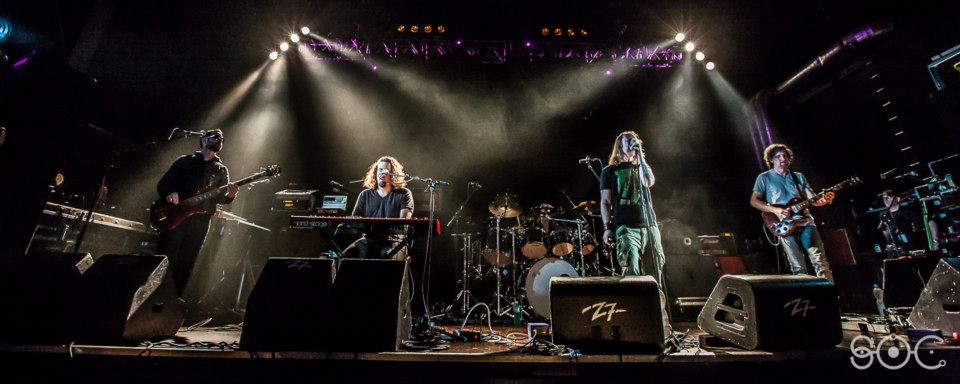
Sound of Contact LIVE at Z7 in Switzerland—Photo by Andy Wright

I have been contemplating the spiritual riches of Dimensionaut, the truly awesome prog masterpiece from Sound of Contact.

For me, the album does what prog does best, with that characteristically proggy ability to immerse the listener in a cosmic philosophical meditation.

To give another example: One of my absolutely favorite tracks from Big Big Train, “The Wide Open Sea,” does this sort of musical meditation stunningly well.

So, to encounter in Dimensionaut an album-length, equally successful exercise in that kind of philosophical and spiritual meditation, is a real thrill. And it’s an even more remarkable achievement if we consider that Dimensionaut is the equivalent of a vinyl double album.

Here is how I would slice it up for a deluxe vinyl gatefold edition:

SIDE 1:
01. Sound Of Contact (02:05)
02. Cosmic Distance Ladder (04:43)
03. Pale Blue Dot (04:44)
04. I Am Dimensionaut (06:25)

SIDE 2:
05. Not Coming Down (06:01)
06. Remote View (03:54)
07. Beyond Illumination (05:53)
[featuring Hannah Stobart]

SIDE 3:
08. Only Breathing Out (05:57)
09. Realm Of In-Organic Beings (02:52)
10. Closer To You (05:05)
11. Omega Point (06:30)

SIDE 4:
12. Möbius Slip (19:36)
I – In The Difference Engine
II – Perihelion Continuum
III – Salvation Found
IV – All Worlds All Times

If people approach Dimensionaut with an open mind, they will have to admit that this double album is an incredible achievement. Amazingly, it is prog that is accessible to everyone, and yet it does not shatter its integrity with any compromises.

All the negative reviews that I have read, and any reservations that I have heard expressed, stem simply from invidious comparisons, which are completely unfair.

Rather, if you clear your headspace of all preconceptions and genealogical obsessions, and just enter into the spirit of the music, the musical conclusion is inescapable:

With Dimensionaut, the Spirit ever lingers… undemanding contact in your happy solitude!

(I append below an interesting video in which Simon Collins and Dave Kerzner talk about the album’s story concept. They affirm that the musical journey explores not just dimensions of science fiction and romance, but most especially a serious spiritual dimension.)

Dimensionaut: Carry On the Awesome Prog

No son of mine?”

No way!

Simon does his dad proud with Dimensionaut, an incredibly satisfying new concept album that instantly and undeniably enters the running for the Top Ten prog albums of 2013.

And I am happy to report that the disc was created in my corner of Canada:

In 2010, Simon, Dave, Matt and Kelly went to record at Greenhouse Studios in Vancouver in different trio combinations with engineer Chris Holmes. The music and story of “Dimensionaut” was born.

Joining the team to mix the album was veteran engineer Nick Davis (Genesis, XTC, It Bites) who came from England to Canada to mix at The Warehouse in Vancouver. The album was mastered by Gavin Lurssen and Rueben Cohen of Lurssen Mastering.

In 2012 Simon Collins and Dave Kerzner found themselves working again on a Genesis song but this time it was by the invitation of Steve Hackett who was putting together his album “Genesis Revisited 2”. The album includes both Simon and Dave participating on vocals and keyboards for the epic Genesis song “Supper’s Ready”.

Hey… no wonder it sounds sooooo good!

This is great stuff, progarchists. Crank it up and enjoy it!

I am happily giving it my top rating — five stars.

Carry on, my awesome son

… we will have prog when you are done!

SOUND OF CONTACT – ‘Dimensionaut’

01. Sound Of Contact (02:05)
02. Cosmic Distance Ladder (04:43)
03. Pale Blue Dot (04:44)
04. I Am Dimensionaut (06:25)
05. Not Coming Down (06:01)
06. Remote View (03:54)
07. Beyond Illumination (05:53)  [featuring Hannah Stobart]
08. Only Breathing Out (05:57)
09. Realm Of In-Organic Beings (02:52)
10. Closer To You (05:05)
11. Omega Point (06:30)
12. Möbius Slip (19:36)
I – In The Difference Engine
II – Perihelion Continuum
III – Salvation Found
IV – All Worlds All Times

Check out the thoughtful review over at Power of Metal by Jason Spencer.

Radio Resurrection

Video Killed the Radio Star

Rocco Pendola argues that “Pandora has done more for local and indie artists in the last 30 minutes than the music industry has in the last 10 years”.

Further, he envisions a way that Pandora can really revolutionize the music industry:

Pandora can leverage the massive amount of data it collects—for example, what do people listen to and where do they live?—to do more local concert promotion, but also front the costs a band has to pay to get into local venues. And/or it can take over the chore of selling those tickets. Organize it as a massive contest. Make it a way of life. I don’t care. But set up a situation where Pandora does the dirty work for the local musician.

If it’s truly in Pandora’s DNA—and I know it is—if Pandora really cares about independent music—and I know it does—it will take the next step. There’s no reason not to. Pandora has everything to gain, nothing to lose. There’s little risk and much reward … if Pandora goes all-in with local music, starting in Hollywood and other major markets.

And his argument is worth reading all the way through to his conclusion:

If Internet radio—a rapidly growing and primary mechanism for spins, sales and promotion of music of all types—is healthy, artists of all sizes benefit. A healthy Internet radio can put more resources into providing the best user experience possible and sales and marketing, which will pump up local music scenes, sell concert tickets and drive digital record sales.

Internet radio—no matter how they pay their royalties (compulsory like Pandora or through direct deals like Spotify) and no matter how they deliver their music to listeners—needs to band together. They must form a bloc to expose the music industry for what it is—a short-sighted bunch of connected entities committed, more than anything, to keeping things exactly as they are, even as they see patterns of consumption and engagement change around them.