I agree that this is a great way to keep the peace when people are being obnoxious and unreasonable.
And it’s also a fine way to habitually cultivate humility on a personal level.
So okay, Mike, you got it. You’re one of my favorite drummers, and you are on many of my favorite albums this year!
But surely something only becomes a favorite because we consider it the best.
And the real reason we share “best of” lists, is not because we claim omniscience, but because we want to share what we know and love, so that others will do the same for us.
If they do, we can thereby learn from them, and thus grow in our love…
We don’t want to merely win musical arguments. We want to learn from the musical experiences of others, and to expand our own experiences, and to enlarge the way we think about music.
But still, when it comes to aesthetic argument, Roger Scruton gets it right:
Perhaps the most persistent error in aesthetics is that contained in the Latin tag that de gustibus non est disputandum— that there is no disputing tastes. On the contrary, tastes are the things that are most vigorously disputed, precisely because this is the one area of human life where dispute is the whole point of it. As Kant argued, in matters of aesthetic judgement we are “suitors for agreement” with our fellows; we are inviting others to endorse our preferences and also exposing those preferences to criticism. And when we debate the point we do not merely rest our judgement in a bare “I like it” or “It looks fine to me”; we search our moral horizons for the considerations that can be brought to judgement’s aid. Just consider the debates over modernism in architecture. When Le Corbusier proposed his solution to the problem of Paris, which was to demolish the city and replace it with a park of scattered glass towers and raised walkways, with the proletariat neatly stacked in their boxes and encouraged to take restorative walks from time to time on the trampled grass below, he was expressing a judgement of taste. But he was not just saying, “I like it that way.” He was telling us that that is how it ought to be: he was conveying a vision of human life and its fulfilment, and proposing the forms that gave the best and most lucid expression to that vision. And it is because the city council of Paris was rightly repelled by that vision, on grounds as much moral and spiritual as purely formal, that Le Corbusier’s aesthetic was rejected and Paris saved.
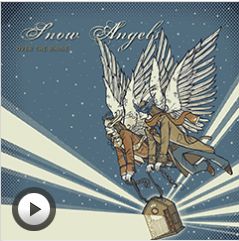
…for some free music! Noisetrade is offering a download of Over The Rhine’s Christmas album, “Snow Angels”. Nice, jazzy/folk holiday music. Click the album cover to go to the download page.
Porcupine Tree’s new live album, “Octane Twisted” arrived in the mail today. It comes in several configurations – the one I ordered is a 2-cd and single dvd set of their April 30, 2010 concert in Chicago.
The first disc is a complete presentation of their 2010 album, “The Incident”. It’s an excellent performance, with the highlights being the Animals-era Floydian song “Time Flies”, and the album closer, “I Drive the Hearse”.
Because they perform the entire album without breaks, the audience is pretty much taken out of the picture. While watching the dvd of the show, it’s clear there is incredible chemistry between the band members, but I didn’t get much sense of rapport with the crowd. Gavin Harrison once more demonstrates he is one of the greats of prog percussion. He deserves to be mentioned in the same breath with Neil Peart and Nick D’Virgilio. Richard Barbieri is a master at creating evocative atmospherics, and Colin Edwin makes playing complicated bass runs look effortless. Once again, John Wesley joins the core PT members to play guitar and vocals.
Steven Wilson is the main attraction, and he doesn’t disappoint – playing both electric and acoustic guitar, and some piano. He pulls off some excellent solos in “The Incident”, “Time Flies”, and “Octane Twisted”. And, of course, he’s barefoot throughout the concert!
Disc 2 contains the rest of the Chicago concert, as well as three songs from an October 14 London show. The other Chicago songs are “Hatesong” (probably my least favorite PT song), “Russia On Ice/The Pills I’m Taking” (“Russia On Ice” drags, but “The Pills I’m Taking” picks up the pace nicely), “Stars Die” (from the early days!), and “Bonnie the Cat” from The Incident (odd choice for a concert closer). The London songs are “Even Less” (a perennial favorite, but this performance is a little lackluster), “Dislocated Day”, and “Arriving Somewhere But Not Here” (a really good rendition of a beautiful song).
Overall, this a fine performance, and you get a lot of music for your money. “The Incident” is not one of my favorite Porcupine Tree albums, though, so unless you like it a lot, you could probably give this one a pass. I was very disappointed that the dvd is just the basics: no special features, and it only offers 2.1 audio, not a 5.1 mix. Also, the editing was much too jumpy for my tastes; the camera rarely stayed on one angle for more than 3 seconds, and I would have preferred to have longer shots of the entire band playing.
If you are trying to decide which dvd of Porcupine Tree to buy, I highly recommend “Anesthetize”. It’s an incredibly energetic performance of an excellent album, “Fear of a Blank Planet”. “Arriving Somewhere” is also very, very good, and features music primarily from “Deadwing” and “In Absentia”.
One of the reasons that I love rock and roll is that, when it’s at its best, it exemplifies St. Augustine’s observation about God being ever ancient and ever new. When you hear a great pop song for the first time there is a sensation of both familiarity and innovation; you feel like you’ve discovered something wonderful and timeless that has always existed that at the same time is fresh and mysterious. Contemporary pop music is good at the evoking the first feeling, but not the second.
He pins down the mysterious side of the Beatles this way:
Today’s bands usually begin weird and adventurous and grow bland and mainstream over time (a great exception is Radiohead). The Beatles did the exact opposite.
Prog seems to especially strive after the mysterious and adventurous. But prog’s Achilles’ heel is when, at its worst, it lacks the truly rocking sensation of freshness.
Which is why prog always needs to rediscover that fountain of eternal youth, to be found, perhaps, at the rock show…
I was raised listening to the 3 M’s: Motown, Musicals and Mozart. My knowledge of singers, let alone songwriters, was limited to The Temptations, Dionne Warwick, and Rogers and Hammerstein. My mother likes the story of driving me and a neighboring girl to pre-school one day, and the little girl told us that she loved Michael Jackson. “Oh, me too!” I said. “And what is your favorite Michael Jackson song?” asked my mother. “Thriller,” said the girl. “Oh What A Beautiful Morning!” replied I.
Fast forward to 1999: my oldest friend’s birthday was approaching in late June. We decided to see Tarzan, the Disney film released that summer. Perhaps you’ve never seen it; it’s a good movie, though I have serious doubts that Edgar Rice Burroughs would have ever penned a gorilla character that sounds like Rosie O’Donnell. This was also my first encounter with anything prog music related.
At age 11, “progressive rock” was not in my vocabulary or musical repertoire. Genesis was the first book of the Bible. And yet, Phil Collins filled my ears. He wrote the entire soundtrack of Tarzan, you see. He sang his own songs, instead of the animated characters filling in the key notes. It was mesmerizing, playful, and flowed like chocolate over strawberries: it was utterly delicious to listen to, and I sat in that dark theater and occasionally closed my eyes, if only to make the song’s notes linger.
A few years down the road, in high school, my musical tastes included The Band, The Who, Led Zeppelin, Coldplay, Bob Dylan, Queen, Pink Floyd, Johnny Cash and plenty of pop music. I passively listened to Phil Collins because my Studio Art I, II and III teacher played him during class. I had yet to connect the reasons of why I love certain types of music, but that would surface in college.
In rural Michigan, thanks to Pandora Radio and its music shuffle, I formally met progressive rock (in the form of RUSH) over my abundance of reading requirements. After a few songs, I became smitten. I would spend hours plugged into the music, getting to know these new friends. Prog rock’s lyrics have substance; prog rock’s instrumental prowess are unmatched; prog rock kept my attention through paper writing, research and editing the independent paper I co-ran on campus.
But back to Phil Collins and Tarzan. Tarzan, the story of the man raised by gorillas who eventually comes into contact with other humans like himself and such, human nature. Collins’ song “You’ll Be In My Heart” won an Oscar, and deservedly so, but that song is far from my favorite.
In third place, “Two Worlds”:
The song parallels two families (human and gorilla) growing in their environments who both face tragedy.
Collins: “Raise your head up/ Lift high the load/ Take strength from those that need you/ Build high the walls/ Build strong the beams/ A new life is waiting/ But danger’s no stranger here.”
This is the song that explores the relationship between Tarzan and Jane, his love interest and fellow human. Less subtly, however, the film shows how the three explorers give Tarzan his first education by showing him slides of city life and the solar system, watching the stars through a telescope, teaching him to read and how to ride a bicycle. But it is Tarzan who has something bigger to teach them about being human: family ties, loyalty, protecting one’s community.
Collins: “I wanna know, can you show me/ I wanna know about these strangers like me/ Tell me more, please show me/ Something’s familiar about these strangers like me // Come with me now to see my world/ Where there’s beauty beyond your dreams/ Can you feel the things I feel/ Right now, with you/ Take my hand/ There’s a world I need to know.”
Finally, in first place, “Son of Man”:
This is one shows Tarzan’s childhood, and the challenges he encounters which shapes his person and his character. His father figure rejects him, his gorilla mother and cousin teach, help and love him, he’s forced to learn his limitations while pushing his abilities, all the while surviving in the jungle. This song reminds me of Rudyard Kipling’s poem “If…”:
If you can talk with crowds and keep your virtue,
Or walk with Kings – nor lose the common touch,
if neither foes nor loving friends can hurt you,
If all men count with you, but none too much;
If you can fill the unforgiving minute
With sixty seconds’ worth of distance run,
Yours is the Earth and everything that’s in it,
And – which is more – you’ll be a Man, my son!
Collins: “Oh, the power to be strong/ And the wisdom to be wise/ All these things will/ Come to you in time/ On this journey that you’re making/ There’ll be answers that you’ll seek/ And it’s you who’ll climb the mountain/ It’s you who’ll reach the peak.”
There is much to be said for the Tarzan soundtrack. Because of it, Phil Collins was inducted as a Disney Insider’s Legends in 2002. This may seem like a silly award, but I find it touching. In an interview with People magazine in 1999, Collins said, “We’ve broken some molds. The fact that I’m singing and the characters don’t burst into song makes it (the film) very different.”
The molds he broke were more than him singing: he introduced progressive rock into the mainstream culture via a children’s animated film, and won an Oscar as a result. He also translated the Tarzan album into German, Italian, French, and two dialects of Spanish (Latin American and Castilian), according to the Disney website – “an unprecedented feat by a musical artist for a motion picture.”
May there be many more recordings! Keep spreading the prog love, Phil.
As “Twilight: Breaking Dawn 2” takes its expected bite of the box office this weekend, let’s get the Progarchy DJ to play some Halestorm for the Twihards.
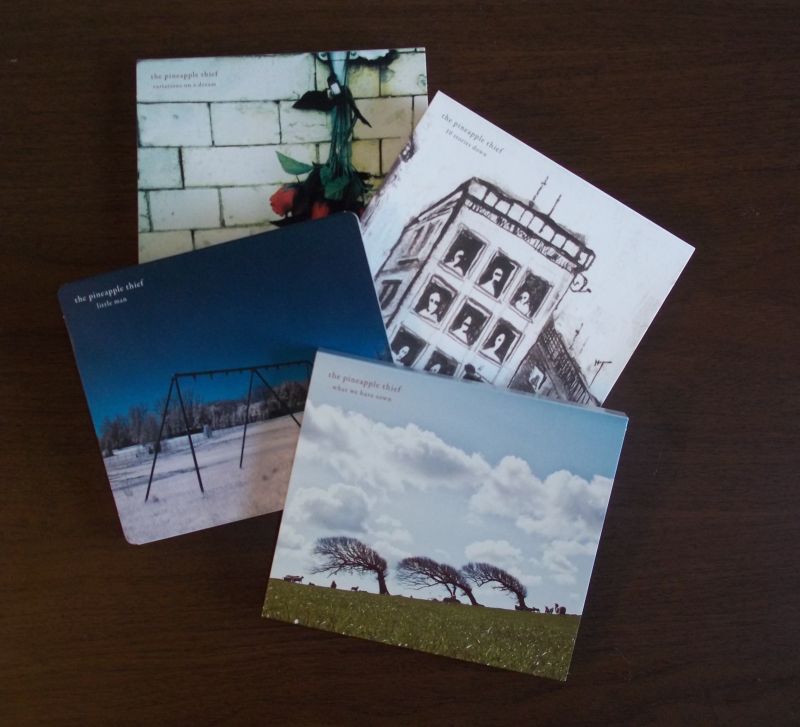
Kscope Music has been reissuing The Pineapple Thief’s albums beginning with their third, Variations on a Dream. With the recent release of their sixth, What We Have Sown, a wonderful back catalog is now available to those of us who missed them the first time around.
I happen to love Bruce Soord’s music, but there might be a “sameness” to it that can be frustrating to some prog fans. Soord’s compositional technique is very minimalist (in the same sense Philip Glass, Steve Reich, and Arvo Part are minimalist). For example, the song “Vapour Trails”, from Variations on a Dream, is nine minutes long, and the entire lyrics consist of
we’re flying too low/we’re flying too low/and trying to go far/but finding it hard/we’ve got your vapour trails to follow/you home/we’ve got your vapour trails to follow/we’re flying too fast/we’re flying too fast/and finding it won’t last/but something will pass…/we’ve got your vapour trails to follow/you home
As the words are repeated over and over, they become part of the overall sound of the song, and small variations in the melody have a much greater impact. It takes patience to listen to a typical Pineapple Thief song, but it is definitely rewarding. Every song creates a sense of time being suspended, as endless permutations of the basic melody are worked out. Perhaps Soord is the Bach of prog, and his songs are fugues!
If you’ve never heard anything by The Pineapple Thief, a good place to start is the two-disc compilation, 3000 Days. Variations on a Dream (probably my favorite, with the amazing mini-suite “Part Zero”) is Pineapple Thief at their most Radiohead-like. 10 Stories Down is more acoustic and lighter in feel. Little Man is a heartbreakingly beautiful account of Soord’s loss of a child at birth.
What We Have Sown was initially released as a quickly-recorded farewell work for the Cyclops label just before The Pineapple Thief began its relationship with Kscope. Recorded in 8 days, it is a wonderful collection that features one of Soord’s finest songs, the 27-minute “What Have We Sown?” as well as the sinuous, Middle Eastern-flavored “Well, I Think That’s What You Said”. Kscope has tacked on two bonus tracks, making it an even better package than the original.
As a matter of fact, Kscope has done an excellent job with all four reissues. They come in attractive slipcases, and all have updated artwork. Variations on a Dream and 10 Stories Down each include a bonus disc of music that was originally given away in limited editions.
The Pineapple Thief represent a more contemplative side of prog, and based upon their latest release, All The Wars, they are still exploring new and exciting musical territory.
Ok, readers, I have a confession to make. I have been indoctrinating my two-and-a-half year old son into prog fandom. In fact, on my iPhone, I have a playlist for this very purpose. The playlist has the oh-so subtle title of “Subversive Indoctrination to Prog”. When I give my son his nightly bath, music from this playlist is usually playing in the background. In fact, sometimes I even time his bath using music from this playlist. Tonight’s bath was rather long – one Underfall Yard and a Firth of Fifth, to be precise.
Am I doing the right thing? I wonder. This could end up causing my son to never be able to sit at the ‘cool kids’ lunch table. And then there is the problem of the odd time signatures being imprinted into his impressionable little brain. Will it affect his ability to dance – and could this in turn affect his ability to find a mate later on in life? Will he be trying (awkwardly) to dance to 7/4 time while a potential girlfriend is gracefully moving to 4/4 time?
On the other hand, as a concerned parent, how can I not do something like this? Should he really be turned loose in the wasteland of pop music of the present and the future as it continues its descent? Should some future Lady GaGa, some future Jay-Z, or some future Justin Bieber be allowed to shave points off of his IQ (if you’ll pardon the neo-prog pun). And living here in Texas, I could be faced with a prog parent’s worst nightmare – that he will spend his 21st birthday line dancing in a bar that exclusively plays country music. The horror … the horror.
In the end, I think I must continue. It’s a parent’s job to guide their offspring, is it not?
Son, if you are reading this someday in the future, I apologize for short-circuiting your dancing ability and whatever distress that may cause you in the dating game. May I suggest you search for a mate that doesn’t like dancing, as I found with your mother? Please know though, my son, I did this with the best of intentions, trying to keep you from polluting your musical taste with “music” created by record company executives catering to the lowest common denominator in pursuit of the highest possible profit. Art should be more than that. As Neal Peart once wrote (and you will know him soon), “glittering prizes and endless compromises shatter the illusion of integrity.” As your father, I’m going to do my best to keep your integrity intact.
“Requiem” begins with a Fripp guitar solo over Frippertronics backing. A gloomy minor mode, fully appropriate for a mass for the dead, prevails. Before long, as Fripp works his initial statement to a climax, the other musicians enter, and soon it is free-form freakout time, the spirit of “Moonchild” and improvising King Crimson III all over again. When the thrashing subsides, the Frippertronics backing has changed to an eerie augmented harmony — the transfiguration of the soul?
Temple blocks! Cowbells! OK, citizens, let’s go exit stage left (see video below), for “The Trees”… where things really get interesting at 1:46; the tension starts to build at 2:24; and — whoa! — now, here we go at 2:52! Alex’s amazingly effective solo starts at 3:08. And then, one of my favorite “great moments in prog” happens from 3:25 to 3:54.
The rest of the song is appropriate election commentary.




 Progarchy