Poor Richard’s Inconsequential Idea

Heaven knows I admire Richard M. Weaver.ideas
The great Southern scholar and philosopher hails from my neck of the woods.  He grew up in Weaverville, NC, just up the road from my mother’s people in Leicester.  His Southern Essays is a book I hold almost as closely as the Bible; it reminds me of who I am and where I come from.  It introduced me (before Russell Kirk) to my early American political hero, that colorful, bull-whip cracking intransigent, John Randolph of Roanoke, with his special blend of “social bond individualism.”  Weaver shaped my understanding and thinking in ways that will ever remain with me.

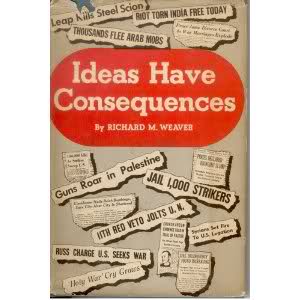
His most famous book is Ideas Have Consequences, a tour de force in traditional conservative thought and social commentary.   Weaver saw the rejection of universals as the harbinger of a disordered mind and disordered society.   Symptomatic, in his view, were certain elements of pop culture, notably jazz music.  On this score, just as Randolph broke with Jefferson, I have to break with the great intellect.

Edward Feser wrote a fantastic 2010 blog post that took Weaver’s ideas on jazz to task.

Weaver and I agree that it was a catastrophe to abandon realism about universals, to deny that things – including, most importantly, human beings – have essences which define an objective standard of goodness for them. But realism comes in different forms, and the different forms have different moral, theological, cultural, and political implications.

Feser draws a distinction between Platonic and Aristotelian philosophies and finds Weaver defaulting to a Manichean view of music.

[Weaver] tells us that jazz is a mark of modern civilization’s “barbarism,” “disintegration,” and “primitivism.” Why? His reasons seem to boil down to four: First, jazz evinces “a rage to divest itself of anything that suggests structure or confinement” and an eschewal of “form or ritual”; second, its celebration of the soloist’s virtuosity is a mark of “egotism” or “individualization”; third, its appeal lies in “titillation” and its themes are often “sexual or farcical,” appealing to the “lower” rather than “higher centers,” so that it fails to raise us to “our metaphysical dream”; fourth, it is “the music of equality.” Obviously, what he says about jazz applies also to other elements of modern pop culture.

Let’s consider Weaver’s concerns in order. First, it is, of course, by now a commonplace that to accuse jazz of formlessness or lack of structure is the height of superficiality. From swing to bop to modal jazz to fusion to acid jazz, it does not take much listening to discern the order underlying even the freest improvisation. Even free jazz has structure, though as I indicated in my previous post, it is so abstract that it can (in my view, anyway) only ever be of purely intellectual rather than aesthetic interest. It is hard not to see in Weaver’s criticism the Platonist’s impatience with the messiness and complexity of the real world, a desire for all form or order to be simple and evident enough to be accessible from the armchair. As the Aristotelian realizes…to know the essences of things we actually have to get our hands dirty and investigate them empirically, in all their rich detail. If the structure of jazz is complex and unobvious, it is in that respect only mimicking the world of our experience.

To which I say, “amen.”  Certainly this applies to progressive music as well.  Perhaps none combined fusion elements better than a band that came up in Weaver’s back yard, the Dixie Dregs.  Begun as a lab project at the University of Miami’s Frost School of Music, the Dregs engaged one another in complex musical conversations that exemplified a flair and swagger secured in its own kind of social bond individualism.

At least I have to believe the audacious John Randolph would have celebrated the Dixie Dregs, even if Richard Weaver would have been freaked out.

So here’s to ideas and their consequences — to getting our hands dirty —  from the appropriately titled Dregs of the Earth.
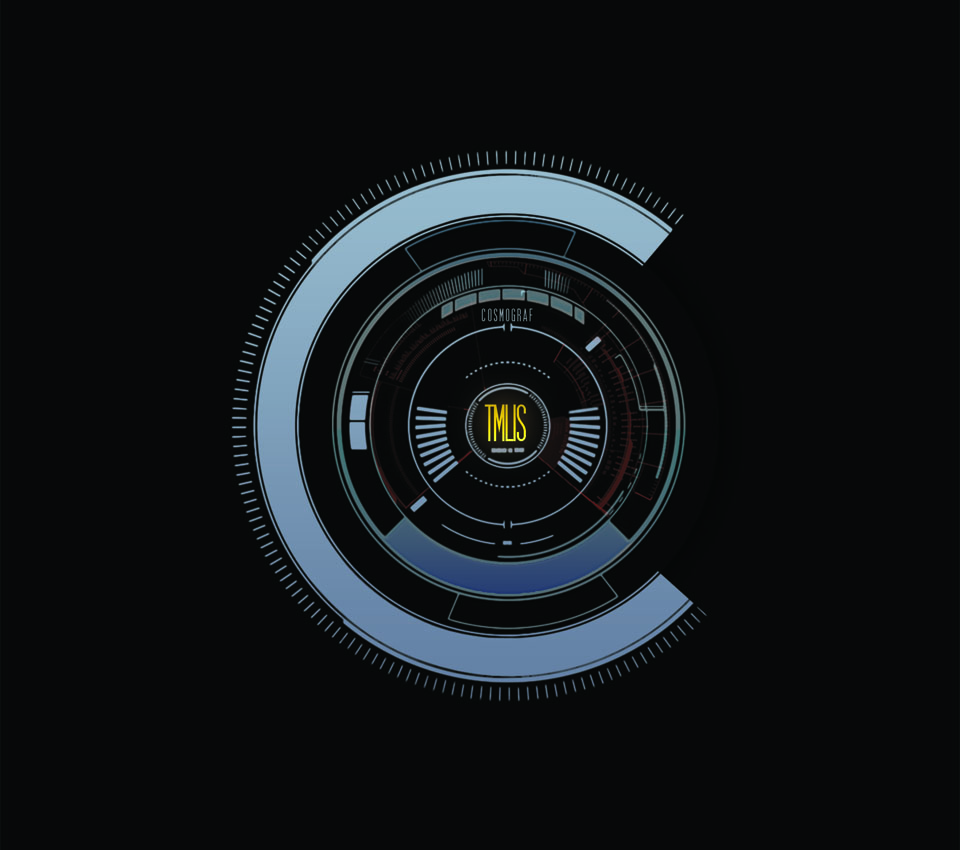
The Modern Condition: Cosmograf’s “The Man Left In Space”

cdcover-tmlisFrom its cover image reminiscent of the all-seeing camera eye of 2001: A Space Odyssey‘s HAL computer, to the final track “When the Air Runs Out”, Cosmograf’s  new album, The Man Left in Space, is a profound meditation on the tragedy of modern man’s surrender to ambition and technology, and the ensuing isolation that results.  

Beginning with a bewildered astronaut, Sam, asking, “How did I get here?”, the listener is transported to the near-future, where Sam is questioning his motives for agreeing to a mission to “change the human race”. Can over-achievement bring satisfaction and happiness?

Ambition brought me here.

A winner in my field.

Dare to be a dreamer.

Find your fate is sealed.

Hidden truths revealed.

Through memory flashbacks, snippets of dialog with the ship’s android, and sampled audio of actual NASA space missions, we share Sam’s growing sense of melancholic disconnection with reality.

I take these pills. They help me numb the pain.

They stop me from feeling blue.

I feel the days getting longer now.

I’d like to dream, but I’ve forgotten how.

He’s even reduced to crooning a love song to his “beautiful treadmill” that will “keep my soul in grace”. Throughout, the ship’s android is monitoring Sam and vainly attempting to create a normal environment.  Earth’s Mission Control tries to contact him, but they cannot get through. Sam realizes that without human contact, he will eventually slide into madness. No simulation, no matter how realistic, can replace the touch of another person.

Eventually, the “man left in space” is forced to face his own mortality:

10 minutes more and the air will run out.

This craft will fall into the sun.

My chance of returning is none. None. None.

As the last chords of the final song fade away, the ship’s android repeatedly asks, “Please respond, Sam?”

Robin Armstrong, who is Cosmograf, has constructed a beautiful, allegorical warning for those of us who would replace face-to-face communication with all the technological means at our fingertips: emailing, texting, Tweeting, “liking” on Facebook, etc. Right on cue, Google is coming out with “Google Glass“, which will add even more distractions to our interactions with others. We must resist the temptation to withdraw into self-imposed isolation and foster real relationships, regardless of the risks.

The Man Left In Space would not be the success it is without having superb music to complement its message. Every track is extraordinary, and the album really must be listened to in its entirety. Highlights include “Aspire, Achieve”, which begins with a delicate acoustic guitar melody and vocal harmonies that shift into crunching metal worthy of Ayreon’s best work. “Beautiful Treadmill” has an indelible hook that will have you singing along in no time. The instrumental, “The Vacuum That I Fly Through”, featuring the marvelous Matt Stevens on guitar and Big Big Train’s Nick D’Virgilio and Greg Spawton on drums and bass respectively, rivals anything Pink Floyd ever committed to tape. Trust me, it’s that good.

Finally, some praise for the artwork. In this age of digital downloads, it’s worth it to get the physical CD. The booklet that comes with the album is essential to fully appreciating the  album. The illustrations remind me of the incredibly realistic sci-fi artwork Shusei Nagaoka did for Electric Light Orchestra’s Out of the Blue album from the late ’70s. The attention to detail is amazing: every page features readouts of various gauges, creating the feeling that you are involved in monitoring Sam throughout his doomed journey. The ship’s android is named ESA-1410-4MY, which pops up in several places and adds to the sense of technological surveillance and control of Sam.

Even though we have yet to finish the first quarter of 2013, Cosmograf’s The Man Left In Space is certain to be in many Top Ten Albums of the Year lists.

Enjoy “The Vacuum That I Fly Through”:

Update: A brief, but illuminating interview with Robin Armstrong.

Mass x Velocity = Band on Fire

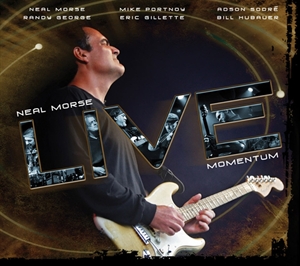
Live MomentumHot on the heels of his Live Momentum Tour, Neal Morse has released a 5-disc set (3 CDs, 2 DVDs) that is a worthy alternative for those of us who didn’t get a chance to see this band live. You always get your money’s worth when Neal is involved, and this release is no exception. The DVDs (available in Blu-ray, as well) and CDs document the entire 3-hour set, and what a performance it is!

Recorded and filmed in HD on October 11, 2012, at the Highline Ballroom in New York City, Neal and the band turn in an incredibly tight, high-energy set for an enthusiastic audience. Neal’s long-time collaborators Mike Portnoy (drums) and Randy George (bass) are joined by Bill Hubauer (keyboards, violin, sax, vocals), Eric Gillette (guitar, keyboards, vocals), and Adson Sodré (guitar & vocals).

I’ve been a fan of Neal Morse since his days in Spock’s Beard – keeping up with Transatlantic and his solo efforts. He is an amazingly prolific songwriter, but of late his work seemed to be suffering from a “sameness”. Then came last year’s Flying Colors and Momentum albums, where it was clear something lit a roaring fire to his creativity. Momentum is his finest solo work since the Question Mark album.

In the liner notes to this release, Neal mentions that he found Hubauer, Gillette, and Sodré through YouTube auditions, so I before I popped in the first DVD, I was a little apprehensive regarding their ability to keep up with Morse, Portnoy, and George. My fears were completely unfounded, as Adson lays down a jaw-dropping guitar solo in the opening song, “Momentum” (you can see the performance of the song in the promo video below). Eric Gillette shines on guitar, vocals, and keyboards throughout the entire show, and Hubauer adds wonderful depth with his keyboard pyrotechnics and fine violin and sax work.

Basically, what Neal put together is a three-keyboard/three-guitar front lineup that is incredibly versatile. Add in their ability to execute complicated vocal harmonies on songs like “Thoughts Part 5”, and this is one of the best live outfits I’ve ever seen. Mike Portnoy is the hardest working drummer in showbiz, and he is obviously having a blast propelling this group through epic after epic. The avuncular Randy George is the anchor on stage, nimbly laying down rock-solid yet melodic basslines, while eschewing the spotlight.

Neal himself is, of course, the center of attention as he moves back and forth between keyboards and guitar, conducting the band (and the audience) from one emotional peak to another. It’s clear he’s delighted with the tight rapport between himself and the band. They are able to shift from a delicate flamenco-style acoustic interlude to crushing hard rock in the blink of an eye and make it look easy.

The set includes four major epics. “Testimony Suite” clocks in at 21 minutes, and it  includes highlights from Morse’s 2003 album, Testimony. Neal is upfront and open about his Christian faith, and it is a genuinely emotional moment for him as he sings this account of his conversion. “The Conflict (From Sola Scriptura)” is 27 minutes long. Initially, I was put off by Sola Scriptura, but this performance illuminated aspects of it that I hadn’t heard before. It’s a beautiful piece.  “Question Mark Suite”, at 21 minutes, is an outstanding distillation of Neal’s exploration of the symbolism behind the Exodus and the Hebrew Tabernacle. After a change of pace with the relatively brief “Fly High” (I would have preferred something like “Absolute Beginner” here; “Fly High” isn’t that strong a song, IMO), Neal and the band wrap up the show with the 33 minute magnum opus “World Without End” from Momentum. It’s an incredible performance that outdoes the original, and leaves the audience yelling for more.

The band fulfills that request with a three-song encore: “Crazy Horses” (yes, the Osmonds oldie!) sung by Mike Portnoy while Neal takes over the drums; “Sing It High” (which features every member taking a solo turn), and finally, “King Jesus”. As the exhausted musicians leave the stage, you can clearly hear a member of the audience call out, “Neal! Neal! Thank You!”

The second DVD disc includes an hour-plus tour documentary. Beginning with rehearsals in Tennessee, we follow the band from their first show in Nashville on October 2, 2012 (which, to my eternal regret, I had to miss) to their last in Chicago on October 12. In the space of ten days, they perform shows in Nashville, Jacksonville, Mexico City, Los Angeles, Seattle, Denver, New York City, and Chicago, all the while practicing and continually refining their parts. It’s a marathon run at a sprinter’s pace. There is video footage of every performance, and much of it is quite good. One definitely gets an appreciation for how much hard work and how many hours it takes to make a live performance look easy. As Mike Portnoy says, “This band kicks ass! I mean, the second gig – it’s tight; a really tight second gig.” Neal himself describes them as “A band on fire”. I can’t disagree.

You can order this CD/DVD set direct from Radiant Records.

Here’s the promo video for “Momentum”:

Self-Imposed Slavery: Riverside’s ‘Shrine of New Generation Slaves’

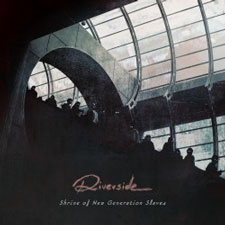
Image    Riverside’s recorded output began with three albums that are collectively known as the Reality Dream Trilogy (‘Out of Myself’, ‘Second Life Syndrome’, and ‘Rapid Eye Movement’).  These are all very good albums, although I wouldn’t call any of them great albums.  However, in 2009, Riverside took a big leap forward with ‘Anno Domini High Definition’ (ADHD).  The music took a noticeably different direction from its three predecessors, and reflected well on the album’s subject matter, i.e. the frenetic pace of modern life and accompanying dissatisfaction that sometimes goes with it.  After a two-and-a-half year wait (with the EP ‘Memories in My Head’ thrown in during the meantime), Riverside has returned with ‘Shrine of New Generation Slaves’ (SONGS).  And once again, they have taken a big – no, huge – leap forward.  Quite simply, this is Riverside’s best album to date.

Conceptually, the album relates to dissatisfaction with modern life, so much so that many people feel that they are slaves to something beyond their control.  Thematically, there are some common threads with various lyrics on SONGS predecessor, ADHD (in particular, the lyrics on the excellent ‘Driven to Destruction’).  Nevertheless, the lyrical (and thus conceptual) content extends beyond that to into areas such as stagnant relationships, the depravity of celebrity culture, surrender to nihilism, and ultimately, redemption.

Musically, the album is just fantastic.  In contrast to its predecessor, it does not feature a barrage of notes and thus gives the listener a little more space to contemplate the lyrics. That being said, I wouldn’t call it dimensionally sparse either, as there is plenty going on.  The music is probably the result of a different approach.  Bass player Mariusz Duda stated in a recent interview:

I had some problems before as I was a little bit tired of the formula that we had in the past and I didn’t want to do another album with complicated structures. I just wanted to finally focus more on the arrangements and the composition. To focus on some details, like a way for playing drums, a way of playing guitar. I really, really wanted to focus simply on songs. Simply songs, ambitious songs should be the foundation of this album. The metal parts I skip and replace them with hard rock elements.

Confident in the chops honed on previous albums, the band has taken more of a big picture approach to the music on this album – an approach that seems to have served them very well.

‘New Generation Slave’ opens up the album, featuring a heavy guitar riff interleaved with verses of Duda’s protagonist lamenting his life and dissatisfaction with it:

Ain’t nothing more to say

Your Honor

Don’t look at me like that

The truth is

I am a free man

But I can’t enjoy my life

The tempo then picks up, and keyboardist Michał Łapaj announces his presence in this piece by getting in touch with his inner Jon Lord (RIP), and repeats this a number of times throughout the album.  The opening track segues into ‘The Depth of Self Delusion’, which is less heavy and a bit slower, but no less good.  The use of acoustic guitar and atmospheric keyboards make their first appearance.  I don’t recall this much use of acoustic guitar on any previous Riverside release, and it’s great to hear them expand their sonic palette in this manner.  The song includes some interesting bass work in the latter half and closes with light acoustic guitar.  The band then blasts into ‘Celebrity Touch’ as Duda offers his critique of our Kardashian-ized culture and the pathological need some have for attention and approval from others:

I can’t afford to be silent

I can’t afford to lose my stand

What matters is to be in view

I am seen therefore I am

I can satisfy my hunger

I can satisfy my thirst

What about the feeling of importance

Now I’ve got my chance

In the center of attention

TV
Glossy magazines

My private life is public

I sell everything

Days are getting shorter

They’ll forget about me soon

So I jump on the bandwagon

With no taboos

The song includes a nice juxtaposition between a heavy riff that accompanies the above lyrics, to a less heavy, more reflective section:

But what if we start to talk

Not only say out loud

What if we sift the babble

From what really counts

What if we disappear

Go deeply underground

What if we hide away

From being stupefied

‘We Got Used to Us’ follows, and is yet another slower track that has somewhat of a Porcupine Tree-like vibe as our protagonist ponders a stagnant and dissatisfying relationship.  This one is pretty emotional.

Next up is the punchy ‘Feel Like Falling’, a song with crossover appeal having upbeat music that belies the lyrics, as our protagonist begins to realize the path he has chosen in life has led him astray and left him wanting to simply give up:

Had allowed that life to drift

For I’ve chosen a different trail

When light fades

I feel like falling into blank space

‘Deprived (Irretrievably Lost Imagination)’ is up next with music that is slower, mellower, and decidedly more melancholy than the previous track.  The music includes a nice, Floyd-ian interlude at about the halfway mark leading into a jazz-infused instrumental section in the latter half featuring some excellent sax playing.   Our protagonists dissatisfaction seems to be so intense at this point that they have gone beyond the mere desire to give up as in ‘Feel Like Falling’ – now we have a full fledged surrender to despair:

Curled up

Deprived
Curled up

Deprived
I shut away

Please don’t call my name

‘Escalator Shrine’ begins as another slower track, but picks up the pace after a few minutes.  Once again we hear the Hammond organ with the Leslie cabinet, some excellent bass playing, and some heavy (but not necessarily metal) guitar.  Like the previous track, it includes another Floyd-ian interlude at about the halfway mark.  Lyrically, ‘Escalator Shrine’ approaches the new generation slavery from more of an intellectual level than an emotional one, as our protagonist channels Albert Camus and the Myth of Sisyphus:

Dragging our feet

Tired and deceived

Slowly moving on

Bracing shaky legs

Against all those wasted years

We roll the boulders of sins

Up a hill of new days

‘Coda’ is the final track on the album, and maybe the most emotionally heavy, even though it is instrumentally the lightest – a single acoustic guitar.  Perhaps our protagonist has read some Epictetus, or maybe the serenity prayer, but it appears he has realized that his happiness and satisfaction with life is ultimately in his control and his own responsibility:

Night outside grows white

I lie faceup in my shell

Open my eyes

Don’t feel like falling into blank space

Indeed, for all of its darkness and all of its sadness, SONGS ends on an upbeat note, as our protagonist casts off his self-imposed chains:

I won’t collapse

I’m set to rise

It’s interesting to note that, although ‘Coda’ is the final track on the album, it is also numbered as Track 1, as is ‘New Generation Slave’.  Indeed, our protagonist has hit the reset button and is starting over.

I simply cannot say enough good about this album.  As thrilled as I was with ADHD, my response to SONGS is in a completely different realm.  Musically, the album has a perfect blend of heavy and light, of complex and simple, emotional and intellectual.  Nothing is overdone, nothing is incomplete.  The lyrics have a strong message, and as dark as the album’s atmosphere, it’s ultimately a message of hope for those that get it.  And if this album is an indication of what we can expect in the future from Riverside, then it’s another strong piece of anecdotal evidence that we are in the midst of a progressive rock golden age heretofore unseen.

Oh, and in case you didn’t get it, I strongly recommend this album 🙂

Porcupine Tree Comes Together – A Fresh Look at “Signify”

Signify Cover

Signify is an important album in the long and varied history of Steven Wilson and Porcupine Tree. The first PT album, On the Sunday of Life (1991), is a tongue-in-cheek solo Wilson tribute to British psychedelic rock in the vein of XTC’s Dukes of Stratosphear. Up the Downstair (1993) and Voyage 34  (1993) were also done primarily by Wilson alone, and are literal acid-rock albums.

The Sky Moves Sideways  (1994) introduces the first real band that operated under the moniker of Porcupine Tree: Wilson on guitars and keyboards, Richard Barbieri on synthesizers, Colin Edwin on bass, and Chris Maitland on percussion. Stylistically, the album is heavily indebted to classic Pink Floyd. While an enjoyable listen, it doesn’t break any new ground. It’s also easy to forget that the group Wilson had formed with Tim Bowness, No-Man, was actually more popular than PT during this period.

Which brings us to 1996, and Signify. Musically, it is a giant leap. Wilson, Barbieri, Edwin, and Maitland are working together as a seamless unit. There are lots of instrumental passages, and Barbieri’s electronic atmospheres are integral to the overall feel of the music. Beginning with the first track “Bornlivedie” and continuing throughout the album, Wilson juxtaposes samples of happy-sounding radio announcers, televangelists, and other snippets of spoken word with beautiful yet foreboding music.

It’s a device Wilson has become the master of: seduce the listener with gorgeous melodies, and insert dark lyrics. Personally, I think Steven Wilson is indulging a sly sense of humor. Continue reading “Porcupine Tree Comes Together – A Fresh Look at “Signify””

The Cautionary Barrett

This is an important month for admirers of the late Syd Barrett.  The artist’s birthday falls on January 6, and his first solo album The Madcap Laughs was released January 3, 1970.  These anniversaries occasion an opportunity to ponder what Barrett left in the cautionaryvery short slice of time that shattered musical conventions.

What Barrett accomplished on guitar is legendary in itself, taking the lowly Danelectro 59-DC and, with a Zippo lighter or a ball bearing for a slide, creating entirely surreal soundscapes scarcely resembling anything on the blues records he enjoyed as a youth.   But it was Barrett’s lyrics that gave substance to his melodic adventures.  As we might expect from a native Cantabrigian, Barrett’s verse was informed by sundry literary figures.  One Russian fan site conjectures  influences ranging from C.S. Lewis (“Flaming” and “Scarecrow”) to Tolkien (“The Gnome” and “Dark Globe”).  Known references include James Joyce’s verse for “Golden Hair” and Hilaire Belloc’s Cautionary Tales for Children on “Matilda Mother.”  I would like to expand upon the latter, as Syd Barrett’s oeuvre seems to be one large cautionary tale, reflected both in his artistry and later, after his crack-up and expulsion from the Pink Floyd, in his personal life.

Cautionary tales are written or recited for young audiences.  Syd Barrett’s music clearly displays infectiously playful, childlike elements.   The Piper At the Gates of Dawn has been characterized as consisting of two main features: extended pieces that included free-from passages (“Interstellar Overdrive”) and shorter, whimsical pop songs.

Of the latter it has been suggested that these include certain dark elements.  A good example is “Flaming.”  The melody and the vocals pack the giddy spontaneity of adolescence — a sense of being swept up in infatuation for the first time.  Listening to this song is to be transported back to age 13 or 14.  The subject to whom the song is directed can neither see nor hear Barrett, but he can see and hear her.  Using buttercups and dandelions to heighten a sense of euphoria, Barrett sings

Too much? I won’t touch you — but then I might.

Later we discover this conversation involves “travelling by telephone” — the preferred medium of exchange for adolescents for the past 60 years (the only difference today being wireless texting).  But the notion of Barrett inserting himself as the agent of sensory overload, of shattering the playful possibilities with a very direct and perhaps unwelcome advance — this is the tension that drives “Flaming.” Continue reading “The Cautionary Barrett”

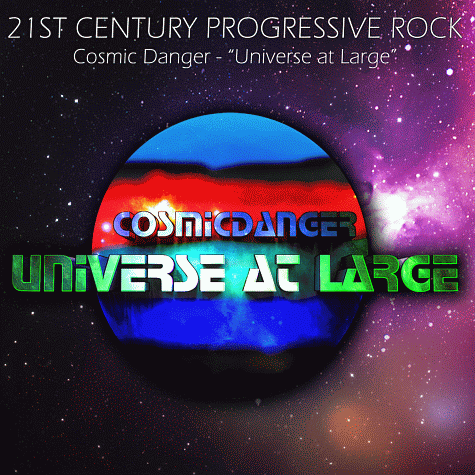
Review: Cosmic Danger, “Universe at Large”

Cosmic Danger - Universe At Largeby Frank Urbaniak

I have listened to Cosmic Danger’s “Universe at Large” several times and I have had mixed reactions on each pass.  The music demonstrates hints of both early Yes and the Rabin /Sherwood years, Camel, Klaatu and Asia and is an interesting but somewhat frustrating listening experience.

There are nine tracks on Universe at Large logging in at about 50 minutes, with a mix of instrumental and vocal tracks.  There is little information online about the band or this album including lyrics or story line.  The quality of musicianship is excellent, but in both lyrics and music the album doesn’t flow well to these ears and the storyline escapes me.

First the good –these guys are exceptional musicians: the guitarist can rip like Howe during The Yes Album days, the drummer is tight, crisp, fast and well-mixed and the keys are always interesting.

The not so good-the name, the cover, the concept of the CD and the lyrics seem a bit too ‘space’ oriented, suitable as a soundtrack for Enders Game but less relevant than other progressive music being released today (BBT, Echolyn).  This isn’t cosmic as in Jon Anderson/Yes, but cosmic as in “we are journeying into space and won’t be back” but the story doesn’t seem very developed.  The bass seems a bit muted.

The mix is puzzling, with excellent drum/keys/guitars, but the heavy reverb and echo on the choruses and effects remind me of a late 80s release like Marc Jordan C. O. W or Yes’s Big Generator.

The first five tracks have vocals with big choruses, giving Universe at Large a strong AOR feel initially. “Champions” starts off the album with a heavy Argent sounding organ and a feel -good chorus suitable for the Olympics, although the words sound a bit hokey: “Champions give all they have, all along”.  “Freedom Flier” also begins with a nice organ riff (Tony Kaye style), and the vocals remind me of Flash/early Yes.  “Skydiving” sounds like a Moody Blues tune with strumming guitars and another heavily reverbed chorus and builds to a frantic conclusion where you can see how proficient these guys are as musicians. “Blue Sky”, the best track on the album, retains the Kim Bullard/Paul DeVilliers (Big Generator) feel with brassy keys and vocals reminiscent of Alan Parsons/Chris Squire.  An excellent guitar solo leads to a nice counterpoint vocal chant of “Blue Sky dawning, Red Sky at night.”

With “Bug in the Wire” the vocals are a bit clearer and ‘grittier’ , sounding a bit like Kevin Moore/Chromakey, with music by Klaatu.  At this point the album shifts to mainly instrumental focus, with “Endless Voyage” one of the most tasteful tracks on the album. “Moon Base Gamma” , the longest track on the album at 7 minutes, loses some of the momentum with some overdone synthesizer effects and cumbersome words about survival at Moon Base Gamma , with the repeating chorus of ‘where is home’ making this sound more like a space opera (think Intergalactic Touring Band).    “Five Year Mission” has a frantic bass/guitar riff and the powerful drumming again demonstrates the proficiency of the musicians.  “Moon Dusk” loses the momentum by concluding this ‘space’ journey with an overlong intro of heavy keyboard effects. Finally the band introduces some  tablas and percussion, but just when the track gets going it abruptly ends with a heavily reverbed chorus briefly chanting the theme from the opening track “Champions”.

In summary, these excellent musicians have produced an interesting but not very original release.  I am unclear as to the message and I am left with an ambivalent feeling about the full album.  While the instrumental tracks are interesting, I think the album would be better paced if some the instrumentals broke up the early vocal tracks to help build the ‘story’.   Certainly worth a listen and because of the obvious talent of the band, I look forward to future releases.

My rating: (out of 10):

Musicianship-8

Production-6.

Pacing-5.

Originality-5

Overall-6.