
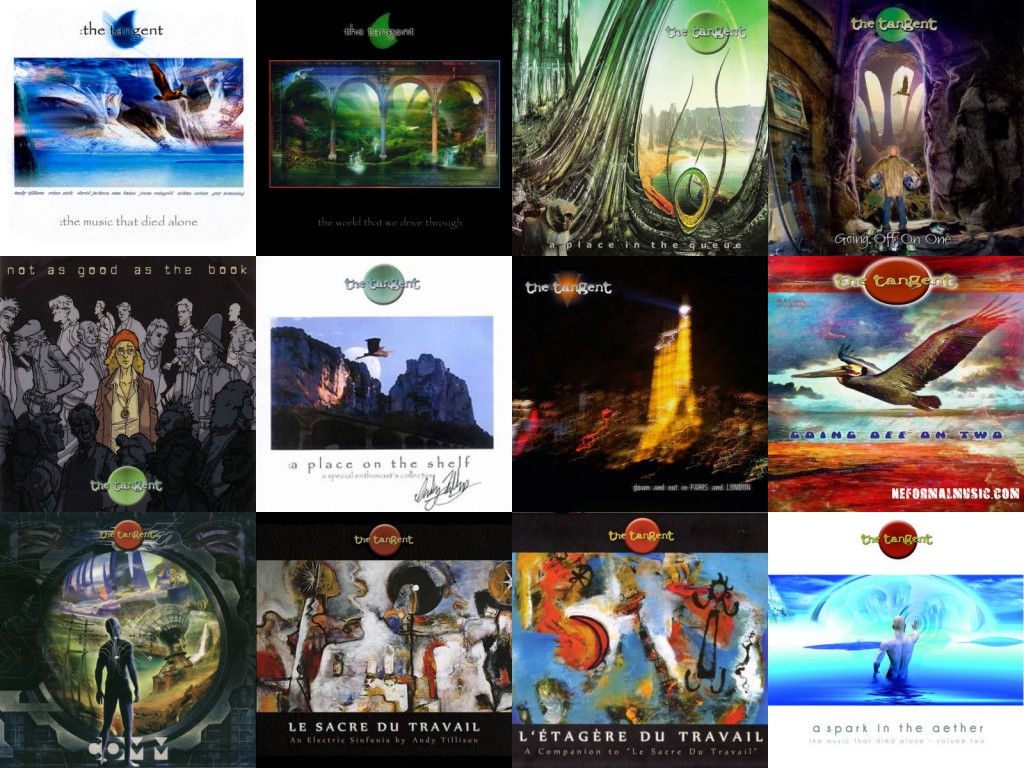
David Elliott, Progmeister and founder of Bad Elephant Music, never does anything not worth listening to. But, here, he’s especially good. Three hours of The Tangent. Enjoy!
David Elliott, Progmeister and founder of Bad Elephant Music, never does anything not worth listening to. But, here, he’s especially good. Three hours of The Tangent. Enjoy!
So, Muse released another single. Umm. Well… the lyrics don’t suck as much as the last single, so that’s a plus. Sorry, I’m just trying to get the disturbing images from the lyric video for the new song, “Dead Inside,” out of my head. I won’t share the link with you because Progarchy is a family friendly site, and the video is, well, suggestive, at best. Think painted goldfinger Bond woman. Think 70s drug trip at a hippie concert with a lot of high, naked women. On second thought, maybe don’t think about that too much.
I will share with you a few live videos taken with cell phones at concerts, however. Musically, “Dead Inside” sounds rather 80s, but in a good way. I like the simple 80s drum sound, and Matt Bellamy’s voice is perfect, as always. I still need to hear the song in the context of the whole album, but the lyrics aren’t nearly as repetitive and annoying as those from “Psycho.”
There are also videos floating around the Tube of You of a song called “Reapers” that is on the album track list, but hasn’t been released yet. I can’t really understand the lyrics because the audio quality of the videos is so poor, but musically it sounds like a return to a more classic Muse sound. I also didn’t seem to hear overly obnoxious repetition either, and the guitar work is pretty freakin’ good. Bellamy is a vocal and guitar god. Overall, I think “Reapers” is the best song I have heard from the new album (out of the three I have heard), but, as of now, you can only see/hear the live versions. Watch, and see what you think.
I’m relatively new to Glass Hammer’s music; 2012’s Perilous was the first album I heard. It’s a fine album, but it didn’t knock my socks off. So I wasn’t prepared to give their 2014 release, Ode To Echo, more than a cursory listen. Big mistake!
The release this week of Glass Hammer’s The Breaking Of The World led me to go back and give Ode To Echo another spin. Am I glad I did – in the words of our beloved editor-in-chief, “Holy Schnikees!” Ode is a shining example of how prog can be both sophisticated and fun. Even though Brad Birzer has already published an excellent review of it, I wanted to put my two cents in.

Maybe it’s lead vocalist Carl Groves’ presence, but there’s real power in both the lyrics and the playing on this album. For example, take the first song, Garden of Hedon, which begins with a description of what sounds like Eden, but gradually introduces some disquieting details:
Sensory – the flies a constant choir for your ears
(In Hedon even bugs we hold dear!)
Taste, touch, see – the sky a vivid uncensored screen
Showing everyone’s deepest dreams
Sensory – as always there’s the fruit of the tree
No restrictions, everything’s free
Taste, touch, see – the Garden offers you everything
In Hedon you can always be king.
Sure, you could say this song is another warning against the temptations of the hedonistic side of the internet, along the lines of Fear Of A Blank Planet. But where Steven Wilson keeps his concerns on a relatively mundane level (the internet anesthetizes its users), Glass Hammer takes it to a whole new one:
When the end comes will we stand tall
Without any shame when we hear our name?
Misantrog is a wonderful musical offering of Trick of the Tail-era prog which paints a sympathetic portrait of a man in a hell of self-imposed isolation:
Leave me safe to be
In a place where there’s no need to see
Where the shadows are so real
And the coldness that I feel reminds me I’m alive.
Crowbone is an understated masterpiece which uses a few lines by Robert Low to impart the desperate nihilism of Viking raiders on a “black-glass sea”. They are mere “feathers on the breath of gods”, while the music progresses from a gorgeous acoustic backing to roaring, full-throated rock.
The centerpiece of Ode is I Am I , which features a dialogue between Echo and Narcissus. Echo tries to reach Narcissus, but he is too self-absorbed to even be aware of her. Susie Bogdanowicz’s vocals as Echo are flawless.
Lest the listener get a little down in the midst of all this hedonism, loneliness, and narcissism, the band resurrects the classic Monkees hit, Porpoise Song. A delightful slice of ’60s psychedelia, Glass Hammer outdo themselves in recreating that first era of prog. Their version is now the definitive one.
I could on and on; there isn’t a single weak track on Ode. It is an album of remarkable depth, both musically and lyrically. It is also a modern-day Book of Ecclesiastes – life is short, so don’t waste it in vain pursuits. It doesn’t hurt that this sobering theme is delivered with such extraordinarily good melodies.
A review of The Breaking Of The World is forthcoming, but I wanted to give Ode To Echo the praise it is due. 2014 was such a bountiful year for prog, I almost missed this one. Don’t make my mistake!
Sorry, everyone, the YES being inducted into the Hall of Fame was a false (April Fool’s) story. Again, apologies.
Third time I’ve been had today!
THE TOP-TEN REASONS TO LISTEN TO PROG
Give me Bob Fripp!
TOPOGRAPHIC OCEANS, and…”Get Off My Lawn!!!”
that prog!”
my diet.
I’ll stick with Hammond B3s, Mellotrons, and Fender Strats.
Drum Roll Please
AND THE NUMBER ONE REASON TO LISTEN TO PROG
by themselves, they delight in singing Mozart. But God, well,
the Lord listens to Big Big Train…
View original post 4 more words
This April Fool’s One Day Sale is “almost” too good to believe!
On April 1st, and for 1 day ONLY, get:
PLUS, on April 1st, every order will include a surprise free gift!
There’s never been a better time to get any or all of these titles!
**These offers end April 1st at 11:59pm (CST)**
http://www.radiantrecords.com/category/191753-april-fools-one-day-sale.aspx
An excellent review from Leo Trimming of Steve Hackett’s new album:
Wolflight refers to the hour before dawn, when much of the album was written, which Hackett felt was a special time in which “You’re in an altered state because you’re closer to the world of dreams”. There is certainly a dream like quality to much of the album, sometimes slipping into darker nightmare, and like many dreams the music is amorphous and difficult to define at times.
Hackett often travels the world and these experiences permeate Wolflight with musical influences and instruments drawn from places as diverse as Armenia, Azerbaijan, the Middle East, the Deep South and Australia. Alongside those more exotic aspects Hackett also adds to his musical palette with imaginative use of classical orchestral music. Nevertheless, Hackett ensures that this album is liberally embellished with his trademark guitar sounds. The diversity of the musical ideas brought to this work means that it is often unpredictable, can be quite bewildering at times, and is certainly never boring!
…
Steve Hackett loves to explore both musically and geographically, and he has also clearly found personal happiness, the experiences and emotions of which are so evident in this work.
Steve Hackett has never stood still in his work and has strived to explore new areas of music. Some of those efforts have not always fully worked or engaged his audience, but he has remained true to his principles of stretching himself. He has previously released albums of mainly progressive rock music, or acoustic music, or orchestral music and even blues music, but he has never so successfully fused elements of all those styles and more on one piece of work. After a period of revisiting old classics it is perhaps fitting that Wolflight underlines so clearly that Hackett will never live in the past.
The only track I have gotten to know well so far myself is “The Wheel’s Turning” (already available on iTunes) and it is magnificent.
Really looking forward to this album…
So Mr Andy Tillison is definitely back in the aether! His legendary radio show Dance On A Volcano has been revived on the no 1 radio station Progzilla Radio! The first show is to be found as podcast right here!! Enjoy, folks!!
So, Steven WIlson has turned Angry Metal Guy into Sad Metal Guy:
My biggest complaint about Hand. Cannot. Erase. is the state of existential sadness that it leaves me in every time I listen to it. Even before I knew the story, the record oozed loss, sadness, and hurt deep enough that I would walk away with a knot in my stomach, but couldn’t keep myself from pressing play again as soon as I got the chance. With stellar musicianship, a truly masterful production job that balances a whole band, electronic sounds, and the London Session Orchestra to perfection, Hand. Cannot. Erase. demonstrates how Wilson is blossoming as a composer to complement his skill as a producer, and his vision really is beautiful.
The whole review is excellent and worth reading. Here is a sample of some important observations:
I see his rise as attributable almost entirely to the fact that he’s the most talented producer of his generation. Furthermore, he’s a man who appears to have become less willing to compromise on the records he produces, meaning that he has taken the right side in the Loudness War, and is using his power and status for good. The result is, of course, that the music he produces, mixes (or masters), remixes/remasters, and/or performs sound so good.
…
One of the things that differentiates Hand. Cannot. Erase. from The Raven that Refused to Sing (And Other Stories) is its tone. The production here is smooth and wet, without that trashy live sound that TRtRtS utilized. On H.C.E., there’s a heavy touch of reverb to soften the edges off, and as the record develops it gets more dreamy and distant. Early on, however, the use of what I will loosely call “electronica” on “First Regret” and “Perfect Life” is a reminder that Wilson isn’t in the business of making a ’70s prog rock cover band. This balance of the new and the old gives this record its unique flavor, while still allowing Wilson to quote at his leisure, drawing heavily from Floyd, Camel, Tull and the one I hear maybe the most in the balance between the bass, guitars and drums: Rush.
The number “50” is off—an 18-year-old Van the Man actually joined Them in April 1964 (thus, 51 years on)—but it’s fitting, as playing with time is something Morrison mastered early and continues to do very well, as singer, 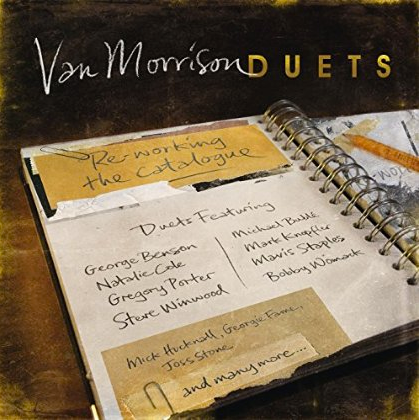 songwriter, and player. In 1966, Morrison and Them performed a series of shows at the Whisky a Go Go; the opening band was The Doors, and the two Morrisons—Jim and Van—performed together. On his new release (his 35th studio album), Duets: Re-working the Catalogue, the Belfast Cowboy performs with several singers who were born after the Sixties: Joss Stone, Michael Bublé, Clare Teal, Gregory Porter, Morrison’s daughter, Shana. Many of the other guests have been there and done that, including Bobby Womack (who died last summer), Mavis Staples, George Benson, Steve Winwood, PJ Proby, Taj Mahal, Mick Hucknall, Natalie Cole, Georgie Fame, and Chris Farlowe.
Those sixteen duet partners encompass blues, jazz, blue-eyed soul, rock, R&B, gospel, and pop, all of which are genres that Morrison mastered long ago, in addition to Celtic, country, and skiffle. No, there’s not a lick of prog on this or any other Morrison album, but there is, I suggest, a certain spiritual connection with certain forms of progressive rock, especially in the mystical journeying of Astral Weeks, the joyful, ecstatic visions of Moondance, and the epic, spiritual wanderlust of Avalon Sunset and Hymns to the Silence. Part of the genius of Van Morrison is that he largely ignores prevailing musical trends, yet is able to connect to a wide range of listeners because of a certain timeless quality to his songs, which are consistently melodic and memorable. My first real initiation into Morrison’s music was in the summer of 1991, when a friend played Avalon Sunset for me; I was instantly hooked, and quickly began acquiring all of Morrison’s music. In my 2002 essay, “The Incarnational Art of Van Morrison,” I reflect on the various spiritual and mystical themes in Morrison’s music. Continue reading “50 years after Them, Van Morrison cuts one of Those “Duets” Albums”

 Progarchy