20 Looks at The Lamb, 14: Windows, Screens, and Dust

“Walls that no man thought would fall,
The altars of the just… crushed…
Dust in the wind”

gabriel_4Oh, yes. “Dust in the Wind.”

It started out this time as two thoughts. They didn’t seem to have to anything to do with each other. Thought one was “Dust in the Wind,” apropos of I-don’t-know-what. Thought two was “concept,” in relation to The Lamb. (It’s supposed to be a concept album, right? And I really do need to start posting again, right?)

I think about associations a lot, because I’ve been reading Freud. That theme has come up here before. But it’s not just some technical psychological thing. I’ll bet you’ve experienced this a lot, if you think about it. Things that aren’t associated, that you’re sure are proximate only as a matter of coincidence, end up being associated after all. Your experience is not just a big container with a lot of things in it. It’s a web that gathers things together. For Freud, this is why your dreams are so weird, as well as why you used that specific word when you misspoke, or why you forgot that particular thing. But even if you don’t know Freud, you know that feeling you get sometimes when things in your field of concern keep “hooking up” with each other, and your mind feels kind of like a cheap motel.
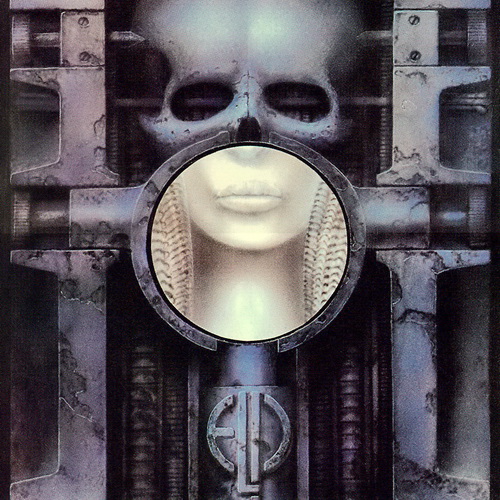
ELP_-_Brain_Salad_SurgeryThinking about “Dust in the Wind” led me back to Emerson, Lake & Palmer’s “Karn Evil 9” (all three impressions) from Brain Salad Surgery (1973). It was when I actually began listening that I remembered how mysterious and scary the concept of the piece had seemed back then, and went “Oh yeah, concept.” Sure, it’s a bit dated now in some ways, as almost always happens with “futuristic” stuff, but it’s still easy to see why a lot of folks point to it as the pinnacle of ELP’s glory years, and why its dystopian vision might still resonate.

Kansas_-_Point_of_Know_Return“Dust in the Wind” was used as a song title the year before the release of Brain Salad Surgery by Todd Rundgren on Something/Anything?, and then most famously by Kansas on 1977’s Point of Know Return. But ELP was THE band during my high school years, and the lyrical transition marked by the phrase in the Third Impression is the one that continues to echo most frequently.

But here comes the surprise connection, back through the piece to the First Impression. What jumped out this time was “THERE BEHIND THE GLASS.” BANG!! I was back in The Lamb, where we find out near the end that Rael’s New York City is behind a “window.” Though there’s no specific reference to glass, “behind the glass” took me to that window, and to the disconcerting idea that a window has two sides. In the case of “Karn Evil 9,” what is behind the glass is “a real blade of grass.” The “behind” is what is on display, the content of the exhibit. That means, of course, that we (the spectators) are in front of the glass.
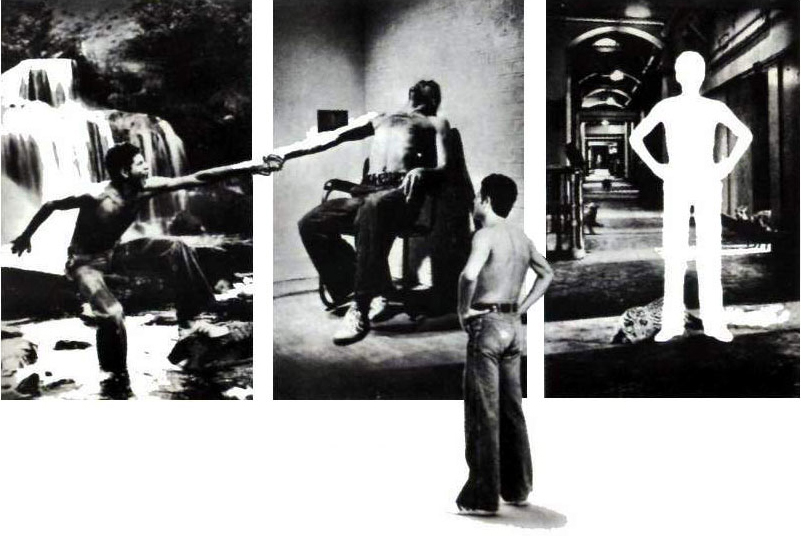
lamb_cover1In Rael’s case, what is “in front” and what is “behind” is precisely what is in question. This is foreshadowed, perhaps, even when the screen (the “wall of death”) bears down upon him, and the suggestion of glass lurks in the comparison to a windshield. What was real, in being absorbed, is now “on screen.” As the online Annotated LLDOB asks, “If what once was thought real is now a movie, is what was a movie now real?”

The window in “The Light Dies Down on Broadway” is one that Rael could presumably step through to return (again) to New York City. But think about where he stands at this point. New York is behind the glass, is it not? It’s on display, exhibited like the evils of “Karn Evil 9.” One might think that to put something on display is to glorify it, to recommend it. Many people seem to think this is what happens when something is put on the screen. We debate about the extent to which life imitates art. Are we more violent because of violence onscreen? But we might wonder also whether putting something on display might remove it from the realm of real options. How likely is it that Rael would choose to return to the world from which he has now twice departed, however strong the gravity of John’s failures as a brother?

I don’t mean to suggest that this is an “all or nothing” question, that we must decide yea or nay as if deciding on determinism or free will. I mean it, rather, as a suggestion that we reflect on the distance between screens and windows, when it comes to where “front” is. It’s a distance for which there’s not a scale or an instrument of measurement, but I hope that won’t stop us from considering it, from listening in light of it.

And it won’t gel, or congeal.  It won’t finalize.  It will keep the indeterminacy and ambiguity that first allowed the associations to pull me in its direction.  It’s still dust in the wind.  But let’s try to feel its sting on our skin a bit when it’s blowing past.
<—- Previous Look     Prologue     Next Look —->

Hello Cleveland: Rush ’74

718es2ZKoML._SX425_Whether it comes down to talent, musical choices, or the genius of their management, Rush continues to pull off an inspired feat:  embedding themselves in the rock mainstream while maintaining a reputation as music biz outsiders and, deceptively, cultural dark horses.  It’s a trick most rock and punk bands would kill for and it actually does come down to a question of honesty.  Rush never cared about being one of the cool kids and guess what, turns out the world’s not made up of cool kids after all.  And those un-cool kids want to see their band live.

Based on the evidence of Rush’s officially released live catalog, you’d be hard pressed to find a better, or better-documented, live “stadium” rock band.  For its consistent onstage delivery the band itself credits its grind in the clubs of Toronto in the early 1970s.  As that decade wore on and they began writing increasingly complex studio material, their live shows became acrobatic technical workouts showcasing tremendous talent (and perhaps some excess too).  But when they first started touring in support of studio albums, their music and their onstage act fit somewhere between Humble Pie, Led Zeppelin, and Ted Nugent.

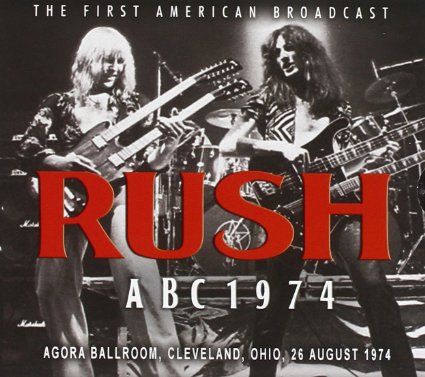
Rush: ABC 1974 captures the band in Cleveland on its first American tour, with a few bonus tracks, also from Cleveland, the following year.  The shows are notable because they were recorded by WMMS, famously instrumental in builiding Rush’s career, and also because the show in August 1974 was the first U.S. broadcast of the band.  More importantly, though, the ’74 show includes new drummer Neil Peart.  It’s something of an awkward moment:  Rush’s first album is a riff metal powerhouse, anchored by drummer John Rutsey’s straight ahead hard rock pounding and suggesting as much Black Sabbath as Led Zeppelin.  Peart’s still finding his feet on this set, busy-ing up songs that maybe can’t sustain his presence.  Still, given they’re from the band’s early days as professionals, the performances are outstanding, with early album hit “Working Man” the obvious crowd pleaser and “What You’re Doing” as mind-bendingly great a piece of stoner rock live as on record.  The duds are all songs Rush wisely never put on an album and a cover of “Bad Boy” that doesn’t really go anywhere.  The three bonus tracks from 1975 suffer from poor audio quality while offering a glimpse of Fly By Night.  That title track, the first real success of Rush mach II, bristles with their new sound, and is genuinely exciting to hear despite the muddy recording.  The other songs from Fly By Night (including Anthem and Beneath, Between, and Behind) also distinguish themselves by containing an energy of a sort entirely different, as well as a lyrical focus stretching beyond the rock tropes that characterize Rush’s first.  It’s pretty clear that the band has re-set its course.

I can’t tell you what the deal is with this record, if Rush actually has any say over its release or not, but there’s nothing here that doesn’t speak well of the band in its formative days; and, if you’re a fan of that era, then the heaviosity on display in Cleveland in ‘74 is pretty much guaranteed to take you to church.

From Carl’s Critical Kitchen: A Baker’s Dozen of Tasty Prog/Rock from 2014

guitar-and-music-paper-1927
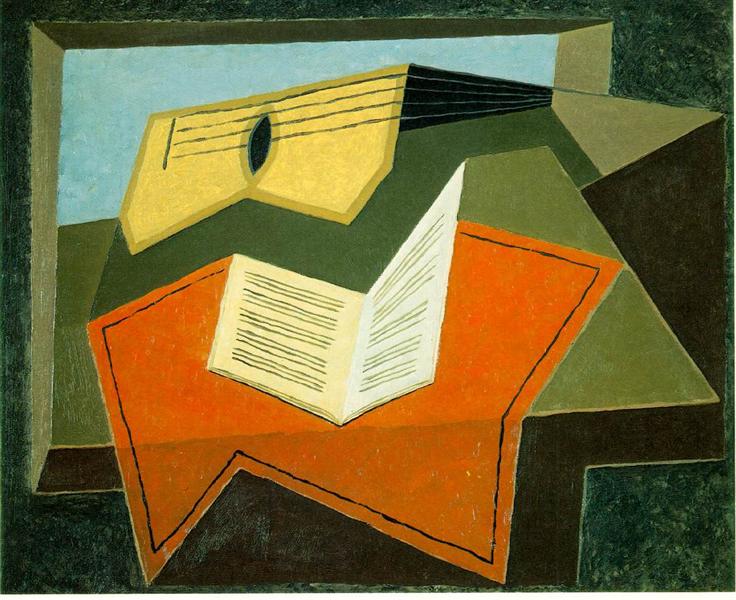
“Guitar and Music Paper” (1927) by Juan Gris

In the process of putting together an end-of-the-year book list for CWR, I came upon my 2004 post on my favorite books and music of 2004. The music list is quite interesting, with just one overtly prog album (Pain of Salvation’s “Be,” which is, in hindsight, one of my least favorite POS releases), and a fair amount of jazz (no surprise) and country (some surprise). I’m glad to say I still listen to much of the music on that list.

This year, I’ve decided to break my music picks from 2014 into three categories: prog/rock, jazz, and the kitchen sink (country, electronica, weirdness). I want to emphasize “favorite” here because there were so many releases I simply didn’t get to, despite uploading over 6500 songs in the past 12 months. Ah well!

And I’m going to try to keep it short and simple, with the exception of my thoughts on my #1 pick in prog, which is also my Favorite Album of the Year. What is it? Read on!

Favorite Prog and Rock Albums of 2014:

12. “Live at Rome Olympic Stadium” by Muse and “Tales from the Netherlands” by Mystery. Muse is about as proggy as a mega-selling, world-famous band can be, known for putting on live performances that are equally energetic and well played. This July 2013 performance is no exception, with the trio ripping through nineteen of their eclectic songs, ranging from from electro-tinged funk (“Panic Station”) to Queen-ish pomp (“Knights of Cydonia”) to Floyd-ish slyness (“Animals”). The DVD is very impressive, not only because it was filmed with HD/4K cameras but also because the band is at the top of their game.

Mystery is fronted by Benoit David, who was lead singer for Yes for a short time a few years ago, before illness led to his firing. David never seemed comfortable with Yes, but his work with Mystery is of the highest caliber. The Montreal-based group is lead by multi-instrumentalist Michel St-Père  (guitars, keyboards, bass, production) and has an epic, soaring sound built on fabulous melodies and exquisitely structured songs. The production, for a live album, is excellent, and David (who has since left the group) is in top form; this is not easy music to navigate vocally, yet he nails it at every twist and turn.

11. “Magnolia” by Pineapple Thief. Bruce Soord has more talent in his toes than most alt-bands have in their entirety, whether it be as a writer, producer, player, or singer. I’ve enjoyed everything from Pineapple Thief, but this collection of incisive, beautifully burnished tunes is Soord’s best work yet, the sort of intelligent, catchy, and detailed modern rock that deserves to be all over the airwaves. Classic Rock magazine sums it nicely: “Small but perfectly formed pockets of 21st century prog.”

10. “The Ocean At the End” by Tea Party. I was thrilled that this Canadian trio (now based in Australia) got together again after several years apart; I still listen to their early albums (“Splendor Solis”, “Edges of Twilight”) which feature an overt Led Zep vibe with a brooding, even epic, melancholy, rooted in Jeff Martin’s powerful voice and bluesy guitar playing. The latter quality is more in evidence here, and the rocking cuts (“Brazil” and “The Cass Corridor”) are the least enjoyable for me. The highlights are the dark cover of “The Maker,” the aching “Black Roses”, and the tour de force “The Ocean at the End”. Distinctive, powerful, emotive rock.

9. “Beyond the Visable Light” by Ovrfwrd. This album made a late charge on my playlist, as each listen revealed deeper layers of detail, melody, and interplay. The four-man group from Minneapolis is instrumental only, with an emphasis on group dynamics and song structures that are complex but very accessible. There is a lot of territory covered in the 5-song, 48-minute-long album, with grungy, propulsive passages melting into subtle, jazz-ish sections, and then giving way to Deep Purple-ish organ, and so forth. Great use of piano throughout, which brings a distinctive detail to the entire, enjoyable affair. Continue reading “From Carl’s Critical Kitchen: A Baker’s Dozen of Tasty Prog/Rock from 2014”

Album Review: Rush Presto on SACD

Drew's avatarDrew's Reviews

In the annuls of Rush history, Presto feels like one of a couple of forgotten albums. It drops right in between what many consider the end of the keyboard era and the start of the return to a more straight approach to rock music. However, the keyboards are not absent on Presto and in fact work really well and help elevate this album to being one of the band’s best.

Presto, released in 1989, is Rush’s 12th studio album and eighth to receive the expensive (at least to the buyer) re-mastered treatment – available this week. It’s the fourth release in the Super Audio CD format by Audio Fidelity. It’s also the third Rush studio album recorded in the DDD format – digital recording, digital mixing and digital transfer. It’s hard to argue a case for an overhaul but it worked well with Counterparts  and Hemispheres

View original post 824 more words

Tiger Moth Tales’ “Cocoon” – Synth-Driven Prog At Its Absolute Best

The Big Big Train Facebook group is a seething hotbed of excellent music tips, so when I saw a post about an album called “Cocoon” by Tiger Moth Tales (aka Nottinghamshire-based musician Peter Jones – read all about him here) I knew it was probably worth spending some time investigating.

The link to a song called “A Visit to Chigwick” immediately intrigued me (as I am sure it would for certain UK people who enjoyed children’s television back in the 60s and 70s…) so I clicked on it.

As the track played a broad grin developed, as well as, I must admit, a slightly moist eye. Something very special was happening here, so off I went to make a purchase, and it landed on my metaphorical New Zealand door mat yesterday afternoon.

Here’s what Peter himself has to say about the birth of this album (from the liner notes:)

It all happened by accident really. One day I sat down to try and write a song, and ended up with a prog song about Trumpton. I had no idea what I was going to do with it, but as I tried to focus more on conventional music, I kept getting more and more ideas about songs on childhood subjects and in my head it was all prog. It seemed there was nothing for it but to see the thing through and see what happened…

For those of you who didn’t have the childhood pleasure of watching stop-motion films about a bygone age such as Trumpton (or its prequels, Chigley and Camberwick Green) – here’s some background, and here’s a clip.

As well as some of my favourite kiddies’ TV programmes, Tiger Moth Tales also cites influences such as Frost, Big Big Train, Haken, Steve Hackett and Roine Stolt. These are excellent reference points that certainly raised my expectations – and thankfully Mr. Jones delivers with aplomb. I’d give some additional nods to Martin Orford, Andy Tillison and a certain Mr. R. Wakeman.

This is a synth-driven concept album that’s ostensibly about kids’ stuff but there are darker themes being explored as it’s also about growing up (and we all know how depressing that is, folks.)

The album is, by turns, uplifting, depressing, thought-provoking, amusing – and very robust so play it loud! There is a ton of absolutely superb music on this album – there’s not a single weak track, and the musicianship and vocals are excellent throughout.

This album easily gets added to my list of favourite 2014 albums. Shame I hadn’t heard it sooner!

You can buy it on CD or via Bandcamp.

Here’s a quick track-by-track walk through. If you want to hear about the tracks in Peter’s own words I recommend that you go here, where you’ll get his insights first-hand, plus some very droll humour on display, which always gets a big thumbs-up from me.

Overture

Everyone loves an overture, and this one certainly doesn’t disappoint. Plenty of suitably bombastic stuff going on, and all of it proggingly good!

Spring

We all love Spring, mainly because it isn’t Winter. The tweet of birds and the bleating of lambs (yum!) This is the first short interlude of (surprisingly) four, spread throughout the album. I won’t labour the meaning too much…

Isle of Witches

Are you sitting comfortably? Then I’ll begin.

The ‘cautionary tale’ of three witches living on an island, and the wizards that covet their coven (so to speak.)

This is a big slab of proggy goodness describing the epic (and very, very loud) battle between the incumbents and the interlopers. Heavy in places and somewhat delicate in others, this track is interesting to say the least, and heavily drawn from a version written when Peter was a mere 13-year-old stripling.

Stylistically it’s a significant departure from the rest of the album, but as Peter comments, what better track to have on an album about childhood?

I love it!

Summer

Just one Cornetto…

Finally Summer is here! Swallows, ice cream vans, seagulls and pebbly beaches.

Tigers In The Butter

A slow, somewhat eerie start, gradually building towards a driving epic about the power and vulnerability of the childhood imagination. This is my joint-favourite track on the album, for reasons that may become apparent when you listen to it. A stonkingly-good track!

It was our time, it was our world, our imagination, yes we had it all. We never thought we’d see the end, we’d last forever.

The First Lament

Childhood innocence is eventually brought down to Earth with a bump.

Bump.

See?

With a haunting intro, this instrumental track slows the pace down somewhat but delivers plenty of power with some epic, soaring guitar work. Superb!

Autumn

When the only decent thing to be said about a season is that you like the colour of the dead and withering leaves, you know it should be abolished. Fireworks, brass bands and geese are some consolation, but they can’t override the cloying sense of existential…dampness.

The Merry Vicar

With a title like that, the presence of the opening church organ is almost compulsory.

This is a fun and rollicking piece about an unconventional vicar. Based loosely on a real person from Peter’s childhood, he’s clearly got the gossip-mongers talking in this track!

With a quirky, music hall-eqsue vocal approach, this puts a big smile on my face every time I hear it.

Doing a lot of good for God – He’s giving the church a bit of a prod… Three cheers for the Merry Vicar!

And just when you think it’s a routine romp, the song surprises you by presenting one of the coolest keyboard-fests I’ve heard for a very long time!

A Visit To Chigwick

This has become my other joint-favourite track. Having a sense of nostalgia for places that never existed may seem a bit odd, but I’m sure we’ve all done it.

This is a wonderful song about that feeling.

Why does it make me sad? How can you miss what you never had? Is there a way we can go back in time to the quiet little town in my mind?

Opening with a very familiar-sounding music box, the vocals and guitar build until…the train pulls into the station…at which point we are treated to another superb instrumental break, returning to the original theme for a warm, optimistic conclusion.

Winter

The true end of our childhood. Bummer.

Sleigh bells, Silent Night and the crunch of snow remind us of how benighted this season is.

Don’t Let Go, Feels Alright

Another music box opens this final track, but it’s playing a more plaintive tune. This is another slow burner, which builds to the epic proportions that the other tracks achieve.

What happens when finally we have to grow up? How do we reconcile who we were with who we have become?

And so we come to the crossroads of truth – do we hide in our own cocoon, or do we join this cruel world? Our childhood logic lies with us still shaping who we become…

And so the track closes on a positive note. Don’t deny your childhood – it made you who you are.

Looking at the pieces of my life, it feels alright, feels alright.

This album is a lot more than alright, of course. Kudos to Tiger Moth Tales for creating one of the finest albums of 2014.

Not That You Should Care, But…2014

Year-end best-of lists are a drag.  Right? Day after Christmas, look out.  Flip channels from one mega news station to another and you’ll get some dude(tte) with a list.  Well, look no further than Progarchy for the same schlockfest.  Because that’s what it is.  There’s a great line from John Le Carre’s The Russia House: “I don’t like lists. Lists tell you too much about the people who make them.”  And it’s true.  So before I get on with it, expose my short list, know this: I make no assumption that it should have any meaning for you.  I would like to send a thanks to my kids, 7 and 9, for insisting we listen to pop radio in the car, for I have found some true and unexpected pleasure there this year, in Lorde and Hozier and Pharrell Williams.

III by Mariachi El Bronx
I’m not going to eff around and pretend that I can construct a reason that Mariachi El Bronx’s latest could be considered progressive music, but consider: the alter ego of L.A. punk band the Bronx, MEB makes original, poppy, mariachi-style music sung in English.  It is a sincere mashup of styles that could easily come off as kitsch, but avoids that pitfall with serious musicianship, lyrical directness, and a genuine love for the music they fuse.  Their third full length is something of a leap, approaching a breezy grittiness, its horns, strings, and vox raising Arthur Lee’s ghost.

Arktika by Pelican
If you haven’t had a chance to hear John Bassett’s Arcade Messiah project, you should give it a listen.  It’s a fine instrumental record from the genius behind King Bathmat and an edgier, heavier complement to Bassett’s more sublime “Unearth.”  Arcade Messiah led me back to Pelican, who I’d listened to long ago on the recommendation of the tattoo artist who first inked me.  Arktika is a live recording that captures Pelican’s mojo: layers of instrumental metal with a live, dirty approach masking mammoth structures.

Demon by Gazpacho
Demon is the most important album in a long time.  It’s a sleeper, a heavy record full of light, melodically beautiful in its moody shadows.  It defies genres.  From its basic concept to its execution, it is unequalled by anything else that came out this year and in most other years.  Its day in the sun is not done.
Reviewed here

Iceberg Soul by newspaperflyhunting
A tremendous album from a Polish band who builds songs out of jams in the grand tradition of krautrock and the Velvet Underground, Iceberg Soul is a mind blower that could school a lot of more experienced prog bands in the art of messiness.  Makes me thankful for the reach of the internet.
Reviewed here

Garden of Ghosts by Fractal Mirror
An unexpected pleasure, Garden of Ghosts shows the value of looking back while moving forward, both musically and lyrically.  Combining the sound of classic new wave melodies — check “House of Wishes,” which kicks off the album, for its rich suggestion of Modern English — and progressive rock flourishes, Fractal Mirror has a sound that I look forward to exploring further in 2015.

Lullaby and…the Ceaseless Roar by Robert Plant
What I like about Robert Plant is that he’s a mover.  Having been a part of the mighty Zep, he could easily let that continue to define him, and while he doesn’t shrug his heritage off, his solo records have always worked against the grain while showing his aesthetic contribution to his former band came from deep springs. His latest album is really nice, and suggests in its laid back daring a smoothness that wouldn’t be out of place on a Bryan Ferry record.

City of the Sun by Seven Impale
As if Sonny Sharrock rather than Robert Fripp steered King Crimson.  Seven Impale bring the heavy jazz, their modal metal killing it, without a whiff of any wankery shenanigans.
Reviewed here

#FirstWorldProblems – 2014 In Review

This past year was chock full of first world problems for many of us, myself most included. At the pace I’m buying music, my iPhone is full and stays full. Often times I have to shuffle out one album off to get a new album onto it, given the limited storage space. After all, having over 2200 songs on the go with me just isn’t enough. I’m going to have to upgrade from the 32 GB model to a newer 64 GB model. Sigh.

Many first worlders with iTunes installed on their computers received an unrequested U2 album, while others among us (myself included) actually had to make the effort to download it. And some of those that received it inadvertently didn’t want it … and actually had to go through the trouble of deleting it! Oh the humanity or something.

And then there is the problem that plagues virtually every reader and writer involved with this website – too much good prog, too little time. This past year gave us another bumper crop of outstanding releases. In fact, the problem was so bad, when I look around at some of the other year-end lists here, I notice a lot of albums (and band) of which I wasn’t even aware. There are many more to which I have given a listen or two, but have not fully digested. And then there are back catalogs to go through (I’ve spend the last two years working through Gazpacho’s back catalog, now I’m starting on Ayreon’s). So as the calendar flips to 2015, once again I find myself in the hole as far as keeping up with new developments in prog. It’s tough, I tell you. (Insert tiny, sarcastic violin music here).

But never fear, first worlders – there are a number of albums I did get to this year, ones that I listend to numerous times and thoroughly loved, albums that spent time (or still do) in heavy rotation.

The best album of 2014 and a masterpiece for decades to come.

One of the heavy rotation albums was Cosmograf’s Capacitor. Coming of an excellent release last year, Robin Armstrongand Co. upped their game with an even better album in 2014. Heavy and brooding in parts, introspective in others, the ensemble cast that plays on this album made it some of the best music of 2014, while Armstrong provided one of the most interesting concepts. It all adds up to a great album.

Prior to this year, my score with IQ was 1-1. The first IQ album I purchased was Dark Matter, which was excellent. The second was The Seventh House … which just didn’t do it for me. Consider the score now 2-1 – or maybe even 3-1 – after Road of Bones. Russell Clarke and Dave Smith both gave us reviews that were spot on. This was a stunningly good release. And why did I up my score to 3-1? Because the bonus disc, had it been released separately, would have been an excellent album on its own. This is what you call good value – a great concept album (disc 1) and an album of great songs (disc 2). This is also what you call “not to be missed.”

Gazpacho decided 2014 would be the year they freaked out their listeners, releasing what was (by their own account) the strangest album of their career, Demon. This album had a great concept behind it. It also differed somewhat in tone and timbre from their previous albums but nevertheless still had the trademark Gazpacho sound. As Mr. Wert mentioned, it takes a little bit of work, but it’s well worth the ultimate reward.

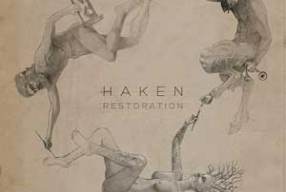
Haken-Restoration I don’t always understand the distinction between an LP and an EP, a question that came to mind with Haken’s Restoration EP. In the days when vinyl was king, this would have been considered a full album, clocking in at over 34 minutes in length. EP or LP, this was one of my favorite releases of the year, with three excellent tracks. The best of these in my opinion is Crystallised, a bloody good epic that is one of the best long form pieces of at least the last five years. I don’t know if this is available on CD, but it’s less than $3 USD on Amazon for a digital download, so there really is no reason not to pick this up and give it a shot.

My instrumental album of the year goes to Cailyn’s Voyager. This is almost unfair, as I was predisposed to liking this just knowing the inspiration behind it. But even if you are not a space geek like me, you should give this one a listen because Cailyn delivered a great work including both her own originals as well as some reinterpretations of Holst’s work from The Planets. My own review is here if you want to read more. But seriously, you should just give this a listen.

a1518259367_10One of my new discoveries this year was the duet from St. Petersburg, Russia, iamthemorning. Their new album Belighted was one of my favorite finds this year. I love their style of “chamber prog”, what a great niche they have carved out for themselves. And Marjana Semkins voice is beautiful, silky smooth and irresistible. Most of the music is pretty mellow, although they do make space for an excellent rocker, The Howler. I really like this act, and I’m very much looking forward to what they will do in the future.

Mariusz Duda, the creative force behind Riverside, returned this year with another chapter in his solo project, Lunatic Soul. Walking on a Flashlight Beam was a worthy release, even if it wasn’t quite as good as the first Lunatic Soul album. Just about anything Duda does these days is worth the attention given to it, and this album is no exception. The songs are very moody, as one would expect, with Gutter being one highlight, while the haunting Sky Drawn in Crayon is probably the best track on the album.

My final entry for this piece is the excellent Ode to Echo by our favorite proggers from Tennessee, Glass Hammer. This glass hammer ode to echoalbum continues a streak of exceptionally strong releases that begun in 2010 with If. There is one quibble I have with this album though, although I do not think it’s the fault of Glass Hammer proper. That quibble is the continued monopolization of Jon Davison’s time by Yes. I’m not going to be one of those guys that says “it’s not Yes without Jon Anderson”, and I do think Davison is about as good a vocalist as they could get in Anderson’s absence. Still, I feel Davison’s home should be with Glass Hammer, whose last four releases (particularly Perilous) have been better than anything Yes has done in … ages. I read a few years ago that upon discovering Davison, the core of Glass Hammer told him that he was the vocalist they had always wanted – and I can certainly understand why. And it really stuck in my craw a few years ago when, on a Cruise to the Edge that included both of his bands, Yes would not allow Davison to perform with Glass Hammer. That was a very disrespectful move, if you ask me, one lacking in grace and class. Yes, I think it’s time for you to take a break, and maybe even consider retiring, as you have nothing left to prove and you’ve had a great career. And Mr. Davison, I think it’s time for you to go home to Glass Hammer and focus your creative energies where they will be best put to use.

There were a number of other albums I heard this year by bands such as North Atlantic Oscillation, Fire Garden, Enchant, and John Basset. But given the limited time and the overwhelming volume of good prog, I just haven’t been able to give them my undivided attention as of yet.

So another year of first world problems – insufficient iPhone storage space, unwanted free albums, and more incredibly good music than I could ever listen to – has come to an end. Still, I’m going to be thankful that I don’t have it as tough as these guys:

https://screen.yahoo.com/tech-talk-iphone-5-000000818.html?format=embed

The Final Moments of Rush 1.0: Driven

Test for Echo (1996), the final album of Rush 1.0.

Growing up in the 1980s, I was certainly well aware of MTV.  I assume many of us here at progarchy were.

Now, music videos are more or less a thing of the past, but I still love this Rush video.  Seems like they perfected the art just as it was dying.

Of course, tragedy would strike Rush very quickly after this, and Rush 2.0 wouldn’t emerge until 2002.

With one day left in 2014, enjoy this great video from 18. . . almost 19. . . years ago.  Ridley Scott meets Monty Python.

Dark Nordic Lullabies

Review of Bjorn Riis, LULLABIES IN A CAR CRASH (Karisma Records, 2014).  52 minutes.  Six songs: A New Day; Stay Calm; Disappear; Out of Reach; The Chase; Lullaby in a Car Crash.

From Karisma Records.

Without a doubt, my favorite Porcupine Tree song is “Arriving Somewhere But Not Here.”  If you could take the best of that 12 minute song—its moodiness, its psychedelic atmosphere, its thundering bass and guitar, its surrealism—and expand it to 52 minutes in length, you’d have Riis’s solo album, LULLABIES IN A CAR CRASH.

Of course, you might also find yourself with a slightly less depressing version of Pink Floyd’s ANIMALS or THE FINAL CUT or a less religious and more nordic version of Talk Talk’s SPIRIT OF EDEN.

Whatever you’d have, you’d be listening to and holding something of intensity, struggle, and beauty.  LULLABIES couldn’t be any moodier, frankly.  In fact, if you’re feeling the holiday blues at all, don’t come near this album.  If, however, you’re in a good state of mind, in a darkened room, wearing your state-of-the-art headphones, and sipping a vodka-tonic, then you’re a blessed listener.  It won’t get better than this.

Indeed, this is the perfect early 1980s album, the type of album that you could (and probably will, even if you’re now in your 40s) listen to again and again and again, trying to immerse yourself in the very Riis-Hollis-Waters-Wilson atmosphere: thick, claustrophobic, and all-pervasive.

Bjorn Riis, having entered the Norse pantheon of prog deities.

No one can avoid comparing Riis’s work here or with Airbag to Floyd and PT.  Yet, there’s something distinctively Riis-ian, too.  This is no mere cover band.  By no means.  In large part, Riis brings three critical things to each of his albums: 1) a haunting vocal style; 2) the uncanny ability to allow his music to flow, organically, as did Mark Hollis; and 3) an outrageously fine sense of audiophilia.

Of course, has there been a misfire from any Scandinavian prog release since Roine Stolt’s mind-bogglingly good THE FLOWER KING?  Not that I know of.

Riis ably follows in this noble tradition.

To learn more, visit Riis’s official site: http://www.bjornriis.com/about/