“Rock ‘n’ Roll might not solve your problems, but it does let you dance all over them.” — Pete Townshend of The Who on Good Morning America, 1978.
From the 1960s through the early 1980s and beyond, Michigan loved The Who. The only place their first single “I Can’t Explain” was a hit in the USA was Detroit. Flint’s Holiday Inn became infamous as the hotel where, according to legend, Keith Moon drove a Lincoln Continental into its swimming pool on his 21st birthday. Their 1975 show at the Pontiac Silverdome briefly held the record for largest indoor concert.
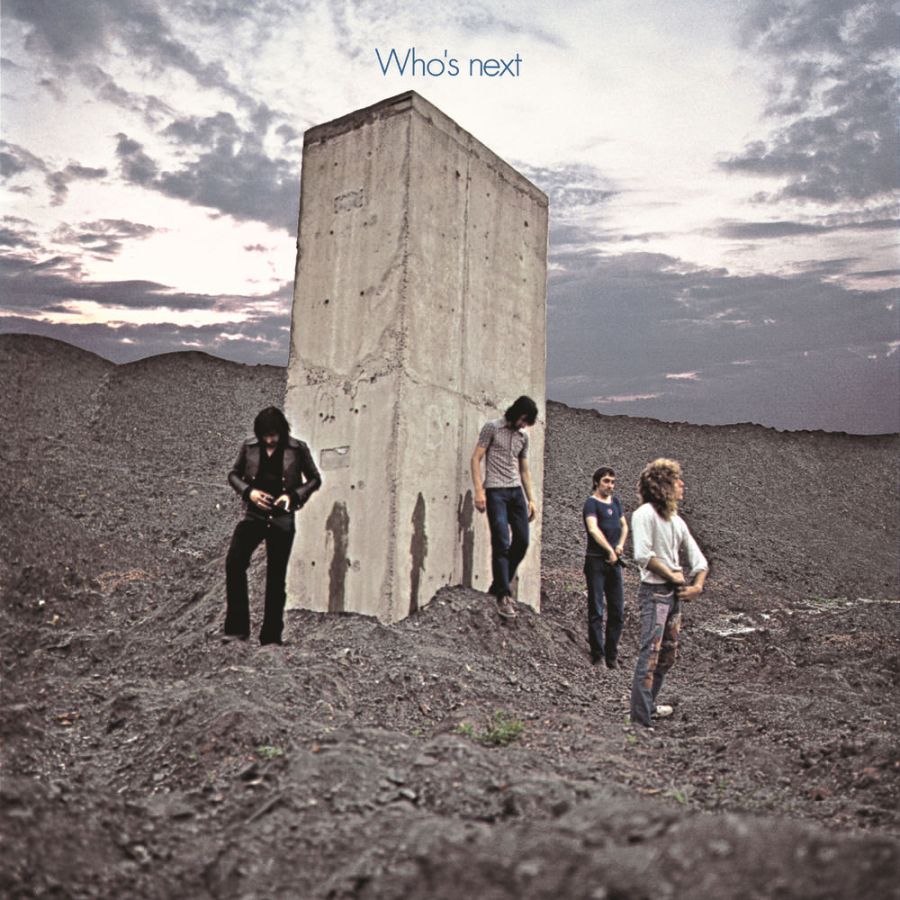
So it wasn’t as if I hadn’t heard songs from Who’s Next before I went to college in 1979; at that point, “Baba O’Riley,” “Behind Blue Eyes” and “Won’t Get Fooled Again” were inescapable on FM radio. But it was at the end of my first term away from home that the 1971 album became something more to me.
I’ve already written here about how, in late November 1977, this album grabbed me and has never let go. Rubber Soul is (to paraphrase my previous comments) a sharp, cogent take on the folk rock fad of the time, mixing in flavors of soul, Indian ragas and Baroque elegance, with words matching the music’s new maturity. It’s the sound of the Beatles downshifting and heading for new destinations, ready to move beyond shaking their moptops to a big beat and basking in the resulting screams.
There are no duds on either the British or the American versions of this album. The UK Rubber Soul kicks off with “Drive My Car” — an exuberant Stax pastiche, a knowing mutual flirtation sketched in three-part harmony, topped with that goofy “beep-beep-yeah” tag on the chorus. The US version, in contrast, starts with “I’ve Just Seen A Face” (from the British Help!)— Paul McCartney breathlessly singin’ and strummin’ a tale of new infatuation, a stream of consciousness laced with unexpected internal rhymes. Neither was at all typical of the Fabs; both sound wonderfully fresh, setting the tone for a different kind of Beatles record.
How many changes can you ring on the classic love song? Rubber Soul shows how far the genre could stretch: surrealism with sitar (John peppering “Norwegian Wood” with non sequiturs a la Bob Dylan); break-ups with a backbeat (Paul’s “You Won’t See Me,” eventually covered with even more swagger by Anne Murray); suffering with added social comment (John’s “Girl,” featuring a chorus that’s just the title word and a deep, frustrated breath). Ringo Starr does a country heartbreak turn on “What Goes On”; George Harrison glumly protects his personal space on the Byrds homage “If I Needed Someone.” And this isn’t even including Paul’s earnest “Michelle,” which, if you were an easy listening artist and had already done “Yesterday,” quickly became the next Beatles tune to cover.
But what’s made Rubber Soul my ultimate touchstone for all things Fab is John’s “In My Life.” It’s hard to top the reflectiveness and wisdom of these lyrics (in fact, I would argue that Lennon’s most famous songs are far less mature). Every year they resonate more for me:
There are places I remember All my life though some have changed Some forever not for better Some have gone and some remain All these places have their moments With lovers and friends I still can recall Some are dead and some are living In my life I’ve loved them all
But of all these friends and lovers There is no one compares with you And these memories lose their meaning When I think of love as something new Though I know I’ll never lose affection For people and things that went before I know I’ll often stop and think about them In my life I love you more
Set to a lovely mid-tempo lope, with George Martin’s getting his Bach on for a gracious piano interlude, “In My Life” is evidence enough that, after Rubber Soul, both the Beatles and rock music would never be the same. Listen to the album here:
Other Favorites by the Beatles: Well, the whole catalog, really. But other favorites among the favorites are (as I’ve mentioned before), A Hard Day’s Night, Revolver, Abbey Road, and whatever Beatles album I’ve listened to last.
Related Favorites:
The Byrds: Essential Byrds (compilation); There Is A Season (box set); Sweetheart of the Rodeo. Inspired by A Hard Day’s Night, the Byrds added Dylan, folk and country to the mix and made magic. “Turn Turn Turn” is another song I never tire of hearing.
Cheap Trick: Heaven Tonight; At Budokan. The Fab Four (pure pop version) of the late 1970s. With added harder rock and wacky stage moves.
The Chipmunks: The Chipmunks Sing the Beatles. The first album my parents ever bought me. Apparently I was tired of The Sound of Music.
Marshall Crenshaw: Marshall Crenshaw; Field Day, The pride of Berkley, Michigan, replete with Beatlemania stage credentials.
The Smithereens: Blown to Smithereens (compilation); Meet the Smithereens (cover version of the complete U.S. album Meet the Beatles). The Fab Four (pure pop version) of the late 1980s.
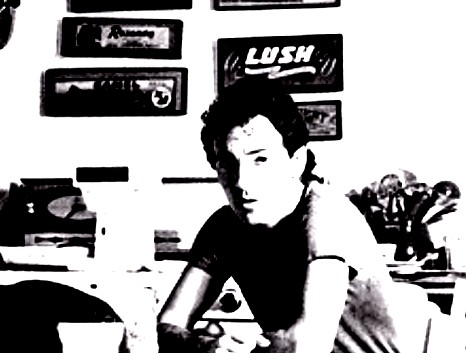
In 2014, Bruce Springsteen covered Suicide‘s “Dream Baby Dream” on his album High Hopes, revealing common roots among artists you wouldn’t normally associate, and further illustrating Springsteen’s connections to the New York art punk scene of the mid and late 70s. His association with Patti Smith, through her interpretation of “Because the Night,” cross-pollinated rock and punk in a critical cultural moment. Then in 1980 Springsteen and Alan Vega of Suicide struck up a friendship while both were recording their respective albums in NYC, and he lent Suicide much-needed support when their second album elicited nothing but stony silence from their label execs. He later likened Vega’s voice, admiringly, to an exhumed Elvis. Springsteen’s rise to bona-fide-and-sanctified rock star in the mid 80s tends to mask that his rock and roll roots were essentially punk, street, to the degree that the nickname he earned early on in his career never sat well with him. He read in Elvis and the Sun brethren an unseating of authority. He was seduced, romanced by rock’s exalting of the everyman, and he built his songs from a society of sympathetic blue collar and rural down’n’outs that appeared fully sketched on record. This was and is his art.
“State Trooper” from Springsteen’s Nebraska (1982) most immediately links his work and Suicide’s, the acoustic blues rock stutter as lean as the song’s words, here exercised in relative economy (compared to, say, “Thunder Road” or “Blinded by the Light,” or, god forbid, “Rosalita”). The lo-fi slapback echo combined with the aesthetic of the cassette multitrack Springsteen was experimenting with to make demos — which he then decided to release rather than flesh-out with his E Street partners — smacks strongly of cheap electronic processing and a reaching towards Suicide’s elemental synthesizer rock.
Both Springsteen and Vega were writing characters deeply steeped in rock’s first wave, but the innuendo is gone, so that Suicide’s Frankie Teardrop and the first person of “State Trooper” — who’s holding on to that thing that’s “been bothering me my whole life” — share a spinning endgame. “Mister State Trooper, please don’t stop me…” is a plea to limit the damage that’s grown out of control, the high-pitched yawp at the conclusion, overloading the mic and my circuits, forever linking Springsteen and Suicide in a stylistic rock’n’roll entirety consisting of a road, a car, probably a gun, and not much time.
soundstreamsunday presents one song or live set by an artist each week, and in theory wants to be an infinite linear mix tape where the songs relate and progress as a whole. For the complete playlist, go here:soundstreamsunday archive and playlist, or check related articles by clicking on”soundstreamsunday” in the tags section.
Nearing the end: Keith Relf (left) and Jimmy Page, 1968
In July 1968 an exhausted Keith Relf handed the keys to the Yardbirds to Jimmy Page, the last of the triumvirate of ground-breaking guitarists to grace the seminal rock band. Relf and drummer Jim McCarty had tired of the road and, in some measure, rock itself, and wanted to do something in a folk vein. For them the frenetic rock scene had run its course.
In October of that year Page took the New Yardbirds (himself plus John Paul Jones, Robert Plant, and John Bonham) to Olympic studios in London. Over 36 hours they hammered out Led Zeppelin, the biggest shockwave in rock history, the culmination of Chuck Berry’s rock n’ roll thunder, recaptured by Jeff Beck’s dangerous and deviant guitar a couple of years earlier, the climax of every frenzied dance ending in sweat-drenched pony-tails and bobby socks blackened by the gym floor.
Page proudly wore his old band on his paisley sleeve: “Communication Breakdown” brandished the proto-punk of Roger the Engineer; “Dazed and Confused” bore the same structure of the Yardbird’s cover of Jake Holmes’ original (credit where it’s due), including a mirror of Page’s guitar break from the BBC version of “Think About It”; “Black Mountain Side” was the Near Eastern-inspired complement to “White Summer”; and the slow burning blues tracks (“You Shook Me” and “I Can’t Quit You Baby”) harken to the Yardies’ roots.
The final Yardbirds salute, the over-powering “How Many More Times,” opens with a cocksure shuffle after the manner of Clapton-era “Smokestack Lightnin’,” then rolls through a Beck-style bolero into not one but two Samwell-Smith-inspired rave ups that bookend a surreal break: a bow drawn over Page’s heavily distorted ‘dragon’ Telecaster — the schoolgirl catching her breath and picking herself up from the dancefloor.
Oh, Rosie…
Seeing Jefferson Airplane in 1967 and hearing Jack Casady’s Homeric bass solo, Page thought to himself, “This is the end of the world.” No. Led Zeppelin was the end of everything. All rock music since January 1969 is post-Zeppelin. Even Led Zeppelin had to become post-Zeppelin to maintain its dignity. The virus exploded; the DNA of countless, nameless concert halls, honky tonks, and juke joints spread through the atmosphere, reconfiguring itself in other forms: folk rock, metal, punk, fusion, techno, roots rock, grunge, etc.
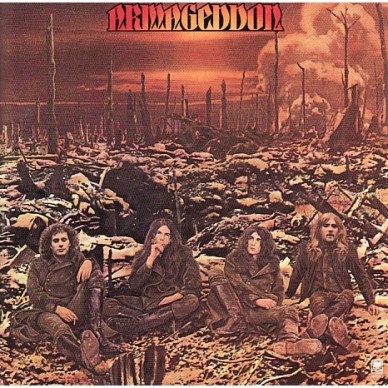
Not the least of these was progressive rock, which is where Keith Relf turned up in 1974 when he formed Armageddon. In addition to Steamhammer’s speed riffer Martin Pugh and bassist Louis Cennamo, Florida native Bobby Caldwell — veteran of stints with Johnny Winter, Rick Derringer, and the Allman Brothers (“Mountain Jam”) — took a seat at the drum kit.
Armageddon (1975) is an aptly titled foray into the post-Zeppelin musicscape. But the album isn’t a detour unto itself. It looks at the past and present musically, and to the future lyrically. Pugh’s riffs are contemporaneous with Houses of the Holy and Physical Grafitti. Prefiguring later developments in prog rock, the music pulls back from the inclusion of multiple themes and motifs, settling into a groove, often one with funk and fusion elements, and extending the passage with subtle alterations. This is particularly evident on the blistering opener, “Buzzard,” as well as “Last Stand Before.”
Relf’s voice isn’t as deep and prominent as on the old Yardbird’s tracks. A lifelong asthma sufferer (it’s painful to watch Jeff Beck mimic Relf puffing on an inhaler), Relf was basically down to one lung by this stage of his ill-fated life and career. But this didn’t thwart his signature harmonica work, and when the instrument makes its appearance toward the end of tracks it comes with the harrowing apocalyptic authority of seven trumpets blowing.
Rock and roll, moving your soul
Took a few as well
On the line, out of time
Shooting stars that all fell
Oh Lord, do something, gotta slow it down
It’s coming on too fast, can’t take it
Feel like I’m gonna drown
Gonna stand and face it, but I need you near
Through the darkest hours, I’m calling
Sometimes I think you don’t hear me calling
Hear me calling
Awareness of the consummation and transformation of all things pervades the album. From the shimmering “Silver Tightrope,”
I thought I saw the candle-bearers
On their way to the beyond
Beckon to me from the future
To come and join the throng
I stepped upon the silver tightrope
Balancing beliefs
And wings unfurling with a new hope
I left behind my griefs
Even the darker “Buzzard” includes a promise,
But the meek will stand
Understanding nature
Seeing far beyond the plan
Take their place in time
Take their place in timeless structure
The end of this present life came quickly and unexpectedly for Keith Relf in May 1975, as he was the victim of an accidental electrocution while working with ungrounded sound equipment in his basement. When the Yardbirds were inducted into the Rock n’ Roll Hall of Fame his wife and son accepted the honor on his behalf.
This post-everything world doesn’t last forever. In the meantime Armageddon occupies the already/not yet space with tight arrangements, subtle time changes, and expert chops from all its participants. And Relf proves the humblest instrument of ages past works in this context, creating a confident work one can take on a long drive — keeping an eye on the speedometer — in the direction of Proghalla.
It’s not until it works its witnesses into a state of ecstatic frenzy, as if reading a preacher-inflected text so self-aware it reaches ascendancy, that New York rock satisfies itself and its audiences. It’s a city of distillations and self-regard, and so in its great contribution to rock and roll, New York puked up a revival so dazzling in its love for rock’s foundations it sometimes barely reads as the punk it became known as (or maybe a common idea of punk): there is no rejection, it is all embrace.
Suicide played rock and roll, and even as they coined the term “punk” — or at least early-adopted it from Lester Bangs to describe what they were doing — in their world that meant you visited the monuments and tore them down to find what was left in substance, not shadow. It was an intentional act of art, constraint-driven, that Martin Rev and Alan Vega followed in the rock they made. And they made it howl.
The pulsing drone riff of “Ghost Rider” leads Suicide (1977), the culmination of seven years of paring and refining and filtering the pure rock spirit. That Suicide did this as a duo with synth and drum machine was revolutionary to the point of riot-inducing, and to this day sounds outside a point in time. Suicide denied time, even to the degree that Vega claimed he was far younger than his 39 years. It was no nostalgia trip, Suicide’s rock and roll, even though that trip hung heavy in the air: this same year the retro band Sha Na Na debuted on TV, though they too had been around for a while, hocking the schlock of 50s rock, that shadow that Suicide made it their business to avoid. Both were needed but only one was important.
soundstreamsunday presents one song or live set by an artist each week, and in theory wants to be an infinite linear mix tape where the songs relate and progress as a whole. For the complete playlist, go here:soundstreamsunday archive and playlist, or check related articles by clicking on”soundstreamsunday” in the tags section.
by Rick Krueger (Thanks to Brad Birzer for his encouragement in the comments on his Sgt. Pepper at 50 post.)
“Bliss was it in that dawn to be alive, But to be young was very heaven!”
— William Wordsworth
I was definitely young — just over 2 years old, in fact — in February 1964, when this came on my grandparents’ TV:
It’s the first thing I remember. It felt like Wordsworth’s “very heaven.” And it instantly led to the first two things I remember wanting: Beatles records, and a Beatles wig.
My birthday is in November, so I have no idea how my parents pacified me till then. I have a vague memory that my mom re-purposed a yellow fringed toilet seat cover and I became a blond Beatle for a while. Whether that’s fact or imagination, you can see the outfit I got when I turned 3 after the jump:
The figure “singing from the window in the Mission of the Sacred Heart” in ELO’s “Mission (A World Record)”, last week’s soundstreamsunday entry, could be the uptight narrator of Radiohead’s “Subterranean Homesick Alien,” from the band’s 1997 tour-de-force OK Computer. As if in mirrored conversation, those two songs, separated in time by over 20 years but perhaps closer than they appear — in their beam-me-up guitar melodies, keyboarded grandeur and darkening moods — are to me joined at their metaphoric sci-fi hips.
Radiohead’s confidence on OK Computer, in both the intense alienation of the fragmented lyrics and the band’s break with the walls and squalls of mid-90s guitar rock, is a subtle swagger ripe with end-of-the-millenia decaying beauty. It’s a prog goth triumph, reaching in its many directions to locate the mood of its time, a burred gloaming richly unsettled. It’s also, I was reminded when listening again to it recently, funny, in the same way that Forever Changes is, or Fight Club, or a mad prophet preaching the end times. There’s just no telling what the next turn will be, but there is a willful design, and so the satisfaction of a wicked lyric or the resolution of a majestic melodic sequence prompts a smile or a laugh. The parts come together, a human victory, a denial of the end even as it’s being trumpeted.
The internally rhyming title of “Subterranean Homesick Alien,” a riff on a Dylan masterpiece (and, further back, a Kerouac novel), feels tossed off on the one hand but also maybe the only choice given its narrator’s painting a scene of alien surveillance and his desire, that he be taken “on board their beautiful ship, show me the world as I’d love to see it.” He’s maybe one of them, maybe wants to be one of them, but who They are is undetermined and in any case moot: the point is homesickness for a place that has to be better, with the “breath of the morning” and the “smell of the warm summer air.”
soundstreamsunday presents one song or live set by an artist each week, and in theory wants to be an infinite linear mix tape where the songs relate and progress as a whole. For the complete playlist, go here:soundstreamsunday archive and playlist, or check related articles by clicking on”soundstreamsunday” in the tags section above.
I never knew anyone who wasn’t at least a little bit of a fan of Electric Light Orchestra. My age privileges me in remembering hearing new ELO songs on the radio when I was a kid — it was almost impossible I think for DJs to screw up their set with ELO, as the band’s music straddled so many genres at one time — and although I never owned any of their albums until I was in my 40s (I can’t believe it either), not liking their music would be akin to not liking having any fun. But along with that fun came a musicality and seriousness of songwriting that could get you scratching your head, too. In the words of the old ad, this stuff was good and good for you.
Those were the days…. Launched on record in 1971, by 1976 ELO had five albums under their belt and their sixth, A New World Record, would distill Jeff Lynne’s profound ambition into a back-to-front nine-song pop-prog epic 36 minutes long. While many fans cite ELO’s next record, 1977’s Out of the Blue, as the masterpiece (and in some ways it is), that double album’s aesthetic really gestated on A New World Record: late-era Beatles laid across heavy accents of American R&B and soul, filtered through an army of instruments and tracks. Lynne’s achievement in 1976 was to make this happen succinctly, in service of his writing, which produced the best kinds of love songs — those without the hey babies — full of heartbreak, hope, and hooks. Always the hooks, the insanely catchy melodies. And so the album is packed with genuine chart hits: “Telephone Line,” “Livin’ Thing,” the odd and wonderful “Do Ya,” the dopey but tolerable “Rockaria!” Pop done and undone to the level of the avant-garde, it’s so ridiculous. But it’s at the end of the album’s sides where the sweetness isn’t so much cleansed as qualified, adding a complex finish to the confections preceding. So the album closer “Shangri-La” declares in its operatic final two minutes a return to paradise, either towards or away from the pain of love, and the last cut on side A is a puzzle that resolves in a lyrical, gorgeous sadness.
From the LP lyric sheet, the (artfully incomplete) words to “Mission (A World Record)”
There is nothing straightforward in “Mission (A World Record),” the central lyrics of which are “watching all the world go by” and — not even printed in the liner notes — “how’s life on Earth?” The rest of it could be a starry sci-fi mini-epic or the rant of a tenant at a mission hospital, or both. But, astral projection or interstellar travel aside, the song concerns itself primarily with a melody, guitar line, and arrangement that read like maps of a future Radiohead. A vibe of desolate beauty, of being left behind, linked with a prophecy or the ramblings of a seer, a paranoid android or a subterranean homesick alien.
soundstreamsunday presents one song or live set by an artist each week, and in theory wants to be an infinite linear mix tape where the songs relate and progress as a whole. For the complete playlist, go here:soundstreamsunday archive and playlist, or check related articles by clicking on”soundstreamsunday” in the tags section above.
In the early 1970s in England there were a few rock bands that mattered and one that really mattered, and that was the Faces. I mean Rock band. Rock and roll. They were a supergroup, a bridge between genres, a match in a haystack. They had big hits and the best hair.
For English kids the Faces must have represented a lot of things, glam without the spacesuits, the Stones but more fun, a way to get back to the basics in the wake of the Beatles’ passing. So they could springboard Rod Stewart to pop stardom, sure, but also be an inspiration, both in attitude and rock power, to punk bands from the New York Dolls to the Sex Pistols. The Faces were about energy and, when they put their mind to it, peerless songwriting, thanks in good part to Ronnie Lane, the core of a band who counted among its cadre once or future members of the Jeff Beck Group, the Small Faces, the Rolling Stones, and the Who. Across their four albums you get the strong sense the rest of them were there because of Lane — playing a cheery bass and occasionally singing, in his homespun warble, songs with a a bit of a wink and a whole lot of heart.
“Ooh La La,” a rock and roll music hall chanty of the type Lane virtually invented in the Small Faces, was the last song on the Faces’ last record. It’s perfect. It’s a smiling shake of the head, a “poor old granddad” and “poor young grandson” dialogue of women and love and sex. There was genius in the decision to have Ronnie Wood sing Lane’s lyric — ragged but right, he brings to it the feeling of an old man, twinkle in his eye, holding forth in the corner of a bar. Such places are after all where the Faces lived, and where you can still find them.
soundstreamsunday presents one song or live set by an artist each week, and in theory wants to be an infinite linear mix tape where the songs relate and progress as a whole. For the complete playlist, go here: soundstreamsunday archive and playlist, or check related articles by clicking on”soundstreamsunday” in the tags section above.
Phil Lynott’s destiny — reimagining rock and roll as heavy Irish metal — meant that his band Thin Lizzy, like Motörhead and maybe AC/DC, had a claim to authenticity that punk couldn’t ignore. Lizzy’s music was lean, written with a razor, and Lynott wrung from his blackness and his Irishness every possible note of rock and roll victory in a landscape that generally counted him out. Lynott’s conversational style in song could echo Van Morrison (if with a brash sexuality Morrison could never pull off), and like the great Van could conjure specific visions of Irish traditional culture while turning them on their ear. I can only imagine that the Clancy Brothers blanched, and Planxty swooned, at his treatment of “Whiskey in the Jar.”
“Emerald” closes Thin Lizzy’s blockbuster Jailbreak (1976), and while not the hit every metalhead thinks it should have been — that honor went to the catchy hard rock of “The Boys Are Back in Town” — as the closing track of a great set (“Jailbreak”!, “Cowboy Song”!), it templated the double-guitar attack metal was moving toward. It’s hard to imagine K.K. Downing and Glen Tipton shrugging off “Emerald’s” twining riffs and solos, as Scott Goreham and Brian Robertson mapped a terrain in this performance where Judas Priest would go on to flourish. Lynott’s lyric has all the Celtic warrior mysticism necessary to make fists shake and heads bang, whether your sporting a safety pin or a mullet, and as ever his impassioned singing and playing cannot be denied. This is the metal mountain.
soundstreamsunday presents one song or live set by an artist each week, and in theory wants to be an infinite linear mix tape where the songs relate and progress as a whole. For the complete playlist, go here: soundstreamsunday archive and playlist, or check related articles by clicking on”soundstreamsunday” in the tags section above.



 In 2014, Bruce Springsteen covered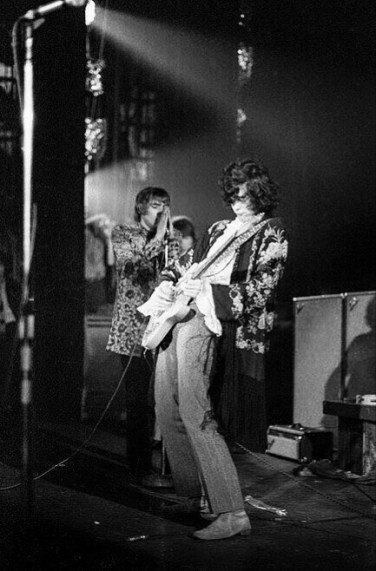
 Armageddon
 It’s not until it works its witnesses into a state of ecstatic frenzy, as if reading a preacher-inflected text so self-aware it reaches ascendancy, that New York rock satisfies itself and its audiences. It’s a city of distillations and self-regard, and so in its great contribution to rock and roll, New York puked up a revival so dazzling in its love for rock’s foundations it sometimes barely reads as the punk it became known as (or maybe a common idea of punk): there is no rejection, it is all embrace.
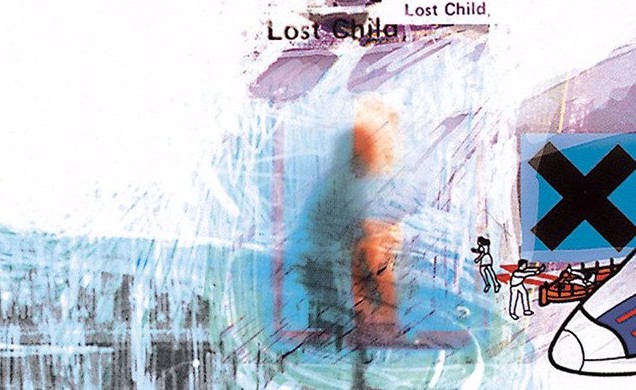 The figure “singing from the window in the Mission of the Sacred Heart” in

 In the early 1970s in England there were a few rock bands that mattered and one that really mattered, and that was the Faces. I mean Rock band. Rock and roll. They were a supergroup, a bridge between genres, a match in a haystack. They had big hits and the best hair.
 Phil Lynott’s destiny — reimagining rock and roll as heavy Irish metal — meant that his band Thin Lizzy, like Motörhead and maybe AC/DC, had a claim to authenticity that punk couldn’t ignore. Lizzy’s music was lean, written with a razor, and Lynott wrung from his blackness and his Irishness every possible note of rock and roll victory in a landscape that generally counted him out. Lynott’s conversational style in song could echo
