Since I’m a college professor, the first part of May every year finds me grading final exams and final papers. It’s not fun. It can be gratifying, but it can also be depressing. Either way, it’s exhausting, and it requires some kind of respite afterwards, a mini-staycation of some sort, a passage into a place where the time is elastic, so that the passage back is simultaneously minutes and days after departure. The passage back (to the place I was before) is to an apparently transformed and renewed place. Or is it just that I was, in those brief moments, gone for so long?
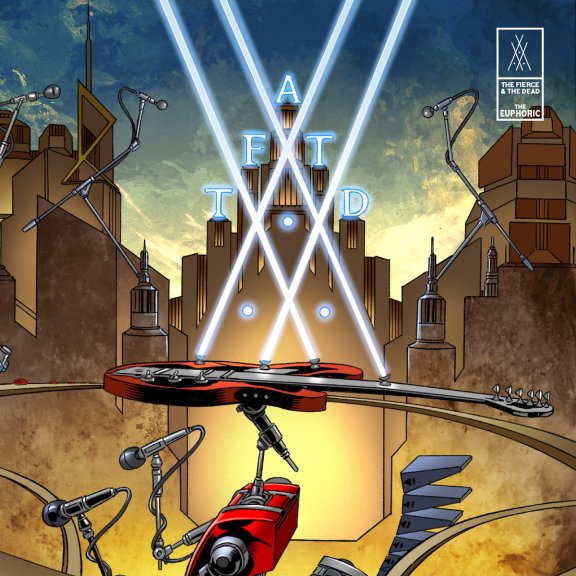
Refreshment comes this May with the BEM release of The Fierce and the Dead’s latest studio album, The Euphoric (official release date 5/18/2018). As I’ve come to expect from TFATD, I’m provided here with a glorious flow of instrumental passages.
One of the wildest and most disturbing aspects of modernity is how compartmentalized everything becomes. One important thing (a person, an idea, an institution) becomes isolated and, in its isolation, takes on its own importance, its own language (jargon), and, naturally, its own abstraction.
During the past 100 years, a number of groups have tried to combat this. In the U.K., most famously, there were a variety of literary groups: The Inklings; the Bloomsbury Group; and the Order Men. In the States, there were the southern Agrarians, the Humanists, the Lovecraftians, and the women (no official name–but Isabel Patterson, Claire Boothe Luce, Dorothy Thompson, and Rose Wilder Lane) who met for tea once a week and shared stories.
The first such known group in the English-speaking group was the Commonwealth Men, meeting in London taverns from 1693 to 1722, attempting to combine British Common Law thinking with classical and ancient philosophy.
It would not be an exaggeration to argue that meeting Carrie Nuttall served as one of the most important moments in Peart’s life and in precipitating Rush 3.0. In her, Peart found a reason to live fully, a reason to rediscover excellence, and a reason to return to his life in Rush. It was through their mutual friend, Andrew McNaughton (now deceased), that the two met.
In those days, Andrew and I often talked on the phone from wherever I wandered, and shared our sorrows and anxieties. Typically, Andrew was determined to find a “match” for this crusty old widower. When my motorcycle had carried me back across the continent yet again, to pause in Halifax, Nova Scotia, Andrew sent me a few test Polaroids of a photo assistant he had been working with-a pretty dark-haired girl named Carrie. Again, I was reluctant, gruffly telling him, “not interested”—but finally I made my meandering way west again, and stopped for a while in Los Angeles.[i]
When she met Peart, she knew next to nothing about the band.[ii] She told him, however, that she would love to see him perform again, especially considering his reputation as a drummer and his own love of music. For Peart, all of this proved almost Faerie-like.
Andrew introduced me to Carrie, my real angel of redemption; in less than a month we were deeply in love, and in less than a year we were married in a fairy-tale wedding near Santa Barbara. Carrie: Beautiful, smart, cultivated, artistic, affectionate; Deep green eyes, long dark hair, radiant smile; Tall, slender, shapely, nicely put together; Half English, half Swedish, all American, all mine. The answer to a prayer I hadn’t dared to voice, or even dream. Carrie. Soulmate, a lover, a wife, a new journey to embark upon, the greatest adventure. [iii]
Though still in pain—a pain that would (and will) never fully cease—when he met her, he found her instantly attractive intellectually as well as personally. They bonded almost immediately in friendship. She considered him a modern-day Conquistador, armed in black leather and mounted on a powerful red horse, forever seeking the road and adventure. But, his days of restless exploration had come to an end, and the Ghost Rider faded into memory. On September 9, 2000, just three days short of his forty-eighth birthday, Peart married Nuttall in Montecito, California.[iv]
Discipline is the ninth in a series of audiophile King Crimson vinyl reissues.
Super-heavyweight – 200g – cut from the masters used for the 30th anniversary series and approved by Robert Fripp, this vinyl version echoes the 30th anniversary edition CD and contains two takes of the majestic Matte Kudasai (featuring Adrian Belew’s lead guitar on track 3 side A and Robert Fripp’s lead guitar as a bonus track at the end of side B – uncredited as per the CD).
Pre-order for 15th June release.
Nine Inch Nails
Bad Witch (cd / vinyl pre-orders)
The six track Bad Witch is Nine Inch Nails’ first full-length album since 2013 and completes a trilogy of story-telling/conceptual releases (that includes 2016’s Not The Actual Events and 2017’s Add Violence EPs ).
Available as CD and vinyl editions.
Pre-order for 22nd June release.
Frank Zappa & The Mothers Of Invention
Burnt Weeny Sandwich (vinyl pre-order)
A 180g audiophile vinyl version of Zappa and The Mothers enigmatic treat Burnt Weeny Sandwich. Supervised by the ZFT, the record was specially mastered for this release by Bernie Grundman with all analogue production and cut directly from the 1970 quarter inch stereo safety master tape in 2018.
Unavailable on vinyl for more than three decades.
Pre-order for 6th July release.
Jon Hassell
Listening To Pictures (Pentimento Volume One) (cd / vinyl pre-orders)
Continuing his lifelong exploration of the possibilities of the studio, Listening To Pictures is the first new album in nine years from musical visionary, Jon Hassell.
Available as a CD in jewel case with printed outer slipcase and 10 page booklet, and as a single 140g vinyl LP in a full colour printed sleeve with printed inner and digital download card.
Pre-order for 8th June release.
Marillion
Smoke / Mirrors (cds)
Smoke and Mirrors are part of a limited edition series of releases that were previously only available via Marillion‘s own web store and features the band performing live at the Marillion Weekend in Minehead in 2005.
Taken from the Saturday performance, Smoke features Marillion’s most up-beat and high-energy songs. Taken from Sunday’s performance, Mirrors showcases the slower and more atmospheric side of the band’s output.
Shipping now.
Orbital
Monsters Exist (cd / vinyl pre-orders)
Britain’s giants of electronic music Orbital return with the bold Monsters Exist.
Available as a deluxe double CD with 7 extra tracks and as a double vinyl edition with full-colour insert and download card.
I’m thrilled to know that Rubenstein’s EP is now available for pre-order. The man looks like Alex Lifeson and plays better than Keith Emerson! His previous album, NEW METAL FROM OLD BOXES, is still a stunner.
And, it’s now possible to get Rubenstein’s entire discography for $13.60. Enjoy!
“Four Points of Focus”, my new EP of four songs, is now available.
This has been over a year in the making, and I’m delighted to share it with you (finally!) .
It is an EP of Four instrumental progressive/fusion songs featuring performances from Tom Hipskind on drums, Shawn Sommer on bass, Bugra Sisman on guitars, Daniel van den Berg on guitars, and Chuck Bontrager on 7-string electric violin.
The project started when Bugra (who plays electric guitar on two of the songs) heard the early demos and asked if we could collaborate on a production. Over a year later of sending recordings back and forth across the world – from the U.S. to Turkey and to The Netherlands and back – here it is. An unexpected gem, to me, because I never thought these songs would ever get past the “idea” stage.
Happily, they did, and here they are. I’m very lucky, and honored, to have such excellent musicians on this recording.
“Four Points of Focus” is available for pre-sale, and will be released on June 25, 2018. Because you’re on the mailing list, you get in early!
Thanks again for your interest, and for your support of “not-the-usual” music.
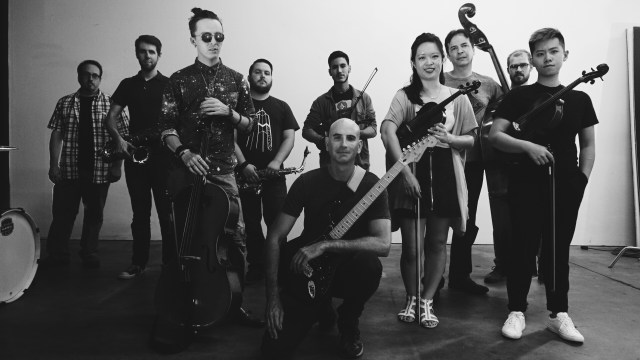
A 12-piece experimental rock ensemble, The Mercy Stone has launched a new studio performance video for the song “Wail Song” taken from their album Ghettoblaster. Watch it below.
Founder of the project, guitarist and composer Scott Grady stated, “‘Ghettoblaster’ uses many different genres/styles of popular music with elements of classical composition. With ‘Wail Song,’ I was looking to take The Mercy Stone into a jazzy/funky musical space. A lot of the musical ideas come from the fact that I play a little bit of many different instruments. Once I had a good idea of how the piece would unfold, experimenting and improvising on strings, winds, and percussion helped generate many of its melodic and rhythmic elements. This is one of the most challenging and most fun pieces that we play. Much of the piece fluctuates between meters frequently, so it keeps us all on our toes. Getting everyone in the band to really groove through all of the rhythmic challenges definitely took some time.”
The Mercy Stone recently started work on their sophomore full-length release.
“While Ghettoblaster was entirely instrumental, this new album will have several tunes with vocals. It will be exciting to share a very different side of The Mercy Stone when all is finished,” Grady commented.
Take a Dylanesque verbal collage by lyricist Keith Reid; marry it to instantly appealing melody and harmony — passionately sung and played by R&B pianist Gary Brooker, drawing equally on Baroque grandeur (Bach’s “Air on the G String”) and dramatic soul (Percy Sledge’s “When A Man Loves A Woman”). Then garnish with Matthew Fisher’s Hammond organ counterpoint. The result: “A Whiter Shade of Pale,” Procol Harum’s first single, a defining hit of 1967, and one of progressive rock’s most influential precursors.
You can argue Procol Harum (Brooker, Reid, drummer B.J. Wilson and a shifting supporting cast — notably Fisher and guitarist Robin Trower) never topped their debut, either artistically or commercially. But they made excellent music for a decade, with reunions every 12-15 years after that — thirteen fine albums that consistently engaged the mind, gut and heart. The latest installment in Procol’s current reissue campaign, Esoteric Recordings’ Still There’ll Be More: An Anthology, 1967-2017, is the long-overdue box set this band richly deserves.
The power in “O Fortuna” — last week’s entry on the infinite linear mixtape — is in its performative setting, the text from Carmina Burana,enlivened, engulfed, by Carl Orff’s score. Liquored- and sexed-up Goliards may have written it, may have given it a chant or two in its 12th-century time, but it was Orff who saw its dark potential and thus defined it. It’s the magic in the most successful pieces of music, and why the idea of performance (whether it’s a live rendering of a piece or a feat of studio engineering), the act of putting on a mask, is such an important counter to its parallel, authenticity, with its passing and uncaptureable fire.
The conceits of performance make any “folk” revival possible, and while the makeup may be thickly applied at times — whether it’s a young Bob Dylan doing his best to carry himself like Woody Guthrie or Gillian Welch’s plaintive approximation of Appalachia — it’s a path to something deeper, a striving towards the elemental.
When Ashley Hutchings left Fairport Convention in late 1969 to form Steeleye Span, something like this may have been on his mind. In bringing together two couples rooted in Britain’s folk music scene, Maddy Prior and Tim Hart, and Gay and Terry Woods, Hutchings was continuing a search to find a balance between the traditional and contemporary, which would soon lead him to form another keystone of the revival, the Albion (Country) Band. The Woods’s left after the first record, 1970’s Hark! The Village Wait (Terry would go on to be one of the essential Pogues), and increasingly over the next decade Steeleye would be vocalist extraordinaire Maddy Prior’s vehicle, but the debut captures the spirit of the BritFolk moment, with Hutchings and Fairport drummer Dave Mattacks giving a rock anchor to traditional flights.
“Twa Corbies” brings the darkness, recounting a conversation between two crows about making a meal of a dead knight. Based on “The Three Ravens,” the song was first published in 1611 but in all likelihood has a far deeper past. Steeleye makes the most of it, Prior’s clarion call washed in the ragged-but-right chorus of her bandmates.
As I was walking all alane,
I heard twa corbies making a mane;
The tane unto the t’other say,
‘Where sall we gang and dine to-day?’
‘In behint yon auld fail dyke,
I wot there lies a new slain knight;
And naebody kens that he lies there,
But his hawk, his hound, and lady fair.
‘His hound is to the hunting gane,
His hawk to fetch the wild-fowl hame,
His lady’s taen another mate,
So we may mak our dinner sweet.
‘Ye’ll sit on his white hause-bane,
And I’ll pike out his bonny blue een;
Wi ae lock o his gowden hair
We’ll theek our nest when it grows bare.
‘Mony a one for him makes mane,
But nane sall ken where he is gane;
Oer his white banes, when they are bare,
The wind sall blaw for evermair.’
The chunky lo-fi crash apropos a murder of crows murks in the background, conjuring its medieval vibe as baldly and surely as Orff might, electric guitars not detracting from the proceedings. We’re there, with the band, with the corbies, pikin’ at the bonny blue een.
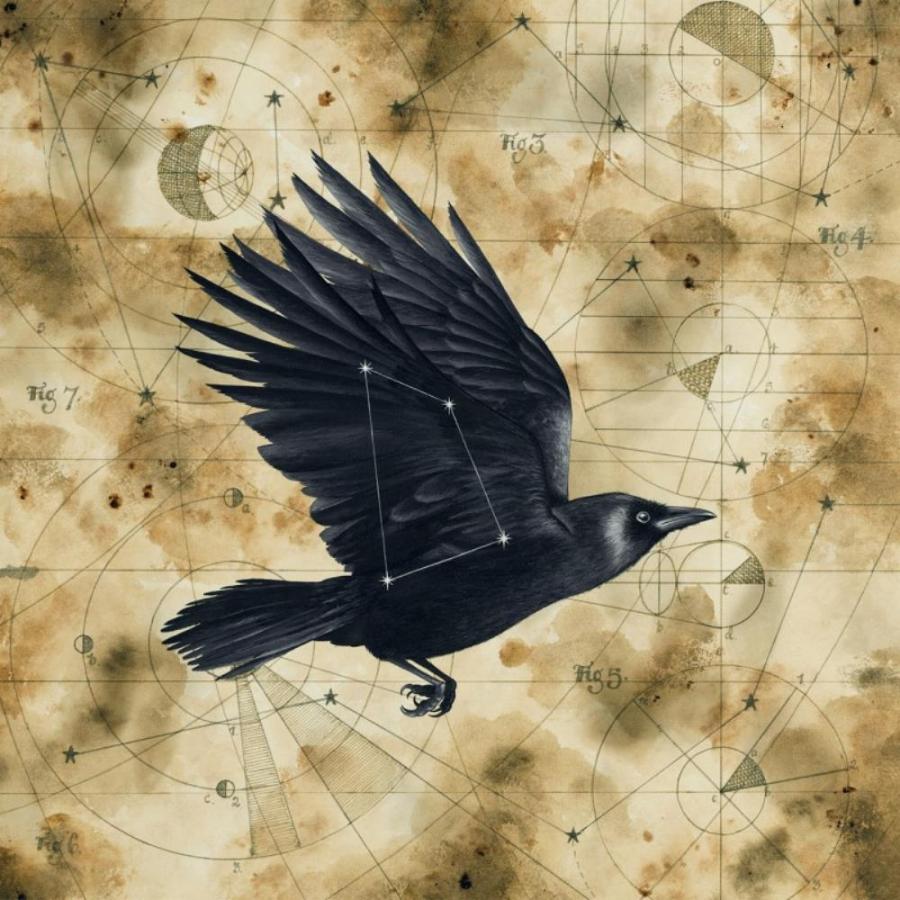
*Image above by Sam Black.
soundstreamsunday presents one song or live set by an artist each week, and in theory wants to be an infinite linear mix tape where the songs relate and progress as a whole. For the complete playlist, go here:soundstreamsunday archive and playlist, or check related articles by clicking on”soundstreamsunday” in the tags section.








 The power in “O Fortuna” —
  Progarchy