Camille Saint-Saëns’ Symphony No. 3 has so many distinct and wonderful flavors, it just amazes me. And the first movement is so vibrant, unexpected, cinematic. The second movement utterly transports me… 1,136 more words
Great news… Lake Street Dive has a new album coming out May 4th!
Not only that, but now I will get a chance to see them live again, this time at the famous Commodore Ballroom in downtown Vancouver!
Come and join me, y’all…
Not only are they brilliant songwriters, they also do the greatest covers you have ever heard. Check out their “Bohemian Rhapsody,” and their “Walking on Broken Glass,” and also this gem:
This May will mark a year since Cornell took his life after a Soundgarden show in Detroit; now there is a new song from the late, legendary singer. Titled “You Never Knew My Mind,” it is the first single from a tribute album—Forever Words—to Johnny Cash. Each of the songs (other artists include Elvis Costello, Jewel, Rosanne Cash, Brad Paisley) features words from poems and lyrics by Cash set to new music. Here is Cornell’s song:
And here is video of Cornell recording the song and talking about his deep admiration for Cash.
The admiration was mutual, as Cash, in 1996, recorded a fabulous cover of Soundgarden’s powerful 1991 song “Rusty Cage”:
When I saw Cornell in concert here in Eugene, Oregon, in the summer of 2016, Cornell sang “Rusty Cage” in the same galloping, country-fied style as Cash, in homage.
Further dates have been added to Bill’s series of talks on creativity in music performance … The trip ends appropriately enough in Cleveland, OH, at the Rock and Roll Hall of Fame for this recent inductee. Just to clarify: excepting the R&R HoF, these talks are gently academic in nature and not about Bill or his career per se. He will not be performing, but he is happy to autograph a book and one other item only, should that be requested.
Dates are as follows:
March 5th: 5.00-6.30 pm. Rhythmic Music Conservatory, Copenhagen, Denmark.
March 8th. 7.00-9.00 pm. Rockheim National Museum of Popular Music, Trondheim, Norway.
April 10th: 2.45 pm. University at Albany, NY (uptown campus), Performing Arts Center (PAC) B-78. Visitors should park at one of the two visitor lots. Free admission.
April 11th: 3.00 pm. SUNY Oneonta, Oneonta, NY. Fine Arts Center M201, Ravine Parkway, Oneonta. Free admission.
April 13th: 4.00 pm. Onondaga Community College, 4585, W Seneca Turnpike, Syracuse NY. Classroom (P110) in the Academic II building. Free admission.
April 16th: 4.00 pm. University at Buffalo, Buffalo, NY. Baird Recital Hall. Free admission.
April 17th: 7.00 pm. University of Michigan, Ann Arbor, MI. Watkins Hall, School of Music, Theater & Dance. Free admission.
April 18th: 11.30 am. Kelvin & Eleanor Smith Foundation Ballroom C, Tinkham Veale University Center, Case Western Reserve University, Cleveland OH. Free admission.
April 18th: 7.00 pm. Rock and Roll Hall of Fame, Cleveland OH. Admission $10.
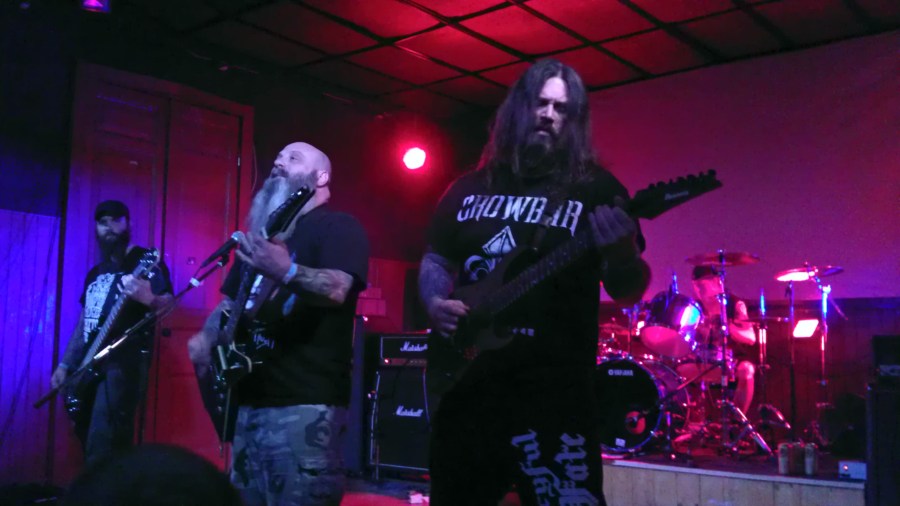
At New Orleans moderate temperatures, 70s Black Sabbath and hardcore punk riffs are known to fuse, forming what we now know as sludge. Crowbar simply crystallized it into a grinding atmospheric doom. It’s downtuned to the abyss and propelled by stocky hardcore punk riffs, usually dragged out to its limits. Rare bluesy strumming and more than adequate raspy vocals – “Slave to no one but your misery. Broken man lies where you used to be” – adds to the essential low. But even at this bleak pace, anyone can easily sense the grinding force that Crowbar inflicts.
These thoroughly grayed out hues may not be everyone’s delight. Crowbar’s creations are essentially tailored – to just fit into the two percentile of the brooding end of the emotional spectrum. But, if gloom is what you seek, ‘Odd Fellows Rest’ is splendid company.
Released in September 1979, Unleashed in the East, recorded on the Japanese leg of their Hell Bent for Leather tour, capped Judas Priest’s first long and storied decade, six months before their mainstream breakthrough British Steel. It’s a killer set, brightly produced, and enlivened some of their early material, which could tend towards studio stiffness. It was itself partly a studio effort, as singer Rob Halford had to add vocals after the fact, but anyone who loves this band or live records in general couldn’t, or shouldn’t, care less: live albums, live rock albums in particular, are by their nature a conceit of production.
This was Judas Priest’s moment: between 1976 and 1980 they released six defining albums, all the while with punk nipping at their heels — and, I think, the band was listening to what was happening on the street, just based on the evidence of Killing Machine/Hell Bent For Leather and British Steel. But metal audiences were coming into their own too, thanks in large part to Priest’s own tireless touring and a body of work that laid the foundation for the faster, thrashier, “New Wave of British Heavy Metal.” Having grown out of the same general scene as Black Sabbath, Judas Priest’s trajectory was away from the early 70s heavy stoner rock that drove so many of that era’s bands into extinction (including, eventually, Sabbath mach 1). After a middling initial effort, Priest (like Rush) found a signature metal sound early on that wasn’t Sabbath or Zep redux and that benefited from a progressive rock outlook, so that they were as comfortable covering Spooky Tooth or Joan Baez (“Diamonds and Rust,” their first real taste of success) as they were busting out such chestnuts as “Island of Domination.”
“Victim of Changes,” as it appears on Unleashed in the East, is the highlight of Priest in the 70s. Originally recorded for 1976’s Sad Wings of Destiny, the song is flagship NWOBHM, its galloping chug and dynamic shifts supporting metal’s best and darkest lyrical effort pre-Metallica, unwinding around themes of alcoholic deterioration and lost love that, as voiced by Halford in his keening wail, describe heart-rending loss. No sword and sorcery here, or southern crosses: the bedevilment in human relationships is fodder enough. Glenn Tipton and K.K. Downing, Priest’s twin guitar threat, are at their creative peak, with interplay both highly technical and soulful, while bassist Ian Hill and Les Binks (offering some early double bass drum action) lay down the solid propulsive core so important to Priest’s success. Heavy. Essential.
soundstreamsunday presents one song or live set by an artist each week, and in theory wants to be an infinite linear mix tape where the songs relate and progress as a whole. For the complete playlist, go here:soundstreamsunday archive and playlist, or check related articles by clicking on”soundstreamsunday” in the tags section.
Might sound like a cliché, but progression is the only constant in life, and this is especially true in music. In fact, incessant change is the norm in prog. For instance, Dream Theater used to define progressive metal. But it’s safe to say that benchmark is now comfortably buried — under layers of odd time signatures, robotic precision and polyrhythms.
But change is also an obvious broader pattern, manifesting over time and at numerous levels.
Both artists and their listeners tend to evolve, often in different trajectories. We are all simply wired differently and more importantly — we constantly learn. At least most of us do. In that sense, it’s also impossible to listen to the same song twice – because each iteration would be perceived through a slightly different neural filter.
Nothing illustrates this more than going back and listening to our decade old favorites. This will inevitably reveal a new facet to the very same sound, something which was never obvious before. Essentially, artistic experiences tend to forge new sets of mental connections, and this way we progressively develop our own individual palate.
A fellow metal-head and a Progarchy reader had recently managed to summarize her own progression, and that also in just about six artists. This sort of prompted me to jot down and share my own seven song list. Needless to say, Powerslave to Funeral Fog took a few years.
There may possibly be some readers who still don’t know that, as well as being editor and chief contributor to Progarchy, Dr. Brad Birzer has also written lyrics and created concepts for two progressive rock albums. This is a track from the latest album Of Course It Must Be. You can explore more of Brad’s work at http://www.birzerbandana.bandcamp.com




 Released in September 1979, Unleashed in the East, recorded on the Japanese leg of their Hell Bent for Leather tour, capped Judas Priest’s first long and storied decade, six months before their mainstream breakthrough British Steel. It’s a killer set, brightly produced, and enlivened some of their early material, which could tend towards studio stiffness. It was itself partly a studio effort, as singer Rob Halford had to add vocals after the fact, but anyone who loves this band or live records in general couldn’t, or shouldn’t, care less: live albums, live rock albums in particular, are by their nature a conceit of production.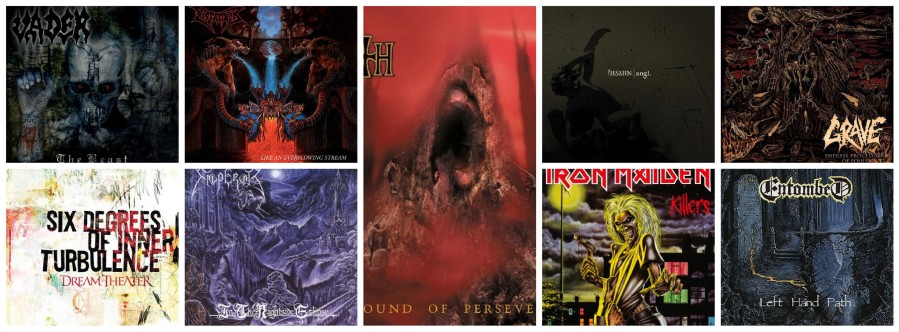
 Progarchy
