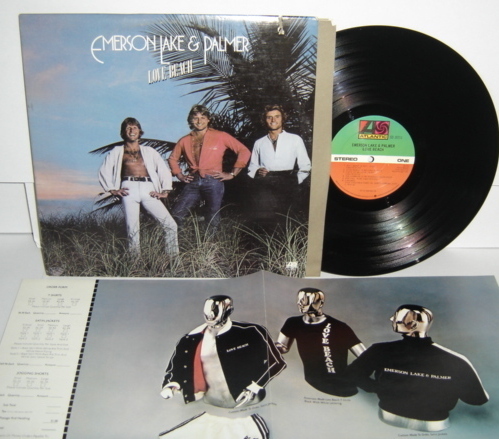
My first reaction to Love Beach (purchased at the Grosse Pointe location of Harmony House, after hearing “The Gambler” on Detroit rock radio in November 1978) wasn’t about the music. It was about the merchandising insert included with the first pressing. I think my actual thoughts were something along the lines of, “They’re selling satin Love Beach jogging shorts?!?”
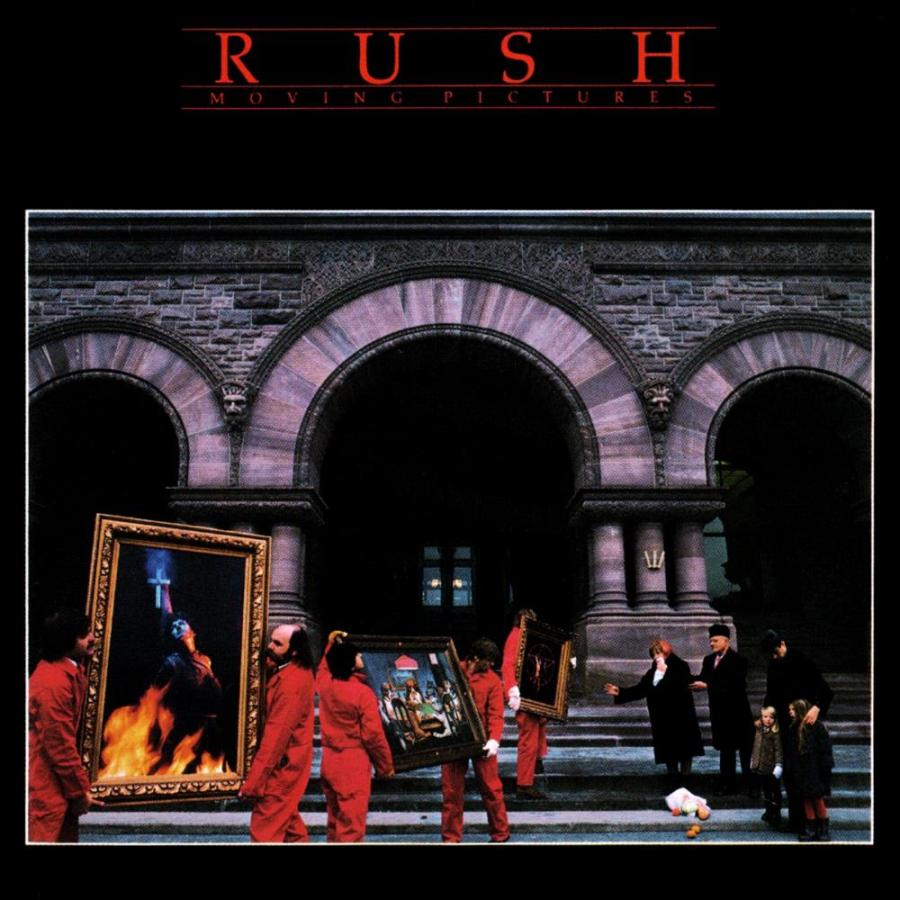
This morning, Andy Tillison, the mighty and mischievous redhead of the prog world, posted this wonderful essay on how much Rush has influenced him and his music.
***
Delayed yesterday owing to the highly unpleasant news about Jonas – and only because I know he’s on the mend – here is the FOURTH of the albums I have chosen to represent some of the influential albums on The Tangent’s career. Once again to stress that this is not a chart, a “best of” – nor is it an effort to say or imply that The Tangent sound like this. Because today – i do not think we sound anything like this band, who (like the previous artist) hail from Canada
Perhaps THE greatest album in prog history?
So far my choices have been street credible and artistically laudable I think – and there will be those who heave a sigh of disappointment when they see that I chose an album by Rush. Indeed, I spent many years not having a great deal of time for this group and they didn’t really hit me until the mid 80s. But when they did… they did.
What I find so appealing about Rush – is something that Sally had also identified, independently of me before either of us met.. and that to us – to try an explain, is the MOTION in which Rush songs set themselves. Where many progressive bands take a stand on the hilltops- taking a view of the broader vista, Rush are always IN the landscape, travelling through it – usually at some speed! They’re looking at the hills that others are standing on – as they whizz past gas stations and motels, steel works and a very very familiar real world environment.
Submitted for your consideration on this day of rest, here is Sarah Slean performing “Holy Ground” off her new album Metaphysics, for CBC Music Festival:
I never knew anyone who wasn’t at least a little bit of a fan of Electric Light Orchestra. My age privileges me in remembering hearing new ELO songs on the radio when I was a kid — it was almost impossible I think for DJs to screw up their set with ELO, as the band’s music straddled so many genres at one time — and although I never owned any of their albums until I was in my 40s (I can’t believe it either), not liking their music would be akin to not liking having any fun. But along with that fun came a musicality and seriousness of songwriting that could get you scratching your head, too. In the words of the old ad, this stuff was good and good for you.
Those were the days…. Launched on record in 1971, by 1976 ELO had five albums under their belt and their sixth, A New World Record, would distill Jeff Lynne’s profound ambition into a back-to-front nine-song pop-prog epic 36 minutes long. While many fans cite ELO’s next record, 1977’s Out of the Blue, as the masterpiece (and in some ways it is), that double album’s aesthetic really gestated on A New World Record: late-era Beatles laid across heavy accents of American R&B and soul, filtered through an army of instruments and tracks. Lynne’s achievement in 1976 was to make this happen succinctly, in service of his writing, which produced the best kinds of love songs — those without the hey babies — full of heartbreak, hope, and hooks. Always the hooks, the insanely catchy melodies. And so the album is packed with genuine chart hits: “Telephone Line,” “Livin’ Thing,” the odd and wonderful “Do Ya,” the dopey but tolerable “Rockaria!” Pop done and undone to the level of the avant-garde, it’s so ridiculous. But it’s at the end of the album’s sides where the sweetness isn’t so much cleansed as qualified, adding a complex finish to the confections preceding. So the album closer “Shangri-La” declares in its operatic final two minutes a return to paradise, either towards or away from the pain of love, and the last cut on side A is a puzzle that resolves in a lyrical, gorgeous sadness.
From the LP lyric sheet, the (artfully incomplete) words to “Mission (A World Record)”
There is nothing straightforward in “Mission (A World Record),” the central lyrics of which are “watching all the world go by” and — not even printed in the liner notes — “how’s life on Earth?” The rest of it could be a starry sci-fi mini-epic or the rant of a tenant at a mission hospital, or both. But, astral projection or interstellar travel aside, the song concerns itself primarily with a melody, guitar line, and arrangement that read like maps of a future Radiohead. A vibe of desolate beauty, of being left behind, linked with a prophecy or the ramblings of a seer, a paranoid android or a subterranean homesick alien.
soundstreamsunday presents one song or live set by an artist each week, and in theory wants to be an infinite linear mix tape where the songs relate and progress as a whole. For the complete playlist, go here:soundstreamsunday archive and playlist, or check related articles by clicking on”soundstreamsunday” in the tags section above.
• It’s condescending. And clichéd. Those of us who have followed prog for more than 20 minutes, unlike Mr. Kyle Smith, author of “Prog Rock: A Noble but Failed Experiment” (NRO, June 15, 2017), are all too familiar with the chortling and snorting that progressive rock is silly, outlandish, over-the-top, nerdy, self-indulgent, and—yes, you guessed it—pretentious. Kudos (I guess) to Smith for recycling all the usual jabs and wrapping them up in a few sentences; it must have taken some talent to do so:
Progressive rock is the nonpolitical description that stuck to the pretentious, arty, classical-and-jazz-influenced bands, most of them English, who created the music fad of the early 1970s. With their mystical themes, their surreal and sci-fi album covers, their outlandish costumes (capes, fox heads), their obsession with faeries and aliens and loopy 20-minute synthesizer solos, bands such as Peter Gabriel–era Genesis, Yes, King Crimson, Jethro Tull, and Emerson, Lake & Palmer led rock down a bizarre sonic detour first mapped out by the Beach Boys on Pet Sounds and the Beatles on Sgt. Pepper’s Lonely Hearts Club Band. Prog rock was the exclusive domain of a certain kind of nervous, experimentally minded, cautiously intellectual young white guy. It was nerd rock. College rock. Dungeons & Dragons rock. Pimply-virgin rock.
This reminds me of how I was told, growing up in a Fundamentalist home, that all rock music was “of the devil,” that it was all about sex and drugs, that most albums featured nefarious, masked lyrics, and that it involved little talent (but plenty of hedonism and self-destructive behavior). In fact, there is a small element of truth to some of this, just as Smith’s smirking descriptive contains some shards of truth, while missing so much it becomes nothing more than a weird form of cultural virtue-signaling. Neither approach—the sophisticated sneering or the fundamentalist frothing—provides much in the way of context or content. Which is unfortunate, since the context and content of prog—then and now—are quite fascinating. Continue reading “Pretentious NRO “review” of prog rock fails in multiple ways….”→
I haven’t had anything similar on my musical plate for a while, so Anubis’ fourth album The Second Hand was an interesting, beautifully surprising and absolutely brilliant variation. Again Anubis mixes progressive sounds with cinematic elements top notch instrumentation with the addition of dynamic riffing and amazing vocals. The outcome is a unique sound that is quite inimitable and rare to find. How much you enjoy the new record will mainly depend on how you respond to this incredible mix and the singing style used by the vocalist. Anyway Anubis rules, especially at night.
The Second Hand is a concept album charting “the downfall of an aging media mogul, James Osbourne-Fox, who, after a severe brain injury is left paralysed and imprisoned in his own body and left to contemplate the futility of his life of corporate success.” The Second Hand is for sure full of emotion and humanity and the way the Australian band reproduces in music the story and the psychosis of the protagonist is wonderful.
As it’s the case with most concept albums, The Second Hand requires time and patience to be understood and to gain the listener’s estimation and it will reward open minded audience. Play it in the dark to fully experience its great music.
The album kicks off with the title song which sets the tone and the mood for the rest of the 9-track record. There’s something disarmingly powerful about vocals from Robert James Moulding that add incredible depth to a song. The intermittent piano notes are just perfect and the dramatic keyboard sound is like a nice shade of color you don’t notice on painting but that painting wouldn’t be the same without it. A great bonus.
“Fool’s Gold” starts exactly where the title track ends but adding a dark shadow to the overall atmosphere. There are still vocals but now are slower and they mix perfectly with the other instruments. The bass is gorgeous and the way the song turns into a more ambient and atmospherical dimension is great. It’s such a damn good track. “These Changing Seasons I” is a slow voice-and-piano piece that also perfectly fits the story and musically serves as an intermediary between the album’s parts. The album continues with “The Making of Me” which feels straightforward for the most part, with vocals leading the game on this one. “While Rome Burns” comes with an atmosphere reminiscent of Pink Floyd; slow synths-driven opening with guitar work influenced by David Gilmour, it certainly is one of the highlights here. “Blackout” is far more song-oriented piece in a classic intro-verse-chorus manner, but it also includes some of the best instrumental work during its almost 8 minutes.
“These Changing Seasons II” is another slow-burning piece with Moulding in the leading role, accompanied with the acoustic guitar strumming. The 16-odd minutes epic “Pages of Stone” is a centrepiece where the band absolutely gives their best. It includes everything crucial for the story: an atmospheric cinematic intro and perfect delivery by the whole band.
An album which engages on a variety of levels, with The Second Hand Anubis have delivered something of power, emotion and beauty and one which sets you thinking on a variety of different levels. More importantly it’s a cracking good listen (especially through headphones) and one which familiarity only continues to improve.
There’s a nice piece on prog rock by Kalefa Sanneh in the latest issue of The New Yorker magazine. Clearly, the author isn’t sure what to make of the genre, but he gives a fair assessment of its early years, and the unfair treatment rock critics dished out in the seventies. I wish he had written more on the current thriving scene, but it’s nice to get some respect in a mainstream publication.
Israel-based Progressive Metal band Soul Enema is announcing a release date of the upcoming album titled Of Clans and Clones and Clowns. Out on June 23, the album is now available for pre-order from Bandcamp and iTunes.
The promising band’s second album represents an interesting and varied combination of influences, including 14 tracks mixed an mastered by legendary Jens Bogren (Opeth, Devin Townsend, Paradise Lost, Symphony X).
Soul Enema has issued a statement on the forthcoming album saying:
“Looking back, it took a lot of time and effort to create ‘Of Clans and Clones and Clowns,’ and the final result brings the feeling of a real accomplishment.It was a long, complicated process, constantly laden with a myriad of good reasons to give up or compromise. It probably couldn’t be any different, as our goal was a mature, well-produced statement, consistent in quality throughout, and at the same time versatile enough in its various moods, styles and approaches.
“A creative and diverse Rock/Metal album, exploring vast melodic and rhythmic territories — from ABBA to Zappa, from King Crimson to King Diamond, between East and West and way beyond — in true progressive fashion. Like any reflection of the world we live in, it takes a wild ride over a wide emotional spectrum: sad, funny, perfectly sane, totally insane, very direct, quite obscure, and everything in between.”
Of Clans and Clones and Clowns also features guest contributions from Ayreon’s Arjen Lucassen, Yossi Sassi (ex-Orphaned Land, Yossi Sassi Band), Sergey Kalugin and Yuri Ruslanov (from leading Russian proggers Orgia Pravednikov).
The band commented: “We had a great honor of featuring the instrumental talents of these, as well as other wonderful musicians. Our next aim was to ensure that all of these components work in the final picture, and that’s the reason why we welcomed one of the best guys on the list to mix and master this work — Jens Bogren. It deserved the best possible treatment, just as you as a listener deserve the best possible quality. The mixing process was far from trivial, and it took some effort to shape everything our way – clear and powerful enough, yet not overproduced. So, if you like what you hear, please order yourself a CD, or the highest quality digital download, to have it the way we really meant it to sound – full-scale and uncompromising. We hope you will have your own exciting experience with the album!”
Soul Enema released a few singles from Of Clans and Clones and Clowns, you can check them below.
Of Clans and Clones and Clowns is out on June 23th, and it can be pre-ordered from Bandcamp or iTunes. Visit Soul Enema’s official website for more information, and follow them on Facebook.
Of Clans and Clones and Clowns Track Listing:
1. Omon Ra
2. Cannibalissimo Ltd.
3. Spymania
4. Breaking the Waves
5. The Age of Cosmic Baboon
6. In Bed With an Enemy (ft. Y. Ruslanov, S. Kalugin)
7. Last Days of Rome
8. Dear Bollock (Was a Sensitive Man)
9. Aral Sea I – Feeding Hand
10. Aral Sea II – Dustbin of History (ft. Yossi Sassi)
Joe Henry always tells it like it is. What this “it” is depends on his song or object of the moment, but if artistry is about honesty then here’s a man who can be a W. Eugene Smith one minute and a Romare Bearden the next. His is an Americana in context, wrought with a realism that has to, must, consider the world beyond the borders of his song. And yet his skill at creating a complexity of life within the three- or four-minute lengths typical of his work belies this, so that his portraits are breathtaking and you are standing next to him, watching and hearing him compose a complete picture.
1990’s Shuffletown recalls both the chamber folk-pop of Cat Stevens and the improvisational glow of Astral Weeks, T-Bone Burnett’s restrained production going live to two-track and allowing a breathing space that played against the channel-filling fashion of its time. I remember, then, marveling that an album like this could even get made anymore, much less thought of. A modern record with a backroads feel that doesn’t get lost in bucolic moods or sentiment, it is more defining in its sound and in its genre than it gets credit for. At its core — and the same could be said of Morrison’s and Stevens’ records — is an immediately recognizable voice, for Henry’s finesse with language is honored by a vocal delivery that is hip to its own thing, knows it limits and its power and its text. It’s also full of hooks, patient in its timing, finding and following melody in Shuffletown‘s deep dusks and twilight.
“The moon is losing ground, drowning in the river…”
soundstreamsunday presents one song or live set by an artist each week, and in theory wants to be an infinite linear mix tape where the songs relate and progress as a whole. For the complete playlist, go here:soundstreamsunday archive and playlist, or check related articles by clicking on”soundstreamsunday” in the tags section above.