Cornell and Allman

Gregg Allman died today, a couple weeks after Chris Cornell.  On the face of it these are not related events, but make no mistake, rock vocalists of their firepower and presence always made a fairly exclusive club.  Who else, we might ask, are members? Their loss — inevitable, of course — provokes a wondering at the world, in the sense of the permanence of art versus the fragility of the human body, the physicality of their presence as they walked the earth.  What they leave behind forever looms over the sum of chemistry and animation that motored them through their time here, hungrier in their rock-and-roll instincts and purpose than the rest of the lot of us.

Strange coincidence: on the day of the evening Cornell died, I traded in my Soundgarden Louder Than Love LP, which I’d owned since its release way back in those hoary days before grunge was called grunge, when Robert Plant was still bemoaning all the Zep copycats while steadfastly refusing to bring the goods himself.  A solid, riffing record, though not their best, and unlikely to get many future spins — its value to others outweighed its use to me.  Do you remember the context of this album? It came on the heels, well, or a year or two later (and I’m not going to stop and look it up now), of Guns’n’Roses bellwether Appetite for Destruction, and outwitted that band’s lackluster followup.  I remember a couple years on and guitarist Kim Thayil saying they were always trying to be Sabbath without the parts that suck, and that about summed them up, because generally they were.  At their core, always, was Cornell, the definition of gifted, who somewhere between Louder than Love and Badmotorfinger found his voice, a cocksure combination of Plant and Rodgers, but so goddamn powerful and so much his own thing.  Henry Rollins once said that Cornell’s voice could peel the paint off the walls, and he was right.  That Cornell could do it in tune and with shifts in timbre and light and tone made him all the more remarkable.  At his death he was still making good records and at the top of his game as a performer.  Soundgarden’s King Animal from 2012, though now unbelievably five years distant, was as good as any record they made, despite the fifteen-year gap between it and Down on the Upside.  His method of exit was undeniably, tragically sad.  Does it match the music? Should it? I’ll be thinking this over for some time.

Today, this first day of a three-day holiday weekend, I spent some time going through my LPs, thinking of the next batch for trade, as I am in the middle of my own vinyl renaissance, with the idea that a good record or book is better played or read than sitting on a shelf.  In the trade stack went a double-album compilation of recordings by the Hourglass, Duane and Gregg Allman’s band prior to the Allman Brothers.  When I later heard of Gregg’s death, I had the thought, following on my Soundgarden trade earlier last week, that somehow my record tastes were guiding the lives and deaths of rock stars.  It’s not a stretch.  They become part of the fabric of life, their music has a profound personal effect, and so the butterfly beating its wings, in the shape of me making the decision to, you know, ditch the Hourglass, becomes causal in Gregg’s death.  Gregg’s death to me, how it effects me.  Me me me.  But like Chris Cornell, Gregg Allman is still Gregg Allman on record.  The life there is indelible.  It’s a human cry, a channeling of the Spirit.  I spun up the first Allman Brothers LP (one I would never trade) this afternoon, and rocked out like I did when I first heard it, back in 1984 when I was working in a photo darkroom in Ft. Worth and my hippie boss always had the radio tuned to the station that would and did play “Whipping Post” on a regular schedule.  When I saw Gregg play with his band in 1987 at Red Rocks in Colorado, opening for Stevie Ray Vaughan, I was aware even then that I was witnessing a legend.  That voice.  Like Cornell, Gregg Allman had a voice that defined an authenticity transcending boundaries of culture or race — it was the sound of the human soul.  I understand he never got over the death of his brother (who would?), and according to Derek Trucks would consult with the spirit of Duane fairly regularly as to the artistic direction of his various bands.

Rock and roll at the level that Chris Cornell and Gregg Allman played it hits hard.  We know their work brought them vast number of fans, but I think for each of us (well, for me at least) there is a connection that is personal, even in some sense private.  I associate memories, there are feelings unnamed, some primal, that accompany passages of their work.  I can write about the riffs, the freedom, the bellow and power of the sound as it moves air, it but ultimately it can’t be intellectualized.

They were only human.  They are dead.  They are here.  I am listening even now.
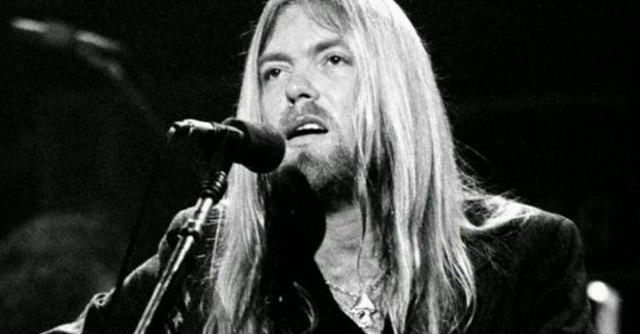
Gregg Allman, 1947-2017

allman

We have lost yet another great musician: Gregg Allman, former frontman and keyboardist of the Allman Brothers Band, died today. More on Gregg in the article below.

http://www.billboard.com/articles/columns/rock/7759662/gregg-allman-dead


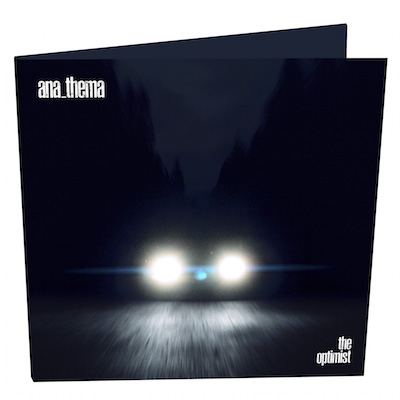
A Return to Brilliance: THE OPTIMIST by Anathema

Review of Anathema, THE OPTIMIST (Kscope, 2017).

anathema optimist
A return to brilliance.

THE OPTIMIST is a wonderful album, a true expression of the best that is in, ironically enough, a band named Anathema.

When the band returned to the music scene after a five-year absence in 2008 with a reworking of their previous music, HINDSIGHT, I was pretty much smitten.  Then, in 2010, with the release of their first proper album in seven years, WE’RE HERE BECAUSE WE’RE HERE, up through their 2013 live album, UNIVERSAL, Anathema was not only not only gloriously on fire but, perhaps, unstoppable.

Continue reading “A Return to Brilliance: THE OPTIMIST by Anathema”

The best musical tribute to Chris Cornell so far…

Back in March 1994, shortly after Soundgarden’s masterful Superunknown was released, Melody Maker‘s Everett True wrote a detailed and often insightful piece about the band on the road (in Tokyo, specifically). Chris Cornell spoke openly with True about his struggles with depression and fear:

“I write songs best when I’m depressed,” Chris tells me. “No one seems to get this, but Black Hole Sun is sad. But because the melody is really pretty, everyone thinks it’s almost chipper, which is ridiculous. Fell On Black Days is another one. Like Suicide is a perfect example.”

We’re they inspired by specific events?

“Fell On Black Days was like this ongoing fear I’ve had for years. It took me a long time to write that song. We’ve tried to do three different versions with that title, and none of them have ever worked. Someday we might do an EP…

“It’s a feeling that everyone gets. You’re happy with your life, everything’s going well, things are exciting – when all of a sudden you realise you’re unhappy in the extreme, to the point of being really, really scared. There’s no particular event you can pin the feeling down to, it’s just that you realise one day that everything in your life is F—–!”

Exhibit A for a “chipper” version of the huge hit is this snappy, big band-ish, “are you kidding me?” version by Paul Anka (yes, the same Paul Anka who wrote the lyrics to Frank Sinatra’s “My Way”—one of the very few Sinatra songs I find annoying, even revolting). And in the past few days, understandably, there have been a number of singers and bands playing the song as a tribute to Cornell, who took his life on May 18th, after a reportedly ragged show at Detroit’s famous Fox Theater.

Continue reading “The best musical tribute to Chris Cornell so far…”

Cruise to the Edge 2018 closes in on selling out.

With just under 9 months away from sailing, Cruise to the Edge has announced that they are over 80% sold out. The 6 day journey from February 3-8 features Yes (on their 50th anniversary), Marillion, Stave Hackett, Mike Portnoy and Derek Sherinian, Saga, Anathema, Gong, Haken, Glass Hammer, Adrian Belew Power Trio and many more incredible prog acts.

I attended CTTE17 and highly recommend the experience, especially to anyone who hasn’t been on a prog cruise before! This time around they added an extra day to the trip as they sail from Tampa, Florida to Belize and Costa Maya for optional daily excursions.

unnamed

Past attendees of CTTE got first dibs on cabins so all of the VIP Suites are sold out, but anyone can join the wait list, as specific cabins may pop up closer to the event.  They are also offering a International Airpass Credit ($100 per person or $200 per cabin max) for travelers from outside the United States.  For International travellers, type in “AIRPASS” for the promotional code when booking- by June 30. For more information and to check out payment plans, go to http://cruisetotheedge.com/

Happy Sailing!


Laser CD ANATHEMA Special

Banners-Anathema-webbanner-1000x380-Final

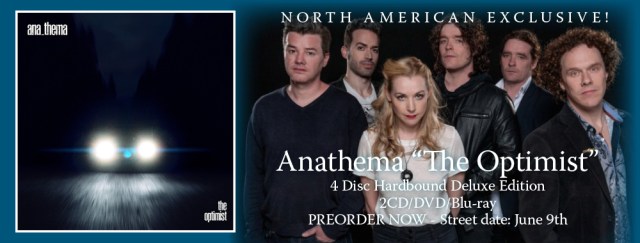
The best CD store in the United States, Laser CD, is offering a really nice deal on the forthcoming Anathema album, THE OPTIMIST.  To order, please go here: https://www.lasercd.com/cd/optimist-4-disc-hardbound-edition-preorder

Glass Hammer Live (Photo)

This photo captures the loving spirit of Glass Hammer.  So much mystery and adventure, an endless exploration of what is known and unknown, majestically progressing not toward perfection, but toward beauty.

GH

Ulver – The Assassination Of Julius Caesar

New music from Norwegian experimentalists Ulver is always something to savour, and its diversity might surprise you. 2016’s cryptically-titled ATGCLVLSSCAP was mostly instrumental and partly-improvised, veering from ambient to intensely atmospheric post rock and back again. Their latest release is a quite different proposition, however.

The Assassination Of Julius Caesar channels progressive, pop and electronica influences to utterly glorious effect. Repeated listens variously bring to mind Pure Reason Revolution, Anathema, New Order, Propaganda, early Simple Minds and Massive Attack, amongst others (a list of musical reference points that will have a few Progarchy readers salivating, I’m sure).

It’s difficult to pick out highlights in an album of such consistently high quality, but right now I’m particularly enamoured by the expansive dark groove of Rolling Stone (at over 9 minutes, the album’s longest track), the elegant pop of Southern Gothic and the achingly beautiful chorus in Transverberation.

I’m calling it now. One of the best albums of 2017.

Neal Morse Inner Circle Goes TOTALLY Digital. NOOOOOO!!!!!!!!!!

Screen Shot 2017-05-24 at 11.42.19 AM
Not cool.

Over the last several weeks, Neal Morse has announced that his venerable INNER CIRCLE club is going exclusively digital.

To state that this infuriates me would be going way too far.  To state that I’m unhappy, however, would not be an exaggeration.

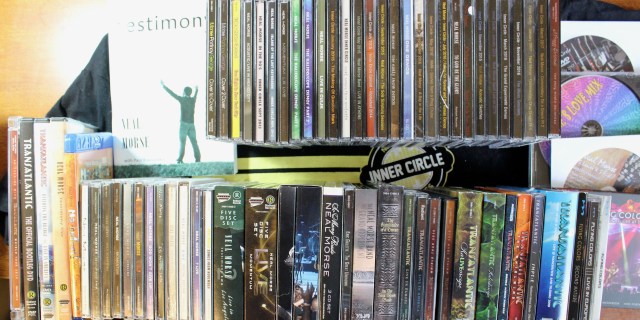
Not only have I been a proud INNER CIRCLE member for years, but I’ve also got my own Neal Morse display in my office–in all of its tangible (yes, TANGIBLE) and technicolor glory.

Do I want downloads?  No.  I don’t want downloads from Neal Morse or from Glass Hammer or from The Tangent or from Riverside or from NAO or from Big Big Train.

As far as I’m concerned, sadly, Neal Morse’s INNER CIRCLE is done.  Whatever it was (and, it was brilliant), it’s over.

I’m so tired of the world moving toward nothing but digital.  We (or, at least I) love prog because everything is so well done–the lyrics, the music, the playing, and the art.  I want an album or a CD or a DVD or a blu-ray.  A down load is just not cheap, but, frankly, tacky.

Mr. Morse, please, please, please reconsider this.

IMG_2085
Very cool.


IMG_2083
My Neal Morse Shrine.  Very, very cool.


Is Prog Really Still Prog?

J.C. Harris posted this in the comments, and I thought it was too interesting to leave it there.  Thanks, J.C.–BB

Samey. I honestly can’t tell one of these ‘new prog’ bands from the other. And I have tried. What originally drew me to progressive rock almost 50 years ago now was the -originality- of the best groups. Each band had a truly distinctive voice. And on almost every album, the groups were really -trying- to incorporate new instruments, cultures, chord structures, rhythms, techniques, etc.; -anything- to widen the variety. -That- was the essence of ‘progressive’. How far things have fallen.

The only response people have to the above critique seems to be, “Man you’re -old-.” Which doesn’t address the point. Whenever I hear almost any new (cough) ‘progressive’ group it makes me wonder, “Are bands like this -really- the best we can manage in 2017?”

IOW: this will sound naive, but back when I was 15, I thought that progressive rock would -grow- just like jazz and classical and other serious art forms. And that the ‘prog’ records of -today- would feature even -better- playing, more outrageous compositions and even more imaginative stories. And mostly? That hasn’t happened.