


Second episode of SexCake! DJ Mowsee and Lady K discuss the music that’s played during this episode track by track. WARNING: This show is uncensored! It contains useful (or useless) info about your favourite tracks, free cake, and a DJ Mowsee without pants!
You will hear music from Cog, Steven Wilson, The Young Gods, Frost*, Curve, Ozric Tentacles, Paper Tongues, 7sleepers, Bob Mould, North Atlantic Oscillation, JOLLY, Riverside, Front Line Assembly, Lax Lizzard, Dead Can Dance, Lounge Orphans, Monuments & Anathema!
You can listen to the show here:
This show was originally broadcast on ISKC Rock Radio! Join the ISKC Facebook Group and give the ISKC Radio Group a like!
http://iskc.rocks/
https://www.facebook.com/groups/1059175824092839/
https://www.facebook.com/ISKCWebradio/
via SexCake episode 2! No pants equals more fun! — Grendel HeadQuarters
 The Cure’s Disintegration is a lush, beautiful masterpiece. When it was released in 1989, the band was cresting a wave of popularity, and rare was the college dorm room in America that didn’t have a copy of their singles comp, Staring at the Sea (1986), sitting next to the deck, while Kiss Me Kiss Me Kiss Me (1987) was radio ready. Robert Smith had become an unlikely hero, a post-punk goth who had paid his dues and, with a colossal songwriting talent, was reaping the rewards of someone who virtually created his own genre. Nobody else sounded like the Cure. Neither psychedelic nor prog nor punk, but fearless in their approach, comfortable in their painted skin. On Disintegration the band slows the tempos, backgrounding Smith’s economical lyrics with huge keyboard/guitar drift pieces that seem to exist in the gloaming. A perpetually wilting flower, the first-person character in Smith’s work has had a long shelf life, and would rot if it weren’t for Smith’s genius with song and his ability to effortlessly write pop hits at will. Entreat is from the tour supporting the album, recorded at Wembley in ’89, and consists of the all the songs on Disintegration in the same running order. It had a very limited release originally, but pieces of it emerged here and there on CD singles taken from Disintegration (I first heard parts of it on the Pictures of You EP), and was eventually, finally bundled with Disintegration on the 2010 re-release. Entreat was a bold move, a full performance of a newly-released record, and demonstrates just how confident Smith and his band were in the new songs.
 For those of you who have not had the chance to listen to the new Glass Hammer album, VALKYRIE, do so.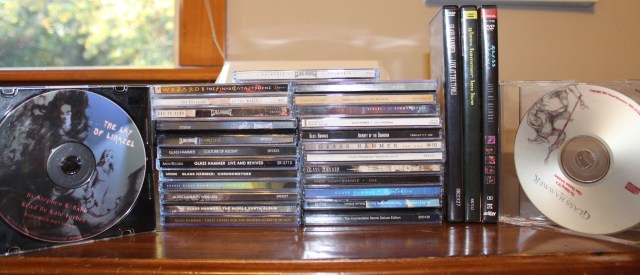


 Finding abandon in structure is what rock is about, but it’s rarely approached with such intentional power as on the live sets that Robert Fripp and David Sylvian played in Japan in 1993, which make up the album Damage and the film presented here, Road to Graceland: Live in Japan 1993. It’s not surprising that one of the great live albums in rock would come from a duo whose very distinct songwriting and voices meshed with such ease, but the precious vein they mined yielded such a small set of work and such little attention — after all, art rock/pop in the early 90s was in a far different place in the popular consciousness than it had been a decade earlier — that the record is nearly invisible today even if you’re fairly well-acquainted with the careers of both men. This is neither In the Court of the Crimson King (or Discipline) or Gentleman Take Polaroids (or Rain Tree Crow), but a striving towards something that summed higher, capturing two artists with deep histories and still in their prime. Fripp’s work here, as always, is masterful; a guitarist whose technical ability is matched by a uniquely creative sound and spirit and generosity, he creates space for Sylvian’s profoundly expressive voice and writing. Sylvian, in turn, doesn’t fill the frame either, yielding his significant presence when necessary to the outstanding band he’s playing with. This is my favorite pairing of Fripp with a vocalist, because as much as I like the work he did in King Crimson with Adrian Belew in the 80s and John Wetton in the 70s, he and Sylvian have a chemistry that gets to the center of their strengths, and, appropriately — given Fripp’s brief but incendiary participation in the Berlin Trilogy — summons the work of
  Progarchy