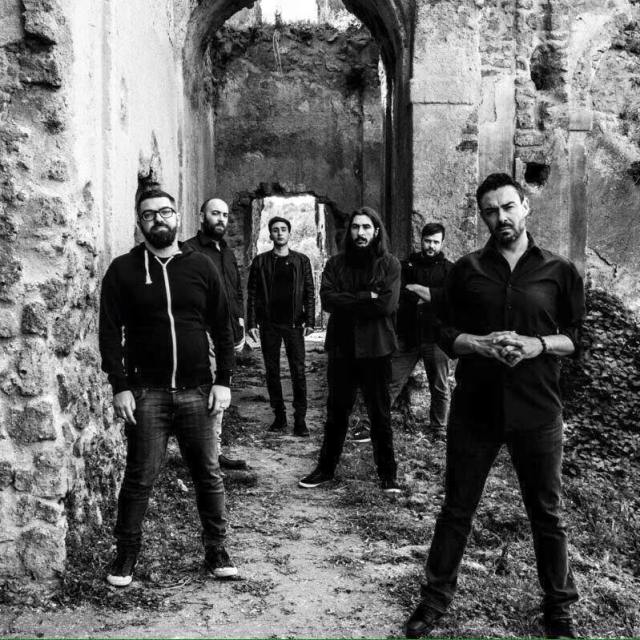
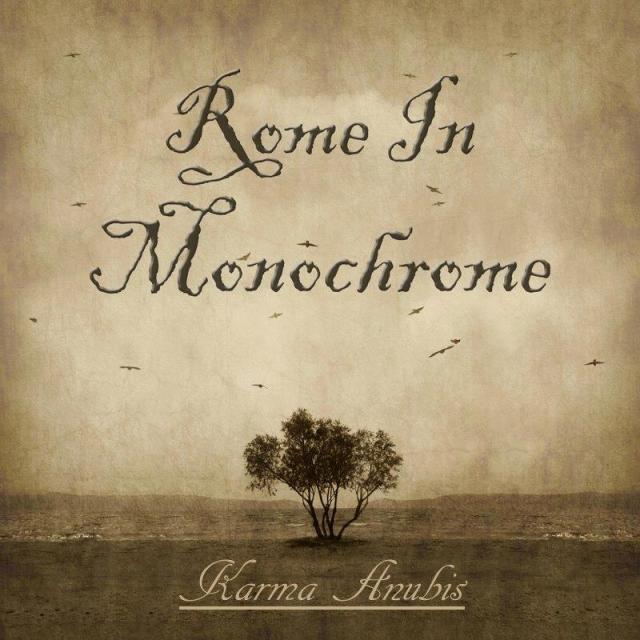
Ethereal aural doomers from Rome, Rome In Monochrome, recently released a three-track EP titled “Karma Anubis.” The band’s guitarist and singer Gianluca Lucarini had time to answer couple of questions for Progarchy.
What made you go for the name Rome In Monochrome?
A friend of mine, Max Varani (ex singer in my grindcore band DEGENERHATE), created this monicker. I immediately loved this name, because it was very representative for the music we played, plus, we are from Rome and we adore black and white. That’s why ROME IN MONOCHROME.
How do you usually describe your music?
We named our music Ethereal Aural Doom, but we don’t like very much using tags to describe our music. We prefer to describe it like an unique blend of doom, postrock, darkgaze and drone.
What is your writing process like?
Me and Valerio (singer), we are the main composers of the band, it all starts with a guitar riff, then the lyrics and finally the song title. After that the structure of the track has been defined, it is arranged and finalized by all the members of the band in the studio.
Who or what is your inspiration, if you have any?
We are daily inspired by everything… talking about our music influences, Katatonia, Paradise Lost, My Dying Bride and Anathema are main and undeniable influences but also slowcore, post rock and shoegaze influences are present in the sound of ROME IN MONOCHROME.
What is your favourite piece on the “Karma Anubis” EP?
Mmmm… Hard to say….I am desperately in love with all the three songs in “Karma Anubis.”
What makes “Karma Anubis” exceptional?
This should ask the people who bought the CD, I’m very curious to know it.
What should music lovers expect from “Karma Anubis”?
Expect a journey through an ethereal, blinding sea of pain, a whiteout of grief, a descent into a maelstrom of caressing void. Buy the limited edition digipack and join the cult of the absence of colour.
What kind of emotions would you like your audience to feel when they listen to your music?
We would like our fans could feel their heart beat when listening to ROME IN MONOCHROME.
Which do you like most, life in the studio or on tour?
Tour life, of course. We are planning some gigs around the Europe for the next year, so stay tuned Monochromers.
Pick your three favourite albums that you would take on a desert island with you.
Only three albums?! What a hard question! Let me see…
1) THE SMITHS – “Meat Is Murder”
2) ALCEST “Souvenirs d’un Autre Monde”
3) OPETH – “Damnation”
Exciting news for Dream Theater and Mike Portnoy fans everywhere. While many of us have been suspecting it for a while, Mike officially announced yesterday that he is going to play all of the DT 12-Step Suite at his 50th birthday celebration on Cruise to the Edge. The cruise takes place February 7-11, 2017. Find out more info on the cruise here.
For those unfamiliar with the 12-Step suite, it as a series of 5 songs released across 5 DT albums, all intended to make their own concept album. The songs were written by Portnoy after his struggle with alcoholism, and they represent the Alcoholics Anonymous’ 12-step program.
OLD FIRE (FEAT. JOHN MARK LAPHAM [THE EARLIES / THE LATE CORD]) LAUNCHES “BLOODCHILD” MUSIC VIDEO
Debut album “Songs From the Haunted South” out now on Kscope
TEXAS – Old Fire, the pet project of Texas based programmer John Mark Lapham (of The Earlies and 4AD band The Late Cord fame), has released a music video for the track “Bloodchild,” taken from the debut album Songs From the Haunted South, out now on Kscope. Stream the new “Bloodchild” video clip on YouTube at: https://youtu.be/uoIje9I_kjA.
Songs from the Haunted South was produced by John Mark Lapham, mixed by JM Lapham and Mark Kuykendall, and was mastered by Ian Hawgood.
Taking nearly a decade to make, Songs from the Haunted South has been a labor of love for Lapham. Born from an album concept for a 4AD project with singer Micah P. Hinson (The Late Cord), the album was originally intended to feature different singers and musicians recording songs that were both covers and originals. After parting ways with Hinson, Lapham remained determined to realize his vision for the album and sought voices he considered special or fitted the inspiration.
The first piece of the puzzle fell in to place after meeting the former owner of 4AD, Ivo Watts Russell, who introduced Lapham to singer/songwriter, Tom Rapp – who recorded a string of haunting albums in the late ’60s and ’70s under the name Pearls Before Swine. The vocals Rapp provided formed the basis of the track “Shadows.” In the following years, guest vocals were recorded by Sara Lowes (The Earlies), DM Stith, Christopher Barnes (Gem Club), Rebekka Karijord, and Alex Maas (The Black Angels).
Sitting alongside original Old Fire compositions are a selection of intriguing cover versions. Lapham uniquely interprets songs by Psychic TV (“The Orchids”), Low (“Laser Beam”), Ian William Craig (“A Slight Grip, A Gentle Hold”), Jason Molina (“It’s Easier Now”), Camberwell Now (“Know How”) and Shearwater (“Helix”).
The 13-track album contains a selection of songs that, in one way or another, are dedications to people, some dead and some still living. Musically, inspirations range from ambient artists such as Brian Eno and Stars of the Lid to psychedelic rock, traditional country and early 4AD.
The project also features a myriad of exceptional musicians including DM Stith – piano & guitar, Christopher Barnes (Gem Club) – piano, Warren Defever (His Name Is Alive) – guitar, Thor Harris (Swans) – drums, Christian Madden – Rhodes piano & organ and Semay Wu – cello.
The powerful cover art was designed by U.K.’s Grammy Award winning designer Vaughan Oliver, famed for his work with artists such as Mojave 3, Lush, Cocteau Twins, Dead Can Dance, The Breeders, This Mortal Coil, Pixies, Throwing Muses, in addition to artists such as David Sylvian and Bush. The cover shot taken in 1958 features Lapham’s father during bivouac camping basic training in the foothills of the Ozarks, at Fort Chaffee, Ark.
1. Old Fire 3
2. Along Came a Sadness
3. Helix
4. Know How
5. It’s Easier Now
6. A Stranger in the Family
7. Bloodchild
8. Faust
9. Shadows
10. A Slight Grip, A Gentle Hold
11. Laser Beam
12. The Orchids
13. Deadhouse Dream
Stay tuned for more information on Old Fire and Songs From the Haunted South, out now on Kscope.
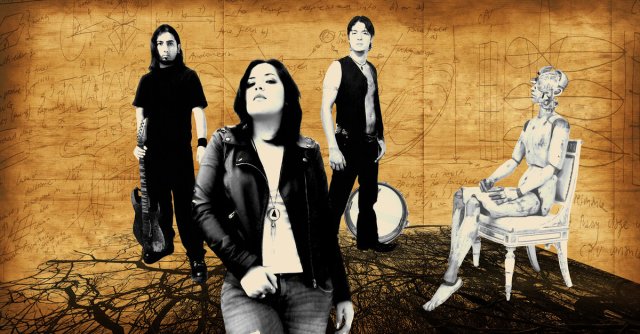
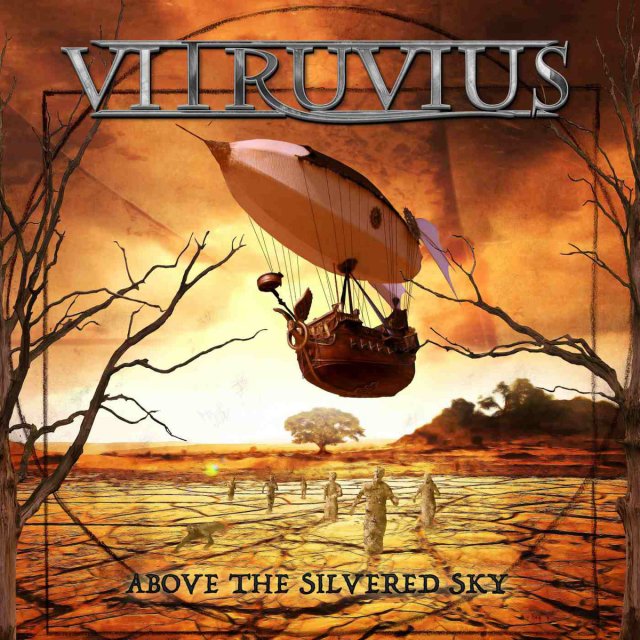
Mexican prog metal band Vitruvius, fronted by Dulce Robles, released their sophomore album “Above The Silvered Sky” in March this year. Dulce and guitarist Oskar Villarreal sat down with Progarchy for an interview where they talked about their sound.
What made you go for the name Vitruvius?
Oskar: Bjorn, former bassist came up with the name “Vitruvius Robot” kind of a cyberpunk concept applied to music in an effort to represent the merge acoustic instruments with electronic textures, but then we took the Robot out because it was too long and hard to remember, I’m also a big fan of Roman architecture myself but the main reason is we think the name sounds cool haha.
How do you usually describe your music?
Dulce: A mix of a weird bunch of styles put together by Oskar.
Oskar: Haha, thanks Dulce I’m glad you like our weird music, but I would say it’s not only me, we’re all accomplices, the concept emerged from all of our twisted minds, and Dulce’s abstract lyrics.
What is your writing process like?
Oskar: About the writing process I can say Inspiration can be misunderstood by a lot of artists, it’s not something that comes to you while you’re watching TV or drinking in a bar, it’s sitting on your butt with your instrument or your pen/notepad while your buddies are partying, you suck it up and play the hell out of it until you get a good groove/riff/progression/verse and then make a second part that has something in common harmonically/rhythmically/lyrically then maybe think about instrumentation, a chorus, an intro, an interlude, an instrumental section an ending and then make it all work out together, or lose the love for a part that doesn’t fit in the context, sometimes that can be frustrating, but you can’t let that discourage you because that’s when things start going south, you just ignore that part and come up with a different idea that fits in, or in the worst case scenario dump the whole song and start over without looking back. The consequence is after a while you have tons of material you can choose from and then magic happens, this is basically how this album came to life, hard work and paying no attention to negative comments unless we consider it to be relevant to the final product but always sticking to our original ideas.
Dulce: Some songs start with a simple phrase or subject that leads to two or three whole sheets of paper in my notebook. I show them to the guys, ask their opinions, pick the most interesting phrases that contain the “feels” and adapt them to the music. I give them some sound, ask for more opinions. Sometimes they just come out how we needed them on the first try. We record, Nothing stays until we all say “Yes! That’s what we want!”
Who or what is your inspiration, if you have any?
Dulce: The “who” would be anyone we have (and haven’t) interacted with, situations around those relationships (family, friends, lovers, ourselves… even politicians!). And “what” could go from any moment we have lived (or wish we had lived) to some shocking news we’ve read.
What is your favourite piece on the “Above the Silvered Sky” album?
Dulce: This kind of question makes me think of a parent deciding which one of their children they love the most…
I would say Silvered Sky, because it came out flowing so simple and easy and it ended up so beautifully complicated. Gust of wind because we dared to do something “out of OUR box”. The truth because we touched a topic so relatable for anyone who follows their passion no matter what. Forgotten smiles because it opened some doors we probably didn’t think existed.
Oskar: My favorite without a doubt is Heaven or Hell.
What makes “Above the Silvered Sky” different?
Maybe the difference could rely on how we hand crafted it note by note from the beginning to the end, with no third party producers, mixing engineers, or other external influences but the mastering engineer, we conceived this album with all our hearts, even though it’s hard to be 100% satisfied with what you do, (we wish we could have done certain things better and hopefully we will next time) we’ve had some really good comments from people who have been beside us since day 1 and also from people that was never involved in the process, that certainly gives us motivation to continue moving forward and working harder. If in the future that makes a tiny difference in the history of music, if what we have done touches, inspires or improves someone in any minimal way, then maybe we can say this album is “different”.
What should music lovers expect from “Above the Silvered Sky”?
Dulce: very different tastes in music blended together into some sort of entertaining hearing exercise.
What kind of emotions would you like your audience to feel when they listen to your music?
Dulce: I’d be satisfied to know someone actually felt something while listening to our music.
Oskar: All of them!!!, Anger, happiness, sadness, fear, love, hate, etc…except from boredom haha.
Which do you like most, life in the studio or on tour?
Dulce: I would say life in the studio. But hectic schedules and travelling from time to time are also fun as hell.
Oskar: I think it all depends on what we’re doing, both are essential for the life of a rock band but we’ve particularly spent maybe 50% of the time in the studio, 35% in the rehearsal room and 15% on stage or so, I as a producer consider myself a total studio geek, I love my toys and the trial and error until it gets as close as possible to what’s in my head and that can’t be done in a live scenario.
Pick your three favourite albums that you would take on a desert island with you.
Dulce: I don’t think I would survive on a desert island with only 3 albums.
Oskar: it depends if I was stranded on a desert island I’d be more worried about what I’m gonna eat and what’s not gonna eat me lol, there’s priorities in life man! plus my ipod or cd player is gonna run out of batteries the first couple of days, and if it was a vacation trip to a desert island I think all I’d want to listen to would be the sounds of nature.
Darryl Way, Ian Eyre and Sonja Kristina join forces again.
Well, you have had an insight into some of the more surprising musical influences of my very early days. ‘Tis time now to indulge more in the “business end” of the music that shaped my life by singling out my first favourite band.
Of course, there were the Beatles, the Dave Clark Five, the Who, the Zombies and the Moody Blues, whom I remember from their early appearances on TV.
However, it took a holiday in Majorca at the tender age of 12 to ignite the quantum leap into the world of prog. During that holiday, I met an “older man” aged 15 called Andy from Oxhey in Watford, to whom I still owe so much if only I knew where he was now.
He talked about Jimi Hendrix and also a band called Curved Air who had just released their debut album, the seminal “Air Conditioning”, that year. It became one of the must-play albums on Radio One in the days when it entertained thinking listeners by playing prog and heavy rock, Pete Drummond and the late and very great Alan “Fluff” Freeman being the main cheerleaders.
It was through their shows that I heard the album’s stunning opener “It Happened Today” and the extraordinary “Vivaldi”.
Here was a band whom I could really learn to love, that arthouse electronic edginess, the hints of West Coast psychedelia and folk, the doomy lyrics, the classical backdrop on which the songs were lovingly arranged, that searing violin and of course, that incredible smoky voice.
The songs seemed to be about love and loss, pain, destruction and depression – quite a heady brew but with an intoxicating sonic drama, which verged on the visceral and the intellectual, they got inside my head, and thankfully, they have never ever really left.
However, it was not until the following year that I was able to fully appreciate the wonders of the band, when their second album “Curved Air II” was released. It is a particularly special album because it was the first one I ever bought – from the proceeds of six weeks’ babysitting.
It gave a chance to finally see on the album cover what the band looked like and of course, they were magnificent and provided my first and probably only real female role model, Sonja Kristina. The lady was the quintessential hippie goddess with her outrageously beautiful face, long, straight hair and overt sensuality, seized on by many a callow youth of the day. These callow youths are now men of a certain age, who still sigh at the very mention of her name.
But Sonja always had that streak of rebellious independence and “don’t mess with me” attitude, which transcended any cute girliness. She was a real woman – and then some. And that sultry voice with its unique vibrato could only really be successfully paired musically with a violin. Darryl Way was her perfect foil. He was able to seamlessly move the violin’s melody lines alongside her vocals.
Francis Monkman was the keyboard/guitar player, a classically trained musician who later moved to Sky and composing film scores, notably for “The Long Good Friday”.
Ian Eyre was the bass player for the first two albums, replaced by Mike Wedgewood, but it was the drummer with the amazing name, Florian Pilkington-Miksa, who became a particular favourite. In fact, a very dear friend remarked recently on how much he now resembles my beloved husband, something which I had not quite previously computed.
It was fair to say Florian was of this young teenager’s first pin-ups because he was so strikingly handsome in an ethereal kind of way. We had the most extraordinary of meetings in the 80s but I shall come to that later.
I loved everything about Curved Air – the way they sounded, the way they looked, the way they seemed to break with tradition in creating music which came from a feminine dynamic, Sonja Kristina taking an autobiographical look at her world through songs such as “Young Mother” and the surprise hit single “Backstreet Luv”. Monkman provided the whole of side two of “CA II”, rounding off with the stunning “Piece of Mind” based on T.S. Eliot’s epic poem “The Waste Land”.
Their third album “Phantasmagoria” somehow passed me by back then – probably because they might have been superseded by Yes by then! However, it did produce the haunting “Melinda -More Or Less”, Sonja Kristina’s beautiful folk song about a lady using induced fantasy to blot out the spectre of her reality.
It was a radically different Curved Air which emerged the following year for “Air Cut”, with all the original band members apart from Sonja having now departed. Into the ranks came guitarist Kirby Gregory – simply known as Kirby. To replace Way and Monkman, a wunderkind called Eddie Jobson was recruited and there are no prizes for guessing where he ended up. It was an interesting album with Sonja Kristina’s tales of seemingly mythical beings and fantasy worlds. It was a heady brew with “Metamorphosis” providing the band with yet another epic showstopper.
The band continued and, by then, I was only following them from afar, even when a certain Stewart Copeland became their drummer for a year, and subsequently married Sonja Kristina.
Remember I mentioned a close encounter with one of the band members? It happened not today, but back in the 80s when I was recovering from an extremely damaging marriage. To cut a long story short, my then ex was a clairvoyant-medium who went horribly off the psychic rails and psychologically, he left me in a very bad place.
However, I had found some good friends by then and we all set off for a day in West Sussex to attend some low key New Age gathering. In the car on the way over, I suddenly had one of my occasional premonitions that told me “I would meet someone there that I know”. Well, I thought it might by my ex but we kept on going all the same.
When we got to the village hall where it was being held, we were ushered into the kitchen to get a cup of coffee. There we were introduced to a couple already there: “This is Christine, and this is Florian.” Well, imagine coming face to face with one of your musical pin-ups in such extraordinary circumstances. I tried to stop the knees from trembling but I did manage to blurt out that I knew who he was and he was quite taken aback that I did recognise him as the drummer from Curved Air.
And they say the best things in life are worth waiting for and indeed they are for the one thing I had not done up until now was to see them play live.
Fortunately, they are still going strong, playing venues across the length and breadth of the land, and in Europe. So when it was announced they were playing right on my doorstep at the Brook in Southampton about four years ago, cometh the band, cometh the fan.
I was accompanied that night by that lovely prog gentleman Sean Filkins and his delightful “A” team, wife Amanda and daughter Abigail.
It was a stunning night if only to finally hear all those soundtrack songs of my youth being played. Apparently, Abigail was very impressed that I knew all the words to the songs!
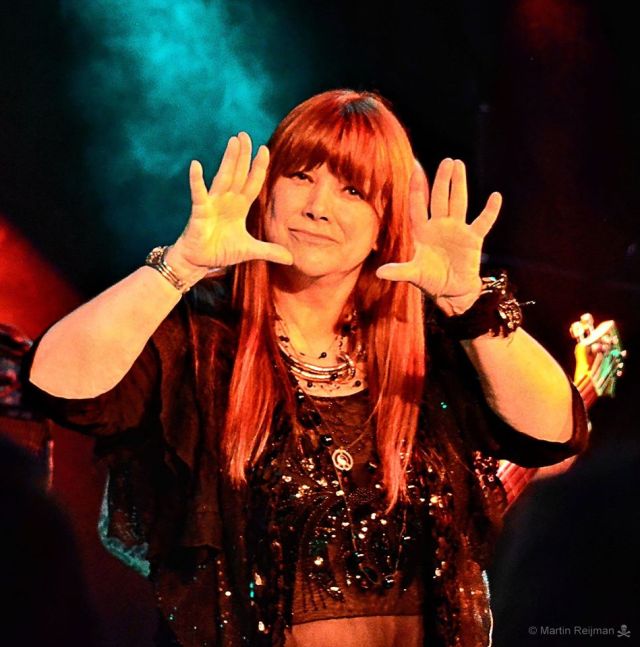
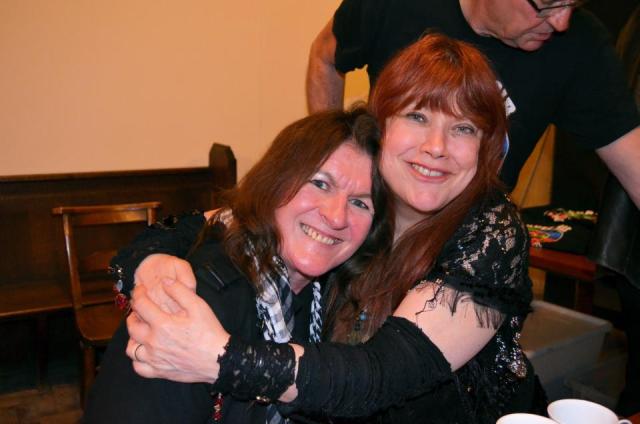
Best of all, I finally got to meet my heroine, who now resembles a gorgeous gypsy queen with her long flaming locks and black lace dress. And Florian remembered our encounter back in the 80s!
I have seen them several times since, including at the High Voltage and Summer’s End Festivals, and at Farncombe Music Club, the venue for our wedding party, where they played the whole set without Florian, who fell ill that night and was unable to perform.
The whole Curved Air cycle came full circle last September, when, on the 45th anniversary of its release, the band took to the stage at Under The Bridge in London to play all of “Air Conditioning”, something which had not been done for many a decade.
The first part of the set was a selection of songs old and new, including some from their most recent album “North Star” released in 2014.
It was the sheer joy of experiencing “Air Conditioning” in a live setting and realising the album had not lost any of its power and excitement in the ensuing years.
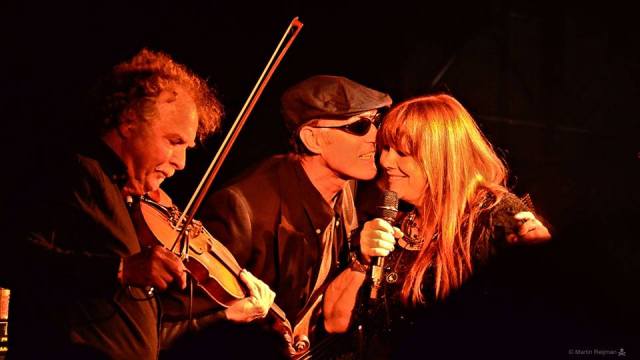
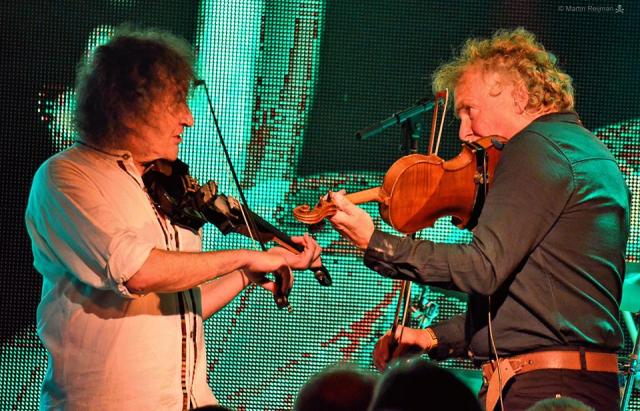
Perhaps I should mention that Curved Air’s current violinist Paul Sax is one of the most electric forces of nature in prog, his whole demeanour that of a wild gypsy violinist.
For this evening and one evening only, he was joined by Darryl Way. who flashed and burned his way through the most extraordinary version of “Vivaldi”. To see a musician play with such incredible virtuosity and passion on a piece fashioned when he was still young enough to be at art school or music college is simply remarkable. And I do not mind saying a few tears were shed, especially when Sax joined him for a sizzling rendition of “Everdance” from “CA II” for the encore.
Ian Eyre, the original bass player, also made an appearance to help celebrate this wonderful landmark in the career of a band that simply keeps on burning brightly.
They’ll be coming here to my current home town of Basingstoke in November and next year they will be one of the bands lighting up the Cruise to the Edge.
I cannot see the Curved Air Everdance ending any time soon – not while Sonja Kristina continues to weave her wonderful sorceress magic onstage, surrounded by the ever-changing, evergreen band of musicians, bringing new nuances and subtle light and shade to their very distinct and special brand of prog.
Hey hey, ‘sme with some news again! I just interviewed David Snape of David Snape & Friends, who interviewed me recently for his own show as well (you can listen to the complete show and interview here). We had a lovely talk about his favourite music, why he has a blog page, does a radio […]
LONDON, England – Se Delan, the dark, alternative, new-wave duo made up of multi-instrumentalist Justin Greaves (Crippled Black Phoenix) and Swedish singer Belinda Kordic, has launched a lyric video for the track “Blue Bird” from its recently released sophomore album, Drifter. Stream the new video clip on YouTube at: https://www.youtube.com/watch?v=DIZZtF3PFs4 or Vimeo at: https://vimeo.com/163676597.
Se Delan vocalist Belinda Kordic comments on the song: “As the world is going to serious shits (with a big no thanks to mankind), which the media so generously reminds us of every single day, I retreat to the comfort that there may be a higher being out there. Being grateful and finding joy in the little things in life gives me hope and keeps me grounded.”
The follow-up to 2014’s The Fall, Se Delan set about to make an album that felt raw, more natural and human. Together with their shared influences (“music, film and life”) and a mutual understanding of the way each other works has led to Se Delan creating an album that musically and lyrically looks at madness and how the line between sanity and insanity can at times appear frighteningly thin.
Drifter takes the slow and dreamy nature of the music from the duo’s debut album The Falland moves it to a far darker place through the lyrics and layers of sound that pulsate throughout the record. By giving up all pretentions and just following their hearts, Justin and Belinda recorded (with Ritchie Chappell at Tripdown Studio) in a way that simply captures how they felt as humanly as possible.
Our esteemed Progarchy editor has invited me to offer some thoughts and insights about how music has shaped my life; so hang on to your hats as there will be much to impart – but not all at once!
Where did it all begin? That’s an interesting question as my first memories are of bands like the Beatles and the Rolling Stones, circa 1964. Even then, the Beatles were the good guys and their single “She Loves You” was the first record I ever owned when I was six. The Rolling Stones were cast as the bad guys and quite honestly, I never really took to them until much, much later when I finally came to understand the more darkly adult themes within their music.
I was brought up on hip new television programmes such as “Ready Steady Go”, “Juke Box Jury” and of course, the iconic “Top of the Pops”, which was then a cutting edge programme very much in its infancy.
However, it was my parents who gave me the first taster of some of what was to come. My Dad, who has always been a huge jazz/big band fan, had a sizeable collection of 78s by artistes such as Glenn Miller, Duke Ellington, Woody Herman with “The Woodchopper’s Ball”, Stan Kenton, Tommy Dorsey and Nelson Riddle. Although I did not have the same deep affection for his big band passions, Dad certainly did teach me how to appreciate and enjoy music- as he found out later to his cost when I became a teenager!
There were two bands that he particularly loved, who went on to influence me and indeed, many of our contemporary heroes.
One was The Four Freshmen, an American four piece vocal harmony band, very much in the jazz tradition, who also played their own instruments. Some of their renditions of standards like “Tuxedo Junction”, “Baltimore Oriele” and “Poinciana” were simply breath-taking in their harmonic complexity and beauty. It is no surprise then that they were a major influence on Brian Wilson, and their vocal style provided the foundations for all that is best in the Beach Boys. Both The Manhattan Transfer and Donald Fagin have also acknowledged the Freshmen as a major inspiration.
Perhaps this is why I have a great love of bands which specialise in close vocal harmonies. Crosby, Stills, Nash & Young, the Zombies, Yes, Queen and Simon & Garfunkel come immediately to mind along with the brilliant Fleet Foxes, and latterly, the great Moon Safari with their vocalist/keyboard player Simon Åkesson’s amazing a capella side project, Accent.
My father’s other great musical love was the Jacques Loussier Trio, an outfit which puts an amazing jazzy spin on European classical music, led by the charismatic, celebral French piano maestro Jacques Loussier, who is also a pilot and wine producer.
I loved the way these three musicians could so effortlessly fuse two distinct musical styles to create a brand new modern-sounding idiom. They were, in fact, probably the first musicians I ever saw in concert at the Winter Gardens in Bournemouth and I must thank my parents for taking me along that night.
Never in my wildest dreams did I think I would hear of them again much further down the line. But it comes as absolutely no surprise that they are one of Andy Tillison’s major influences and you can detect that inspiration in The Tangent’s music, especially when the Maestro cuts loose his jazzier mojo.
To a lesser extent, the other group who I remember hearing very early one via my parents was The Swingle Singers. There are links with the Freshmen and Loussier yet again as this group were French-based and weave their close harmony vocal magic on European classics in very much a jazz style, with double bass and drums accompaniment, their most famous interpretation being Bach’s “Air On A G String”. And if you listen to the instrumental passage in ELO’s “Mr Blue Sky”, you will find them right in there too!
There were early classical influences too, such as Antonín Dvořák’s extraordinary Symphony No 9, better known as “The New World Symphony”, which was influenced by his experiences of America and its native music. The other piece which really rang true was “Vltava”, more popularly known as “The Moldau”, by his fellow Czech composer Bedrich Smetlana. This was the first time I ever heard nature pervading music with that incredible “river” effect achieved in the composition.
I have never had a chance to reflect on these beginnings but, writing it down now, it makes perfect sense and gives me a much greater understanding on why I now love the music of so many artistes, who use so much of what is best in classical and jazz, to give us this all- encompassing style we know and love as prog.
One of my earliest musical loves was Simple Minds. For those of us who grew up deeply loving prog, the late 1970s and early 1980s were a very difficult time. If we couldn’t get our belovedly and outrageously complex 12-minute or even 24-minute epics, we had to find a worthy—no matter how watered down—substitute. For me, at least at the age of 12 or 13, I wasn’t willing to go the classic rock route. No matter how many times the radio played Jackson Brown or Aerosmith, these bands meant nothing to me. Sometimes less than nothing. Even worse was Top 40 pop.
In 1981 and 1982, that meant the only real alternative in the rock world was what was being called New Wave. While their songs were way too short, the use of keyboards and bass—at least in the best of the New Wave sound—I found them rather progressive. And, just as often, the lyrics were as intense as they were intelligently playful.
The bands I loved most: ABC; Thomas Dolby; and Simple Minds. I didn’t just tolerate these bands, I fell in love with them. I couldn’t even count the number of times I listened to GOLDEN AGE OF WIRELESS or LEXICON OF LOVE.
They played over and over again on my stereo during the early 1980s.
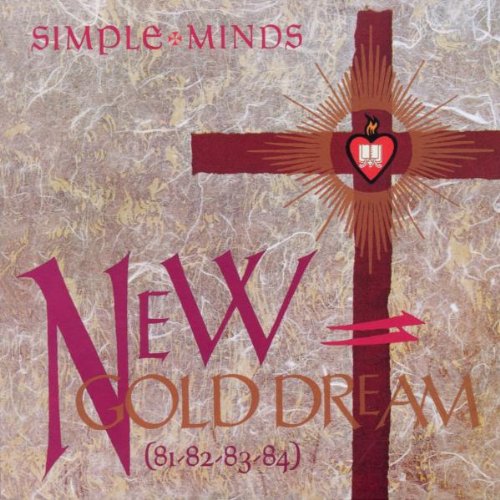
I came to Simple Minds a bit latter than either Dolby or ABC, but only a bit later. To this day, I think Sister Feelings Call/Sons and Fascination, New Gold Dream, and Sparkle in the Rain are some of the best albums I’ve ever heard. Even when compared to straight-up progressive albums, I would place anyone of these albums—but especially New Gold Dream—in my top 50 albums of all time.
Anyway, a brief thought about why New Wave mattered. Until next time. . . .








 Progarchy