

Review: Anima Tempo – Caged In Memories
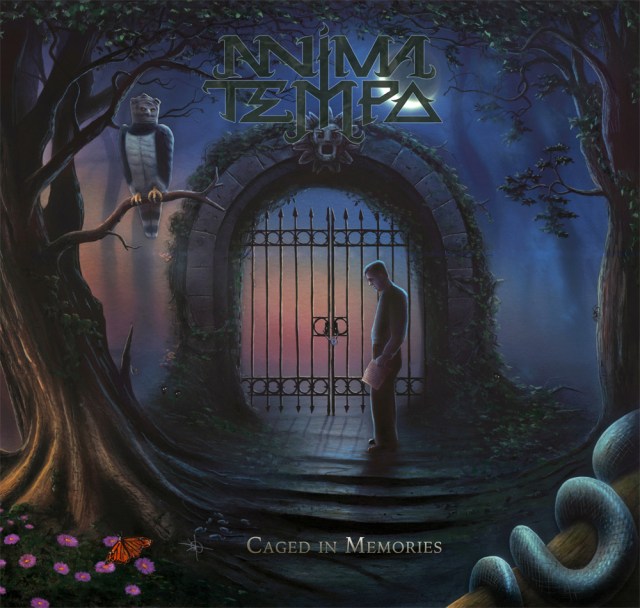
My obsessive hunger for more music has brought me again to Mexico, this time to a band called Anima Tempo, whose new album, which will be discussed here, I received in the latest Prog Sphere Promotions package.
Anima Tempo, was born in 2009, after long-time friends Dante Granados (guitars, synths), Gian Granados (vocals, guitars), and Pedro Vera (bass) decided to form a band where they will pour out all their creativity. After two demo records, in January 2016 Anima Tempo released their full-length debut titled “Caged In Memories.” Consisting of seven songs, the album represents the group’s take on the progressive metal genre, completed with elements from death metal, symphonic music and djent.
Musically, “Caged In Memories” is rooted in 90’s prog metal, with heavy riffing, intense drumming and vocals that range from cleans to growls and all the way back. Besides the aforementioned prog metal structure, the band does not fear to explore further, embracing term ‘eclectic.’ As it’s notable that the majority of progressive metal bands were or are influenced by Dream Theater, Anima Tempo’s closest description, by my ears, would be blending aforementioned prog metal veterans with Opeth, Between The Buried And Me, Kamelot and Hans Zimmer-inspired soundtracks. The raw energy splutters from every single tone and seeminlgy, the band does not care too much to tame it, but rather let it grease the speakers.
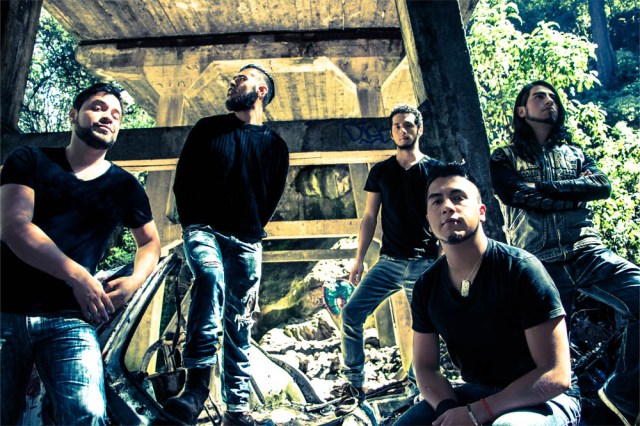
Anima Tempo succeeded to avoid a prejudical approach the majority of bands of the similar genre orientation have implied in their music. You might find this album “hard” for your ears, but to break that image, I may conclude that during the album’s running time you don’t feel any kind of pressure from that side. This album floats easily on its way. The Mexican and international scenes are certainly stronger by having another band under its wings.
Buy “Caged In Memories” by Anima Tempo on Bandcamp.
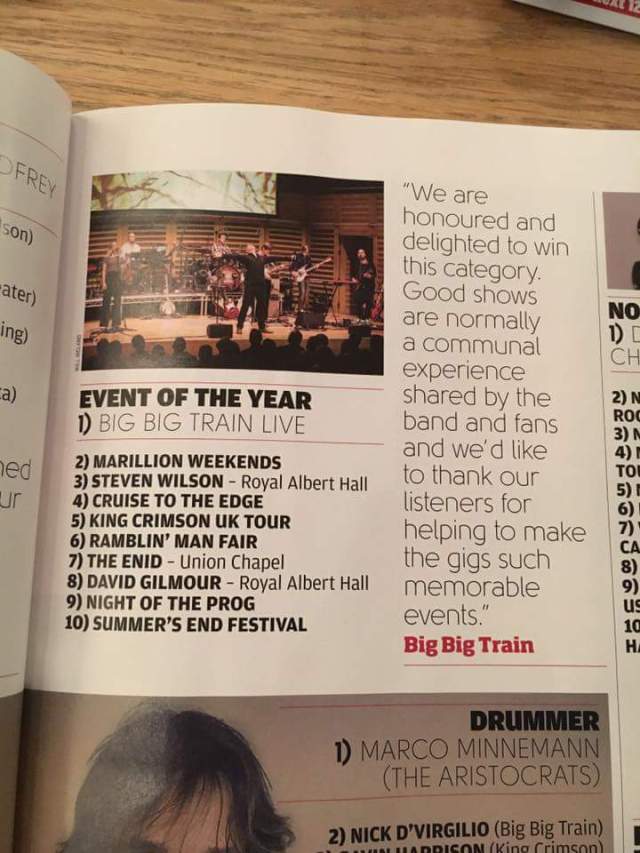
Big Big Train no 1 in Event Of The Year category in Prog Mag’s Readers’ Poll 2016
It’s with great delight I read in the latest issue of Prog Magazine that the wonderful social get together that was the The Big Big Gigs at Kings Place in London August 14-16 has been chosen No 1 Event Of The Year in the Readers’ Poll 2016! The grateful comment from the band is so significant of what this wonderful band is all about. Love! 🙂 As you also can see the band’s drummer Nick D’Virgilio was number 2 in the Drummer category just behind the monumental Marco Minnemann. (Thanks to Greg’s daughter Ellie for the picture which I nicked from her Facebook timeline.)
Dream Theater’s Rebellion
Not sure what is going on, but I received this in email this afternoon. Definitely more interesting than the upcoming Iowa Primaries.
|


Nosound’s Teide 2390: Profoundly Delicate
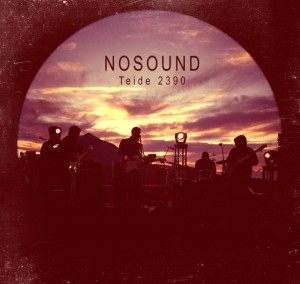
Of all the bands I love and review, the hardest to review—without question—is Nosound. At least for me.
This post is a perfect example to illustrate my failings. I’ve had a copy of Nosound’s 2015 live album, TEIDE 2390, for nearly a year, and I’ve still not written a review. And, if you know me, you know I’m obsessed with writing, and I’m especially obsessed with writing about what I love.
I was recently told as a criticism: in my writing, I “fling superlatives.” My response to this is: “why, yes, I absolutely and most certainly love to fling superlatives.” It’s true. Just imagine what I’m like when I’m lecturing to forty 19-year olds.
With Nosound, however, it’s really, really (sometimes outrageously!) hard to fling superlatives. Why? Because everything glorious about Nosound is understated, tasteful, and minimalist. As a 48-year old Kansan, I just don’t do minimalist well. At least when it comes to writing. Yet, I know and appreciate minimalism—especially when it comes to the computers and gadgets designed by Steve Jobs (rest in peace) or the music so lovingly crafted by Mark Hollis or Arvo Part.
Enter Giancarlo Erra. His Nosound is profoundly delicate. Not effete. By not means, effete. Never. But, certainly delicate.
As I’ve written before, Erra is a genius, plain and simple. This is as clear in his photography as it is in his music and his lyrics. Again, far from effete, he approaches art and the world of art and creativity with an extreme sensitivity. His creativity in his photography is as much about what is not there as it as about what is there.
The same is even more true of his music. Nosound is as much about silence as it about notes.
Throw in Erra’s somewhat mystical lyrics and dream-like vocals and you find yourself—as a listener—fully immersed in his world, drifting along some radically natural psychedelic dream state.
His lyrics deal with frustration, loss, desire, hope, depression, joy, and everything that matters in this world and, perhaps, in the next.
A little over seventy-five minutes in length and recorded in September, 2014, on a Spanish island, TEIDE 2390 demonstrates that Erra’s genius is not merely in the studio. As he’s demonstrated before—his live version of Pink Floyd’s “Echoes” is possibly better than the original version from the early 1970s (heresy, I know!)—he knows exactly how to create a full minimalist sound, even on stage and away from the hyper-controlled environment of a professional studio. This is no small achievement, as the music demands the full attention of an audience that probably would not mind head banging. No one head bangs to Nosound. Instead, one swirls, and rides, and flies, and soars, and dips, and drifts.
I think it’s probably fair to state that many proggers like their music heavy and fast. Erra reminds us so importantly that we need to breathe as well.
Worlds Have Collided: Galahad at age 30
Galahad is a band that knows where it’s been, where it is, and where it’s going. I love this. But, then, I love Galahad. And, so should you.
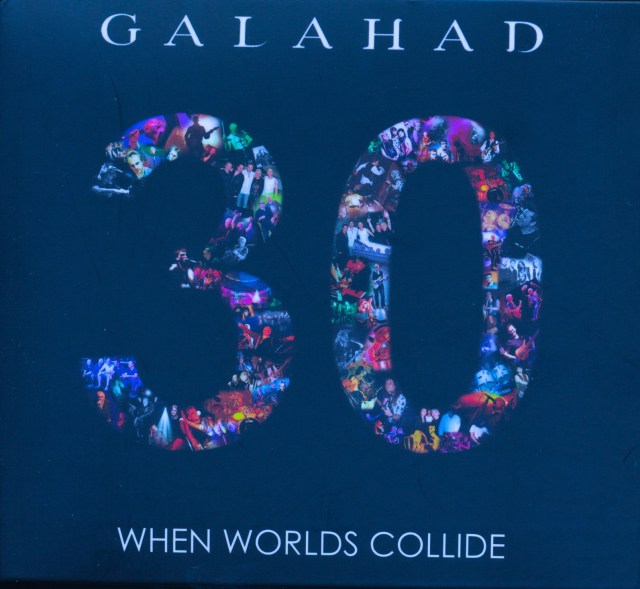
For the latest release, When Worlds Collide, Galahad has re-recorded a number of its older tracks and meshed them with the more recent ones in a wonderful and engaging two-volume set. In existence now for thirty-one years and with most of its original members still members (amazing; can you imagine saying the same thing about, say, Yes?), Galahad is neither shy nor cocky, just happily content. They never wanted to be rock stars, puppets of some record label, or the playthings of some marketing firm.
They just want to be Galahad. And they do it with such grace. That grace finds its way into their lyrics, their music, and their very presentation. If you forced me to make a comparison of the band, I would suggest imagining Peter Gabriel and Tony Levin playing with Ultravox and then progging it up to 11.
Here are the tracks and the dates (original and re-recorded):
CD1
- Lady Messiah (1985/2015)
- The Chase (1988/2015)
- City of Freedom (1986/2015)
- Chamber of Horrors (1990/2015)
- Dreaming From the Inside (1985/2015)
- Room 801 (1990/2015)
- Ocean Blue (1996/2015)
- Don’t Lose Control (1990/2015)
- Exorcising Demons (1992/2015)
- Karma For One (1997/2015)
CD2
- Empires Never Last (2006/2014)
- Sleepers (1992/2012)
- Richelieu’s Prayer (1990/2012)
- Painted Lady (1985/2014)
- Bug Eye (1997/2014)
- Singularity (2012)
- Guardian Angel (2012)
- Seize the Day (Single mix) (2012)
- This Life Could Be My Last (2006/2014)
As is obvious from the above track list and the accompanying dates of original recording and the re-recording, the band has been re-creating its sound for years now. All to the good. Even the older tracks—regarded as “neo-prog” by the press at their release feel much more dynamic and more “Galahadian.” Just as a test, I played several of these tracks—all from different releases—in succession to get a feel for just how different When Worlds Collide. The audio quality is simply amazing. It always has been, but with all of its confidence and just pride in being in existence for over three decades, Nicholson and Co. give us everything they have with When Worlds Collide.

Sadly, I didn’t encounter the music of Galahad until Lady Alison introduced the band to me in 2012. Since then, I’ve been hooked. I own the CDs, I own the authorized band biography, and I consider the lead singer, Stu, a friend and ally.
Whether you’ve loved the band for thirty-one years or if you’re reading about them for the very first time right here, right now, do yourself a huge favor: purchase When Worlds Collide. It’s a delight for the ear, the mind, and the soul.
YesYears: Twenty-Five Years Later
Remember YesYears? It was one of the first really nice box sets to come out, back in the day when the only nice box set was that Bruce Springsteen one that had come out in the late 1980s?
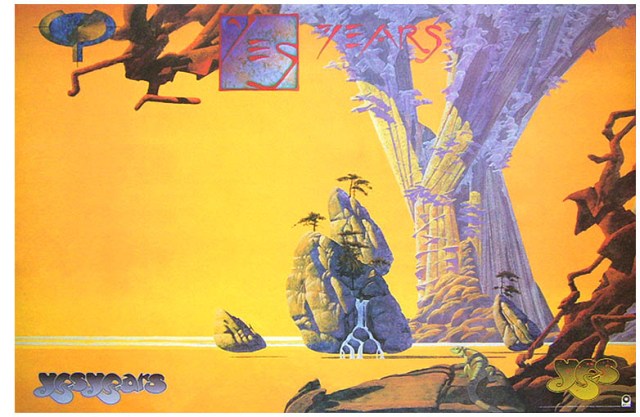
YesYears came out on August 6, 1991. Union had come out at the very end of April that same year. Unless you were really connected to the internet (not that easy in 1991), Yes fans just had to guess as to what was going on that summer with the band. Was Yes really an eight-person band? And, how long would that last? YesYears seemed to present the eight as living in harmony with one another. After all, while the four discs did not include anything from Anderson Bruford Wakeman and Howe, it did list them as a part of the really nice fold-out sleeve, tracing every aspect of Yes history from “The Warriors” to Yes incarnation #9.
Whether real or not, the packaging of YesYears certainly makes a coherent narrative of the band and everyone of its members from Alpha to. . . well, certainly not Omega! Yes was alive! Or, so it seemed.
At the time that YesYears came out, I was very poor (a second-year graduate student) and still listening to cassette tapes. Despite the expense of the YesYears box set, I purchased the four-cassette package. And, yes, it made a deep cut in my savings account. Those were years when I would skimp on lunch (usually not even eating one) to spend the money on music or books.
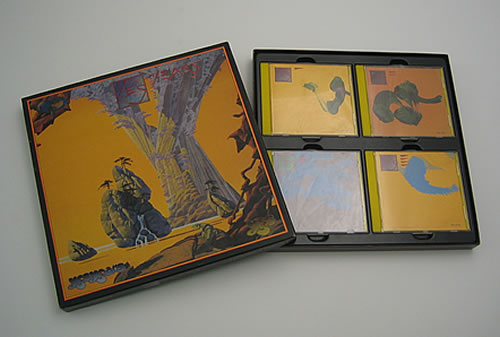 And as far as I remember, I never regretted having bought that box set. Sadly, though, the cassettes that came with it were not of the best quality, and I wore my copies out rather quickly.
Jump forward two decades. Today, in the mail, all the way from an Ebay seller in New Jersey, arrived a mint condition 4-cd box set of YesYears.
Wow, it is a thing of beauty.
I know that many of the songs that had not been readily available in 1991–such as Abilene, Vevey, Run with the Fox–are now very easily available. Still, the 1991 box set is really, really gorgeous. I actually paid less for this mint condition version (including postage) than I did for the cassette version 25 years ago.
Just as in 1991, I have no regrets. The sun is out, my kids are laughing somewhere in the house, and I’m listening to disk three of YesYears.
Still amazingly beautiful. . . even a full quarter century later.
Review: Fake Heroes – Clouds
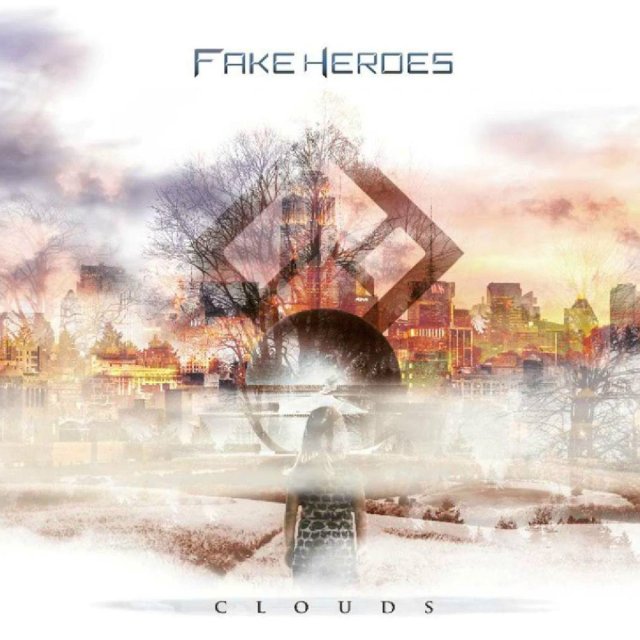
The second album of an Italian prog metal band calling themselves Fake Heroes, ‘Clouds’ is nothing, if not incredibly diverse. Taking the sounds of classic progressive metal and a great many other styles, and compiling them in an 11-song trek of music, this is quite an ambitious project, especially coming after an average debut. However, despite proving that the band is evidently very adventurous, the end result is an album that is very good in the way it turns out, making for an inconsistently enjoyable piece of work.
Led onward by the vocals of singer Manuel Gatta (whose voice is oddly reminiscent of TesseracT’s Daniel Tompkins), the music cycles through everything from classic progressive metal, to djent, ambient, to even a number that could have been on ‘In Utero’. Overall, while I understand that the band is testing the grounds quite a bit with this one, it does feel incredibly tight, and the songs as a result have very big flow to them.
The songwriting is excellent here, very consistent, ranging from excellent (especially towards the second half of the album) to memorable. On top of the album feeling a bit too long for its own good, the album’s structure is in a state of great condition, and Fake Heroes deliver a very good impression with “Clouds.”
Support Fake Heroes here.
Review: Wolfram – Music of the Heathen
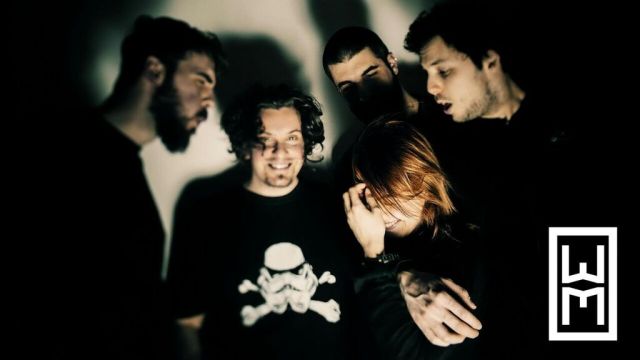
One of the more unique acts to come from the underground in recent years, Wolfram from Serbia have finally released a debut album after teasing us with an EP in 2013. Music Of The Heathen is a clash of apocalyptic walls of noise and ethereal passages that, I believe, the band has become known for in their native Serbia.
Mixing ambient sounds and raw power this release is both a thing of beauty and a tale of urgency and survival. Opening track, On This Side of The Line, opens with a clean guitar voicing followed with the series of atmospheric doom riffs, and wonderfully accompanying vocals of Aleksandar Apic. Building up a crescendo of static noise, the song breaks before dropping into second track Music Of The Heathen. This continues in the same way as the opening tune, with greasy riffs that evolve around another run of voicing and spluttering chorus. Babel shifts from the guitar driven sound towards more ambient, synthesised vibe in the first part of the track, along with a line “People always hear what they want to hear.”
The album tracks also contain a number of guest vocalists what gives the feeling of diversity throughout the album. A Different Kind of Sleep, which features Dunja Dacic Dojo, is the strongest vocal performance on the album. Dunja’s voice is markedly both powerful and fragile, layered to counter pose the beautiful melodies and forceful high notes created with her voice.
Utilising synthesisers, bowed guitars, layering electronic tracks with a backing of crashing drums, Wolfram have created a sound which is hard to define. Blending the stringed influences of Sigur Rós with the heavier post-rock of Russian Circles, the band boast the talent to become the breakthrough Sigur Rós were in the 2000s.
Music Of The Heathen is a bold debut by a band that is look to push the boundaries of how we experience music. While we didn’t get to review the visual side to the physical release, this release does not disappoint.
Follow Wolfram on Facebook.
Yes: Bizarre, Beautiful, Utterly Human.
Ever since PROGENY appeared last year, I’ve been in a Yes-ish mood. As I’ve already written in probably too many other pieces for progarchy, I have gone through massive Yes stages in my life. Yes—at least YESSONGS—was the first prog album that really made an impression on me, though I was only five at the time.

And, I recently had the chance to remember, though briefly, 90125 on progarchy.
Strangely enough, unlike say my love of Rush or Talk Talk, my love of Yes has been hit and miss, hot and cold. Intermittent.
My great friend, Liz, reminded me that I absolutely loved Yes in college and somewhat existed on campus as a Yes evangelist. I was a bit skeptical about this. After going back to letters and journal entries I wrote at the time—I was definitely VERY into Yes. Liz’s memory is far better than mine. My journal entries are full of me trying to explain and understand Yes lyrics.
At age 21, at least according to my own notes from the time, I was even rather convinced that Steve Howe’s guitar spoke its own language. And, yes, I realize I’m starting to sound like a certain Glass Hammer album warning exactly of such dangers and fan obsession.
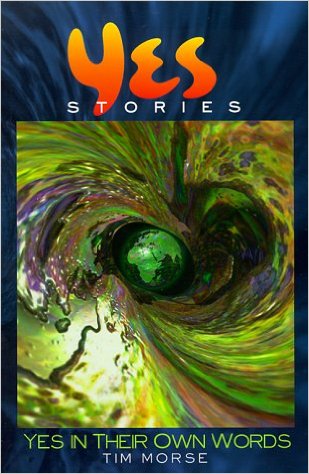
Since Progeny came out, however, I’ve really jumped back into a very personal Yes fandom. And, for better or worse, I recently reread three books about Yes: Tim Morse’s Yes Stories; Chris Welsh’s Close to the Edge; and one other (can’t remember the title at the moment). I’m struck more than ever how utterly Yes was (and is?) one unbelievably dysfunctional family, always desiring to make art but really letting fame and money get in the way of this. Regret and guilt sets in, confessions are made, penances promised, and Yes starts the cycle all over again.
And, yet, what incredible brilliance to emerge at times as well. I’m not sure it’s worth fighting over which “phase” of Yes is really Yes. Yes is what it is, what it was, and what it will be. Trevor Horn is a part of it, just as Jon Anderson and Steve Howe are. Chris Squire (RIP) is a critical figure, but Geoff Downes and Billy Sherwood are, too. Even seemingly marginal figures in the Yes drama, such as Patrick Moraz and Eddie Jobson, matter deeply in the end. I love Howe’s guitar work, but I also love Rabin’s and Banks’s. Kaye, Moraz, Wakeman, Downes, Rabin—all incredible keyboardists. Really, where does it stop?
Was Yes ever actually a group? Maybe. Maybe not. I’m not sure. And, I’m not sure if they were ever sure or even if there was really a “they.”
In reality, though, Yes is a bizarre, beautiful, organic association of wild egos, all-too human desires, and cosmic longings and glimpses into the realm of the spheres.
 Progarchy