

To order:


Sanguine Hum – “The Weight of the World”
by John Deasey
Back in 2002, a relatively unknown band called Lorien released an album called ‘Under the Waves’. Although a fairly low-key affair with a relatively bland Coldplay/Doves/Athlete type of vibe, there were some seriously beautiful tracks with a definite prog tilt. The album also included some of the best vocals I’ve heard from their Italian singer Fabio Ciarcelluti.
A natural countertenor, Ciarcelluti added a fantastic and unusual tone to produce some really moving and memorable songs, which still rank highly in my collection.
This same tone is brought to mind immediately on the opening track of Sanguine Hums second album, ‘Weight of the World’. The Oxford quartet are led by Joff Winks who’s elegant and understated vocals blend perfectly with the bands clever, languorous and intelligent music.
This is my first exposure to Sanguine Hum, their first album ‘The Diving Bell’ having slipped under my radar, but even on first listen it is clear these guys have been playing together for a long time. It turns out Winks, keyboardist Matt Baber and bass player Brad Waissman have been together for ten years in various guises and it shows.
They create a lovely, fluid and subtle sound that is very complex but made all the more accessible by some lovely hooks and melodies that grab your attention, fleetingly, and draw you in to investigate further. This is not music to play in the background – it is complex, tricky but ultimately very rewarding with layer upon layer to unpeel and delve into.
So, to the music.
Five seconds into opening track ‘From the Ground Up’ and the silky, gossamer layers that are to frequent this album become apparent. A gorgeous vocal over what can only be described as a spider’s web of keyboard and guitar create an immediately gentle and captivating atmosphere.
There is a lot going on here, with clever bass lines weaving in and out whilst shifting rhythms subtlety propel the track forward. It is a great opening track and sets the scene wonderfully.
‘System for Solution’ follows with a super sinuous guitar lead snaking around the languorous vocals of Winks. Languorous. A word that could neatly surmise the whole thing really. Nothing really jars, no guitars scream out of the mix, no distortions are out of place. This is a good track which shifts around, never settling, but which has about as urgent a pace as there is on the album. It also has one of the few guitar solos and it’s an absolute belter with not a note wasted or over-played. Again, subtle and languorous.
Next up we have a wonderful instrumental track – ‘In Code’ – which really showcases the musical talent on display. Something about this track reminds me of Steven Wilson’s later stuff, with it’s jazz tendencies, key changes and complex arrangement.
‘Cognescenti’ and ‘ Day of Release’ continue the general theme with the added interest of electronic elements being nudged into the mix. These are introduced skilfully here and there to add lovely sonic textures that in many cases, have you hitting the rewind button to check again.
The penultimate track, ‘Phosphor’ is beautiful and gentle and reminds me of classic Blue Nile. A neat, precise and condensed piece of beauty.
The finale, so to speak, is the title track which at 14.52 minutes long could be considered the albums swansong, a Magnum Opus, an over the top exultation of all that has gone before it. It couldn’t be further from the truth. This is yet another musically excellent, structurally fascinating and interesting track that weaves and snakes it’s way around a chorus that works it’s way into your head after a few plays.
This album surprised me. After a couple of plays in the car on the way to work, I wasn’t too thrilled about it. Nothing jumped out, nothing shouted out, no hooks leapt into my head and stayed there, but I heard enough to make me want to investigate further. Sure enough, listening to it carefully, in a quieter environment allowed a peeling back of the layers to reveal a wonderful piece of music put together by talented young English guys.
I haven’t really got under the skin of the lyrics as they are well in the mix and not clear enough to discern with any real meaning, but the tone and delivery suggests a weary, but not maudlin, take on how the world is going but not in any hectoring way, more in the way of idly contemplating and reflecting.
This is Progressive music at it’s progressive best in my opinion. There are traces of influences scattered throughout. I can hear Radiohead, Porcupine Tree, Mew and the aforementioned Lorien but it really is wrapped up in it’s own skin and provides a refreshing take on ‘Prog’ as we know it.
Wonderful stuff.
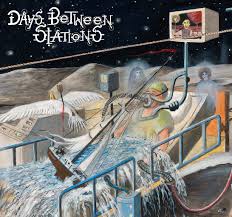
2013 has already shaped up to be one of the most bountiful years ever for prog. Consider a few of the outstanding albums that have already been released: Big Big Train’s English Electric 2, Cosmograf’s The Man Left In Space, Bruce Soord/Jonas Renkse’s The Wisdom Of Crowds, KingBathmat’s Overcoming the Monster, Sanguine Hum’s The Weight of the World, Sound of Contact’s Dimensionaut. Add to that list Days Between Stations’ In Extremis, which has taken up permanent residence in my home CD player and my iPod.
Days Between Stations, based in Los Angeles, is Oscar Fuentes Bills (keyboards) and Sepand Samzadeh (guitars). In Extremis is only their second release, but it possesses the maturity and excellence of a far more experienced group. Their 2007 self-titled debut consists of five extended instrumentals with some wordless vocals (plus two “intermissions” of sampled conversations), and is top-notch prog in its own right. The opening track, Requiem for the Living, begins with a beautiful yet mournful theme on synths and piano, which eventually develops into a slide guitar workout that would do David Gilmour proud. According to Samzadeh, it was inspired by Gorecki’s Third Symphony, also known as his Symphony of Sorrowful Songs. The album concludes with the epic Laudanum, which never loses focus or power over the course of its 22 minutes. It includes ambient textures, jazz fusion, and, of course, lots of prog guitar!
While Bills and Samzadeh were ably assisted on their first album by Jeremy Castillo (guitars), Jon Mattox (drums), and Vivi Rama (bass), for In Extremis, they have taken things to an entirely new level. Billy Sherwood (Yes) is sharing production duties with Bills and Samzadeh, Tony Levin (King Crimson, Peter Gabriel, and many others) is on Stick and bass, Colin Moulding (XTC) lends his voice to a song, and Rick Wakeman (Yes, etc.) contributes some mellotron and minimoog. In a fitting way, the late Peter Banks (Yes, guitar) adds his magic to several songs. As a matter of fact, these are Banks’ last recorded performances.
In Extremis begins with a massive fanfare featuring the Angel City Orchestra that becomes the overture for the album. The most obvious difference with this set of songs is that we now have vocalists singing lyrics! Billy Sherwood sings in the Floydian Visionary, Eggshell Man, and the title track. Thematically, the lyrics convey the loss and regret of someone near the end of his life:
There’s no replacing what’s been left behind
There’s no returning to that place and time
In sight were all the distant horizons
In flight were all the dreams alive
(From Visionary)
A high point is Colin Moulding’s marvelous vocals on the wry pop of The Man Who Died Two Times. Set to an irresistible, bouncy ’80s vibe, Moulding sings of
All the angels cried
For the man who died two times
And they wiped away tears of laughter
And helped him survive
Going station to station
Always ready to revive
Next up is a touching string quartet piece dedicated to Peter Banks, which is followed by the crowning glory of the entire album, Eggshell Man. It features a delicate accoustic guitar intro with gorgeous vocals by Sherwood and a mellotron flute solo by Wakeman. It soon picks up speed and intensity, including a section with some Middle Eastern flair. The tempo ebbs and flows over the course of twelve minutes, Wakeman has a terrific minimoog solo, Levin is rock-solid on bass, and Sherwood sings of “best laid plans” and empires returning to dust. It’s one of the finest songs released this year.
Believe it or not, there is still the title track to come, and it’s a monster, clocking in at 21:37. In Extremis is a requiem for a man (the Eggshell Man?) who realizes too late the brevity and preciousness of life:
Images upon the screen
Recanting all the memories
From the first breath
To the last goodbye
Dust dancing on beams of light
Most groups would give anything to achieve a track like In Extremis. Days Between Stations pulls it off with ease, and manages to precede it with seven other tracks that are its equal.
There have been some extraordinary releases in prog music this year, and Days Between Stations’ In Extremis is near the top of the heap. This is an album not to be missed.
Here’s the official trailer:
 Henry Fool’s new album, Men Singing, is an alternate history, a prog rock proclamation that it was the Soft Machine, not Elvis, who invented rock and roll, out of the ashes of bop, not blues. Led by keyboardist Stephen Bennett and stellar no-man vocalist Tim Bowness (who joins his bandmates in not singing on the album — he plays guitar here), Henry Fool conjures first wave English prog and ambient while alternately dodging and burning the spirit of King Crimson’s “Starless” and Soft Machine’s Third. If anything could convince me this is the way rock’s mainstream should have shaken out, Men Singing is it.
In writing* and on record, the project’s relationship to first generation progressive rock is explicit and real — Phil Manzanera is a collaborator here — but also cautious, with an important ambition to avoid simple mimicry. Any way you look at it, this is not an easy thing to pull off, and in fact is the central obstacle to bands consciously working in the contemporary prog rock genre. How to avoid stylistic forgery? The early prog groups had an entirely different set of references that, naturally, did not include prog, and there’s an uneasy recognition that once it’s “prog” it’s no longer prog. With that said, if it’s possible to meet expectations while pushing boundaries, Men Singing more than succeeds.
The four-song album begins with the longform “Everyone in Sweden,” which maps the record. The aggressive, energetic rhythm section structures the melodic builds and mixes, suggesting the work of Robert Wyatt with Soft Machine, Jaki LIebzeit with Can, and Klaus Schulze with Tangerine Dream. Which is to say that Bitches Brew-era Miles hovers like some benevolent deity. But this is not a music stuck in the past. It has a smartly produced, live sound that brings the drums and bass up front — with a rising and falling cadre of guitars and horns and glockenspiels and mellotrons working alongside — while avoiding the airtight digital separation or cleanness of many contemporary prog albums. It works anew the fertile ground turned over by post-rock instrumental bands like Pell Mell and Tortoise, and arguably offers a more focused experience than either of those estimable groups.
At 40 minutes, Men Singing is well-paced and doesn’t linger too long, which might have been a problem in different hands or in different eras. Terrain is explored, not exploited, and the two 13-minute cuts are satisfying in their development. The two shorter pieces make their point even more powerfully, with “My Favorite Zombie Dream” going some distance towards explaining the band’s name, a homage to Hal Hartley’s late 90s movie but really a nod to Hartley’s music, which colors his films in a moody, darkly humorous palette.
It’s hard to recommend this album too highly, which, given Bowness’s involvement, should be no surprise. And while an instrumental album called Men Singing might feel clever, the voices on this record show it’s only half a joke.
*http://timbowness.wordpress.com/album-writings/henry-fool-men-singing/

A big thanks to Kevin Williams for his first listen (and heads up) to the new Dream Theater: “The Enemy Inside”.
The new track debuted over at USAToday.com, but if (like me) you are located in Canada, the streaming from SoundCloud will not work at that link.
So, over at the Dream Theater Facebook page, there is a link that takes you to a localized stream for non-USA countries: http://smarturl.it/theenemyinside
That link didn’t work for me (I got a “404 Not Found—The requested resource was not found” message), but I did track down the track for Canadian playback over here: Dream Theater – “The Enemy Inside” [Song Stream] [Exclusive Canadian Premiere].
The track is awesome. You’ll want to read Kevin’s excellent “first listen” review, to compare notes. Be sure also to listen to “On the Backs of Angels” at the same time, to compare your listening experience with his assessment:
The chorus is soaring – a perfect counterpoint to the thunderous verse sections – and it immediately grabbed me in the same way that “On The Backs Of Angels” did from “ADTOE.” It’s then followed by a keyboard riff very reminiscent of a run from “ADTOE.”
We’re looking forward to September 24!

Dream Theater’s last effort, “A Dramatic Turn Of Events,” was, as usual, welcomed by many and likely shunned by just as many, for different reasons. Whether fans wanted to hear more of the heaviness from previous efforts such as “Black Clouds And Silver Linings” or “Systematic Chaos,” or if they were predisposed to not like any Dream Theater effort without co-founder Mike Portnoy behind the kit, “A Dramatic Turn Of Events” might not have been their cup of tea.
I certainly didn’t share that sentiment. The balance Dream Theater struck between the heavy and the melodic on nearly every track of “A Dramatic Turn Of Events” – even with the obvious (and oft-written) comparisons to the song structures from their landmark “Images And Words” album – was music to this DT enthusiast’s ears who actually was tiring of the increasingly heavy music from the DT camp. Though he didn’t have a hand in the songwriting process, Mike Mangini provided a musical jolt not unlike what we saw when Jordan Rudess made his DT album debut on “Six Degrees Of Inner Turbulence” with the type of pyrotechnics reserved for clinics and rarely on major album releases.
The band recently announced their self-titled follow-up to “ADTOE,” which will be released in September, but they soon followed up that announcement with news that the first single, “The Enemy Inside,” the second track from the forthcoming album, would make its debut via USA Today’s online music section.
The opening 25 seconds of “The Enemy Inside” is a full-on assault starting with a blistering riff by John Petrucci, soon joined by bassist John Myung and Mangini thundering away. A second riff gets things going but left me wondering where Rudess was (likely answer: doubling Petrucci with a guitar patch on keys?), but he arrives in the main intro to the song with a string part floating over the rhythm section thundering away. On first listen, it’s a “classic,” heavy DT riff setting up vocalist James LaBrie’s first verse.
The chorus is soaring – a perfect counterpoint to the thunderous verse sections – and it immediately grabbed me in the same way that “On The Backs Of Angels” did from “ADTOE.” It’s then followed by a keyboard riff very reminiscent of a run from “ADTOE.”
Following another verse and chorus, a B-part verse breaks things up with its half-time start, which then builds to the solo sections. Rudess and Petrucci start things off with one of their usual dizzying solo runs that builds and leads to a Rudess keyboard solo with a percussive patch, followed by Petrucci matching Rudess in intensity and melody with his own solo, then back to the chorus for a short time, leading out to a reprise of the intro riff to finish us off.
“The Enemy Inside” features all the elements of a classic DT song in a concise format (just over six minutes; short by DT standards). To these ears, it’s not a groundbreaking track but also not a regression to the heavier metal edge that began to disinterest this fan prior to “ADTOE.” The track does exactly what it’s supposed to do: Get me fired up for the album release this fall. Done!
Leeds-based Chris Wade is the man behind the band Dodson and Fogg and he sings, as well as playing guitars, bass, keyboards, percussion and flute. He’s enlisted the help of Celia Humphris (Trees) on vocals on seven of the tracks, and Alison O’Donnell (Mellow Candle) on one, as well as Nik Turner (Hawkwind) on flute, Colin Jones on trumpet and Amanda Votta on flute.
“That’s a lot of flutes”, I hear you say and whilst other reviewers have mentioned Jethro Tull don’t be expecting any standing on one leg frenzied flute action.
I have, over the past 9 months or so, become increasingly disillusioned with much of what passes for ‘progressive’ rock music nowadays.
What I have found refreshing, though, are bands like Dodson and Fogg, These Curious Thoughts, KingBathmat and echolyn to name a few who are making truly original music, without seeing the need to clog the soundstage up with unnecessary instrumentation, over-production or Pro-toolery. The songs are given room to breathe, the melodies become all important and sometimes it’s the gaps between the instruments that are truly spectacular, aurally.
The debut, and this second album have been garnering lots of positive reviews, and Chris was recently interviewed by the Classic Rock Society. There he mentioned his influences were Leonard Cohen, early Cat Stevens, Simon and Garfunkel, really early Jethro Tull. His favourite songwriter, though, is Ray Davies and there’s a quintessential Englishness (have a listen to Too Bright) to this record that reflects that I think.
I love how no song ever outstays its welcome, how the vocals and lyrics support the tune, and not the other way round, and how every bit of instrumentation, be it trumpet, flute, acoustic or electric guitar is almost perfectly placed. Record and mix it any other way and it loses its beauty, its fragility, its inner core. It is, dare I say it, art. Art that serves no purpose other than to be art.
But what I love more than anything are the electric guitar sounds this young man creates. The trumpet on What Goes Around is pretty special too, as is the acoustic guitar and trumpet on Too Bright (early Tull, anyone?) but I digress. Guitar-wise, check out Can’t Hold Me Down and Too Bright for example. I get very, very early Buck Dharma, in both Stalk Forrest Group and Blue Öyster Cult incarnations. Lovely, psychedelic, sparse guitar runs, or flourishes, even notes that make me at least beam from ear to ear. It’s To The Sea where the guitar lets rip though, albeit in a very restrained, beautiful way. Notes, chords of electric guitar duet with strummed acoustic as the song gathers pace, wanting to break lose but resisting the temptation. The prog equivalent of tantric sex methinks. It’s a staggering piece of music. And I’m spent.

I mentioned These Curious Thoughts in my first review for the site and I think it’s worthwhile to revisit their 2012 release Building Mountains From the Ground. There’s a new album out at the moment and I’m working on a review of that but for the moment I’d like to share with you something I wrote a wee while ago by way of an appetiser for an underrated band who I think deserve wider exposure. This review has previously appeared elsewhere but I’ve changed a few paragraphs and moved a couple of commas about.
In 2011 Londoner Jamie Radford (lyrics) and Sean Dunlop from Motown, a.k.a. Detroit in the U.S. of America (music and vocals) were joined by Nate Shannon on bass and Sean “Nasty” Nasery on drums. And thus we have this new album, which continues in a similar musical vein as their earlier record. It’s a few minutes short of an hour long, and is positively packed to the rafters with fantastic musicianship, and intelligent, thought-provoking lyrics. The last one was good but this is even better.
I’ve Got God On The Phone gets the album off to a rollickingly good start, a feel good poppy/rocky tune, a bit Talking Headsy perhaps, with a memorable chorus, great guitar fills and backing vocals by God, who asks, quite understandably ‘what the hell do you want?’ Indeed.
Uncivilised Society is a slab of alt pop/prog reminiscent of Spiraling, or Talk Talk, whilst Dark Star has the REM/BOC thing going on that I was so enamoured of on the last record. With a touch of Neil Young thrown in for good measure. The exuberant run for the finish and sublime little guitar solo towards the end is particularly pleasing.
The title song is a slower piece, more keyboard oriented than the preceding tracks before we’re off back to guitar town and Nothing Is Supernatural. Yet another great guitar solo in the style of Donald (Buck Dharma) Roeser marks out this song as one that’s sure to appeal to BOC fans, as are the multi-tracked vocal harmonies.
The Illusionist has a swinging Dave Matthews Band vibe to it, musically and vocally, as well as sounding like it wouldn’t have been out of place on Mirrors.
Arctic Heart Attack puts me in mind, very much, of the solo work of personal favourite Johnny Unicorn of Phideaux, both in terms of the vocal delivery, and the intelligent lyrics.
Dirty Water is a piano–led (think the start of Joan Crawford) slab of intelligent alt/prog slash math rock with a kick-ass chorus and odd bursts of what sounds remarkably like the riff from Culture Club’s ‘Do You Really Want To Hurt Me?’
10 Days After has an infectious, more laid-back REM groove to it, whilst I’m A Simple Man swings along right out of the gate with those trademark Roeser-esque guitar fills, vocal delivery and harmonies that has me all of a quiver.
I Am Not Insane gets us back in Dave Matthews territory, and has some of REM’s poppier sensibilities to propel it.
Charles Darwin is the longest song on the album, at a tad under six minutes. A sampled vocal, and sound effects muse on life, the universe and everything. It’s a powerful, challenging and experimental piece, akin to something Radiohead or Mogwai might do, and musically is very percussive.
Animals muses on what an alcohol-sodden species we in the western world have become before Get Along segues in, a wonderful dollop of intelligent post-modern pop/prog, before yet another (all too short) burst of fantastic soloing.
When God Was A Boy is the last song on the album, mixing reflective piano and a sing-along chorus. Tremendous.

It is entirely fitting that Rush guitarist Alex Lifeson makes his dwelling amidst The Trees:
Ms. Zivojinovich and her husband Alex Lifeson consulted Toronto-based architect Dimitri Papatheodorou, who quickly saw the potential: The house would sit on a natural belvedere, set back from the road and surrounded by pine trees.
“It was pretty obvious that the house wanted to align with the cosmos,” he says.
Now the rolling hills north of Toronto offer a tranquil setting for family gatherings, and the trees provide seclusion for Mr. Lifeson during downtime from a demanding schedule of touring as guitarist for the hallowed Canadian rock band Rush.
In Italian, belvedere means “beautiful view.” The home’s position on a ridge offers vistas of nearby farms from the second-floor master suite and family bedrooms. The principal rooms on the main floor are encircled by trees.
Be sure to check out Alex’s fine wine cellar as you take the visual tour.
I’ve chosen for this, my first piece for Progarchy, to write about an incredibly talented independent musician making music of the very highest quality all on his own. Or rather a number of said musicians all of whom have released records in the last year or so which in my opinion are as good as, if not better than anything the ‘mainstream’ has been able to come up with. And by mainstream I mean both the prog mainstream and the mainstream, er mainstream. I am however going to review one of those records as this is still ostensibly a review. It’s fair to say I am honoured to be among such esteemed colleagues – the quality of writing here is second to none and an ego-free zone. It’s all about the music, just as it should be. A celebration of the genre we all love, in its many and varied forms.
Now in the past I’ve made no secret of my love for American and Scandinavian progressive rock and admit I’d rather listen to Discipline, echolyn, Izz, The Flower Kings and Beardfish et al than to a lot of what passes for progressive rock music in the UK. With one or two major exceptions of course but by and large to my tired old ears a lot of it sounds just that. Tired. And old.
However, I’ve chosen as my first review piece a record by an Englishman. Which is for my money as good a record as good as anything I’ve heard this year. And which kind of makes a mockery of my contention in the paragraph above. Now I never said I couldn’t be contrary, and I think what excites me most about the current progressive rock scene is not some new over-produced major label piece by an 80s neo-prog band that sounds pretty much like what they were doing in the 1980s. But rather it’s the current crop of independent solo/duo artists making exciting, vibrant modern progressive rock music all by themselves. It’s hard enough to play one instrument well, but these guys play half a dozen or more, write lyrics, sing, do the art, and mix, produce, manufacture and market the album. They will no doubt have made the tea too.
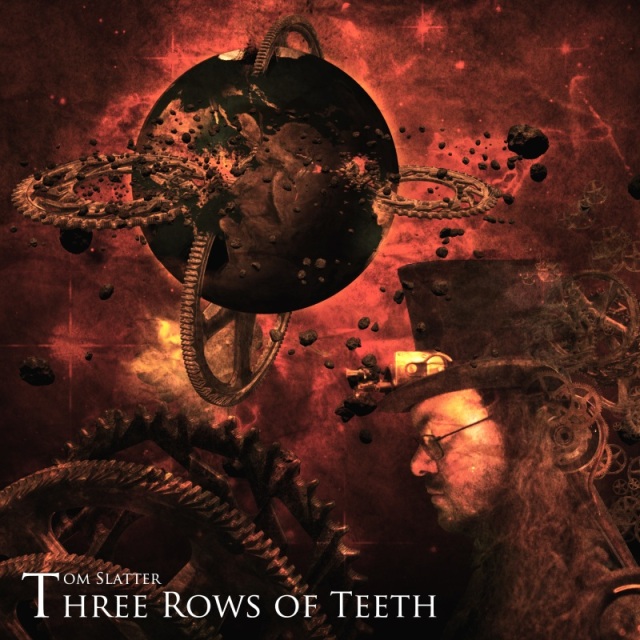
That Englishman is Tom Slatter. But he’s by no means unique. And before I delve into his current album, Three Rows of Teeth in a bit more detail it’s pertinent I think to give what young people term a ‘shout out’ to some other unsung heroes who have refreshed my somewhat jaded palate and who have given me a lot of pleasure musically in recent months.
Sean Dunlop and Jim Radford (These Curious Thoughts) have been making quirky, polished alt/pop prog for a while now and I’d heartily recommend their back catalogue to one and all. Similarly, Johnny Unicorn (of Phideaux fame) made for me one of the albums of the year recently in Sadness and Companionship; as did Chris Wade (Dodson and Fogg). Chris has a new album out, his third in a year. Sounds of Day and Night is I feel a mellower, more introspective record than Derring-Do which has garnered a phenomenal amount of good press and good will in the progressive rock media and has seen wider radio play by DJs rightly mesmerised by his blending of folky and psychedelic elements and his inspired use of guest players. Matt Stevens continues to impress in both his solo guise and as part of instrumental band The Fierce and the Dead whilst John Bassett (KingBathmat) has just released the very excellent Overcoming the Monster, reviewed here on Progarchy and yet another in a long line of excellent albums that for some inexplicable reason seem to have slipped under many people’s radar.
If you haven’t heard of any of these artists I’d strongly recommend you check them out and have a listen to modern progressive rock music in its truest, most honest and open form. Unimpeded by dreams of riches beyond avarice, and corporate jiggery-pokery. Which brings me nicely to Mr Slatter. I have my friend Leo Koperdraat to thank for switching me onto Tom’s music and if ever there was an ‘add to cart’ moment (and I’ve had a few) then this was it. A quick listen on his bandcamp page (http://tomslatter.bandcamp.com/) and I was duly hooked. The glass on the emergency debit card box was duly broken and due to the wonders of Paypal two (count them) shiny discs were promptly dispatched to chez bri. The new one, Three Rows of Teeth, which is reviewed here, and his previous album IronBark.
Tom describes his music on his website, http://www.tomslatter.co.uk/, as “the sort of music you’d get if Genesis started writing songs with Nick Cave after watching too much Dr Who”. And who am I to disagree with him?
He’s from London and his music is inspired by both steampunk and sci-fi genres. Three Rows of Teeth, released in March, is his third solo album and “contains songs about such clichéd subjects as fake spiritualists, murder, time travel, replacing one’s body parts with mechanical alternatives and flying an airship into a cloud full of birds with too many teeth. There is also mention of ravenous church steeples”. So there.
At 44 minutes it’s not a long album by any stretch of the imagination but it is perfectly paced and after my first listen at home on decent kit I hit the replay button straight away. I’ve had it on in the car for a week’s worth of (albeit short) commutes to the train station.
It’s bursting at the seams with the unbridled burlesque mania of The Cardiacs, the eccentricity of Johnny Unicorn, and the tunefulness and melody of These Curious Thoughts. To name just three of my favourite bands. It’s a joyous and endlessly surprising record musically and the lyrical content, touched on above mean that you will give all 44 minutes your unbridled attention. He has quickly become a firm favourite of mine – an autobuy candidate in the parlance of the prog forums. And rumour (i.e. his website) has it that he wore a cape when performing the guitar solos.
Now I love every song but if I had to choose a favourite it would be Dance Dance Dance. I have had difficulty shaking this one from the memory banks recently – it’s an earworm alright and the main vocal refrain is simply sublime. There’s an equally super little guitar solo that’ll have you tapping the steering wheel (if you are in a car, that is) like a thing possessed. However the title ‘favourite song’ is a close run thing since the album concludes with all twenty minutes or so of the three-part Time Traveller Suite. Which is simply immense. It demands to be listened through to in all one go even the three sections are individual tracks on the disc. Track of the year? Perhaps. All I know is the girl with the missing eye has a lot to answer for. It’s cinematic in scope and an absolute triumph. It twists and turns all over the place but remains melodic throughout and is chock full of hooks and delightful little guitar solos. Lyrically it’s packed full of imagery and inventiveness. All the more impressive when you remember this is all the work of one dude.
All I know is that Tom has cornered the market in steampunk sci-fi prog (if sub-genres are your thing) and has proven that modern progressive rock can be truly progressive in terms of movement forwards. I’d heartily recommend this record to one and all and I for one can’t wait to hear the next one.
Oh, and IronBark is staggeringly good too. A tad more acoustic than this one but highly recommended as well. If he’s got any left.
If your interest has been piqued you can find an interview with Tom at:
The album, and his back catalogue can be ordered at his bandcamp page.
 Progarchy
