The Textures of Nosound–Never an Afterthought

afterthoughts640Review: Afterthoughts (2013; Kscope Records).  It can be ordered here.

Listening to a Nosound album (original, live, or compilation–they come in every variety and always possess the very essence of quality itself) is so much more than a moment or an event.  It’s an immersion into something immeasurably deep and wide and beautiful.   It’s a mystery.  It’s liturgy.  It’s possibilities.  It is eternity.

Looking over the reviews of the first three studio albums–Sol29 (2005), Lightdark (2008), and A Sense of Loss (2009)–a few words appear repeatedly and unmistakably.  Ethereal, intelligent, contemplative, flowing, organic, psychedelic, spacey (as in Pink Floyd space rock), progressive, artful, ambient, flowing, melodic, painted, cinematic.

If one had to label the music of Nosound, it might be something like: neo-classical, Hollis-esque, Shoe-gaze prog.  Certainly, the spirit of Mark Hollis lingers over the music of Nosound, but, as with most bands loved and admired by Progarchy, Nosound is its own band, and the sound it creates is its own.

Some have labeled the music of Nosound minimalist, but this is simply false.  While it might have the feel of Philip Glass at times, Nosound is about a wall of sounds as well as about the absence of sounds.  Just as Arvo Part uses amplifiers when necessary to make the music he needs, so does Nosound.  If a synthesizer is called for, a synthesizer is used.  But, if a real stringed instrument is appropriate, the stringed instrument is used.  Everything has its place, and every thing supports every other thing.

Afterthoughts (2013; Kscope)

In less than a week, Kscope will be releasing the fourth studio album from Nosound, Afterthoughts.  When it was first announced, I ordered the three cd-version immediately.  Very graciously, Nosound sent us a promo-advanced copy of Afterthoughts.  I’m not sure how many times I’ve listened to it over the past week and a half.  It is every bit as captivating as the first three albums, and I have thoroughly enjoyed and appreciated and been made better by my immersion in this latest work.  It is a glory, to be sure.

It is certainly Nosound, but it is Nosound plus.

The nine songs of the album are: In My Fears, I Miss the Ground, Two Monkeys, The Anger Song, Encounter, She, Whatever You Are, Paralysed, and Afterthought.

As always, the album ebbs and flows.  Though I grew up on the treeless and waterless plains of Kansas, I imagine the music best represents the ebb and flow of the tide.  Just as with the ocean, one must imagine creatures populating the water well beyond anything we know, and we must imagine the edge of the world just over the horizon.  When reaching it though, one does not fall into nothingness but into everythingness, life itself.

The words flow as beautifully and as meaningfully as the music itself, and the lyrics only take one further into this sacramental reality.  The listener feels the joys, the anguish, and the incomprehensibilities experienced by the lead singer, Giancarlo Erra.

While every song presents and exists in its own form of majesty, the album especially reaches its highest highs in the second half.  From the longings of Encounter (the fifth track), Afterthoughts climbs to ever greater heights, reaching eternity sometime in the middle of the eighth track, Paralysed.

Giancarlo Erra

The mastermind behind the band, Roman Giancarlo Erra, is as intelligent and as talented as he is kind.  An artist in the purest sense, Erra writes for himself, but he never forgets his audience.  Yet, unlike so many in the larger rock and pop world, Erra keeps that sense of traditional relationship between artist and patron (his fans and those who purchase his CDs).  He never–in any way, shape, or form–dumbs down his art, but he remains responsive to his audience, incorporating them joyfully in his own art.

As the greatest of Anglo-American poets, T.S. Eliot, explained at the very end of World War I:

And he is not likely to know what is to to be done unless he lives in what is not merely the present, but the present moment of the past, unless he is conscious, not of what is dead, but of what is already living.

Though 94 years early, Eliot must have been writing about Erra.  Certainly, we can consider Eliot’s voice prophetic.  Erra embraces the moment while never forsaking what he has inherited.  Indeed, Erra willfully and lovingly embraces the past in the present, and the present in the future.  As with Eliot in the greatest work of art of the twentieth century, The Four Quartets, Erra stands in the middle of his art and looks outward.  He observes the world from within the miracle.

Unlike so many those pretentious artists of the last century who often stood aloof from all of those around them, Erra, again, invites all listeners into this world of majesty.  They might not accept his invitation, but the invitation remains, nonetheless.

As I would with Greg Spawton, Matt Stevens, and Robin Armstrong, I would give much to sit down and have a drink with Giancarlo.  It wouldn’t matter if we had a coffee, a beer, or a glass of red wine–the conversation, I assume, would be spectacular and meaningful.  We’d certainly talk about music, but, if I’m judging Erra correctly, we’d talk about everything under the sun and, perhaps, beyond.

Probably, Erra’s work will be remembered someday more as an early 21st century equivalent of Arvo Part and Henryk Gorecki rather than it will be with, say, Marillion or  Oceansize (both bands I love).

Regardless, the work of Nosound is a must-own for any person celebrating this current return of prog music or any real lover of any kind of music.  And, not just Afterhoughts, but every studio album by Nosound.  You can also go beyond the studio albums as well.  Happily, Erra never stops releasing EPs and other assorted good things.  At the Pier, Clouds, The World is Outside, and The Northern Religion of things are well worth owning as well.

And, perhaps most interesting of all is the mixing of Nosound and No-man in what is arguably the finest name ever for a band, Memories of Machines.  Erra’s music has its own place within the current revival of prog, and it’s as important as the music of Big Big Train, Gazpacho, Matt Stevens, The Reasoning, Neal Morse, and a number of other acts Progarchy cherishes.

Thank you, Nosound.  You ably capture the essence of the music of the spheres, and we living in this vale of tears can do nothing but smile and appreciatively wait for more glimpses of all that is eternal.
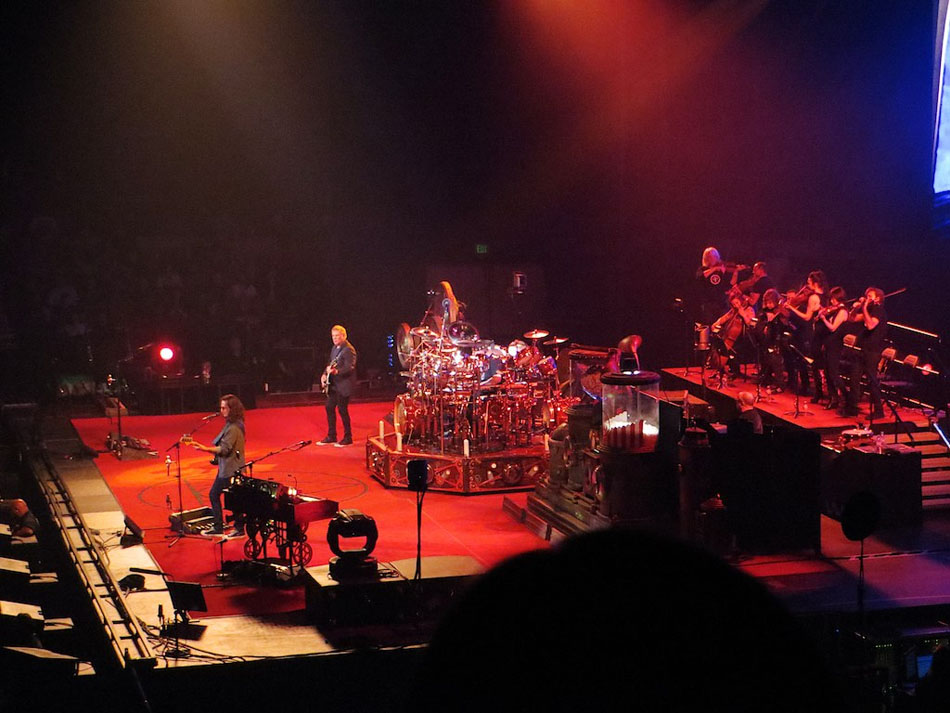
You Can Do a Lot in a Lifetime, If You Don’t Burn Out Too Fast – Rush, April 23, 2013 at the Frank Erwin Center, Austin, Texas

ImageJust one week after a long-overdue induction into the Rock and Roll Hall of Fame, Rush opened the second leg of their ‘Clockwork Angels’ tour – and fortunately for myself and thousands of other Texans, they did it right here in Austin.

For long-time Rush fans, a Rush concert is more than just an event where we see musicians performing their catalog in a live setting.  For us, it is something that gets into us the way dye gets into a shirt and alters its color; something that affects each of us right down to the molecular level.  This show certainly did that for me, more for reasons I will get into below.

The steampunk aesthetic of the stage setup was spectacular.  It was refreshing to see a big visual presentation to accompany the music, which is a rare thing these days.  In contrast to the 70’s, when progressive rock was bigger and had more backing by the record companies, most contemporary prog shows are played in smaller venues without the type of visuals as were present in some of the gargantuan shows of that earlier time (think ‘Yes’ on the ‘Relayer’ tour).  Rush is the rare band from that era that can still play large venues with a corresponding stage set and light show that turns the presentation into more of an event than just a live music performance.

After a long break from the road, the band seemed rested, recharged, and ready to go.  Some of Rush’s typically humorous opening video greeted the audience when the lights went down, featuring the band’s trademarked slightly bizarre humor.  The concert proper then opened with a rousing version of ‘Subdivisions’, followed a number of 80’s works.  In the first set, they did three songs from ‘Power Windows’, including ‘The Big Money’, ‘Grand Designs’, and ‘Territories’, while also managing to squeeze in ‘Limelight’, ‘Force Ten’, and ‘The Analog Kid’.  After the latter tune, the band moved into the 90’s with ‘Bravado’ and ‘Where’s My Thing’ and then into the 00’s with ‘Far Cry’, which closed out the first set.

After a short break, the band returned to the stage, this time with eight additional musicians collectively known as ‘The Clockwork Angels String Ensemble’.  This tour has been the first in which Rush has brought extra musicians on stage, and they were used to good effect here.  The string ensemble filled in some spaces while enhancing others, remaining on stage throughout the performance of ‘Clockwork Angels’ and for several songs afterwards, including a blistering performance of ‘YYZ’, which is captured through a smartphone (not mine) here.

Beginning with another entertaining bizarro-humor video (with Neil, Alex, and Geddy playing dwarfs) the second half of the show kicked off with ‘Caravan’, and followed through with most of the songs from ‘Clockwork Angels’.  Regrettably missing from that list was ‘BU2B’ and ‘Wish Them Well’, the latter being a favorite of mine not only for the music but for the life lesson within the lyrics.  A guitar snafu during ‘The Anarchist’ was a minor hiccup that left Geddy alone without melodic accompaniment for a moment, but Alex and his guitar tech had the presence of mind to quickly swap out instruments.  The performance of ‘Clockwork Angels’ concluded with a spectacular performance of ‘The Garden’, the visuals of video working great with the music here.

After concluding ‘Clockwork Angels’, the band went back into the 80’s again, with ‘Manhattan Project’, a short drum solo, ‘Red Sector A’, and ‘YYZ’.  The string ensemble exited the stage and the band closed out the set with ‘The Spirit of Radio’.  The band returned for an encore including ‘Tom Sawyer’ and ‘2112’ (‘Overture’, ‘The Temples of Syrinx’, and ‘Grand Finale’) before calling it a night for good.

I don’t have much to critique for the show, but I do have to say that the soundman could have done a better job with the mix.  It was very bass-heavy, and this caused a bit of muffling of notes, particularly on a few of Alex’s guitar solos.  But overall, that wasn’t enough to dampen the experience, which was still overwhelmingly positive.

All in all, an outstanding show, played with the energy and intensity that belied their age.

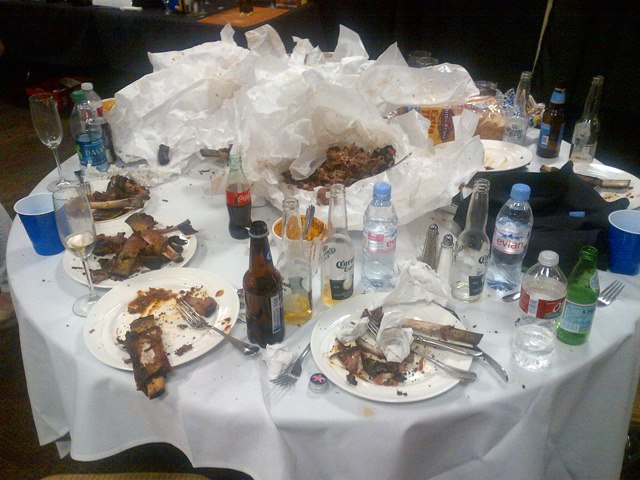
ImageAfterward, according to their Facebook page, Neil, Alex, and Geddy got in touch with their inner cavemen by devouring some Texas barbeque, as shown in the photo.  At this point of the review, you’ll have to excuse me while I go off on a tangent, but there is something in that photo that I think I need to address with the band members.  Geddy, Alex, Neil – I’m glad you enjoyed your barbeque during your most recent visit to the Republic of Texas.  The ribs and brisket are hard to beat.  However, I have to say I am a little disturbed in looking at some of the bottles on the table.  You three are Canadian boys, and therefore have Canadian genes – which means like other great Canadians, such as Bob and Doug McKenzie, you are drinkers of hearty beer.  Thus, seeing several bottles of Corona on the table gives me pause.  Corona is more or less a summertime beer – I could give you a pass on this if the gig was an outdoor gig during the sweltering months of July or August.  But last night was an unseasonably cool April night, and thus I just cannot understand the Corona.  Even more disturbing is what appears to be a bottle of Bud Light on the table.  Perhaps one of you reached for a water bottle and didn’t notice the difference?  Now, in fairness, toward the upper right corner, it does appear that some redemption is present, as I am about 90% confident that’s a bottle of Shiner Blonde.  I’ve compared the portion of the label I can see in the picture to an actual bottle of the same in my refrigerator, and the lack of a bar code on my bottle appears to be the only difference.  I’ll do more research of the label tomorrow night as I watch the NFL draft – just to be sure, you know.  Nevertheless, Shiner Blonde is a beer befitting of your Canadian DNA, guys, so I would recommend you use that to wash down your next Texas barbeque dinner.  Ok, tangent over.

This Rush concert was special in a way that says something both about Rush and their fans alike.  Not only was this my fifth Rush show, but it was the fifth different decade in which I had seen them.  Previously I had seen them in 1979 (Rupp Arena, Lexington, KY, Hemispheres tour), 1984 (Hampton Coliseum, Hampton VA, Grace Under Pressure tour), 1990 (Charlotte Coliseum, Charlotte, NC, Presto tour) and 2007 (Verizon Wireless Amphitheater, San Antonio, TX, Snakes and Arrows tour).  The 70’s, 80’s, 90’s, and 00’s. Now I can add the 10’s.  I’m comfortable in saying that I’m not alone among the Rush fan base, and in fact know there are fans that have seen many, many more shows than I have, and moreover, within the same five decades.  There are not many bands out there that one can say the same about.  There are even fewer (if any bands) that one can say that about while also saying that it was with the same lineup each time.  That’s a testimony to their longevity, as well as to the loyalty of the fans that have stuck with them all of these years.  As many of you will recognize, the title of this piece is drawn from the lyrics of ‘Marathon’ off of the ‘Power Windows’ album.  And those words, written by their philosopher-drummer nearly 30 years ago, appear to be even more true now than when that album was released.  Rush, despite some serious ups and downs, has persevered and continued to make great music far beyond the time when most bands lose their creative edge.  And fans like myself and countless others, we’ve lived our lives and had our own ups and downs for all of these years, and yet we kept coming back, keep buying the albums, and keep going to the concerts because we appreciate the excellence, the professionalism, the creativity, and the wisdom inherent in the lyrics. That neither Rush nor their fans have burned out, that both have shown the endurance to stick with one another throughout the decades only proves the wisdom of the lyrics from which this review draws its title.

Thanks, guys.  Not just for last night’s show. But for everything over all of these years.

Oblivion Sun

Have progarchists heard of Oblivion Sun? This is a project by two of the founder members of Happy The Man. A tip-off from Twitter pal Chris McGarel (@WhiteRhinoTea) led me to check out their latest album The High Places, and it really is quite splendid: modern in sound but with nods to bands like Genesis. Much love has been expressed for Big Big Train in this blog, and I’ll wager that devotees of that band will feel very comfortable with Oblivion Sun.

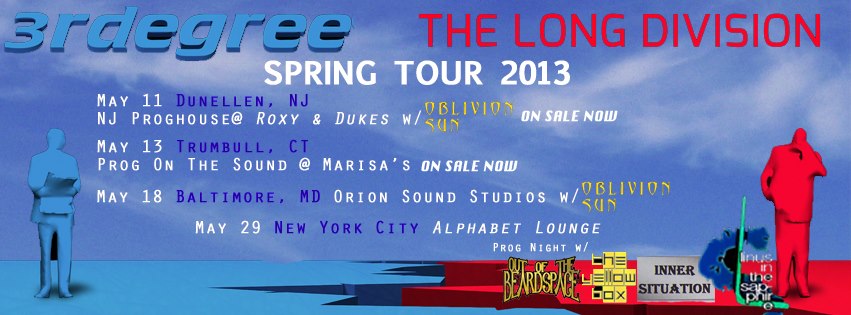
Live performances are very much on the agenda, although gigs planned for May in New Jersey and Baltimore have had to be cancelled following an injury to keyboard player Frank Wyatt. Hopefully, he’ll recover soon and they can resume touring. I’ll certainly be first in line to see them if their plans to tour Europe in 2014 come to fruition.

Vinyl Worship

big_big_train_-_the_big_difference_machine

Jason Notte reflects in “Where Music Gets Physical: A Boston Memoir“:

As much as music listeners dig cloud-based music and having their MP3s and channels follow them wherever they go, there’s still a desire for the physical, the ownable, the “real.” CDs don’t fit that mold anymore, as the digital files on them exist in far better form in far more accessible places. …

Vinyl, however, makes the argument for music as a religious artifact — an idol worthy of worshipping, rather than a ubiquitous score for life’s most mundane tasks. Putting music everywhere makes it permanent Muzak and makes quality an unnecessary luxury. …

With vinyl, it’s artists themselves that get the place on the pedestal. Buying records, like creating a library of books, isn’t just about entertainment or passing time. It’s about amassing knowledge and culture and putting them on display. Much as a bibliophile might reserve prime shelf space for classics or Pulitzer and Nobel winners, a record buyer reserves vinyl purchases for works of artistic, esoteric or sentimental value.

Tull Under The Microscope

In October, Indiana University Press will publish a dissertation by Tim Smolko, entitled Jethro Tull’s Thick as a Brick and A Passion Play: Inside Two Long Songs. Apparently, Smolko “discusses the band’s influence on popular culture and why many consider Thick as a Brick and A Passion Play to be two of the greatest concept albums in rock history.”

Sounds interesting. Any Progarchists up for reviewing it?

Mini-Review: The Pineapple Thief’s 137

Continuing its series of top-quality reissues of The Pineapple Thief’s back catalog, Kscope Music has just released their sophomore effort, One Three Seven. It’s a surprisingly mature and accomplished set of songs. Bruce Soord’s vocals are reminiscent of Thom Yorke’s, but distinctive enough to not be derivative. The first track, “Lay On The Tracks” and the sixth, “Ster”, are among the poppiest songs he’s ever written. “Perpetual Night Shift” features a laconic melody with a droning bass line. I like it a lot. “Kid Chameleon” was included on the 2009 compilation 3000 Days, and it is outstanding. In it, Soord channels David Gilmour for an exquisite guitar solo that perfectly complements a memorable song. “Release the Tether” is an instrumental raveup that is relentless in its drive.

There isn’t a single clunker among the thirteen tracks, but the highlight is the nearly twelve-minute track, “pvs”, which begins with a beautiful acoustic setting, transforms into Led Zep heaviness, and ends with a classically styled piano/cello/guitar coda.

Originally performed, recorded, and mixed by Soord between June 2000 and March 2001, 137 is fascinating to listen to as a document of him developing his minimalist technique of composition. My initial impression is one of immediacy – Soord is a man with something to prove, and he isn’t afraid to get in your face, both musically and lyrically. The album features some of his most aggressive guitar work, along with lyrics like this:

it’s taking a while he said

keep shouting at the wall

never get out, he said

unless you take the fall

taking too long, i said

i cannot climb this wall

it’s taking too long, i said

watch me as i fall….

If you’ve not heard The Pineapple Thief, 137 is an excellent entry point. It nicely balances Bruce Soord’s deft pop touch with his heavier side. Having a length of more than 70 minutes, this is a lot of music to absorb, but it never drags. And hey, you have to admire a band that uses a Fermat spiral for the cover art!

No sleep until Kingston: it’s time to Celebr8.2.

No sleep until Kingston: it's time to Celebr8.2..

Farewell, Porcupine Tree?

Prog Magazine has just reported that Steven Wilson is putting Porcupine Tree on hold.

Here’s Wilson as quoted by Something Else!,

“I think it’s slightly more complex with Porcupine Tree, which can’t really happen without me instigating it and being the main writer and director of that situation — so, that’s more problematic,” Wilson added. “I don’t have time in my life to do that, and what I’m doing now. So, I guess I have made the decision, right now, to concentrate on the solo career. But that’s not to say that the band has broken up or anything like that. It’s always conceivable that we could get back together in a year or five years, or 10 years. I really can’t say. There are no plans at the moment.”