The Big Big Tangent

Subtitle: “Or, How Plato Made Me Realize We Need to Love 2013.  And, If We Don’t, Why We’re Idiots.”

A week or so ago, I had the opportunity to list my top 9 of 11 albums of the past 11 months.  Several other progarchists have as well, and I’ve thoroughly enjoyed looking at their lists as well as reading the reasons why the lists are what they are.  I really, really like the other progarchists.  And, of course, I’d be a fool not to.  Amazing writers and thinkers and critics, all.
Another page from the booklet.  Courtesy of the band and the artist, Matt Sefton.
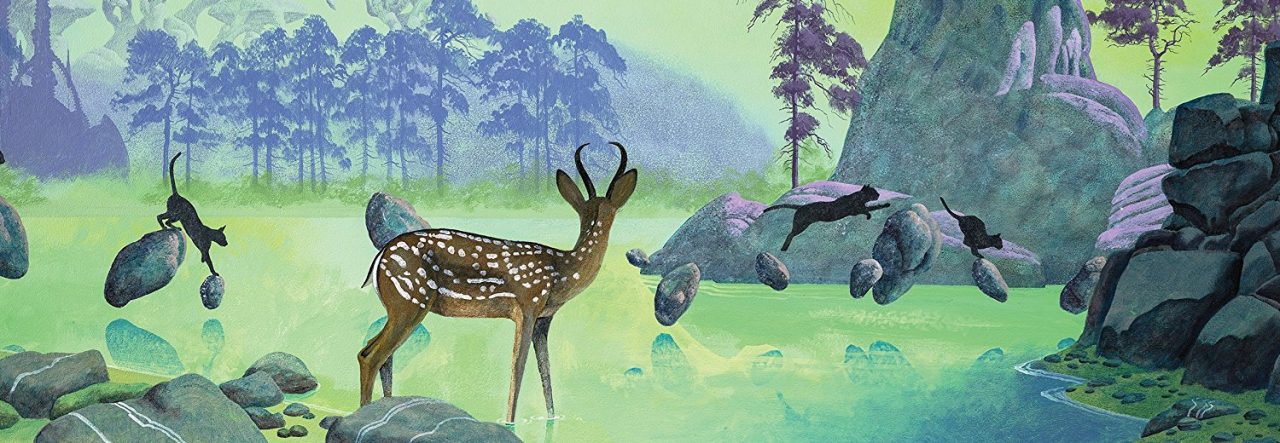
From the 96-page BBTFP booklet. Courtesy of the band and the artist, Matt Sefton.

I’ve been a bit surprised, frankly, that there hasn’t been more overlap in the lists.  I don’t mean this in the sense that I expect conformity.  Far from it.  We took the name progarchists—complete with the angry and brazen red anarchy sign in the middle—for a reason.  We’re a free community—free speech, free minds, free citizenship, and free souls.  We have no NSA, CIA, or IRS.  Nor would we ever want any of these.  And, we’ve really no formal rules.  We just want to write as well as we can about what we love as much as we love.  Any contributor to progarchy is free to post as often or as infrequently as so desired, and the same is true with the length of each post.

I, as well as many others, regard 2013 as the best year of prog in a very, very long time, perhaps the best year ever.  I know that some (well, one in particular—a novelist, an Englishman, and a software developer/code guy; but why name names!) might think this is hyperbole.  But, having listened to prog and music associated with prog for almost four decades of my four and one-half decades of life, I think I might be entitled to a little meta-ness.  And, maybe to a bit of hyperbole.  But, no, I actually believe it.  This has been the best year in the history of prog.  This doesn’t mean that 2012 wasn’t astounding or that 1972 was less astounding than it actually was.  Being a historian and somewhat taken with the idea of tradition, continuity, and change, I can’t but help recognize that the greatness of 2013 could never have existed without the greatness of, say, 1972, 1973, 1988, or 1994.

In my previous posts regarding 2013, I thanked a number of folks, praised a number of folks, and listed some amazing, astounding, music—all of which, I’m sure I will continue to listen to for year to come, the good Lord willing.  And, I’m sure in five years, a release such as Desolation Rose might take on new meaning.  Perhaps it will be the end of an era for Swedish prog or, even, the beginning of an era for the Flower Kings.  Time will tell.

So, what a blessing it has been to listen to such fine music.  My nine of 11 included, in no order, Cosmograf, The Flower Kings, Ayreon, Leah, Kingbathmat, The Fierce and the Dead, Fractal Mirror, Days Between Stations, and Nosound.

The cover of the new Sam Healy solo album, SAND.

And, there’s still so much to think about for 2013.  What about Sam Healy (SAND), Mike Kershaw, Haken, Francisco Rafert, Ollocs,and Sky Architects?  Brilliant overload, and I very much look forward to the immersion that awaits.

No one will be shocked by my final 2 of the 11 that have yet to be mentioned.  If you’ve looked at all at progarchy, you know that I can’t say negative things about either of these bands . . . or of Rush or of Talk Talk.  Granted, I’m smitten.  But, I hope you’ll agree that I’m smitten for some very specific and justified reasons.  That is, please don’t dismiss the following, just because I’ve praised them beyond what any reasonable Stoic with any real self respect would expect.  No restraint with these two, however.  Admittedly.

So, let me make my huge, huge claim.  The following two releases are not just great for 2013, they are all-time great, great for prog, great for rock, great for music.  In his under appreciated book, NOT AS GOOD AS THE BOOK, Andy Tillison offers a very interesting take on the current movement (3rd wave) of progressive rock.

The current, or third wave of new progressive rock bands is as interesting for demographic and social reasons as much as for its music . . . . Suddenly a wave of people in their late thirties began to form progressive rock bands, which in itself is interesting because new bands are formed by younger people. . . .

I’m not sure how much I agree with Andy regarding this.  I’m also not sure I disagree.  I just know that I’ve always judged eras or periods by what releases seem to have best represented those eras.  Highly subjective, highly personal, and highly confessional, I admit.  But, I can’t escape it.  For me, there have been roughly four periods: the period around Close to the Edge and Selling England by the Pound; the period around The Colour of Spring, Spirit of Eden, and Laughing Stock; a little bit longer—or more stretched out—period around Brave, The Light, Space Revolver; and Lex Rex.

Of course, I’ve only listed three.  We’re passing through the fourth as I type this.  Indeed, the fourth is coming from my speakers as I type this.  Over the last year and a half some extraordinary (I’m trying to use this word in its purest sense) things have happened, all in England and around, apparently, some kind of conflicted twins.

When asked about why he participated in latest release from The Tangent, Big Big Train’s singer, David Longdon, replied:

Amusingly, [Tillison] has said that The Tangent is Big Big Train’s evil twin.

In this annus mirabilis, does this mean we have to choose the good and the evil?  Plato (sorry; I’m not trying to be pretentious, but I did just finish my 15th year of teaching western civilization to first-year college students.  And, I like Plato.) helped define the virtue of prudence: the ability to discern good from evil.

Well, thank the Celestial King of the Platonic Realm of the Eternal Good, True, and Beautiful, we get both, and we don’t have to feel guilty or go to Confession.

Progarchy Best All-Around Progger, 2013, Brit: Sally Collyer.

Aside from being the Cain and Abel of prog, The Tangent and Big Big Train offer the overall music world three vital things and always in abundance of quality.

First, each group is smart, intelligent, and insightful.  Neither group panders.  The music is fresh, the lyrics insightful—every aspect is full of mystery and awe.  The listener comes away dazzled, intrigued, curious, and satisfied, all at the same time.

Second, each group strives for excellence in every aspect of the release—from the writing, to the performing, to the engineering, to the mastering, to the packaging.  And, equally important, to interaction with fans.  Who doesn’t expect an encouraging word and some interesting insight on art, history, and politics—always with integrity—from either band?

MARTIN STEPHEN COVER PICAs maybe point 2.5 or, at least, the culmination of the first two points, each band has the confidence to embrace the label of prog and to embrace the inheritance it entails without being encumbered by it.

In Big Big Train’s English Electric Full Power, there are hints of Genesis and, equally, hints of The Colour of Spring and Spirit of Eden.  But, of course, in the end, it’s always Greg, Andy, David, Dave, Danny, Nick, and Rob.

In The Tangent’s Le Sacre du Travail, there are obvious references as well as hints to Moving Pictures, The Sound of Music, and The Final Cut.  But, of course, in the end, it’s always mostly Andy.
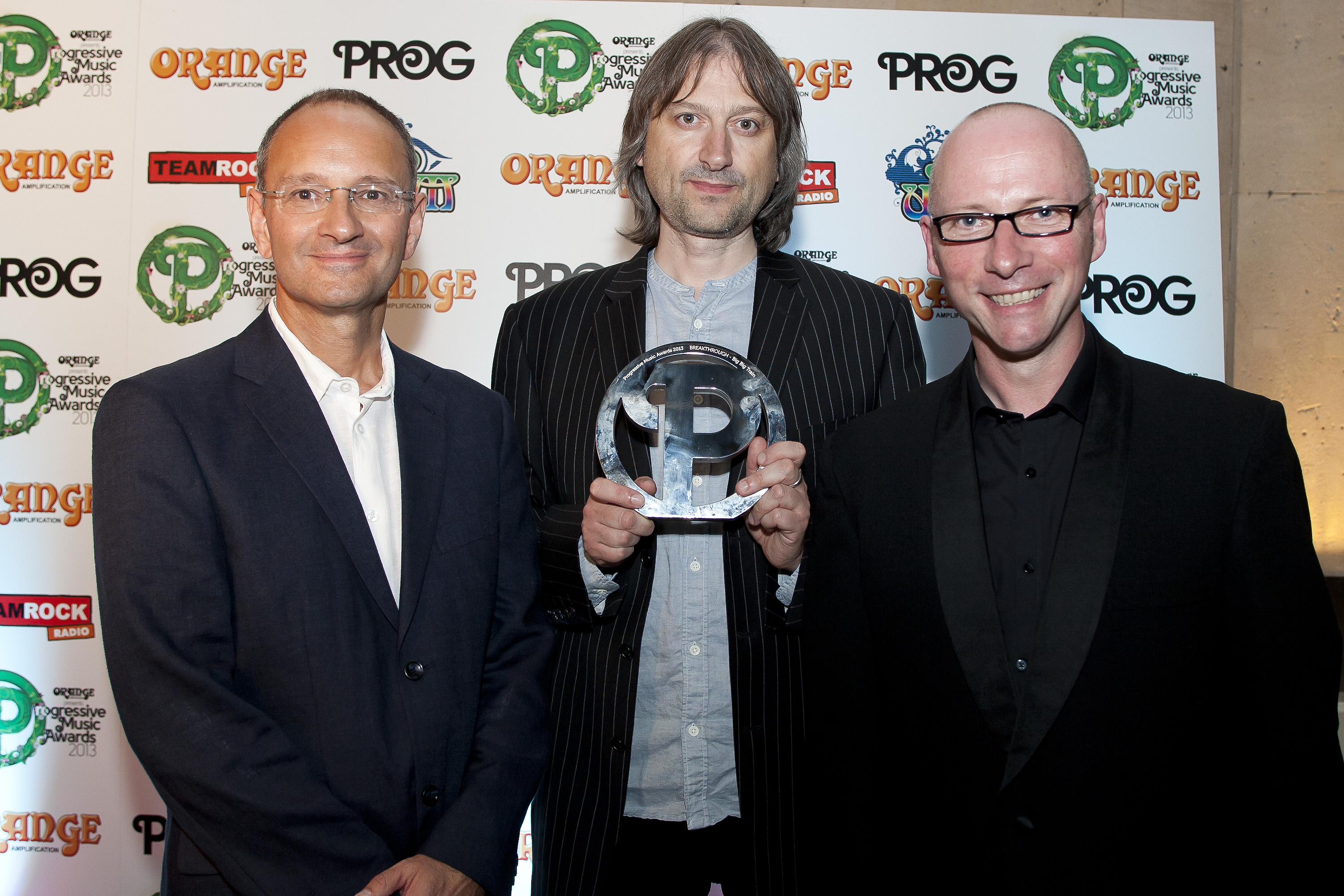
Big Big Train's justly deserve award, "Breakthrough Artist of 2013," by Jerry Ewing and the readers of PROG.
Big Big Train’s justly deserve award, “Breakthrough Artist of 2013,” by Jerry Ewing and the readers of PROG.

Regardless, each gives us what David Elliott masterfully calls “Bloody Prog™” and does so without hesitation.  Indeed, each offers it without embarrassment or diversion, but with solidity of soul and mind.

Finally, but intimately related to the first two, each band releases things not with the expectation of conformity or uniformity or propaganda, but with full-blown art.  Each band loves the art for the sake of the art, while never failing to recognize that art must have a context and an audience.  Not to pander to, of course, but to meet, to leaven.

Life is simply too short not to praise where praise is due.  Life is too short to ignore the beauty in front of us.  And, no matter how dreary this world of insanities, of blood thirsty ideologies, of vague nihilisms, and of corporate cronyism, let us—with Plato—love what we ought to love.

The Tangent and Big Big Train have given us art not just for the immediate consumption of it, or for the year, 2013,—but for a generation and, if so worthy, for several generations, perhaps uncounted because uncountable.


[Ed. note–if there are any typos in this post, I apologize.  I’ve been grading finals, and I’ve been holding my two-year old daughter on my lap.  She’s a bit more into Barney than Tillison or Spawton at this point.]

Video: Andy Tillison Downloads

Available at thetangent.org.

In a Spirit of Gratitude: Andy Tillison offers even more. . . .

andy PO90

***

Andy writes the following at Facebook (here’s hoping he doesn’t mind me reposting here. . . .)

Pleased to announce number 2 in our Tangent Historical Artefacts Download Series. This time it’s a Po90 album – the very first one recorded in 1994-6. Apart from 30 home burned copies sold via the newly discovered “Information Super Highway” the album was subsequently released for a 500 copy limited run by Cyclops records AFTER the release of our Second album (Afterlifecycle). Like Porcupine Tree of the first couple of albums, Po90 was largely just one person.. in this case me. The album always included a 20 minute long BONUS track from the last days of GFDD which is the second version of the song “A Gap In The Night”. A Third version appeared on the Tangent’s album “The World We Drive Through”. This second version includes contributions from Guy Manning and Hugh Banton (VDGG) who recorded some organ for it (well actually there’s a story there.. he recorded it for ANOTHER song that we incorporated into this one) during rehearsals for a gig in Peterborough in the early 90s.

The album also includes a recording of the track we claim to have been the First Mp3 promotional file available for net download – “The Third Person”. The album is lyrical, very Tangent related and highly seminal to the rest of the dynasty’s output.

For the first time we’ve published a full set of lyrics with this album, the original 4 page cover plus all the new lyrics are included as a PDF virtual CD booklet and there’s a tray jpg if you wanna make the thing up. I’ve annotated the songs and written acouple of pages giving more info about the album. Hope some of you will go and see where what I’ve always seen as Chapter TWO started…

All funds we get from this are being ploughed into future projects (which includes tonight’s tea  ) and I hope those of you who get it enjoy it. Hint… Put the PDF onto a tablet/pad/phoney thing and browse it with the album! A nostalgic look back at the early days of the Third Wave…. And of course you get it at www.thetangent.org

Prog News on this Day of Thor!

TA Kaleidoscope
TA announced their studio album today, to be released on January 27, 2014.


tangent dowloads
And, that impish genius, Mr. Diskdrive, announced a series of rolling back catalogue releases, available only through http://www.thetangent.org. Some folks like to call Steven Wilson, “Mr. Prog.”  For me, that title goes to Mr. Diskdrive.  I’m listening to the first, FOG, as I type this. A nice glimpse of the beyond. . . .

Supper’s Off?

Almost a couple of months ago, Brad wrote about L’Étagère Du Travail, the long-awaited companion disc to the wonderful Le Sacre Du Travail. With uncharacteristic restraint, I chose not to listen to the proffered download of this, preferring to wait instead for my physical CD. But it finally arrived last week – hence these words.

I won’t attempt to duplicate Brad’s eloquent review, but I thought his favourite track, Supper’s Off, deserved some deeper analysis, since it struck me also as a particularly noteworthy piece.

I’ll say right up front that I regard Andy Tillison as a major figure in prog, not just because of the sublime music that he creates, but because he has something important to say, too. In a genre where oblique lyrics and obscure concepts are considered almost a virtue in some quarters, his style is admirably direct and unusually relevant. Le Sacre‘s critique of the rat race certainly put one or two noses out of joint, and the pointed observations he makes here may have a similar effect.

Critics will no doubt latch on to the Genesis reference in the track’s title, as well as the lyric

We tried to change the world
But the world won’t take the hint.
They go running off back to Genesis,
and all the other bands are skint.

But this is not a dig at Genesis fans in particular. Tillison writes in the sleeve notes that “Genesis were great. I don’t mean to offend either them or their fans. Just the non-inquisitive attitude of people who will never listen to the myriad of bands who offer an equally adventurous experience to their heroes of the 1970s and who don’t necessarily have blood line with them.”

Other lyrics, spoken over the music, deliver the crux of his argument with laser-like precision:

And of the thousands of people who watched Yes at QPR in 76, only a few hundred will turn up to watch their descendants on a whole tour.

Yet if The Who were to plan some kind of comeback, they’d sell tickets for 90 quid to hundreds of thousands of people my age all over the world, who’ll turn up in posh cars and 4x4s, because I am talking about my generation…

There are some important and interesting questions at the root of all this. Is it not true that people retain a great fondness for the music they fell in love with during their formative years? And if this is the case, why don’t they make the connection to contemporary artists doing the same kind of thing? Do people form allegiances to bands rather than to styles of music? Do they prefer nostalgia to the joy of discovering new music? I could go on…

Those who would rush to condemn Tillison for his abrasiveness should think first about how difficult it is to make music for a niche audience these days. The digital revolution has been a double-edged sword, democratising production whilst simultaneously devaluing the product in the eyes of the general public. David Byrne argued cogently in UK newspaper The Guardian recently about the particular threat to creativity posed by streaming, for example.

I’ve never heard a prog artist put money up at the top of their agenda, but there’s no denying that artists need some kind of income from their music if they are to continue as artists. Besides the fact that it is a deserved reward for an artist’s efforts, money buys them time and space, the freedom to make good art – and we all benefit as a result.

So here’s my plea (I guess I’m preaching to the converted here, but what the hell):

By all means, go see the rock legends in the big arenas, but don’t forget about the little guys. Buy their albums. Go see them if they are playing anywhere near your home town, however pokey the venue is. And if you have to choose between tickets for a comeback tour by dinosaurs looking to put an extra couple of Ferraris in the garage or for a band still writing exciting new music whilst trying to make ends meet… Well, you know what the right thing to do is!

Perfecting Perfection: Big Big Train’s English Electric Full Power

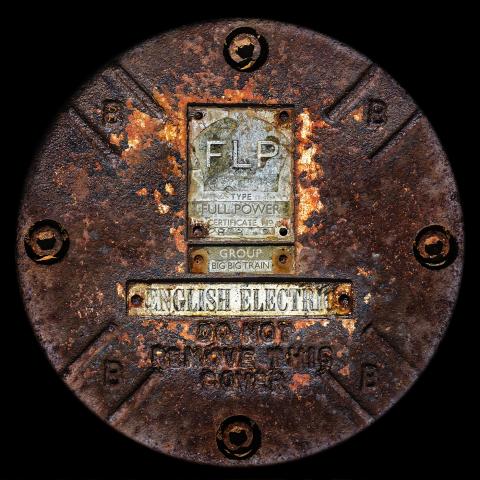
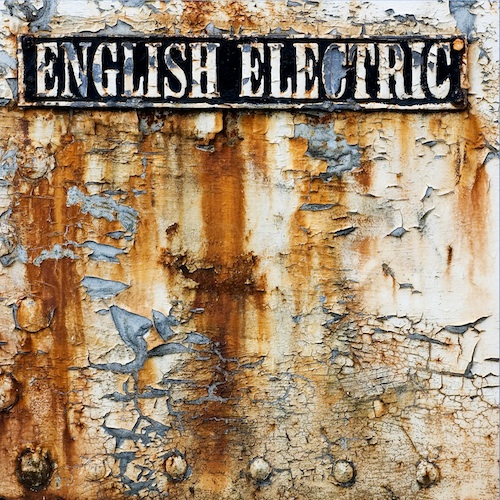
English Electric Full Power, September 2013

Set in stone.  Chiseled, carved, done.  Or, at the very least, set in digital stone.

For the ever-growing number of Big Big Train devotees (now, called “Passengers” at the official Facebook BBT page, administered by everyone’s most huggable rugged handsome non-axe wielding, non-berserker Viking, Tobbe Janson), questions have been raised and discussed as to how BBT might successfully combine and meld English Electric 1 with 2 plus add 4 new songs.

How would they do it with what they’re calling English Electric Full Power?  Would they make it all more of a story?  Would the album become a full-blown concept with this final version?  Where might Uncle Jack, his dog, or the curator stand at the end of the album?  Actually, where do they stand in eternity?

The members of BBT have already stated that EE as a whole calls to mind–at least with a minimum of interpretation–the dignity of labor.  Would the new ordering and the four new songs augment or detract from this noble theme?

Somewhat presumptuously, many of us Passengers proposed what we believed should be the track order, and I even took it upon myself to email Greg last spring with a list.  Well, I am from Kansas, and we’re not known for being timid–look at that freak, Carrie Nation, who dedicated her life to hacking kegs and stills to bits, or to that well-intentioned but dehumanizing terrorist, John Brown, who cut the heads off of unsuspecting German immigrants.

And, then, there’s the fact, for those who know me, that I can produce track lists like I can produce kids.  No planning and lots and lots of results.

Or, that other pesky fact, that I’m so far into BBT that I could never even pretend objectivity.  [Or, as one angry young man wrote to me after I praised The Tangent, “your head is so far up Andy’s @ss, you can’t even see sunlight.”  Cool!; who wants to spend tons of time writing and thinking about things one doesn’t like?  Not me!  As Plato said, love what you love and hate what you hate, and be willing to state both.  Guess what?  I love BBT and The Tangent!  And, just for the record, I’ve never even met Andy in person, so what was suggested is simply physically impossible.]

Admittedly, maybe I’m such such a fanboy that I’ve gone past subjective and into some kind of bizarre objectivity.  You know, in the way Coleridge was so heretical that he approached orthodoxy.   Or, maybe I’m just hoping that Greg and Co. will ask me to write the retrospective liner notes for the 20th anniversary release of EE Full Power.  I’ll only be 66 then.  Who knows?  Even if I’m in the happy hunting grounds (I’m REALLY presuming now), I could ask the leader for some earth time. . . .

If you’ve read my bloviations this far, and you’re still interested in my thoughts on English Electric Full Volume, well, God bless you.  A real editor would have removed the above rather quickly.

The members of Big Big Train with Dutch photographer, Willem Klopper.

Back from the Blessed Isles of soulful prog realms. . . .

In my reviews of English Electric 1 and 2, I stated that these albums were the height of prog music perfection, the Selling England By the Pound of our day.  I wouldn’t hesitate to proclaim this again and, perhaps, even more vocally and with more descriptives.

At the risk of turning off some of my friends, I would say that EEFP is even superior to its 1973 counterpart.  How could it not be, really?  Selling England is now an intimate and vital part of the prog and the rock music traditions, and it has been for forty years.  Add that album and hundreds of others to the integrity, dedication,and purposeful intelligence, imagination, and talents of Greg Spawton, David Longdon, Andy Poole, Dave Gregory, Nick d’Virgilio, Danny Manners, and Rob Aubrey.   Putting all of this together, well, of course, you’d demand genius.

You’d expect genius.

And, you’d be correct.

It’s the height of justice that Jerry Ewing of PROG awarded Big Big Train with the Prog Magazine Breakthrough Award.

That breakthrough started with that meaningful paean to British and western patriotism in Gathering Speed, reached toward sublime spheres in The Difference Machine, found a form of edenic Edenic perfection in The Underfall Yard and Far Skies (it’s hard for me to separate these two albums for some reason), and then embraced transcendent perfection in English Electric 1 and 2.  Each member who has joined the original Greg and Andy has only added to the latest albums.  Nick, the perfectionist drummer; Dave, the perfectionist guitarist; Danny, the perfectionist keyboardist; Rob, the audiophile.  And by perfectionist, I don’t mean it in its modern usage, as without flaw, but rather as each having reached his purpose.

I don’t think this point can be stressed enough: these guys are perfectionist NOT against each other but with, around, near, above, and below each other.  They are a unit of playful perfectionist individuals who become MORE individual, not less, in their community.

Looking at the history of art from even a quasi-detached and objective viewpoint, I think we all have to admit, this is more than a bit unusual.

Breakthrough, indeed, Mr. Ewing.  Breakthrough, indeed.

Greg and Andy don’t become less Greg and Andy as the band grows beyond what they have founded, they become more Greg and more Andy.  In the first and second wave of prog, how many bands are known for only getting better and better with each album?  Those that did are certainly the exceptions.  One of the most important differences of this third wave of prog is that the best only get better, even after twenty years of playing.  Exhaustion and writers-block seem to be of another era.

BBT exemplifies this trend of improvement in this movement we now call the third wave of prog.  And, not surprisingly, when BBT asks artists to guest with them, they invite those with similar trajectories–Andy Tillison and Robin Armstrong to name the most obvious.

David Longdon.  Photo by the Willem Klopper.
David Longdon. Photo by the Willem Klopper.

Longdon

Again, if you’ve made it this far in this review, you should be asking–hey, Birzer left out David Longdon above, what the schnikees?

Yes, I did.  So, let me now praise famous Davids (with apologies to Sirach). I’ve not been shy in past writings (well, over the last four years) to note that I believe David is the finest singer in the rock world at the moment.  He has some rather stiff competition, of course, and I reject the notion that he sounds just like “Phil Collins.”

No, David is his own man and his own singer. I do love and appreciate the quality of David’s tone and voice.  He possesses a beautiful and talented natural one, to be sure.  Nature or God (pick your theology) gave this to David in abundance, and he’s used his own drive and tenacity to bring his voice to the height of his profession.

But, what I love most about David is that he means every single thing he sings.  These aren’t “Yeah, baby, let’s do it” lyrics.  These are the lyrics of a bard (Greg’s lyrics are just as excellent, of course, as I’ve noted in a number of other articles; these are two of my favorite lyricists of the rock era–rivaling even Mark Hollis).

Longdon can make me as happy as one of my kids running to the playground on the first day the snow thaws (“Let’s Make Some Noise”); he can make me want to beat the living snot out of a child abuser (“ABoy in Darkness”); and he can make me want to start a novena for a butterfly curator.

In no small part, Longdon has a voice that makes me want to trust and follow him.

Put David and Greg together, and their lyrical abilities really knows no known bounds.  They are the best writing team, to me, in the last fifty years.  I know most would pick Lennon/McCartney, but I’m a firm believer that “electrical storms moving out to sea” trump “I am the walrus.”

Master of many things, Greg Mark Aurelius Spawton.  Photo by Willem Klopper.
Master of many things, Greg Mark Aurelius Spawton. Photo by Willem Klopper.

EEFP

So, what about this third manifestation of English Electric, English Electric Full Power?  Well, all I can state with some paradoxical certainty, Spawton, Longdon, and five others, have now shown it is possible to perfect perfection. I’ll use perfect here in its proper sense: not as without flaw (though that would apply as well) but as having reached its ultimate purpose, as I noted above.

EEFP is still very much about the dignity of labor, and, as such, it has to deal with the dignity of the laborer, that is, the fundamental character of the human person in all of his or her stages.

The song order of EEFP, consequently, follows this natural logic.

The opening track, a new one penned by Longdon, celebrates the joys of innocence. David has said it was his goal to invoke the glam rock of his childhood.  For me, it invokes the rock of my mother’s college days.  A shimmering, pre-Rolling Stones rock.

The video that the band released just makes me smile every time I watch it.  The video also confirms my belief that these six (and Rob, the seventh member) really, really like each other.

Rather gloriously, “Make Some Noise” fades into one of the heroic of BBT tracks, “The First Rebreather.”  This makes “The First Rebreather” even better, especially when contrasted with the innocence of track one.  After all, in The First Rebreather, the hero encounters beings from Dante’s Fifth Circle of Hell (wrath).

The second new song, “Seen Better Days,” begins with a strong post-rock (read: Colour of Spring) feel, before breaking into a gorgeous jazz (more Brubeck than Davis) rock song.  All of the instruments blend together rather intimately, and David sings about the founders and maintainers of early to mid 20th century British laboring towns, while lamenting the lost “power and the glory” as that old world as faded almost beyond memory.  The interplay of the piano and flute is especially effective.

The third track, “Edgelands,” begins immediately upon the end of “Seen Better Days,” but it’s short.  Only 86 seconds long and purely a Manner’s piano tune, it connects “Seen Better Days” with “Summoned by the Bells.”  If at the end of those 86 seconds the listener doesn’t realize the creative talents of Mr. Manners, he’s not thinking correctly.

The fourth new track, “The Lovers,” appears on disk two, after “Winchester” and before “Leopards.” The most traditionally romantic and folkish song of the four new ones, Longdon’s voice has a very “Canterbury” feel on this tune, and the tune provides a number of surprises in the various directions it takes.

English Electric

What’s next for BBT?

Thanks to the delights of social networking, we know that Danny’s kids are concerned that he doesn’t look “rock” enough (he needs to show them some Peter Gabriel videos from Gabriel’s last studio album), and we know that Greg’s middle name is Mark.

Ok, yes, I’m being silly (though all of the above is true).

We do know that Big Big Train is working on a retrospective of their history, but with the current lineup.  I don’t think any of us need worry that this (Station Masters) will be some kind of EMI Picasso-esque  deconstruction of Talk Talk with a “History Revisited: The Remixes.”  Station Masters will be as tasteful, elegant, and becoming as we would expect from Greg and Co.

After that, we know that BBT is writing a full-fledged concept album, their first since The Difference Machine.  We know that the boys are in the studio at the very moment that I’m typing this (NDV included).

Perhaps most importantly, though, we trust and have faith that Greg and Co. are leading progressive rock in every way, shape, or form.  EEFP is the final version of EE.  At least for now.  But, BBT is not just breaking through, it’s bringing a vast audience, sensibility, and leadership to the entire third movement of prog.  And, for this, I give thanks.  Immense thanks.

When it comes to BBT, perfection only gets more interesting.

***

To order English Electric Full Power, click here.

Ransom-ed Prog: Glass Hammer

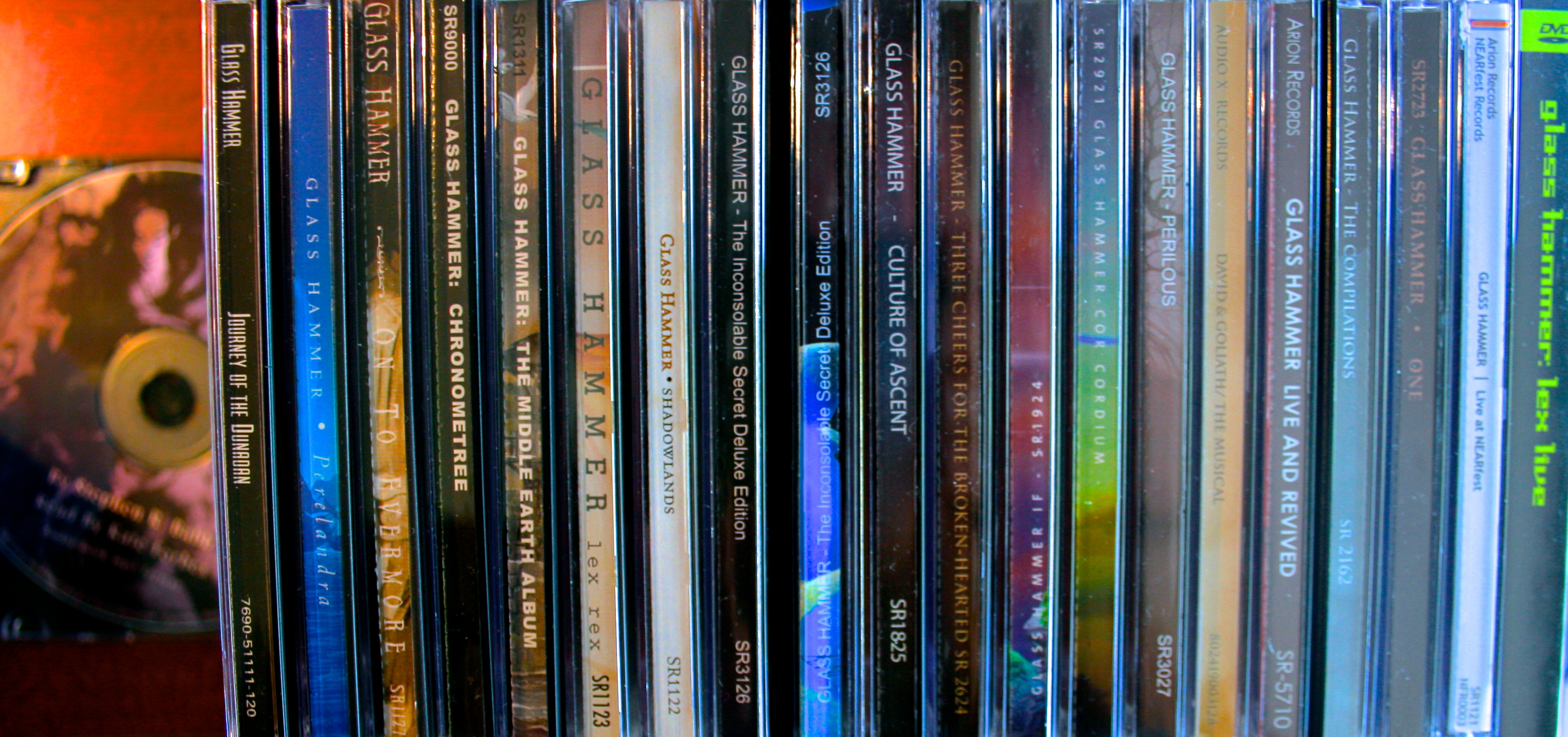
Glass Hammer-Birzer Collection
Progarchist Birzer doesn’t like doing ANY thing half way–his love for GH is tangible. He also owns the t-shirt.

Feel free to call me a “Glass Hammer Junkie.”  Steve and Fred might not approve, but it is the truth.  Ever since my great friend, Amy Sturgis, introduced me to their music, days or so before LEX REX appeared in 2002, I’ve been hooked.  As you can see by the accompanying photograph, I’m pretty much a completist as well.  After all, why like anything halfway?  Besides, Glass Hammer isn’t a “half-way” kind of love.  You either love them completely, or you don’t know them.

Some reviewers have–in an almost obligatory way–compared their music to that produced during the first decade of Yes.  As Babb has joked, GH admires Jon Anderson and Yes deeply, but he’s merely acknowledging the debt in his own music, not mimicking it.  And, frankly, from my perspective, GH has much more of a “Leftoverature” feel than a Yes one.  Regardless, Babb and Schendel are artists, pure and simple, indebted and original all at once.

There is so much I could write about GH, a book really.  But, for now, let me state that there will be more much about GH at progarchy, as well as an extensive analysis and history of the band over at Carl Olson’s brilliant, Catholic World Report.  Additionally, we’ll have a long interview with GH co-founder, Steve Babb.

As many of you know, I’m not a huge fan of labels, as they tend to narrow the beauty of a thing.  If you forced me to label Glass Hammer’s music, though, I’d probably claim it as “Ransom Prog,” the kind of music Elwin Ransom would’ve written while on Malacandra.  For one (or three, really) of the things to love about GH is the “voice” of the band.  And, I don’t mean the vocalists.  There are lots of vocalists for GH, and there have been since the band’s beginning, the release of their first cd back in 1993, twenty years ago.  There quite good.  I’m especially fond of Susie Bogdanowicz.  Phew, can she sing or what?  Her rendition of Yes’s “South Side of the Sky” is simply breathtaking.  The vocal equivalent would be Dawn Upshaw singing Gorecki’s Third Symphony.  Yes, Bogdanowicz is THAT good.

The real voice of the band, however, can be found in three very different things.  Second and third, the distinctiveness of the bass and keyboards, a profound mixture of the punctuated, the soaring, and the lush.  But, first and foremost, are the lyrics.  Glass Hammer contains some of the best lyrics in rock history.  No exaggeration.  Last year, just as 2012 was winding down, I was utterly blown away by Perilous.  I even held up my “best of” because of the album.  It went from not being on my radar in October to being one of the top releases of the year by early December.   The music is, certainly, excellent.  But, the lyrics are top notch–meaningful, imagist, and philosophical.

IMGI think the lack of recognition of excellent lyric writing is one of the great faults in reviewing and assessing this third wave of prog (as our own Brian Watson labels it).  After all, look at the lyrics of Spawton, Longdon, and Tillison, the lyrics of the Tin Spirits, of Gazpacho, or Ayreon (the plot of Ayreon is also mind boggling–but this is for another post), and others.  The lyrics for GH are at this top.  They are as good as the music, and the two–lyrics and music–serve one another.  The lyrics are at once mythic and deeply moving.  Here’s just one example from Inconsolable Secret:

This is where we draw the line
And here is where we make our stand
You’ll gather all our forces here for
Here we stand on hallowed ground
And here the foe will surely fall
We’ll send his army scattering for
This is where we draw the line
And here is where we make our stand
Now sound the trumpets, form the battle line
Hold the line

Babb’s lyrics reflect those of the Beowulf poet as well as the poet of the Battle of Maldon.  Certainly, Babb is drawing upon these medieval sources, and, probably, a bit of Chesterton’ s Everlasting Man.

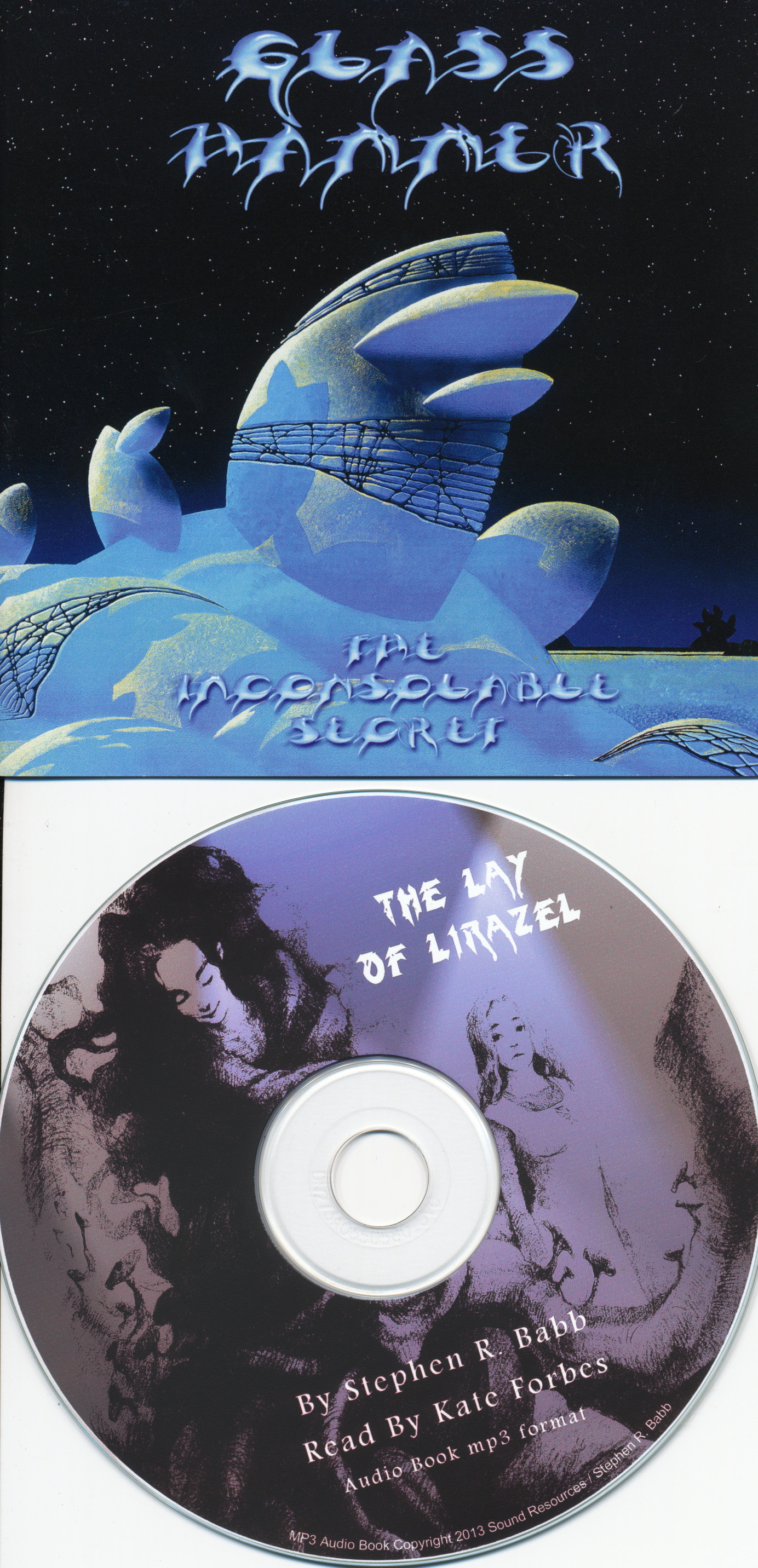
There’s a really nice review of the rereleased and remixed version of Glass Hammer’s masterful, Inconsolable Secret, over at http://www.progrocket.com.  Sadly, I can’t figure out who the author is, or I’d give her or him explicit credit.

One of the quintessential modern-day symphonic progressive rock bands, Glass Hammer recently re-released their 2005 album The Inconsolable Secret. The new “deluxe edition” contains all the original material from the two-disc album, as well as a third disc featuring remixes of several of the songs, two with new vocal tracks from present lead singer Jon Davison, who is currently the lead singer for Yes. Glass Hammer is led by multi-instrumentalists Steve Babb and Fred Schendel.–Progrocket.

To keep reading this excellent review, click here.

For Glass Hammer’s official website, click here.

Andy Tillison on PROG AWARDS

The "red-headed" one.  Stolen from Tillison's FB page.  Without permission but not with malice.
The “red-headed” one. Stolen from Tillison’s FB page. Without permission but not with malice.

Andy posted this at his personal facebook page.  Very well worth reading and yet another reminder as to why Andy is a sheer modern (well, maybe post-modern) genius.

Some thoughts on the Prog Awards that took place in KEW, London last week. First of all, I had a great time and as I have already shown off on another thread, I got to share a table with three quarters of Transatlantic, Arjen Lucassen and the people from Insideout music who’d invited me. This in itself was a bit of a “wow” thing.

Looking around at the famous faces was worrying. I kind of realised that some hanger-on-to-1979-NME “everything must die so that punk may live” journalist could probably have wiped the genre from the face of the earth with a dodgy batch of Salmon Mousse. Rick Wakeman was right behind me, Ian Anderson, Dave Brock, Steve Hillage, Steve Hackett, Robert John Godfrey – Jeez!!! – if anyone had told me when I was at school that I’d be at this thing I’d have not believed them.

Most of my friends know that this kind of shindig is not really my scene. I felt a bit awkward in all posh clothes, a bit nervous to be with all the great and good – and this is not something that applies just to awards ceremonies, it goes back as far as “terror of the sixth form disco” and those student parties where you really DID find me, always in the kitchen. I’m just a bit nervous of formal events. Can’t be myself and that’s as simple as I can put it.

The formalities of the awards kicked off after a meal. Some of you know that my personal relationship with the organisation (PROG magazine) did not start quite as well as it might. My relationship with the editor and big chief there, Jerry Ewing, was worse than frosty for more than a year. Actually my fault when all is said and done – I really think most of it was to do with a bit of Northern Cantankerousness mixed with sense of humour failure and a little bit too much pride. And the fact that the mag had said that The Tangent looked like a bunch of Sheep Farmers and Accountants. I SHOULD have had a right old laugh about that. Because at the time, my partner Sally was working in accounts and we DID live in the middle of a sheep farm. Maybe it was just too close to the bone.

Ewing kicked off the proceedings with what, to my surprise and delight, was the most motivational speech of the night. It focussed heavily on the new bands both “real new” and “established new” and far from being corporate gesturing which is so often evident at this type of event, I got a real feeling that he MEANT it all, and that he didn’t actually see the third and fourth waves of Prog as some kind of pro-active fan club of the first and second. That was more than refreshing. And to watch the Von Hertzen Brothers claim their award, Big Big Train and Steven Wilson etc was great, knowing that there is, was and will be a lot of life in the genre AFTER 1977.

I’m always gonna be happier in jeans and a t-shirt, wrestling with a monitor mix at The Peel, The CRS, Summer’s End or Celebr8 than at a posh three course meal. And of course I did note that there were more people at the awards than are at most of the gigs. If all the musicians were to support each other at each others events we could significantly audience sizes – (but NOT ask to be on the guest list!!). But what’s really really great about these awards is that we’re all HERE, the old heroes and legends, the guys who want to follow them and the people who want to make it happen. I’ve always felt as a Prog musician to be “part of something” – of course I have.. but where so many negative correspondents have portrayed Prog as a safe, middle class and system supporting genre, I have always seen it as sticking up two fingers to the classical music establishment and saying “we can do that too” After all the shit, lies, misrepresentations and misunderstandings we’re ALL STILL HERE. Bring on the Salmon Mousse!!! We’ll survive that too!–Andy Tillison, Facebook, September 8, 2013

A Moveable and Glorious Feast: L’Étagère Du Travail by The Tangent

etagereJust as The Tangent’s Le Sacre du Travail was entering into the ordinary time of our lives, Andy Tillison (though the son of a Congregationalist minister) jolts us toward a high Feast Day, and the liturgy of life and art continues with The Tangent’s second release of 2013.

A moveable but glorious feast, L’Étagère Du Travail offers us more glimpses–through a glass, not darkly, as it turns out (with apologies to Paul)–of the essence of truth and beauty.

Please forgive all of the religious references, but musicians such as Tillison, Spawton, Longdon, Armstrong, Cohen, Erra, Stevens, and others bring this out in me.  These fine artists always reach for the best, and that best is often beyond any rational interpretation or explanation.  It’s no wonder the medievals spoke of artists with reverence and awe, in terms of ecstasy.  They touch something the rest of us (the vast, vast majority of us) can only sense exists.

2013 will go down, someday, as one of the best years in the history of progressive rock music, and Tillison has now contributed not one but two major releases and, consequently, two critical steps to and toward the sheer quality of this year.

The Tangent has been in existence for over a decade now, and Mr. Diskdrive himself, Andy Tillison, that red-headed, mischievous sprite, has given the music world much to celebrate.  Tillison has consistently brought together the best of the best musicians, and he has orchestrated all–lyrics, instruments, and arrangements–with some thing that is nothing short of brilliance.

The "red-headed" one.  Stolen from Tillison's FB page.  Without permission but not with malice.
The “red-headed” one. Stolen from Tillison’s FB page. Without permission but not with malice.

This new release, available exclusively at thetangent.org consists of ten tracks including, as the website notes, five new “unreleased demo” tracks and 3 “revisitations.”  The 10 tracks come to roughly 1.2 hours of music.  So, this is no EP.  As Tillison notes on the site, it’s a companion album, a “sister” (a very lovable little sister, I presume) to Le Sacre du Travail.

As with its sibling–naturally having received almost nothing but rave reviews–L’Étagère Du Travail is a must own.  It needs to be in the collection of anyone who appreciates fine art, but especially for those of us who like our music progressive.

I received a review copy just after departing for family vacation, and it has, in many ways, become the soundtrack of my trip into the American West, despite the fact Tillison is, perhaps, the most English of English folk!

From my many listens, I’m absolutely taken with and blown away by the energy and the highly controlled anger of the album.  It’s jazzier and more experimental (there’s even a hint of disco on one track, “Dancing in Paris”–all done, of course, with taste), moment by moment, than Le Sacre du Travail.  This, of course, is to be expected, as the former album told a coherent story, while this companion album explores the same sacred space, but in exemplary fragments not in overarching mythos.

Yet, Tillison’s art is unmistakably Tillison’s art.  Every single thing you love about The Tangent is here in abundance.  As far as I know, I (rather proudly) own everything The Tangent has recorded with the exception of A Place on the Bookshelf (a stupid oversight on my part; it slipped under my radar when it came out; and I’ve regretted not buying it ever since), and I’ve been listening to them for a decade.

Getting a review copy just on the eve of my longed-for summer vacation into the Rockies was akin–again, forgive the religious references–to having wine filled to the brim at a wedding.  As it was at Cana, so it must be in York.  Tillison’s goodness overflows.

Yet, as I just wrote–there’s a lot of anger in this album, but it’s the anger of a righteous man, the kind of anger that demands justice.  What Tillison does with his lyrics is criticize what desperately needs to be criticized in this world.  He does it with passion, but also with immense graciousness, charity, and exactness.  This is not the cheesiness of Bono’s preaching in 1987, but the jeremiad of, well, a modern Jeremiah, albeit an atheist anarchist Jeremiah.  Tillison wants the idealism of his era to meet reality, and he finds the post-modern world more than a bit disconcerting.  The Tangent’s website proclaims correctly and with perfect self-understanding, “Progressive Rock Music for a World on Auto-pilot.”

Yes.  Absolutely, yes.  Every word Tillison sings proclaims, “Wake up, world!!!”

I’ve never had the privilege of meeting Tillison in person, but I suspect he’s rather Chestertonian–clever as the dickens and willing to let the world know what needs to be known, but always with that impish and knowing smile and always with a wry sense of humor.  He is, I believe, a man who reaches and reaches but who understands too much of human nature to be taken in by the nakedness of the king.

Topics on this companion album include generational betrayal, crony capitalism, and corporate biotechnology.

As soon as I heard the first lyrics of “Monsanto,” I knew I’d love this album as much as any thing Tillison has written.  Perfection itself.  My favorite track, however, is the bitterly hilarious “Supper’s Off,” an obvious reference to the Genesis classic, complete with generational disgust and bewilderingly Apocalyptic imaginings, bettered only by John the Revelator himself at Patmos!

As I’ve noted before at progarchy and elsewhere, the various prog musicians in the world today are nothing if not perfectionists.  Eccentrics, to be sure, but perfectionists, too.  And, to these perfectionist eccentrics, I offer the highest praise I can.  If every person took her or his life and work as seriously as do the greatest of prog musicians, the world would not swirl so close to the abyss, the killing fields might be kept a bit more at bay, and we might all recognize the unique genius in every one of our neighbors.  Or, as Tillison writes of himself: “romantic enough to believe you can change the world with a song. I wanna write that song.”

Mr. Diskdrive, thank you.  Thank you for truth, and thank you for beauty.  Long may you rage.

*****

ETAGEREbanner

Order from http://www.thetangent.org/.  Now.  Yes, now.  Hit the link.  Quit reading this–go now!  Ha.  Sorry–too many John Hughes’ movies in my life.  Go order!

Seriously, enjoy this offering from The Tangent.  L’Étagère Du Travail by The Tangent (2013).  Tracks: Monsanto; Lost in Ledston; The Iron Crows (La Mer); Build a new House with The Le; Supper’s Off; Dancing in Paris; Steve Wright in the Afternoon; A Voyage through Rush Hour; The Ethernet (Jakko Vocal Mix); and The Canterbury Sequence live.

For interviews with Tillison (including with the grandest of interviewers, Eric Perry and Geoff Banks), check these out:

  • interview – Eric Perry, “beta tester” for the new album asks Andy some very involved questions about it – and gets some very involved answers.
  • interview – The Dutch Progressive Rock Page’s David Baird asks about the album, the band, the lineup changes etc
  • radio interview – Geoff Banks and Andy natter on ad-infinitum about prog, pop, Magenta, the UK, the world etc.