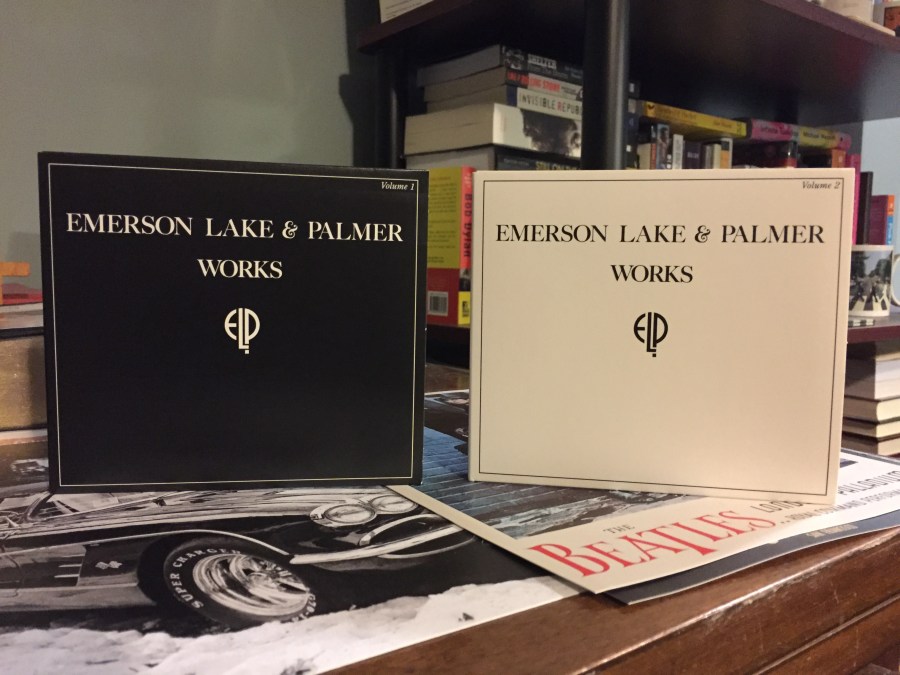
Rick’s Retroarchy: Works Volume 1 by Emerson, Lake and Palmer

by Rick Krueger

“The word ‘bombastic’ keeps coming up as if it were some trap I keep falling into … when I’m bombastic, I have my reasons. I want to be bombastic.  Take it or leave it.” – Dave Brubeck

What were they thinking?

You’re Emerson, Lake & Palmer, coming off a three-year layoff  — though admittedly, you were at the top of the charts and your game when you downed tools.  To regain your fan base and add to your audience, would you come back with a double album that had one side of material by each band member (with guest players and full orchestras) and only one side of ELP playing together?  And then, would you take a 59-piece orchestra and 6-voice choir on the road with you?  To most people, that would sound like a recipe for disaster.

Continue reading “Rick’s Retroarchy: Works Volume 1 by Emerson, Lake and Palmer”

Remembering ELP: Genuine Art and Beauty

Bruce Frohnen has an essay over at TIC about ELP, arguing that they are “the most important musical group of the rock era.” Here’s part of his argument:

“Karn Evil 9” is not overblown, it is genuinely and intentionally music on a grand scale, combining classical techniques with multiple, interlacing rhythms, and polyphony to immerse the listener in a web of sound that for a time creates its own reality.

“Counterpoint” is a concept (not to say a reality) little understood among most rock musicians; but it was crucial to ELP’s ability to produce sounds that made sense at a level frankly higher than can be achieved in most blues-based music, with its emphasis on a single, simple melody underscored by rhythms deeply rooted in a single beat. At their usual best, Emerson, Lake, and Palmer performed according to a vision of rock music as rooted in the classical past. They produced both direct classical adaptations (“Fanfare for the Common Man” being the most famous) and original compositions that likewise combined modern rhythm and technique with melodic sophistication to create genuine art—pieces of beauty capable of affecting the souls of listeners.

“Gravitas”: A mediocre Asia album, but a decent John Wetton solo album

As an Asia album: 6/10asia_gravitas

As a John Wetton album: 8/10

Earlier this year I posted about the (then) upcoming, new Asia album, “Gravitas,” and wrote the following about the first single, “Valkyrie”:

The positives: Wetton sounds great; his vocals are impressively strong and clear at the age of 64. The song itself is quite decent, with the distinctive Asia “sound”: soaring keyboards, big chorus, and lyrics tinged with semi-mythical elements. The negatives: the video is rather (very!) low budget, the song sounds quite a bit like most Asia songs of the past couple of decades, and young Coulson seems underused. What strikes me odd, as I’ve read about this new album, is that while the band members talk about Coulson bringing a harder, even more metal-ish, sound with him, it doesn’t show up in the first single or in the clips of the other eight tunes. And, of course, none of them really sound prog-gy at all. Come to think of it, when did Asia last really incorporate anything obviously proggy in its albums?

Having now listened to the entire album a dozen times or more, I confess to being a bit conflicted. The positives are pretty much as described above. Wetton, who is 65, sounds exceptional; his vocals are strong, clear, and with plenty of nuance and bite, as evidenced on the title track. If anything, my appreciation for Wetton as a vocalist expanded in listening to this new release, especially for the various colorings and emotional nuances he brings to the table. The production, handled by Wetton and keyboardist guru Geoff Downes, is mostly excellent (see below for the negative), featuring lush soundscapes and impeccably crafted waves of vocal harmonies, a classic Asia staple.

In short, the top end—lead vocals, vocal harmonies, and keyboards—sound great.

Unfortunately, the rhythm section and guitar ranges from occasionally agreeable to rather boring. There are times, frankly, when I wondered, “Carl Palmer still plays drums, right? Where, oh where, is the bass?!” Yes, there are a few moments that rise above average (“Nyctophobia”, for example), but overall the drums are so far back in the mix and so generic sounding, it may as well have been Session Drummer Bob Smith behind the kit. The same could be said for much of the bass guitar, with a couple of exceptions, such as a nifty solo-ish section in “Russian Dolls”. Simply put, the bass and drums are often quite pedestrian, especially for players of this caliber; they might as well have been mailed in via Pony Express and then told, “Sit down way back there and play quietly!”

As for the harder guitar sound, I’ve heard heard more rockin’, “in your face” guitar on Michael Jackson albums. Sam Coulson might be the next Joe Satriani, but he rarely gets a chance to show what he brings to the table, and his solos are short, safe, and sadly generic. There is more guitar in, say, “Sole Survivor” or “The Heat Goes On,” than on the entire “Gravitas” album.

Having listened to “Gravitas” several times, I went back and listened to “Asia” and “Alpha”, which established, for me, the benchmark for subsequent Asia albums. Two things stand out: first, the early Asia songs were far more interesting, especially musically, with a remarkable amount of “proggy” elements for such commercially successful albums (of course, the early ’80s were far kinder in that regard, as also evidenced by Yes’s “90125”); secondly, the early Asia sounded like a band that wrote songs as a band and wanted to be a band. The input and influence of Steve Howe and Palmer are readily evident, even if Wetton and Downes were the primary songwriters. And so the songs were far more diverse, ranging from “Heat of the Moment”, with its upfront guitar lick, to the dramatic push-and-pull of “True Colors”, to the deeply longing, semi-epic “Open Your Eyes” (a personal favorite). To sum it up, the songs on “Gravitas” lack variety, suffering from sameness and, in places, some overly long and repetitious choruses and outros.

“Gravitas” is, as an Asia album, rather mediocre; it has some good moments, but is lacking. Those good moments are due mostly to Wetton’s singing and Downe’s keyboards. Lyrically, there is a singer/songwriter quality here that also suggest this is more of a Wetton vehicle than a real band effort. There’s nothing wrong with that, I suppose, but I miss the interplay and band-oriented sound of earlier Asia.

John Wetton: “It’s clearly elitist, this prog thing.”

The group Asia (website) has a new guitarist (20-something Sam Coulson) and a new album, “Gravitas,” which is due out on March 25th. The band talks about their new guitarist (their fifth? seventh? twelfth?) and the new album:

The more eye-brow-raising interview, however, appeared on the Huff-and-Puff Post earlier this week. A couple of interesting excerpts; first, from John Wetton about aging and songwriting:

Most of this band are in their sixties–we’ve got one exception who’s twenty-six, but most of us are getting to that respectable age now. We can’t come up with punk anthems, we never have done. What we do is we reflect the internal conflict that people get. Look at “The Heat Of The Moment.” It’s an apology. “Only Time Will Tell” is about a relationship falling apart because of infidelity. My complete change-around as far as lyric-writing came in 1971 when I had three records that I listened to all summer. One was Joni Mitchell’s Blue, the other one was What’s Going On by Marvin Gaye and the last one was Surf’s Up by The Beach Boys. The one that hit me the hardest, really, was Blue by Joni Mitchell because she wrote every song in the first person. It’s all like she’s reading straight out from her journal. For me, who had been brought up on art rock where you’re observing other people from a distance, it catapulted me into the world of, “Why don’t you write it from your own experience? To this day, if I hear someone bleating on about fame, I want to hear about their fame, not someone else’s. If it’s coming from the horse’s mouth, great. If it’s coming from the horse’s ass it’s no good at all.

And this, about prog and classic rock:

MR: I also have to ask you, you said “classic rock,” but Asia also falls under the category of progressive rock, which I think allows you the freedom you talked about before to do anything you want with your music.

JW: Yes. We have a foot in three trenches, really. We’re classic, we’re prog, and we verge on pop at times. We certainly can have singles that will appeal to people outside the prog fraternity, which they probably don’t even like. It’s clearly elitist, this prog thing. The bands that we came from, certainly all of them were prog. They died in the war of prog. But Asia, when it came out, reached far beyond the prog circles. To this day our audience is so varied, we get real kids at concerts, we get people our age and everyone in between. It’s great, I love it. And we still have a fairly broad spectrum as far as gender. Usually, we don’t have a room full of beards and sweaters, it’s usually a good mix of women and men. Very, very healthy audience. It’s great.

Wetton also states, a bit later: “My favorite male artist of all time is Don Henley because it’s like he’s reading poetry that comes straight from himself and it’s so gorgeous.” Huh. I cannot say I saw that one coming. Not that there’s anything wrong with Henley’s music; I enjoy some of his solo stuff and a fair amount of the Eagles’ music as well. But not expected.

Here is the video for the album’s first single, “Valkyrie”. The positives: Wetton sounds great; his vocals are impressively strong and clear at the age of 64. The song itself is quite decent, with the distinctive Asia “sound”: soaring keyboards, big chorus, and lyrics tinged with semi-mythical elements. The negatives: the video is rather (very!) low budget, the song sounds quite a bit like most Asia songs of the past couple of decades, and young Coulson seems underused. What strikes me odd, as I’ve read about this new album, is that while the band members talk about Coulson bringing a harder, even more metal-ish, sound with him, it doesn’t show up in the first single or in the clips of the other eight tunes. And, of course, none of them really sound prog-gy at all. Come to think of it, when did Asia last really incorporate anything obviously proggy in its albums? The mid-1980s? I’m not sure, because I stopped listening for about 20 years or so, and have only regained interest in the past couple of years.

Personally, I’ll always have a soft spot for the first three Asia albums. In part, because of my age; I was in junior high school when the self-titled debut album appeared in 1982 (32 years ago this month), and in high school when Alpha (1983) and Astra (1985) came along. I thoroughly enjoyed all three albums, and they were in my regular rotation, along with Kansas, Queen, Styx, and some groups I’m too embarrassed to mention here. Through Asia, I learned about ELP, but I didn’t discover King Crimson until many years later, and when I did, I thought, “Wow, that was John Wetton?!” Part of me wonders if the mega-success of the first Asia album didn’t create some problems, creatively, for Wetton and Geoff Downes; it certainly led to lots of conflicts, break-ups, and such over the years. Whatever the case, I am curious about this new album, but I’m trying to have modest expectations. I am thankful, however, that the group didn’t do a cover of Henley’s “Boys of Summer”.

Trevor Rabin: “As long as it’s good and well-played, all music is worth listening to.”

Once again, the AllAboutJazz.com site has another great piece about a prog musician: “Trevor Rabin: All Colors Considered”, by Ian Patterson. The focus is on Rabin’s outstanding new solo album, Jacaranda  (one of my favorites of 2012), which is Rabin’s first solo excursion since his exceptional 1989 album, Don’t Look Away, which I played incessantly back in the day and revisit on occasion. Patterson begins by putting Rabin’s impressive career in perspective:

Whether taking a stance against apartheid in the early ’70s in his native South Africa or turning down the opportunity to play in super group Asia for artistic reasons, Rabin has always done things his own way and stuck to his principles at every step. Rabin is perhaps best known around the world for the mega-hit “Owner of a Lonely Heart” and his 12-year stint with progressive rock giant Yes, but there are a surprising number of strings to the musician’s bow.

While it would have been easy to carry on touring and recording with the legendary British group, Rabin felt that after a dozen years a new challenge was needed, and he said no to Yes. So it was in the mid-1990s that Rabin embarked upon another career as a composer of film soundtracks. In a little over 15 years, Rabin has recorded 40 film soundtracks of varying genres, winning numerous awards in the process.

Just when it seemed as though Rabin’s music would only be heard in cinema houses around the world, he’s back with another surprise in the form of his sixth solo album, Jacaranda (Varese Fontana, 2012). It’s his first solo album of original material since Can’t Look Away (Elektra, 1989), and it’s an inspired collection of guitar- based instrumental compositions.

Continue reading “Trevor Rabin: “As long as it’s good and well-played, all music is worth listening to.””