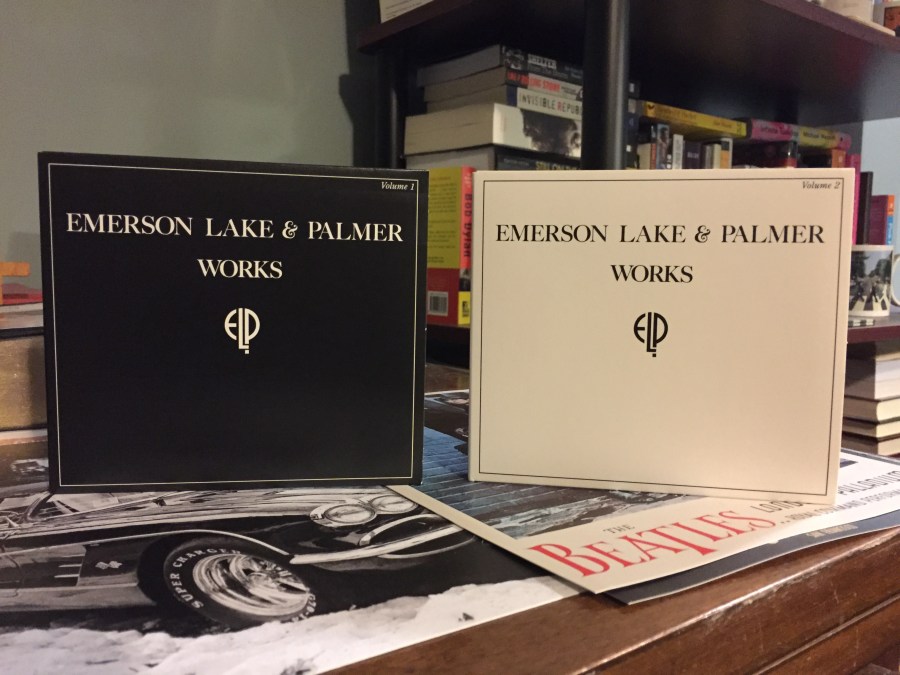
Rick’s Retroarchy: Works Volume 2 by Emerson, Lake and Palmer

by Rick Krueger

When I picked up Works Volume 2 (on the day after Thanksgiving 1977, at Hansen’s Music Store in Greenville, Michigan — thanks for taking me along, Mom!), it didn’t feel like a disappointment.  In fact, on first listen it was a nifty change of pace from the orchestral bombast of Volume 1 — 12 shorter tracks, all new to me, exploring the jazz, blues and boogie that only occasionally showed up on ELP’s earlier records.

Continue reading “Rick’s Retroarchy: Works Volume 2 by Emerson, Lake and Palmer”

Rick’s Retroarchy: Works Volume 1 by Emerson, Lake and Palmer

by Rick Krueger

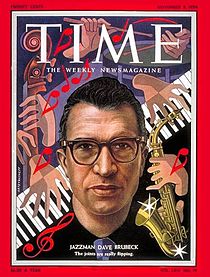
“The word ‘bombastic’ keeps coming up as if it were some trap I keep falling into … when I’m bombastic, I have my reasons. I want to be bombastic.  Take it or leave it.” – Dave Brubeck

What were they thinking?

You’re Emerson, Lake & Palmer, coming off a three-year layoff  — though admittedly, you were at the top of the charts and your game when you downed tools.  To regain your fan base and add to your audience, would you come back with a double album that had one side of material by each band member (with guest players and full orchestras) and only one side of ELP playing together?  And then, would you take a 59-piece orchestra and 6-voice choir on the road with you?  To most people, that would sound like a recipe for disaster.

Continue reading “Rick’s Retroarchy: Works Volume 1 by Emerson, Lake and Palmer”

Jazz phenom Eldar Djangirov performs Radiohead’s “Morning Bell”

The young pianist Eldar Djangirov (website) has already released several exceptional albums, featuring a wealth of stunning virtuosity and musicality. Dave Brubeck, who knew a thing or two about jazz piano, called him a “genius”, which gives you a sense of his talents. His early albums were sometimes criticized (and fairly so) for being heavy on flash and flair and light on interpretive depth and emotional resonance. But his work has matured with each release and I think his new album, “Breakthrough”, is his finest work yet. And I was pleasantly surprised to see that he took a page from the great Brad Mehldau and performs a Radiohead tune, the lovely “Morning Bell”. Here it is:

Our Progarchist Week

GlassHammerPerilous2012borders_001Just in case you missed any of this, we had yet another brilliant week at Progarchy.  Dr. Nick and Alison Henderson reviewed the new Steve Hackett album, Genesis Revisited II (Insideout).  Tad Wert posted about guitarist Michael Hedges.  Chris Morrissey reviewed (briefly) one of his favorite albums of the year, the debut album from Flying Colors, and he posted about the excellence of Mike Portnoy.  I had the great privilege of interviewing Blake McQueen of Coralspin.  Ian Greatorex (doesn’t everyone want an ubercool last name such as Greatorex?) looked at the past of Beardfish.  Roger O’Donnell remembered his time recording Disintegration with The Cure.  Jazz legend, Dave Brubeck, passed away, the day before turning 92.  Carl Olson offered a nice review of his career.  Finally, our Englishman, turned-Kiwi, Russell Clarke, explained why Big Big Train allows him to remember, fondly, his homeland.

Forthcoming, more reviews of Steve Hackett (at least one more, maybe two) as well as a review of the forthcoming King Bathmat.  Several (if not all!) Progarchists will also be explaining our “best of 2012.”  Lots and lots to come before 2012 is done.

On a personal note, I’ve spent much of my free time this week, going back through the myriad interviews with the various members of American prog demi-gods, Glass Hammer.  There’s plenty of quotable material from these guys.  My favorite, though, comes from a 2002 interview with one of my oldest friends, Amy Sturgis.  In response to one of her questions, Steve Babb stated: “We were attempting to repackage progressive rock (which we though had long since vanished) as fantasy rock.”

Continue reading “Our Progarchist Week”

Dave Brubeck on Race

Our own Progarchist, Craig Breaden, came across this fascinating interview with jazz legend, Dave Brubeck, about race.  The interview itself reveals mightily the power of art and integrity to overcome human indignities.

http://www.pbs.org/brubeck/talking/daveOnRacial.htm

The catholicity of jazz (with an idiosyncratic list of jazz albums for people who don’t like jazz)

davebrubeck_progarchyThe following was originally written in May 2011 for the Insight Scoop blog. I’ve decided to share it here as a very modest homage to Dave Brubeck, who died this morning, one day shy of being 92 years young. It sounds like Brad has more about Brubeck on the way. Anyhow, here goes!

I just read a fun post, “The Catholic Roots of Jazz?”, by Joe Trabbic on the “End of the Modern World” blog, and wanted to blather about it for a bit. Joe writes:

Jelly Roll Morton was a key figure in the early development of jazz. Some people even regard him as the first real jazz musician, the man who brought together various musical forms into the new thing that we now know as jazz. Jelly Roll’s real name was Ferdinand Joseph LaMothe and he was raised Catholic, but the dissolute life that he began leading as a teenager, when he secretly took a job as a piano player in a New Orleans brothel, quickly made his Catholicism unrecognizable. But who knows the hearts of men save their Maker?

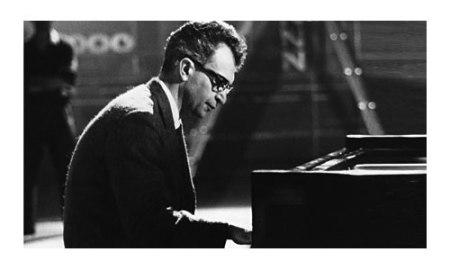
He goes on to mention early jazz giants Dominic “Nick” LaRocca and Louis Armstrong, and then remarks upon Dave Brubeck, one of the finest (and longest-performing) jazz pianists, saying, “Well, if jazz didn’t have anything Catholic about it, why did one of the greats of later jazz, Dave Brubeck, decide to enter the Church of Rome?”

He admits he is having fun with it, but the two questions are interesting: “Does jazz have Catholic roots?” and “Is jazz Catholic?” The first one, it seems to me, is bound up to a large degree with the history of jazz, which is a complicated matter. But it is pretty evident that jazz, to put it rather simplistically, has roots in both the European cIassical tradition and very American forms of music—ragtime, blues, early country, spirituals, gospel, dance music, etc.—harkening back not only to New Orleans, but Chicago, New York, Texas, and a variety of other places, especially throughout the southeastern United States. Elijah Wald’s How The Beatles Destroyed Rock ‘n’ Roll: An Alternative History of American Popular Music (Oxford University Press, 2009), offers a fascinating and slightly iconoclastic version of that history, especially in the first seven chapters. Jazz was, in the beginning, very much dance music, and was usually associated with a less than upstanding life-style. And that image was hardly helped in the 1940s and ’50s when many jazz musicians came under the spell of heroin and other drugs.

One of my heroes, G. K. Chesterton, had nothing good to say about the jazz of the 1920s and 1930s. I beg to differ with him, but I’m sure it was an unusual and even jarring thing for the Englishman to hear. It was a music filled with great energy, imbued with a beguiling combination of rawness (sometimes sexual in nature) and sophistication (often classical in origin), being both very rhythmic and melodic, with an ever-increasing harmonic complexity. I own dozens of books on jazz (and close to 11,000 songs classified as “jazz” on my iTunes), and they all agree that defining “jazz” is a very difficult matter. Barry Ulanov was one of the first great jazz critics (he was also a Catholic scholar—more on that in a moment), the author of A History of Jazz in America (Viking Press, 1954) and A Handbook of Jazz (Viking, 1960). He wrote, in the latter book, “The harder one listens to jazz, the more one hears European rather than African influences—the folk songs of England, Scotland, and Ireland, of France and Germany and even the Balkans, rather than the music of the jungle and the coast settlements from which the slave ships came.” Continue reading “The catholicity of jazz (with an idiosyncratic list of jazz albums for people who don’t like jazz)”

Dave Brubeck, RIP

ImageWell, I’ve been working on a piece on Dave Brubeck–focusing on Time Out and Time Further Out–for over a month now, and it’s still not ready.  Today, he passed away.  Amazingly, he would have been 92 tomorrow.  What a brilliant artist.  Rest in Peace, Mr. Brubeck.  How many minds did you boggle during your life?  Thank you.