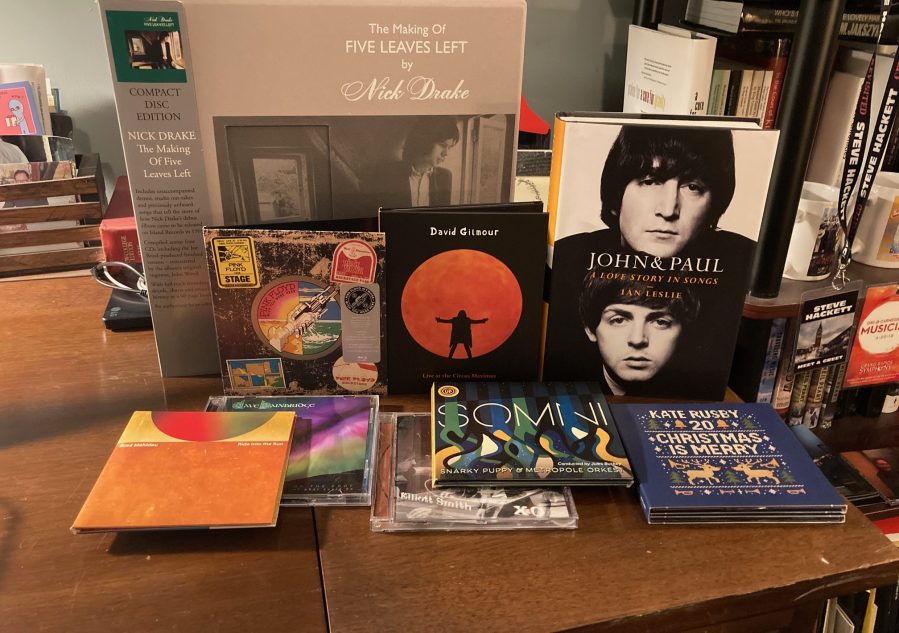
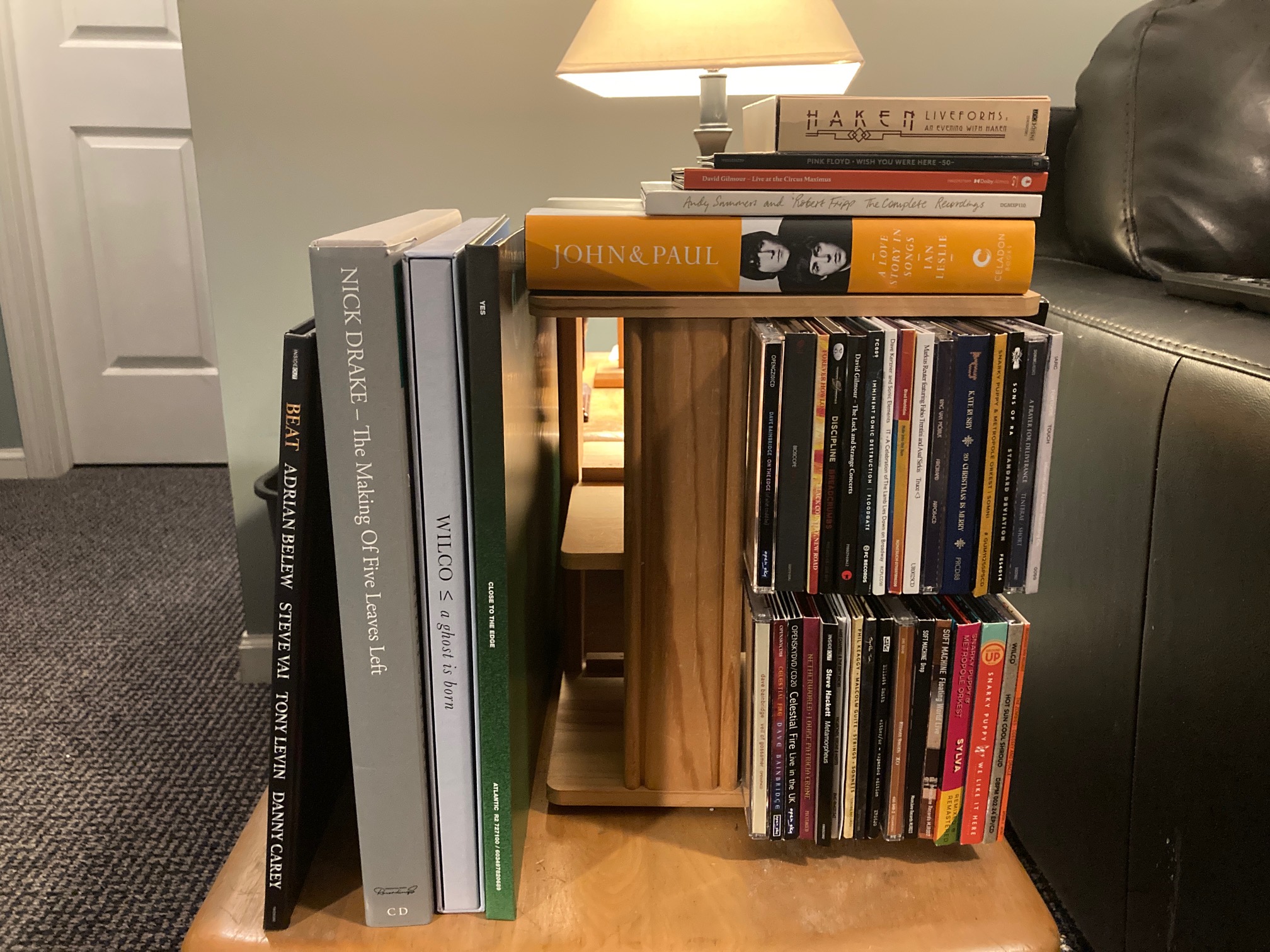
It’s been a good year for music! So good it demanded a slightly different format this time around. You can read my original reviews of my 40 or so favorites from 2025 at the article links that precede each listicle. Listings include the types of release as laid out below, with Top Favorite listings in bold italics (as well as pictured above)!
New Releases:
New Albums
Live Albums (audio and video)
Christmas Albums
Back Catalog:
Reissues
Box Sets (minimum of 3 CDs)
Discoveries (unheard until 2025)
Rediscoveries (heard before, forgotten, loved again in 2025)
Nick Drake, The Making of Five Leaves Left – Top Favorite Box Set! An utter original who died far too young, Drake’s wistful, sturdy, thoroughly unique British folk-rock gradually rose from turn-of-the-1970s obscurity to be embraced by aficionados worldwide. While his three albums (and another disc of studio leftovers) speak for themselves, this lovely box traces his progress over two formative years, from impromptu dorm-room recordings through a breathtaking audition and simpatico sessions (especially those with double bass magician Danny Thompson and master orchestrator Robert Kirby) to the uncluttered, spacious beauty of his debut. If Drake needs any advocacy beyond the sheer communicative power of his songs, here’s all the evidence you need; and as a bonus, long-time fans will find treasures they may not have known they were missing.
No haikus this time, I promise! However, I am going to try and make up for my recent radio silence by covering a lot of ground at a fast and furious pace. Listening links will be available in the title listings. Buckle up . . .
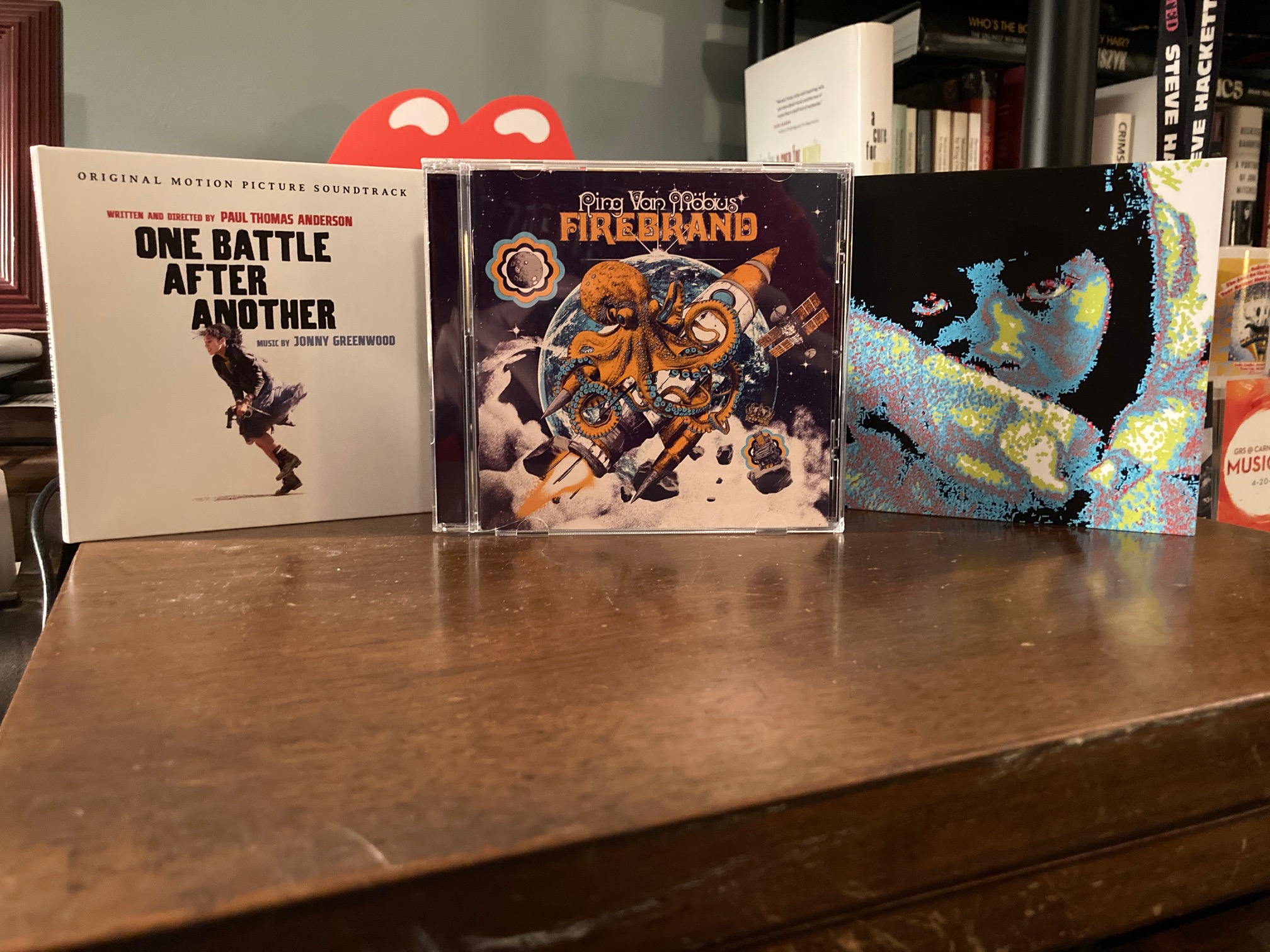
Completely new & noteworthy releases have seemed few and far between the last few months — although I’ve not yet heard the new Neal Morse album Time Lord has so fulsomely praised. My hands-down favorite (easily making my year-end shortlist) has to be Firebrand, the farewell album from Norwegian keyboard trio Ring Van Möbius. On three extended tracks, Thor Erik Helgesen delivers more frenzied organ riffs and howling modular synthesizer licks per minute than we’ve heard since the glory days of Emerson, Lake & Palmer — plus thoroughly unhinged singing of Dag Olav Husås’ trippy lyrics to boot! With Havard Rasmussen’s growling bass and Husås’ throbbing percussion driving the album to multiple shattering climaxes, Firebrand is a demented psychedlic journey to the outer limits of angular, aggressive prog — and all the more gripping on account of it! Meanwhile Tony Levin, Markus Reuter and Pat Mastoletto are back as Stick Men for a 5-track EP of new material, Brutal. This one packs a serious, King Crimson-adjacent punch; the title track, “Bash Machine” and “Pulp” all live up to their names, leaping out of the speakers with heady abandon, precision instrumental riffery, and dense blocks of hardcore sound. More, please! And whatever the debate over the merits of Paul Thomas Anderson’s latest film One Battle After Another, Jonny Greenwood provides yet another arresting soundtrack for the director; this time around, Greenwood foregrounds jagged piano over his exquisitely modernist orchestral textures (as well as the occasional gnarly reminder of his trademark guitar sounds in Radiohead and The Smile).
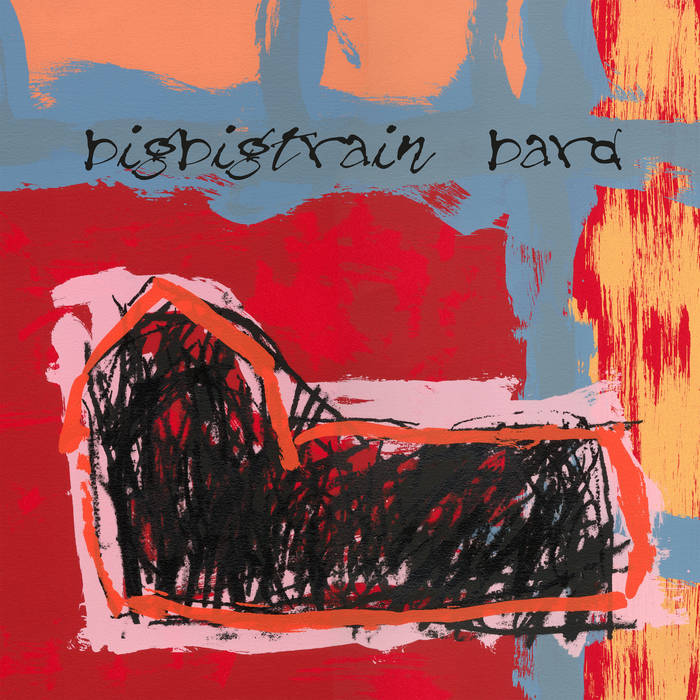
On the other hand, there’s a motherlode of excellent live albums out this quarter! Big Big Train score yet again with Are We Nearly There Yet?, as Alberto Bravin, Greg Spawton and their band of equals blitz through 2024’s fabulous The Likes of Uson disc 1, then gloriously reaffirm BBT back-catalog highlights and rarities on disc 2. District 97 has buffed up and expanded their stellar 2013 collaboration with John Wetton, One More Red Night: Live in Chicago, doubling the disc’s playing time with the Wetton/Leslie Hunt duet “The Perfect Young Man” and D97’s debut album epic “Mindscan”. Reunited with Mike Portnoy, Dream Theater’s 3-CD, 2-BluRay Quarantieme: Live a Paris is an unbeatable 40th-anniversary souvenir; from the crunchy, complex metal of “Metropolis” and Scenes from a Memory through phone-waving power ballads like “Hollow Years” and “The Spirit Carries On” to full-on prog suites “Stream of Consciousness” and “Octavarium”, the entire band operates at a new peak. And, while mashing up a new production of Hamlet with songs from Radiohead’s Hail to the Thief for the Royal Shakespeare Company, Thom Yorke decided the group’s concert takes on the material deserved their own release. Hail to the Thief (Live Recordings 2003-2009) is a banger well worth fans’ time; Radiohead is at their most feral here, squeezing fresh juice from the album’s fuzzed-up, squelchy snapshots of cultural unease with a tightened-up yet wilder sound.
Still, two live particular live releases stood out for me. David Gilmour’s 2024 tour set, available as audio from throughout (The Luck and Strange Concerts) or breathtaking video of a single show (Live at the Circus Maximus), is sleek and spectacular in equal measure, the subdued melancholy and sublimated anger of his solo albums and late Pink Floyd interlaced with the familiar flavors of selected Floyd classics. One of the best things about this set is that it isn’t all Gilmour’s baby: Greg Phillinganes ably fills the keyboard and vocal roles of Richard Wright on “Time”; daughter Romany visibly steals the Rome audience’s heart with her lead vocal on “Between Two Points”; backing vocalists Louise Campbell and The Webb Sisters light up a fresh take on “The Great Gig in the Sky” plus recent solo songs “The Piper’s Call” and “A Boat Lies Waiting”. But Gilmour is still the star, never disappointing on the standards, raising chills with his singing and solos every bit as much on “A Great Day for Freedom” and “High Hopes” as on “Wish You Were Here” and “Comfortably Numb”, his young backing band keeping up all the while. Unmissable, and a unquestioned 2025 Favorite, especially the video version.
Plus, just this past week I discovered my holiday album of the year! Yorkshire songstress Kate Rusby, “the nightingale of Barnsleydale”, has made eight Christmas albums in the last two decades; her latest, Christmas Is Merry, is a live compilation from recent December tours that celebrates the season with the joy and awe it deserves. From whimsical takes on Tin Pan alley chestnuts (“It’s the Most Wonderful Time of the Year”, “I Want a Hippopotamus for Christmas”) to rumbustious traditional carols (“Hark Hark”, “Sunny Bank”) to off-center originals (“Glorious”), all backed by a trad folk band and brass, Rusby is guaranteed to raise a smile. And when she switches to her intimate croon for the foreboding “The Moon Shines Bright” and a hushed “O Little Town of Bethlehem”, I dare you not to be moved. An immediate 2025 Favorite; you really need to hear this.
There have been first-rate reissues aplenty as well. My Favorites have been: The Zombies’ long-neglected Summer of Love classic Odessey and Oracle remastered in mono, with Colin Blunstone’s sublime vocals and Rod Argent’s classically tinged organ propelling an impressively mature song suite; the 20th anniversary remaster of Sigur Ros’ Takk — a delightfully imaginative, massively symphonic highlight of the Icelandic post-rockers’ output; and Pink Floyd’s 50th anniversary edition of their elegiac masterpiece Wish You Were Here(especially the BluRay release, which includes a complete 1975 show suitably exhumed from its original bootleg by Steven Wilson).
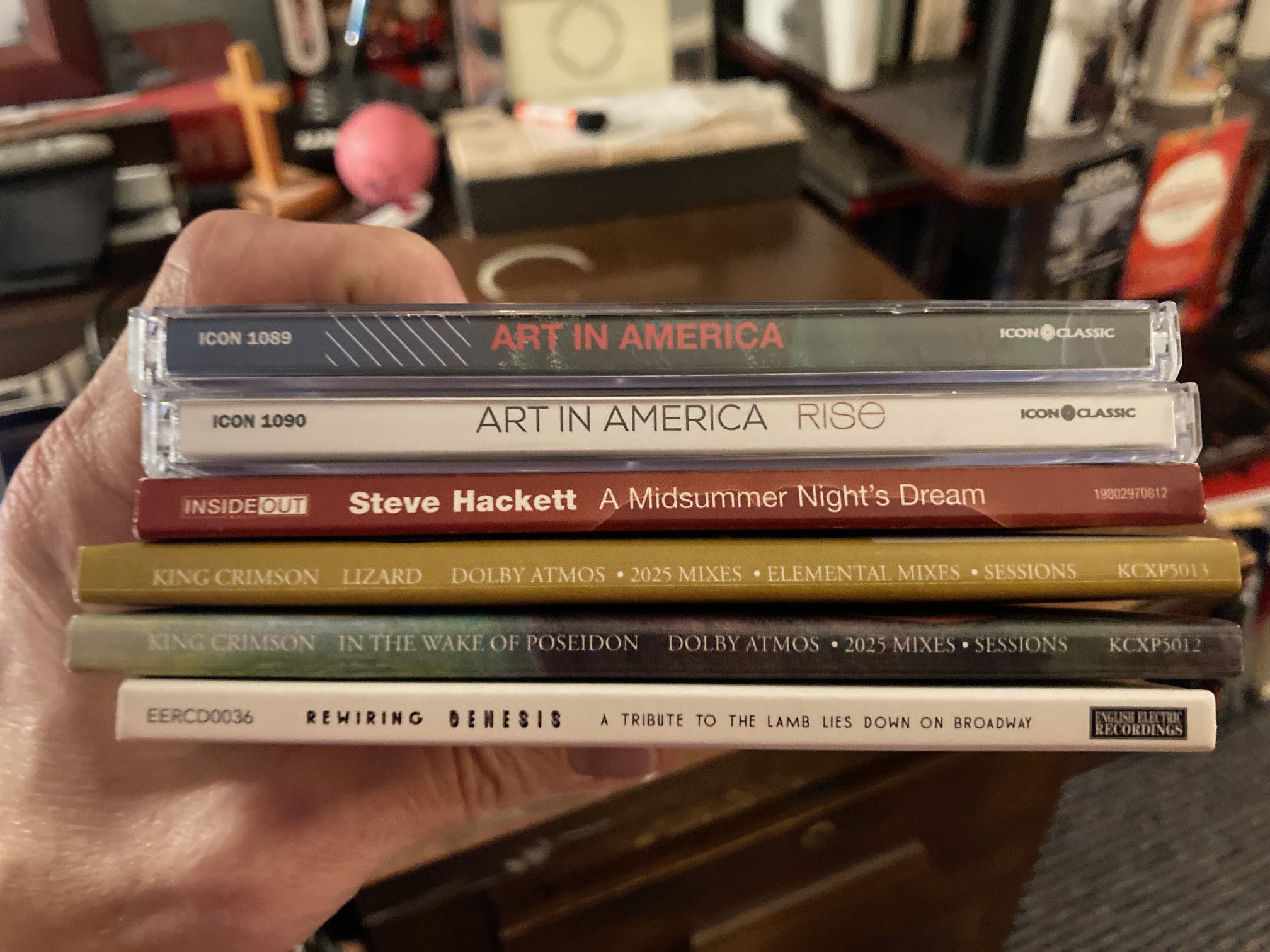
And there are lots more reissues worth a listen: the 1983 debut from Detroit pop-proggers Art in America (they had a harp player — yes, a giant harp, one with all those strings) along with their unreleased second album Rise; Steve Hackett’s album-length acoustic collaboration with Shakespeare and the Royal Philharmonic Orchestra, A Midsummer Night’s Dream; fresh Steven Wilson remixes in stereo, surround and Atmos of King Crimson’s transitional albums In the Wake of Poseidon (Robert Fripp and Peter Sinfield carrying on from the innovative debut with a rotating cast of characters) and Lizard (free jazz meets post-Wagnerian romanticism; quite the magnificent mess); Nick d’Virgilio and Mark Hornby’s long-unavailable, polystylistic Rewiring Genesis: A Tribute to The Lamb Lies On Broadway (with full orchestra on “In the Cage” a Dixieland “Counting Out Time”, sneaky Jethro Tull quotes tucked in the fadeout of “The Waiting Room”, etc.)
Lastly, while the music industry’s annual fourth-quarter release glut means that my box set backlog is worse than ever, I can wholeheartedly recommend the super-deluxe version of the original The Lamb Lies Down on Broadway; while the set’s Atmos mix has been controversial, its straight-up stereo remaster gives the music an absorbing clarity that fills in the blanks of Peter Gabriel’s opaque storyline, and a live bootleg from Genesis’ contemporaneous tour (with vocals mostly overdubbed by Gabriel 20 years later) is equally, winningly surreal. Finally, the 20-disc Peter Hammill: The Charisma and Virgin Recordings, 1971-1986 isn’t for the faint of heart — but given Hammill’s track record with Van der Graaf Generator, hardcore enthusiasts like me knew that anyway. Boundless existential musings set to music of structural, timbral and histrionic extremes — nearly 200 tracks, with 1975’s proto-punk album Nadir’s Big Chance and 1977’s dark, devastating break-up song cycle Over standing out. Hammill (who opened for Genesis during parts of The Lamb tour) may be strong meat, but he never gives less than his all.
How does a two-week vacation circling the Great Lakes wind up being this . . . proggy?
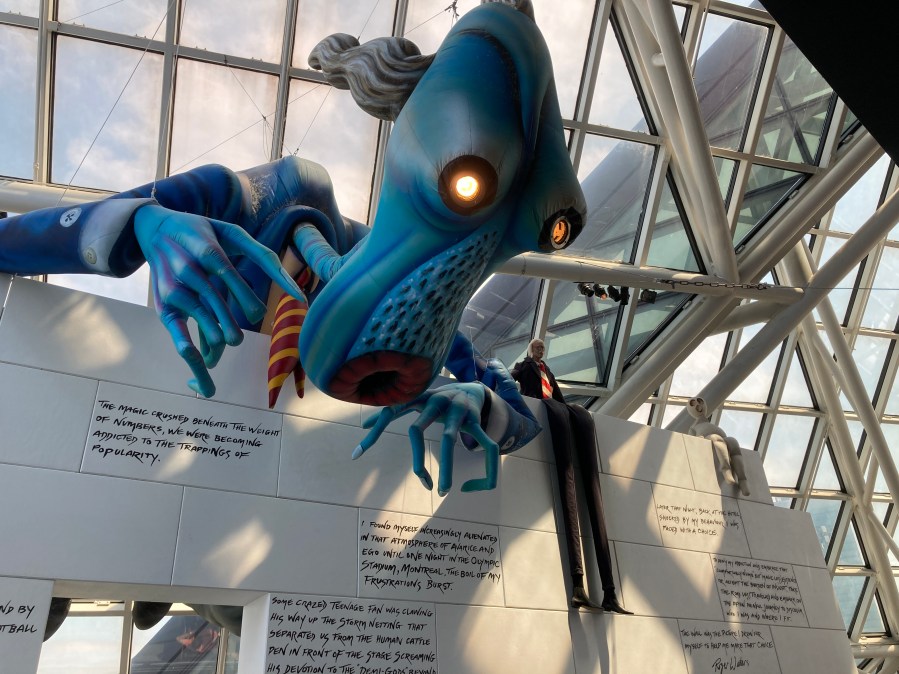
Well, starting out with a few days in Cleveland made a visit to The Rock and Roll Hall of Fame inevitable; it’s been almost thirty years since I set foot in its controversial precincts. (In fact, I’d argue that any hall of fame, no matter its subject, is about controversy — who’s in, who’s not, who should and shouldn’t be there. On such foundations are sports talk radio and the seething hatred of prog fans for Rolling Stone magazine built.) Has the R&RHoF improved in welcoming progressive rock since its fledgling days in 1997, when gigantic props from Roger Waters’ version of The Wall glowering from the top of its atrium (see above) were about the only evidence prog was even on its radar?
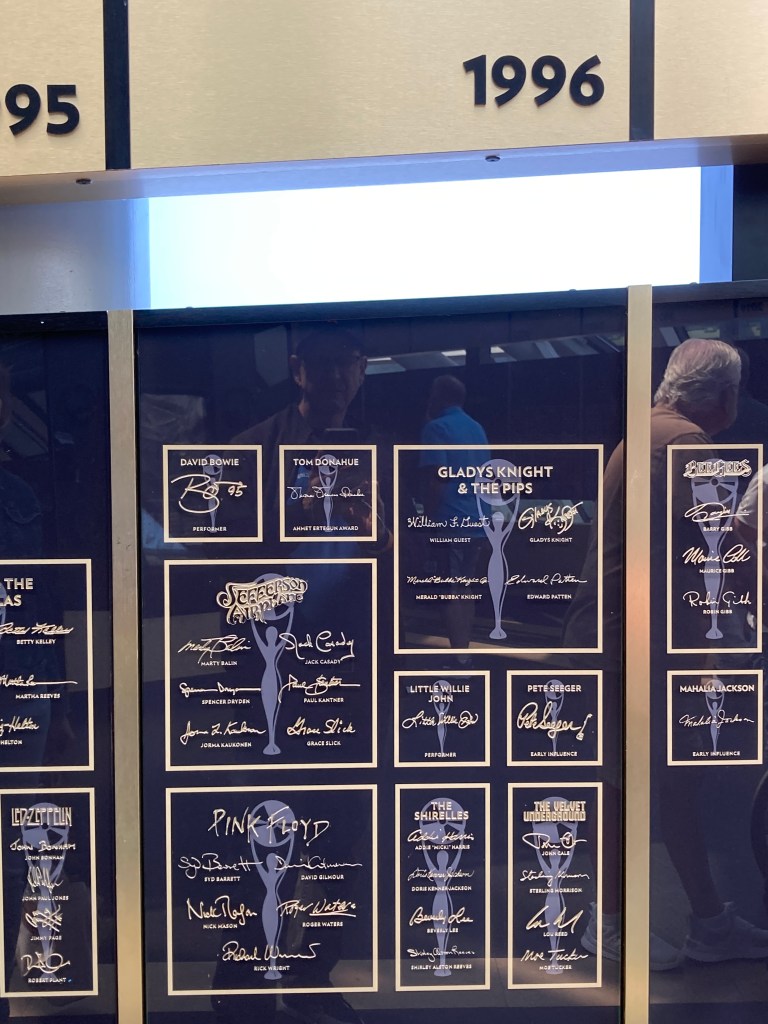
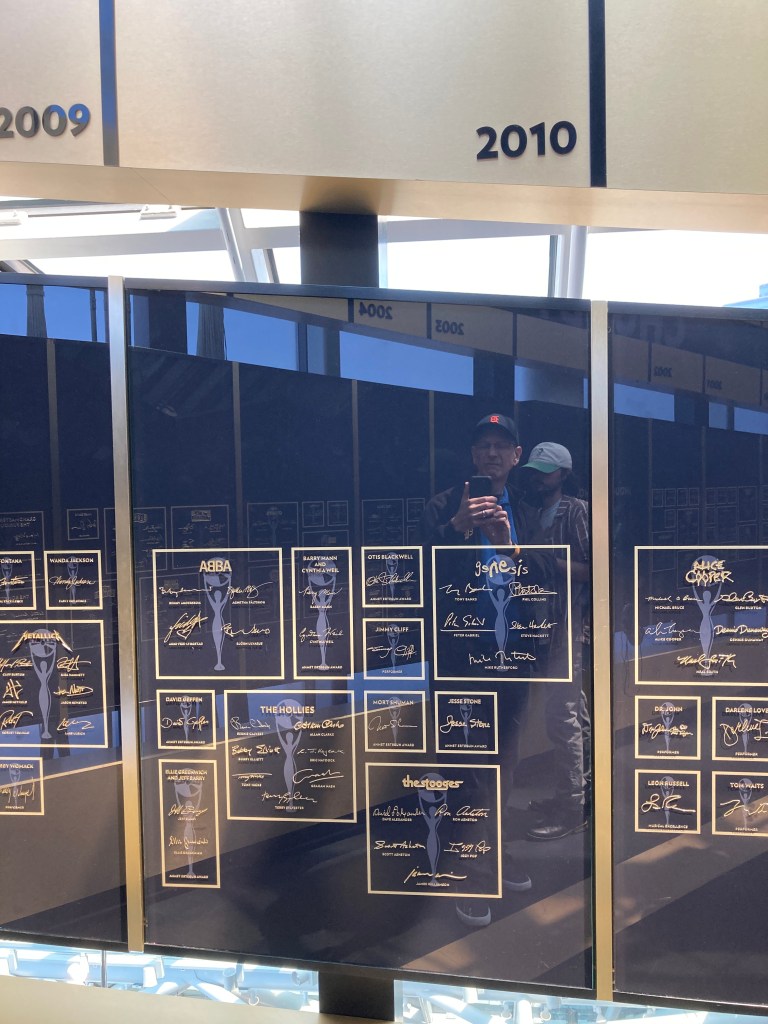
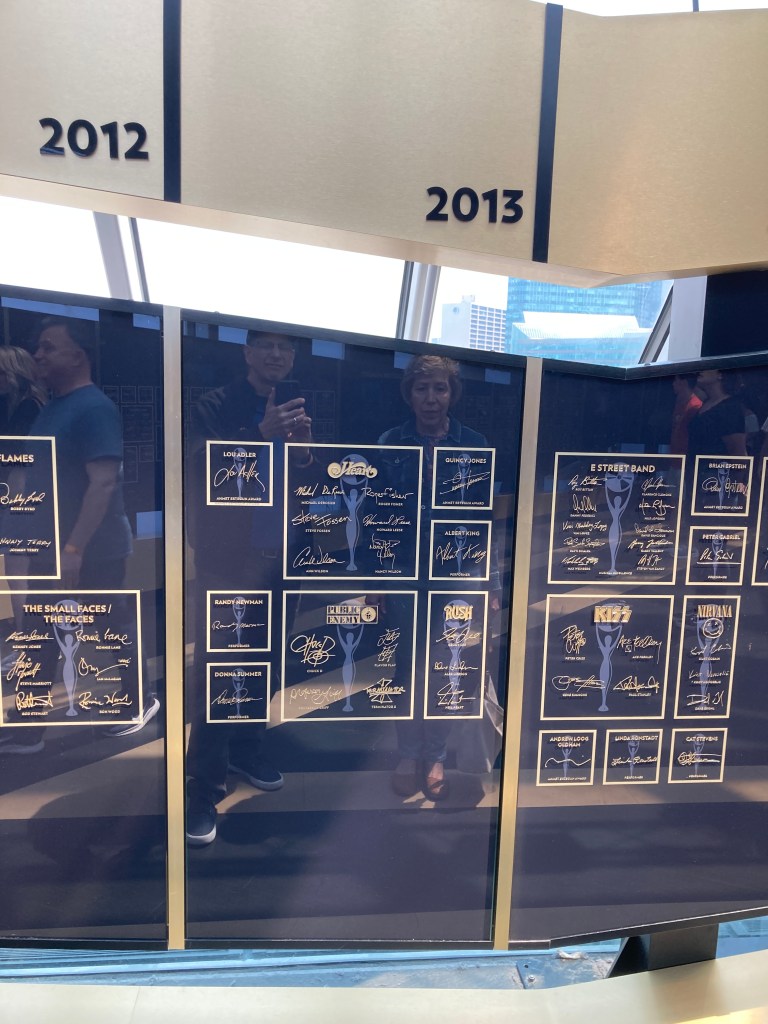
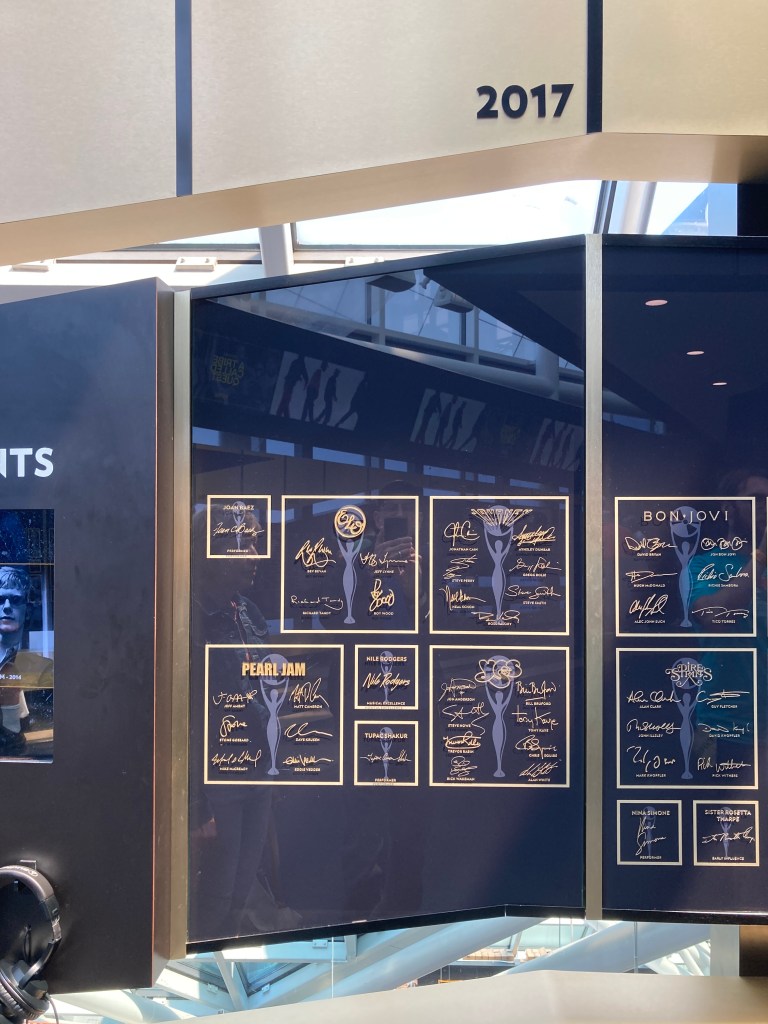
Honestly, omissions are still painfully plentiful; the otherwise comprehensive rock history displays on the first two floors blank out prog entirely, hopping from psychedelia and singer-songwriters to punk with only the barest nod to heavy metal. On the other hand, there has been movement in the last 30 years, with three of Britprog’s Big Six — Pink Floyd (1996), Genesis (2010) and Yes (2017) — plus Rush (2013) inducted into the Hall proper, currently housed on the third floor.
(By the way, you can watch highlights from any artist’s HoF induction on video displays stationed in the Hall. Of course I dialed up that marvelously manic night when Rush was honored — the highlight reel included a full minute of Alex Lifeson’s inspired “Blah blah blah” speech.)
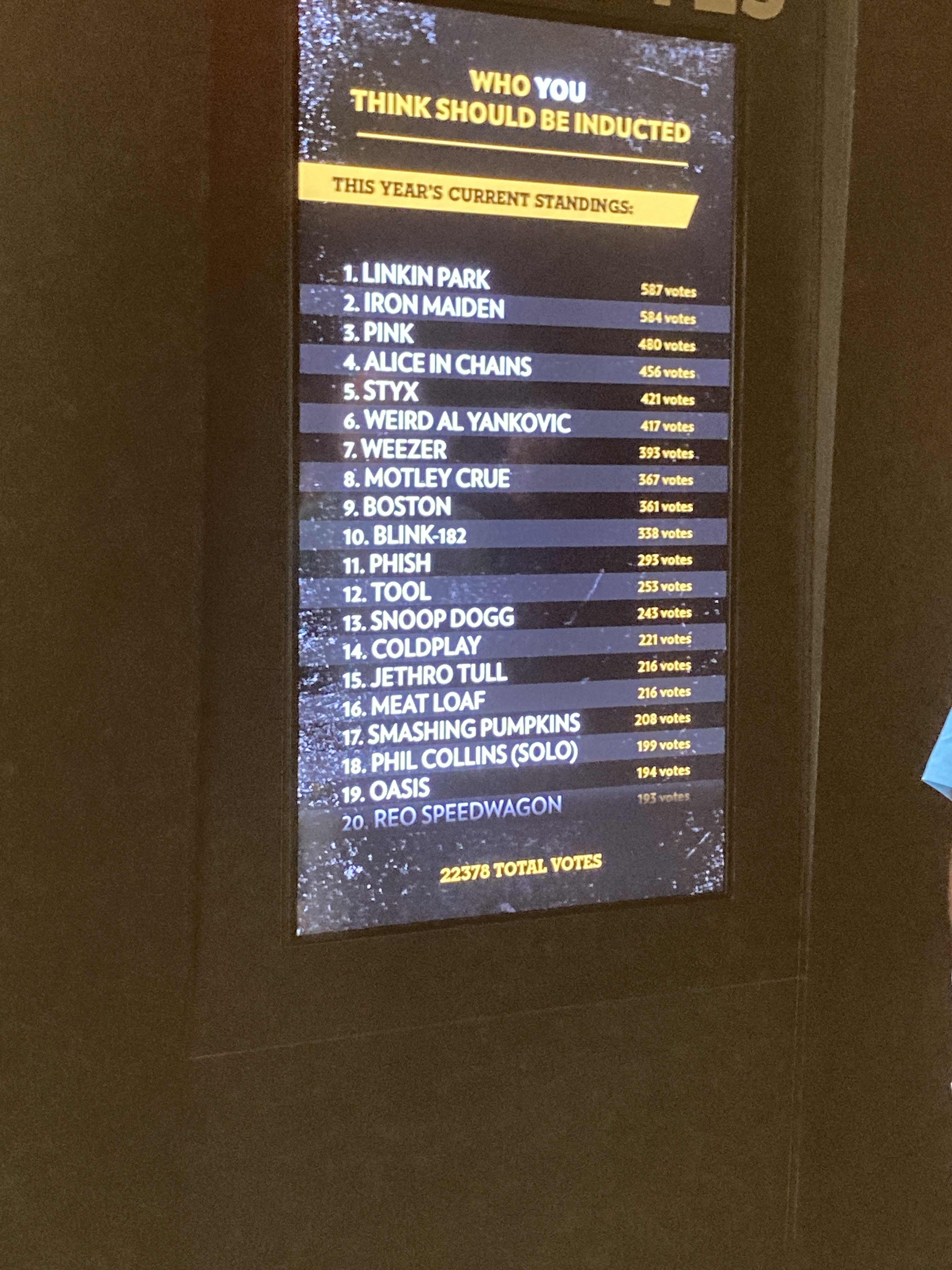
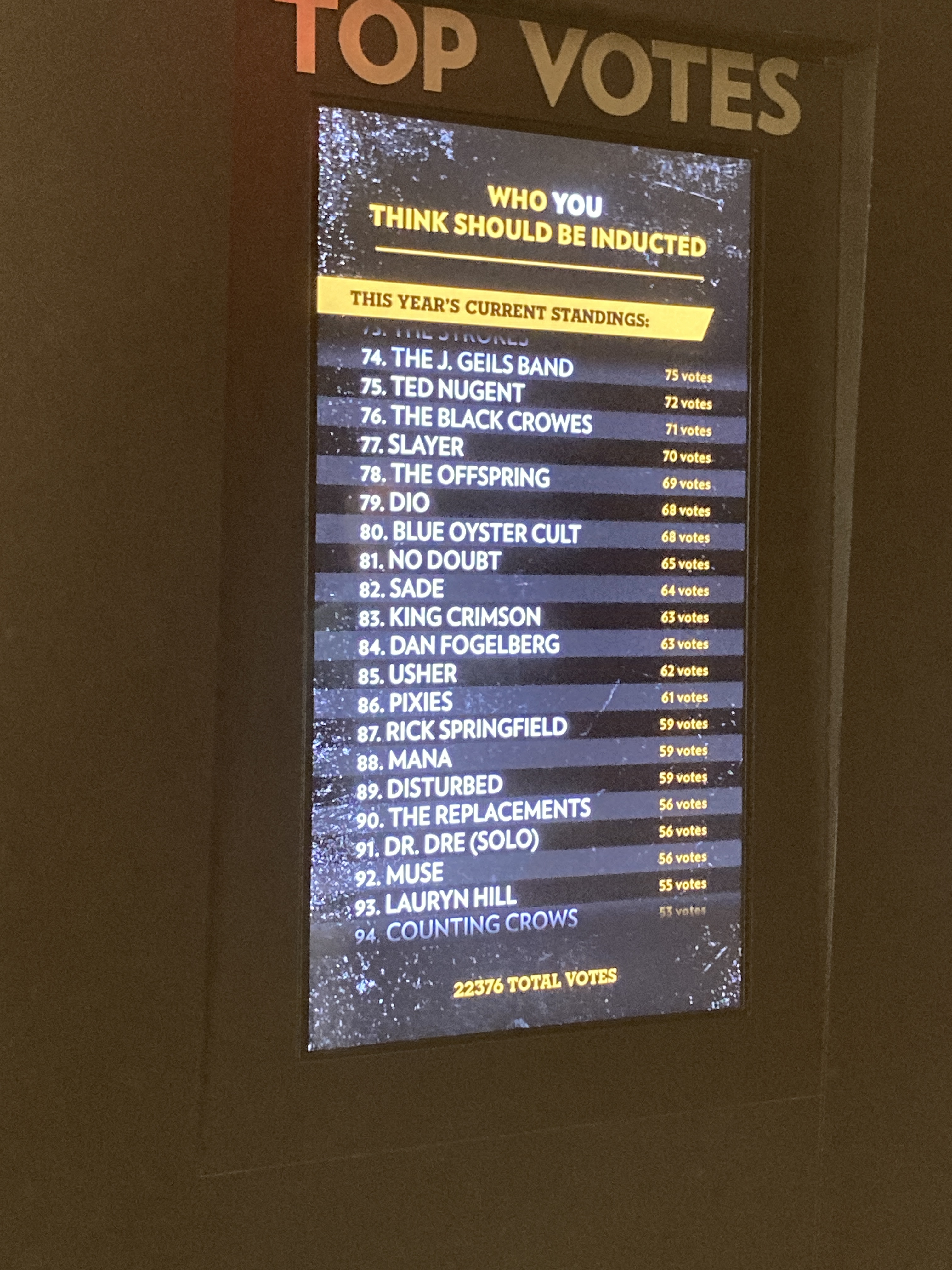
And, doubtless more to harvest email addresses than anything else, you can also vote on who you think should be in the Hall on adjacent video screens. Having done my civic duty by casting a vote for King Crimson, it was heartening to see them at #83 in the Top 100 of this year’s fan poll, though in a lower position than Styx (#5, just in front of Weird Al Yankovic), Tool (#12), Jethro Tull (#15), and Kansas (#35, not pictured). (And sad to say, Emerson Lake & Palmer were nowhere in sight.)
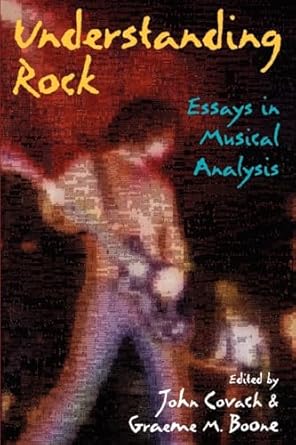
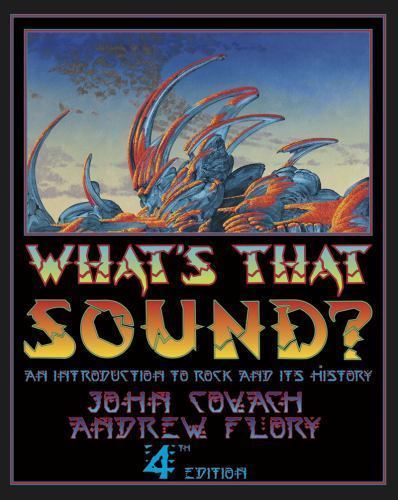
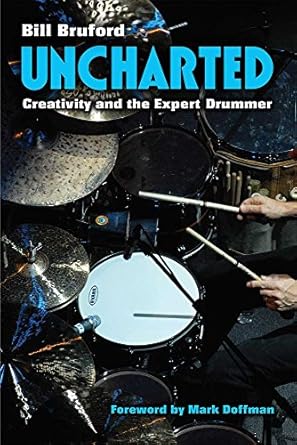
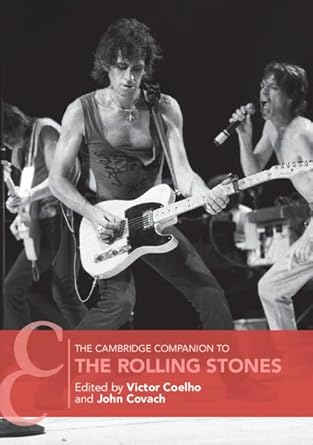
Then it was on to upstate New York, where I spent a delightful hour over coffee with noted music theory scholar and killer guitarist (and acquaintance from my grad school days) John Covach. One of the vanguard academics who pioneered rigorous analytical study of rock in general and prog in particular, John overflowed with good vibes as he waxed eloquent on the delights and challenges of shepherding books like Understanding Rock, What’s That Sound? and The Cambridge Companion to the Rolling Stones through the university press publication process; setting up a lecture tour of U.S. music schools for legendary drummer Bill Bruford (fresh from gaining his own Ph.D at the time); and getting gigs in a Yes tribute band when the post-Anderson version of the group still toured North America every summer! It was a blast to reconnect with John, who in addition to teaching and researching at the Eastman School of Music, is hard at work editing The Cambridge Companion to Progressive Rock (still in pre-publication, hopefully to be officially announced in 2026).
From there, it was a short border hop to an overnight stay in St. Catherine’s, Ontario — in a subdivision:
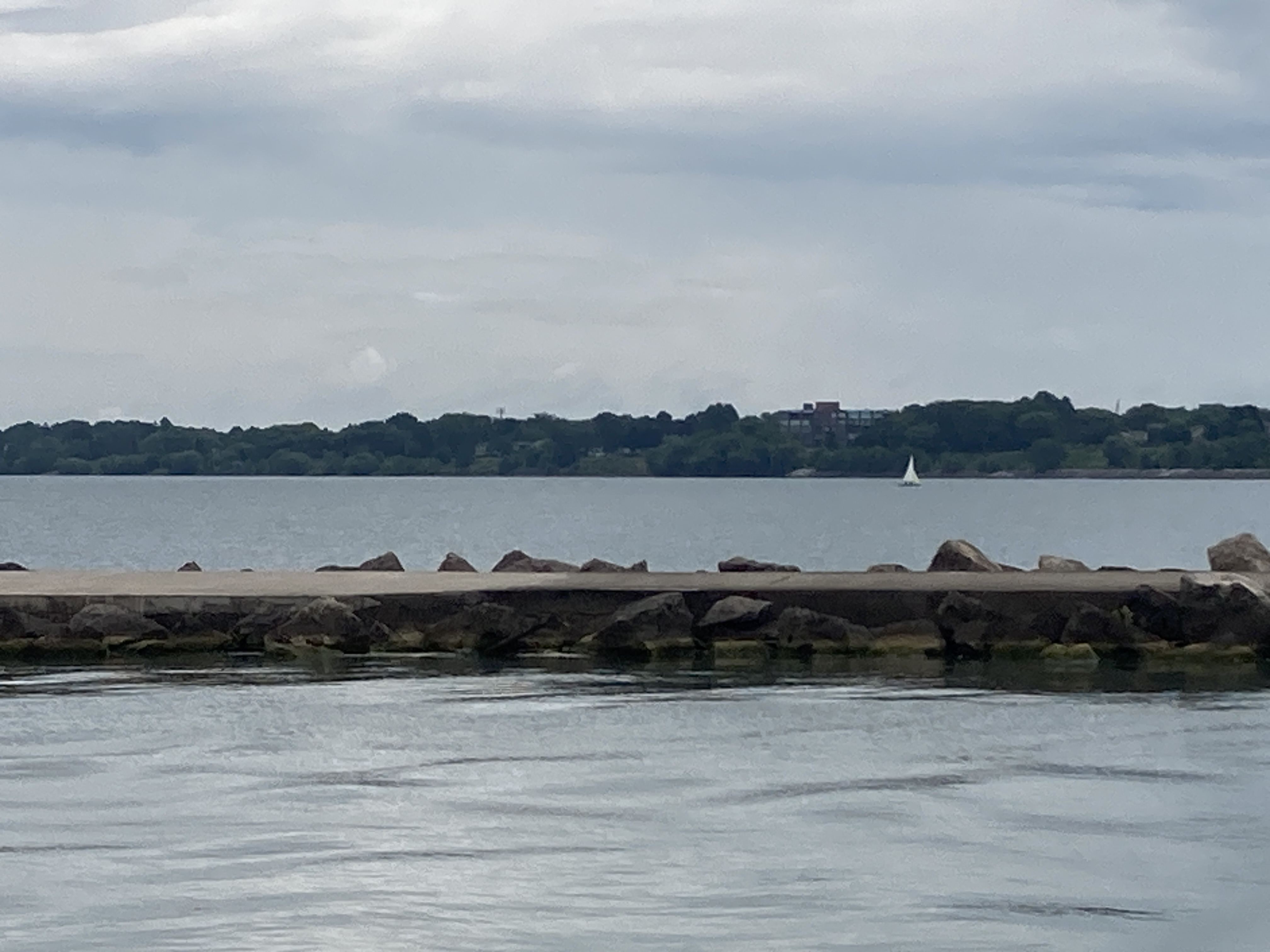
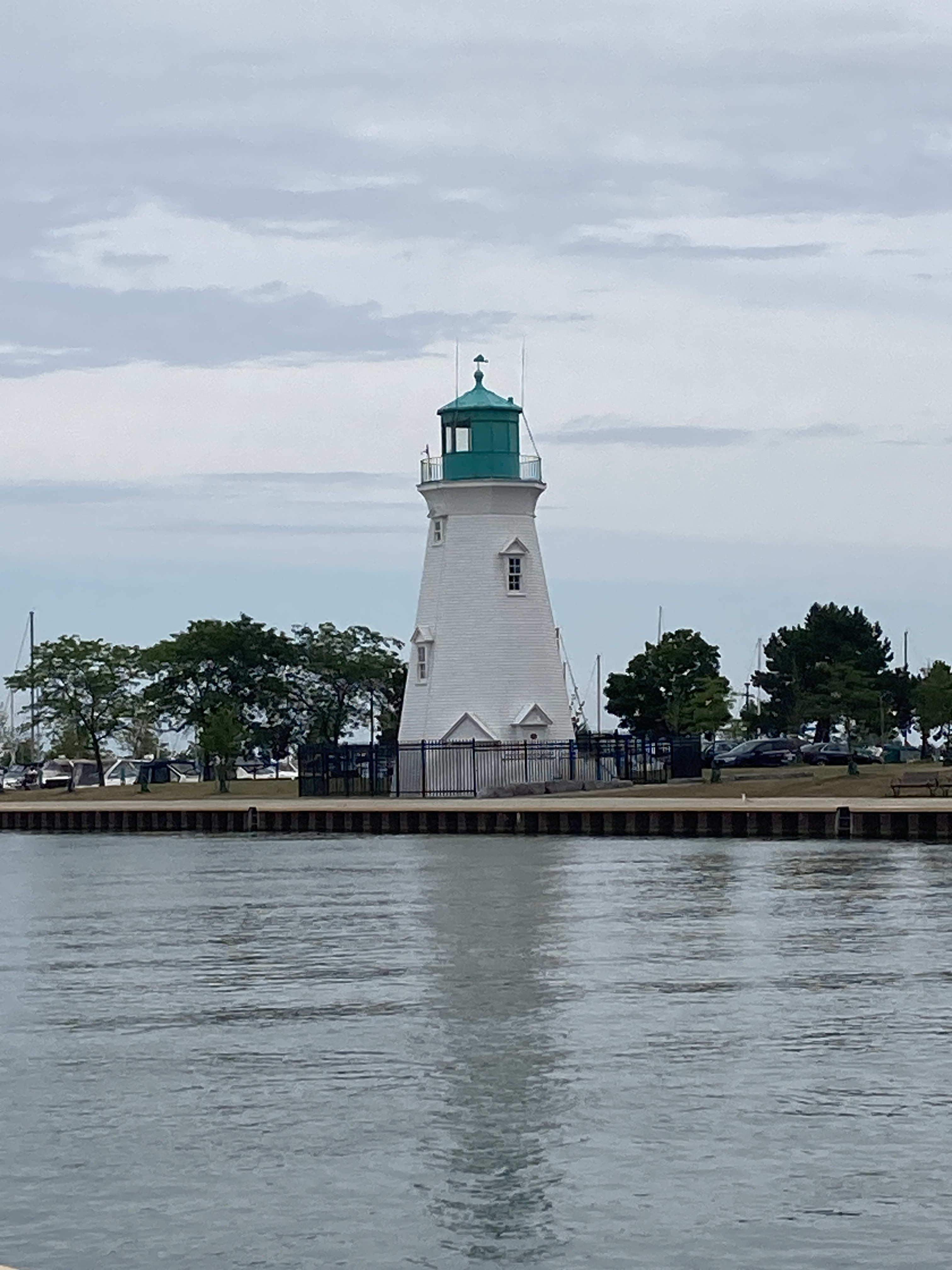
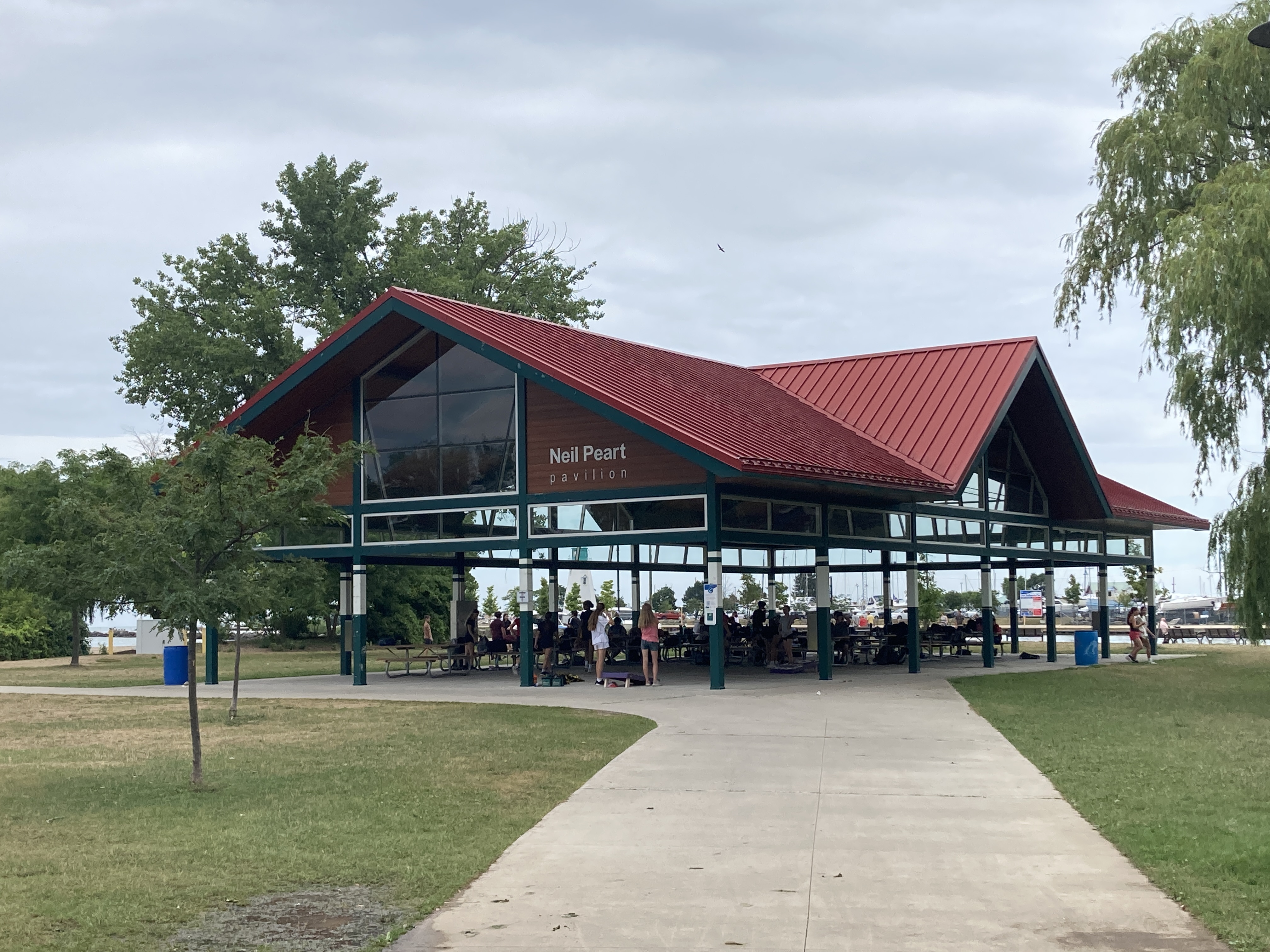
And yes, landing in the hometown of prog-metal’s finest drummer/lyricist was no coincidence; an outing to the town’s Lakeside Park (gorgeous even on an overcast day), complete with a picnic lunch in the shadow of the Neil Peart Pavilion brought the early Rush song of that name to vibrant life. (Fundraising for a memorial sculpture of Peart to be installed in the park has been in progress since last fall; click here for more information.)
If there’s a lesson, I suppose it’s this: a proggy vacation does not just happen; it must be carefully planned. So, fellow Progarchists: what’s your dream itinerary?
— Rick Krueger
P.S. Yes, all of the above is pretty retro; but new prog and more cool music piled up in my inbox while I was gone, so the appropriate Quick Takes are coming . . .
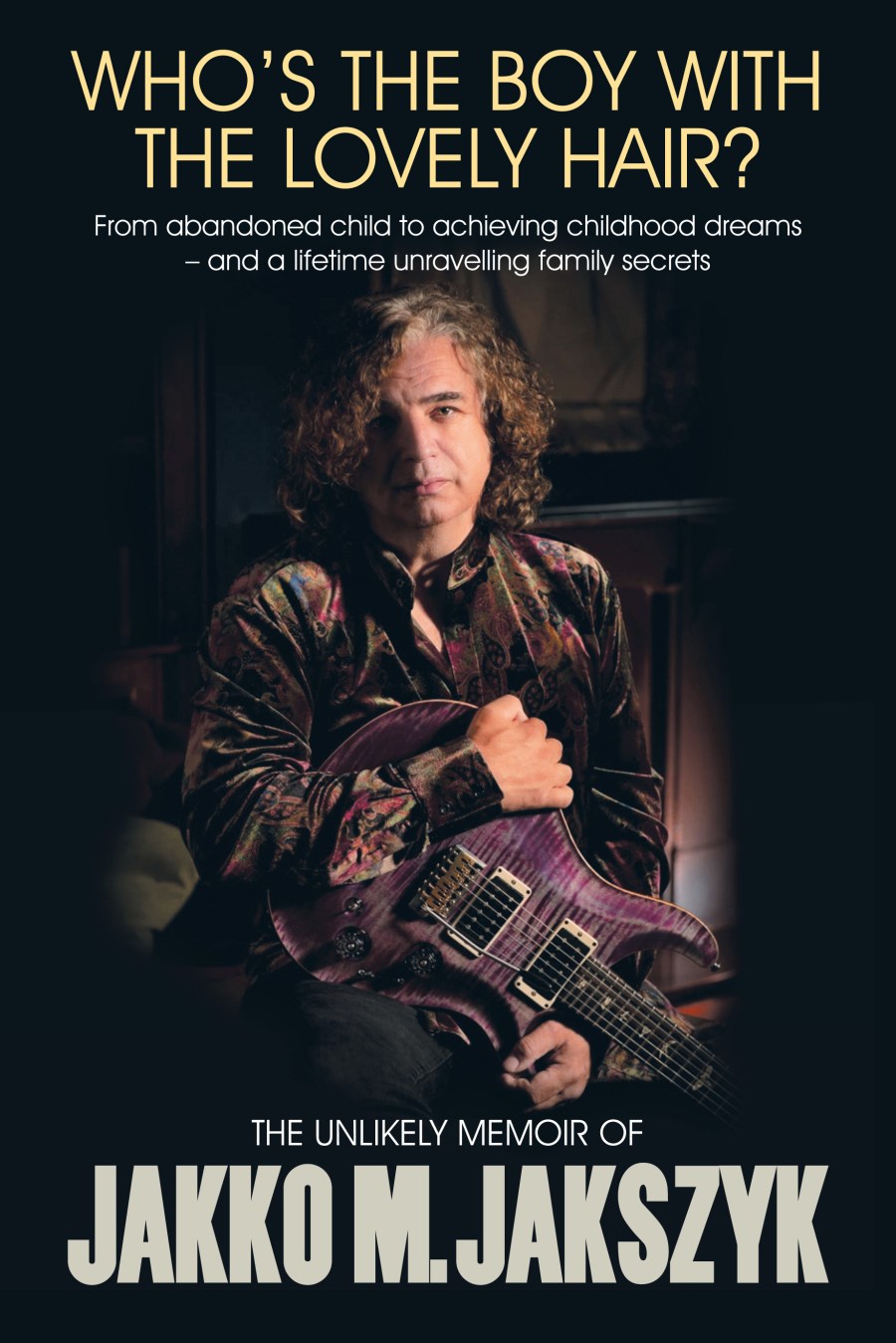
“A Musical Memoir Like No Other” – as always, the estimable Alison Reijman nailed it in her review of Who’s The Boy with the Lovely Hair: The Unlikely Memoir of Jakko M. Jakszyk last fall. Stranger than fiction would be an understatement; only Jakszyk could have told this page-turning, hair-raising narrative — the son of Irish and American parents, raised by a older Polish/French couple, driven both to make his mark in the music business (from having his shoes noticed by Michael Jackson to joining The Kinks for a week to becoming the singer in King Crimson’s final incarnation to date) and to suss out the twisty, elusive truth of his life story.
In fact, Jakko’s past has consistently fed his most personal art, from radio dramas and one-man theatrical shows to his pensive, potent solo albums The Bruised Romantic Glee Club (2007) and Secrets and Lies(2020). Released later this month, his new record Son of Glen continues his quest for both clarity about his past and a settled present, building from subdued acoustic beginnings to an explosive electric finale with patient, long-breathed confidence. Like all Jakszyk’s work, it’s bracing stuff that nonetheless goes down smooth — fearless, affecting and engrossing.
It was a pleasure to talk to Jakko about the new album. Even at the end of what I’m sure was a long day, he was positive, attentive and kind — when I had audio problems at my end, he generously recorded the interview and sent it to me! My thanks to him for his time and for going the extra mile. Audio is immediately below, with a transcription following.
We last talked about five years ago, after your last [album] had been released, and I know you published your book in that time. What are the things that you see as milestones or turning points on your path between Secrets and Lies and Son of Glen?
Well, I guess the book came in between. I did a one-man show at the Edinburgh Festival, which is loosely based on events in my life; that followed the album.
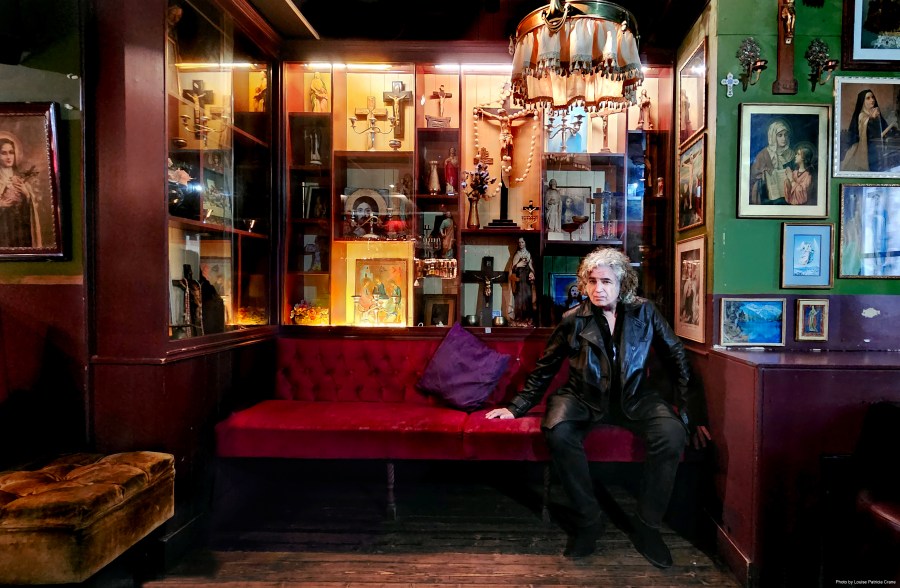
And then, as a result of that, I got the book deal. And although I’d been asked to complete another record, I kind of started bits and pieces. Really, what inspired the record as it stands now was partly the work I did on an album called Netherworld by the lovely Louise Patricia Crane.
And I did a lot of things on there at her behest, I think; I found myself digging deep into my musical DNA and my past to come up with stuff that is part of what I grew up listening to, but stuff I hadn’t ever really used in my own work.
And then when we’d finished, when I’d finished the book, again, I was in a weird place and Louise was incredibly significant in building my confidence back up. And then I remember one evening we were having dinner and, having discovered my real father after decades of fruitless searching for him, she pointed out something that I guess was kind of obvious, but hadn’t crossed my mind in that the reason I exist at all is that my American airman father was stationed in England and fell in love with a dark haired Irish singer.
And here I was all these decades later, kind of repeating the same thing! Which was, I guess, kind of staring me in the face, but it was only when she mentioned it. And so that became the inspiration for the title track and the title of the song, really.
I then, armed with this conceptual idea — both [my] kids play, they’re both great musicians, both my kids. So there’s always instruments in the house everywhere. And they quite often, both of them, my daughter and my son, mess around with alternate tunings. I’ve never really done that. And I remember picking up a guitar and I had no idea what was going on, tuning-wise. And I came up with this pattern, and that started the whole title track.
And then it just developed. I didn’t set out to write some epic. It was just this conceptual idea, a few chords, and then it just kind of started to write itself, really. And then that set the tenor of the whole record, and the idea of making it relate to the book.
Okay. You mentioned some musical areas that you dug into when working on your partner’s album that you had maybe put aside or not necessarily used. Could you be a little more explicit about that?
Yeah, sure. When I was a kid, the band I probably saw live more than any other was the Gabriel-era Genesis, because they played locally to me, where I live in England. And I was completely taken with that. But I’ve never really done anything Genesis-like, I don’t think, on my own stuff. And there were certain references that Louise was utilizing when we were creating her album. And I thought, “oh, okay, yeah, I used to love that record!”
And so Genesis, there’s bits of Jethro Tull, again, a lot of acoustic-type stuff that’s not really normally evident or fundamental to any of the work that I’ve done. I think I’m referring to those specifically in terms of my own record. But there was other stuff. There’s a lot of the references that she utilized that I was able to kind of replicate, because I understood the musical language.
To backtrack a little bit, one of the things I noticed is that a number of the chapter titles in your book become song titles on Son of Glen. I’m assuming that’s a deliberate thing, and that there’s some significance involved with that.
Yeah, some of them were ideas I’d started and then wrote the book. In fact, there was a couple of things I’d done when I was promoting the book later on. There was a couple of instances where it was a really interesting thing, where I would talk about how some of the songs are kind of diary entries. They’re responding to something that’s happened. And so I was able to say, “well, look, what I’m going to do now is read a passage from the book that describes the event in detail, and then I’m going to play the song that I wrote about it.” So I was able to do that at that stage as well, because the two things started to overlap.
And sometimes I’d just have a title, which I then used as the title for the chapter of the book, and then extrapolated from that. And some of the things I’d already started, that were from way back, but fitted into the conceptual continuity of the whole nature of the book and the album together.
Another thing I noticed: if you divide the album into LP sides, each one opens with a distinct version of that instrumental, “Ode to Ballina”. Is that simply for the sake of variety, or does that play a part in how things unfold musically?
It was a deliberate ploy. I thought, and I was deliberately thinking about it as vinyl, even though I know it comes out on CD too. For the first time really, I was definitely thinking about it in vinyl terms. I had a conversation with Thomas Waber, whose label it is, and we were discussing about how the length of albums has got preposterous due to the ability to store more information on a CD. And in his head, and kind of mine, those album era years of the ‘70s, 40 minutes, 45 minutes, that was enough, that was ideal. So, I did think in those terms.
And I thought, well, “Ode to Ballina” is a piece based on my emotional response to going to Ireland, back to where my mum came from for the first time. And so I thought, that’s a great place to start, because that’s the kind of start of the story. And then halfway through, to reiterate that theme, but do it — by which time I’m now a musician, and I’m living a life as a musician — to reiterate that same thematic idea, but in a more modern, more electric way. So that was deliberate, as was the beginning of each side and the end of each side.
I knew I definitely wanted to end with the 10-minute title track. And I wanted to end side one with the song I wrote about Louise.
And as I heard that album, what I felt like was that the whole thing built from the acoustic beginning on the first side, it was almost like this long 40-minute crescendo, which was really effective.
Oh, well, thank you.
Because like you say, on side two, you’re bringing in more of the electric elements, and it just sort of gains in whoomp, to use a technical term.
[Laughs] That’s great. You know, these things, you have a rough outline of a conceptual idea, and then the music kind of takes over and presents itself in a way. So it’s a combination of finding a vehicle and then somehow something else takes over. I mean, I don’t know what it is, whatever you call it, you know, inspiration or the muse or whatever.
Yeah, I felt good that I’d kind of dealt with some subjects that are peppered throughout the book and ended up with a paean to my real father. That’s the mystery of the beginning of my book and the beginning of my life. That’s where the book ends, really: me finally, after decades of fruitless searching, finding who he was and stuff about him after being thrown all sorts of red herrings by my mother and downright lies.
I know one of the themes of the book is how difficult it has been to get to the truth, because you had to pick your way through any number of deceptions and equivocations.
Yeah. And it feels, like all of us, we want a degree of stability, we want to know who we are, we want some solid ground on which to stand, you know.
And you keep thinking, “Oh, OK, that’s what happened. Fantastic.” And then, and then, you know, a few years later, the rugs pulled out and you thought, “Oh, hang on, that was all bulls–t. Wait a minute!”
And so, you find yourself constantly in a state of flux. And, you know, these things, as we’ve discovered in the decades since — at its most basic in the 50s and 60s, I think the attitude was, “Well, having children adopted has got to be better than bringing them up in a home [orphanage],” and it’s only in the intervening decades that a lot of research has been done into how that experience fundamentally affects an awful lot of adopted kids, and it f—s with your psyche and it and it has a whole controlling influence on your whole personality.
So as you say, these songs are full of people from your history, your birth mother, your adoptive father, your current partner, your biological father, a friend who passed away. Does writing about them, whether in your book or for this album — how does that make a difference in terms of how you think about them, how you feel about them?
Well, I think writing the book in particular, because it’s so detailed and so if you’ve read the book, you’ll realize how long it is.
Oh yeah, that was one of the things that I think was fascinating about it, is how much detail and depth and — your life has been so full of incidents and coincidences and synchronicities, as well as — frankly, the incredibly difficult foundation that you had. But again, you can tell that you’re processing this.
Yeah. I tell you what, there was a weird thing right at the end of writing the book. There was a sense of achievement. Because I know when I was first approached to write the book, the publisher sent me a kind of contractual breakdown and advances and all this. And then I ignored it.
And about three weeks later, they said, “Do you not want to do this?” And I said, “I don’t think I can do it. I’m a small person at the bottom of the Himalayas. I can’t get up there. That’s miles away.”
And then they suggested, “Well, maybe we can get a ghostwriter.” And I said, “You know what? I’m not going to use a ghostwriter. So, I’m going to write an opening chapter. And if you think it’s of any worth, then let’s discuss it further.” And that’s what I did.
So, when I finished the book, there was a sense of achievement and euphoria that I’d actually done something that extraordinary and that long and [of] that depth. And that stayed with me for about a week. And then we had a meeting about it coming out.
And then suddenly it dawned on me that I’ve written this unbelievably personal, exposing stuff. And everyone would — you know, people were going to read this!
So that was a real shock. I mean, I know it sounds ridiculous in that that’s the very nature of writing a book. But that really freaked me out.
So, it was a whole rollercoaster of emotions, because on one level, it was incredibly cathartic. But on another level, you know, all these things have happened. There’s an approximate chronology in your head of how things led one thing to another. But when you sit down in a concentrated way and lay it all out before you, all of those things, the random things that you mentioned, you know, it’s kind of weird moments of luck and timing.
But they’re all kind of connected, because had I had a normal upbringing, I would not have been so driven and I wouldn’t have felt so fundamentally insecure and have a low self-worth, which means I wouldn’t have just worked like a maniac, you know, and said yes to everything. So I would never have put myself in those different places and gone forward, so it’s a kind of weird mishmash of the experience.
So, you’re still left with those fundamental flaws in your personality from what happened as a child. But at the same time, it’s enabled me to live this extraordinary life and meet the most amazing people. So, it’s a weird kind of car crash of of all those things, of all those emotions.
And I think the cathartic nature of it, seeing it all written down, understanding how bits fit. When I finished the book, I went into some post-adoptive counselling as well. And one thing I found is that, whilst you can place what happened and how you feel as a result of what happened and while you can understand it and see the logistics of it, what it doesn’t do is stop you — you still feel those feelings. The difference is, you now know where they come from, and you understand how that journey has manifested itself. But it doesn’t — for me anyway, it doesn’t stop those innate feelings. You just know where they come from.
[On the other side: Jakko talks with and about Steven Wilson, best mate/drummer supreme Gavin Harrison, the guys in Marillion, Robert Fripp, the future of King Crimson releases, and much more!]
With new releases from the first third of 2025 piling up, a desperate attempt to answer the question “Can album reviews convey the essential info listeners need in haiku form?” For example, about the format used below:
Streams linked in titles; Brief poetic impressions; Shopping links follow.
Spawton’s young heartache Sparked this grandiose concept – Well-wrought remaster. (CDs sold out; vinyl available at Burning Shed and The Band Wagon USA)
A good chunk of early 2025’s prog action has been concentrated “in the arena”: new releases and reissues of concert recordings, whether of decades-old vintage or just yesteryear, unplugged or fully electrified. Purchase and streaming links are provided below where available. (One relatively new challenge: physical media is selling out faster than ever these days; some of what’s below ran out of stock even before the official release! Bookmark the appropriate page and hope for restocks, I guess?)
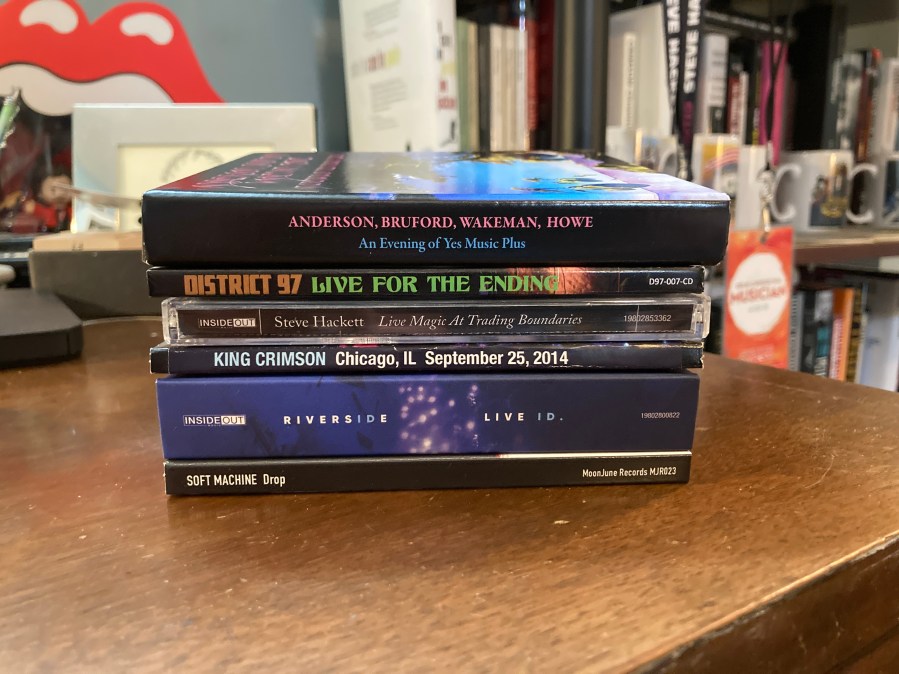
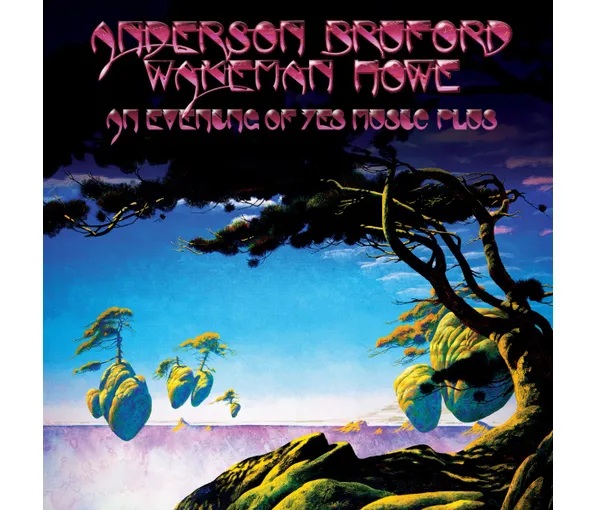
Anderson Bruford Wakeman Howe, An Evening of Yes Music Plus:One of the odder detours in Yes history, as Jon Anderson left the more commercial mothership of the 1980s and gathered 3/5th of the band’s breakthrough line-up for an album/tour cycle that proved equal parts throwback and reboot. As on ABWH’s 1989 studio album, the freshest moments of this 2 CD/2 DVD concert set occur when Howe’s plangent guitar and Wakeman’s graceful piano vault over Bruford’s syndrum clatter on new tracks “Birthright”, “Brother of Mine” and “Order of the Universe”. (Meanwhile, Anderson’s melodic volleys of New Age word salad remain consistent. Never change, Jon!) Potent, precise takes on classics like “Close to the Edge” and “Heart of the Sunrise”, along with plenty of solo space, make for an enjoyable show that proved there was life in these middle-aged dogs yet — even if Trevor Rabin and Chris Squire wouldn’t share the original group’s name. Thanks to Action Records of Preston, UK for their prompt service when preorders sold out!
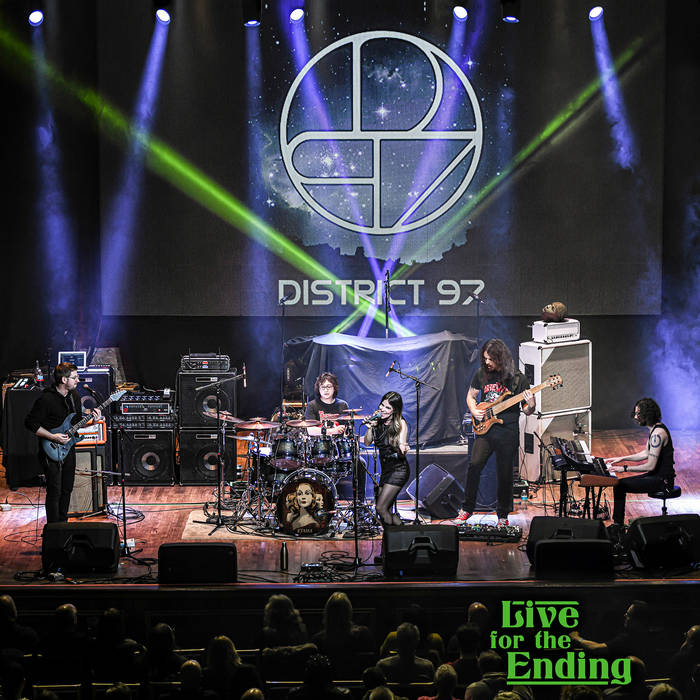
District 97, Live for the Ending: Chicago’s finest proggers play the entirety of their latest album live, at home and overseas. D97’s reading of the complete Stay for the Ending is a straight-up recital with few variations from the recording; what impresses here is the consistent commitment and energy on display. It’s evident how fiendishly difficult this stuff is, how the now-long-time lineup of Andrew Lawrence, Jim Tashjian, Tim Seisser and Jonathan Schang sink their teeth into the harmonic and melodic extremes of each track — and how consistently Leslie Hunt rises to the occasion, riding every chunky guitar/bass lick, synth blast and time-warping drum fill with her expressive, acrobatic singing. Given the constant hairpin turns and switchbacks of this music, the occasional rough edges slot right in; this is a band playing right up to the limits of their considerable skills, then going above and beyond! Longtime fans like me won’t be disappointed, and newbies will get a solid sense of how gutsy and thrilling District 97 are in concert.
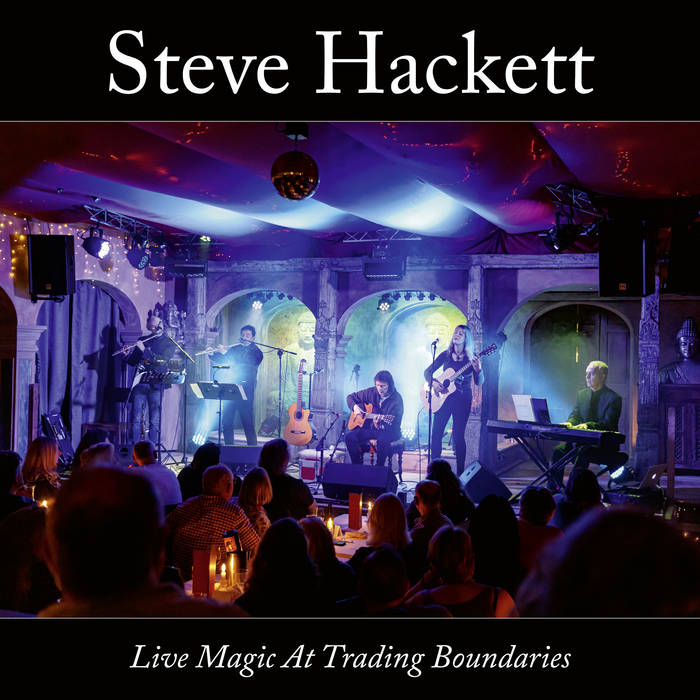
Steve Hackett, Live Magic at Trading Boundaries: The ninth live album of Hackett’s Genesis Revisited era, this unplugged set compiled from multiple year-end performances at an art gallery/performance space/boutique hotel in the British countryside, is genuine surprise and a refreshing change of pace. With Hackett focusing on nylon-string acoustic guitar, there’s plenty of old-school Genesis (the medley of an excerpt from “Supper’s Ready” and “After the Ordeal” is a masterstroke), an eclectic range of solo material (with Hackett’s brother John and Rob Townsend on woodwinds), lovely original songs from sidekick Amanda Lehmann (with Steve on harmonica!) — even a blast of digital keys from Roger King, waking everyone up with a bit of Francis Poulenc’s organ concerto! Delicate, luscious and immediately appealing , Live Magic also proves a worthwhile appetizer for recently reissued “special editions” of Hackett’s acoustic back catalog (1983’s Bay of Kings, 1988’s Momentum, 2005’s Metamorpheus and 2008’s Tribute) — which seem to be selling out even as I type . . .
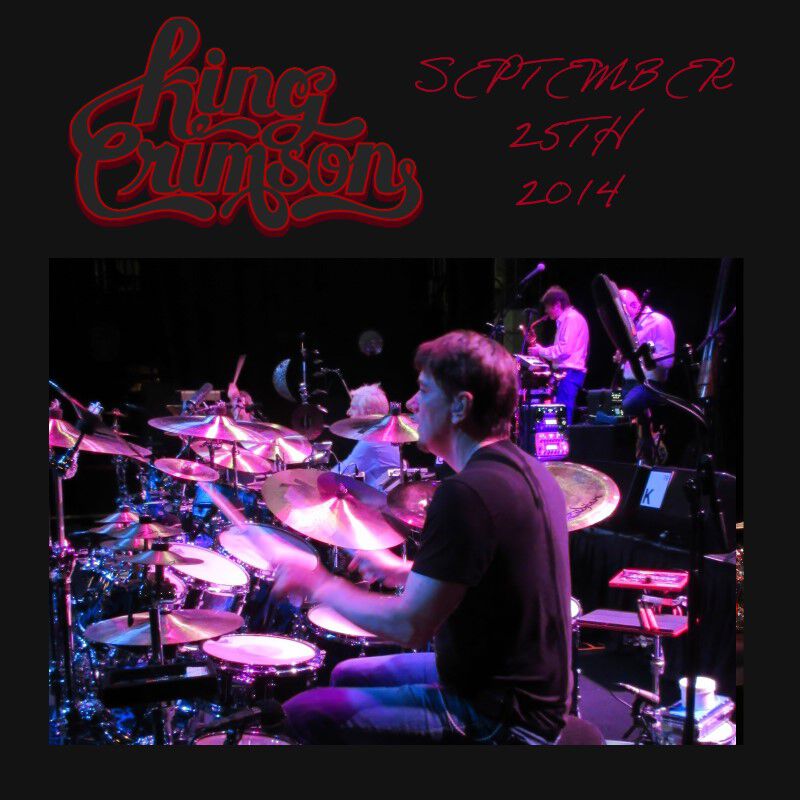
King Crimson at nugs.net: Partnering with the premiere online concert specialists (whose clientele range from superstars Bruce Springsteen and Jack White to up-and-coming jammers Billy Strings and Goose), Robert Fripp’s Discipline Global Mobile has already made 44 Crimson shows (26 from 1996’s Double Trio outings, 18 from the 2014 Elements of KC tour) available for streaming with paid subscription, or for purchase as downloads or CDs. I picked up the CD of the night I attended the 2014 tour in Chicago (September 25th at the Vic Theater); after six years away from the concert stage, this edition of The Mighty Crim blew away the audience with its triple-drummer frontline, Mel Collins’ visceral attack on multiple saxes, Jakko Jakszyk’s mellifluous vocals, and a wide-ranging setlist stretching from 1969 psychedelia to the wide-open soundscapes of 2011’s A Scarcity of Miracles. With more tour bundles from across the decades promised for the future, nugs.net now seems the go-to source for archival Crimson concertizing. Bring on the 2019 and 2021 tours, please!
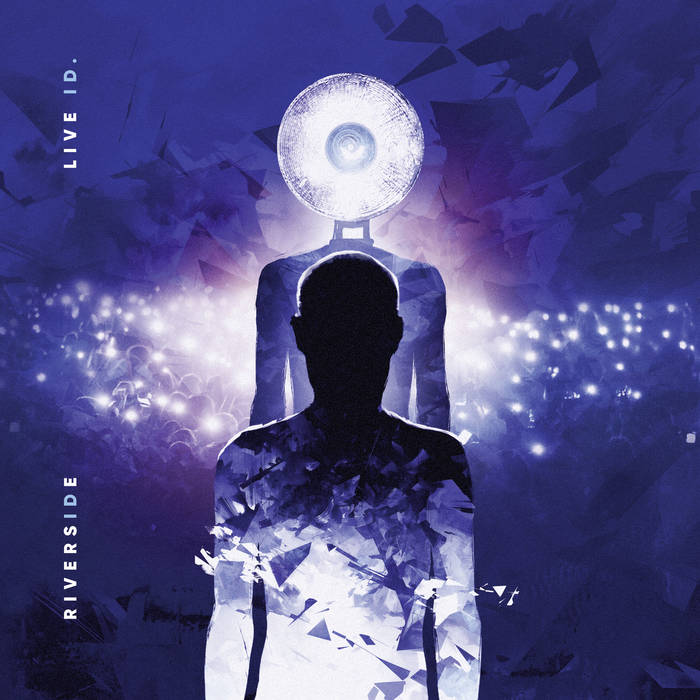
Riverside, Live.ID:The Polish quartet comes out smoking hot for the final gig of their 2023 ID.Entity tour on this 2 CD/BluRay set. Michal Lapaj’s ebullient keyboards grab hold with sizzling synth and organ hooks; Maciej Miller’s gruff power chords and earthy leads anchor the driving hard-rock sound; Piotr Dozieradzki’s pounding drums push the music forward. And at center stage, Mariusz Duda holds down one busy bass groove after another, all the while launching compelling, dystopian narratives of isolation in an overconnected age. With a setlist split evenly between their last album and their back catalog, these guys prove looser, yet more ferocious than on their fine studio albums, never letting up on the intensity. And the audience respond in kind, matching Duda’s request for them to be “the fifth member of Riverside” with enthusiasm to spare. More than a concert, this feels like an event — a great intro for neophytes, a rewarding summary of Riverside’s career to date for longtime fans. (Note that the CD/BluRay version is already hard to find!)
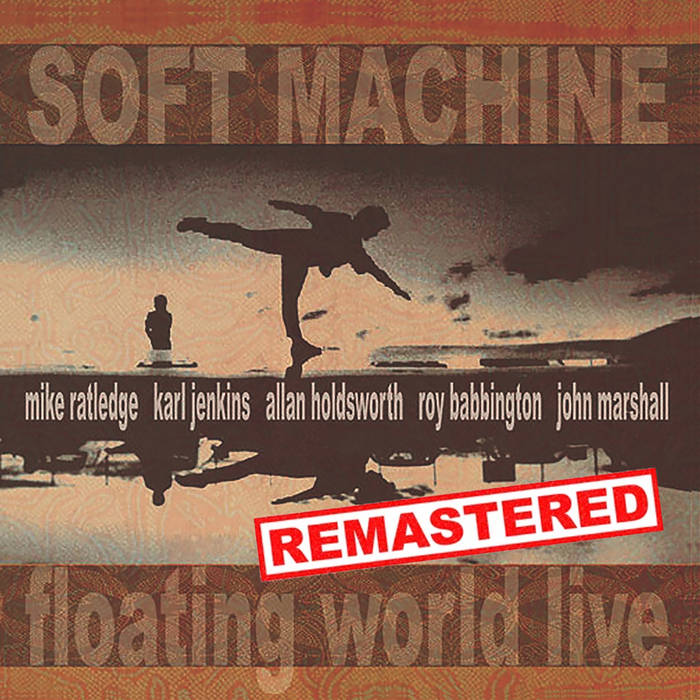
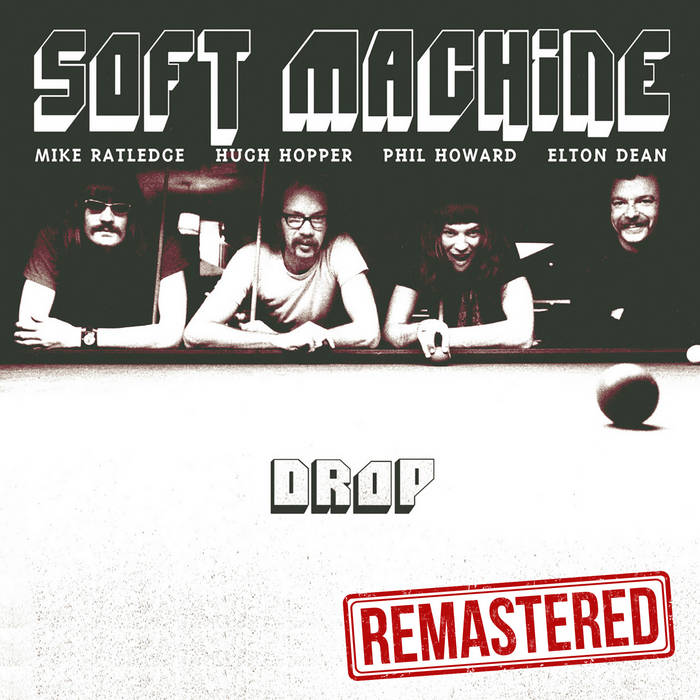
Soft Machine, Drop & Floating World: Only four years separate these two sets from the pioneering British jazz-rockers, freshly remastered by guitarist Mark Wingfield — but what a difference those years make! Recorded live on a 1971 German tour, Drop unveiled a quartet speeding headlong for the outer limits of music itself; riding cascading waves of Phil Howard’s manic, loose-limbed drumming, saxophonist Elton Dean screams and howls into the ether, while bassist Hugh Hopper and keyboardist Mike Ratledge hang on for dear life. It’s a breathtaking whirlwind of sound, shaped more by free rhythm than discernible melody — exhilarating, but not for the squeamish.
By 1975, Dean, Hopper and Howard were out; in their place, Karl Jenkins (later to earn a knighthood for his classical crossover project Adiemus), Roy Babbington and John Marshall were laying down a more fusion-oriented, arguably more sedate vibe. Enter fledgling guitar hero Allan Holdsworth to fire things up on another German tour; his lightning-quick runs and ear-catching chord work energize Floating World Live, inspiring his bandmates to fresh heights of invention and interplay on pieces from the first-rate studio effort Bundles. Awash with echoes of Mahavishnu Orchestra and Return to Forever filtered through a genial, sardonic English sensibility, this is required listening for fans of the genre and Holdsworth heads. (A manufacturing error has held up the release of the Floating World Live CD, but MoonJune Records mainman Leonardo Pavkovic is on the case!)
File under “unfinished business”, I guess. Below, albums from last year I hadn’t gotten around to reviewing, or hadn’t heard yet, or didn’t even know existed until I stumbled across them. (That last category, by the way, turned up a couple of real winners!) Purchase links are included in each artist/title listing; streaming options follow each review.
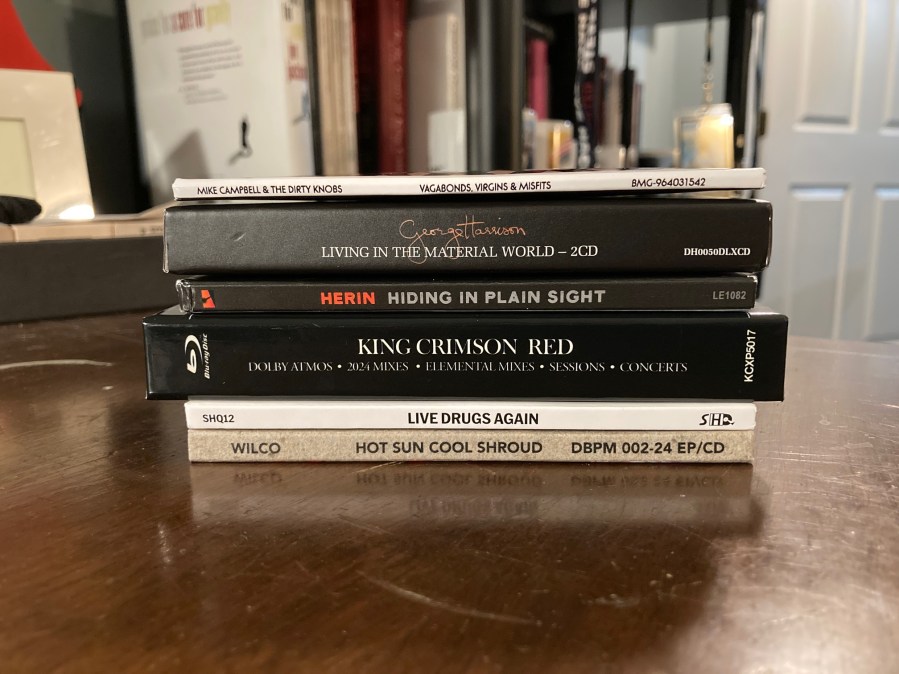
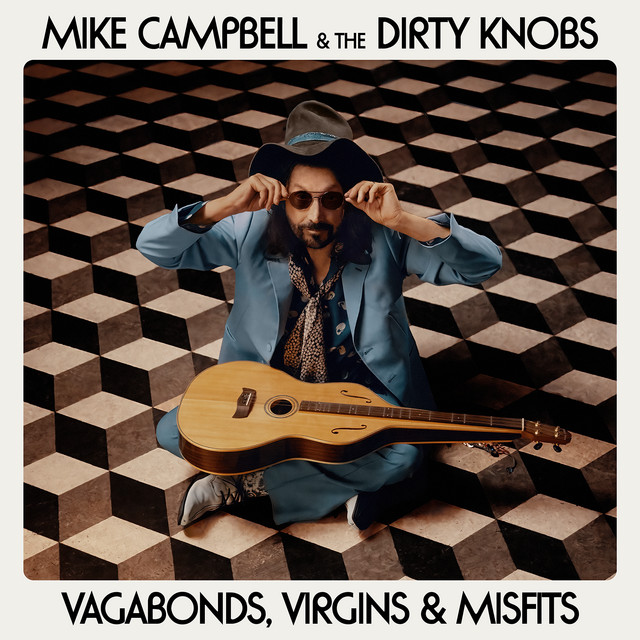
Mike Campbell and The Dirty Knobs, Vagabonds, Virgins & Misfits:On their third album as a band, the late Tom Petty’s right-hand man Campbell and compadres hit the motherlode. It takes a few tracks for the Dirty Knobs to loosen up, but once the desperate slowburn “Hands Are Tied” achieves rave-up velocity, it’s all gold — Byrdsy stomp “Shake These Bones”, harrowing border narrative “An Innocent Man”, honky-tonk single “Don’t Wait Up” (with country-soul heavyweight/summer tour partner Chris Stapleton kicking in a verse) and trashy addiction kiss-off “My Old Friends” are just the highlights! Guest stars galore, including former Heartbreakers, prove worthy foils for Campbell’s tales of big trouble and occasional triumph, spun out by his sinewy baritone and tasty, twangy guitar. If you’re looking for an album that puts the classic back in classic rock, look no further! I’m calling this a Delayed Favorite.
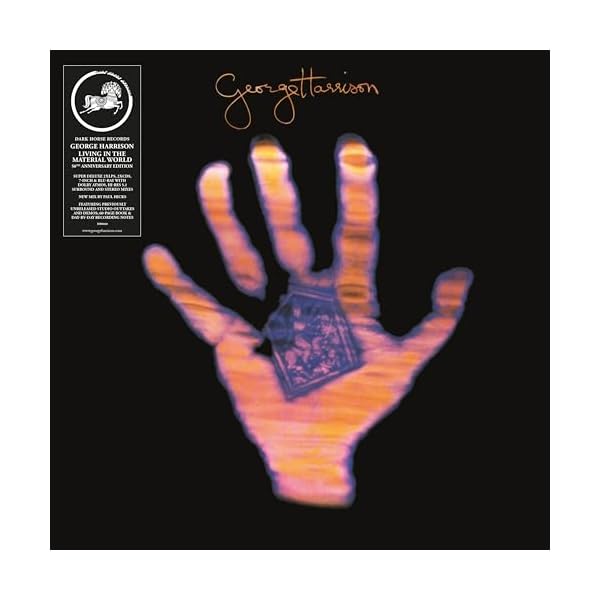
George Harrison, Living in the Material World (50th Anniversary Edition): While Harrison’s 1973 sophomore solo effort did chart-topping business and garnered positive reviews back in the day, it never quite lodged in public consciousness like his monumental debut All Things Must Pass. Songs that ricocheted between rapt religious devotion (“Give Me Love”, “Don’t Let Me Wait Too Long”), pressurized street-corner sermons (the title track, “The Lord Loves the One”) and sour reflections on post-Fab Four wrangling (“Sue Me, Sue You Blues”, “Try Some, Buy Some”) had a part in this, along with muddy production obscuring inspired, rootsy playing by George, Gary Wright & Nicky Hopkins on keyboards, and – rock solid as ever – Ringo as primary drummer. Paul Hicks’ fresh mix opens up things considerably: George’s breathy vocals are now more passionate than harsh, his acoustic playing shimmers, his slide work bites hard and sweet, and the band chugs along in high style. Now much more approachable, this vivid new version is well worth hearing (available in single, double and super-deluxe configurations).
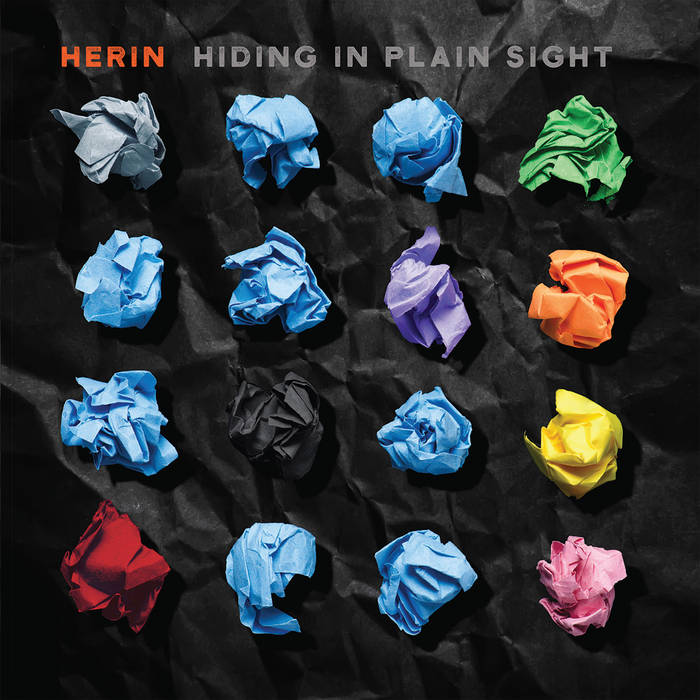
Herin, Hiding in Plain Sight: Detroit guitarist/songwriter Chris Herin is best known as the mainspring of hard-proggers Tiles (rooted in the music of Rush, with producer Terry Brown and artist Hugh Syme frequently on hand to play up the similarities) for 25 years. Here he goes solo with a deeply personal concept record, chronicling his beloved father’s 10-year struggle with Alzheimer’s disease. Grounding the music in accessible yet expansive AOR, Herin constantly shifts lyrical perspective — now observing dementia’s progress from the outside, now imagining how it played out inside his dad’s head. With Herin’s unswerving rhythm guitar at the center, an starry cast of players and vocalists bring his song cycle to life: highlights include subtle guitar textures from Jethro Tull’s Martin Barre (“The Darkest Hour”) and Alex Lifeson (“Second Ending”), a searing lead playout by Peter Frampton (“The Heart of You”), heart-piercing vocal turns from Porcupine Tree/Steven Wilson sideman Randy McStine (especially “Secret Adversary”) and a trio of dramatic soliloquies by Discipline’s Matthew Parmenter set to chamber music backdrops. Somber yet uplifting in its evocation of loss, pain and undying love, this is a special album.
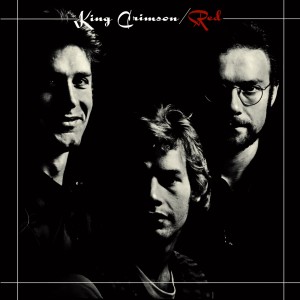
King Crimson, Red (50th Anniversary Edition): Limping home from the endless highways of America in 1974, Robert Fripp had had it with everything about King Crimson — even the unbeatable rhythm section of John Wetton (who wanted to go for mass appeal a la Dark Side of the Moon) and Bill Bruford (who wanted to hit as many things as possible loud, hard and often). Recorded in a last gasp before Fripp declared the band finished forever (oops), Red somehow gave all three players, plus guests from throughout Crimson’s first run, a unparalleled chance to shine. The uber-heavy title track, the wistful elegy “Fallen Angel”, the stinging clatter of “One More Red Nightmare” unleashed a power trio equally apt at dark romanticism and modernist brutality. And then there was “Starless” – a 13-minute swansong kicked off by Wetton’s most funereal vocal, collapsing in on itself, mounting to peak tension as Bruford slowly rebuilt the beat over a bass/guitar duel worthy of a Shostakovich string quartet, finally exploding into a double-time frenzy of wailing saxes and Fripp’s frantic, fuzzed-up speed-strums. This new 2 CD/2 BluRay version includes multiple fresh and original mixes, six complete concerts from the era, and all the surviving session reels. Overkill at its finest, capturing one of prog’s most ambitious bands going over the top just before Fripp called retreat and abandoned the genre label for good. (As mentioned last month, a Favorite for 45 years.)
The War On Drugs, Live Drugs Again: A second sampling of Adam Granduciel and his live septet making super-sized music to wallow in. Leaning heavily on 2021’s first-rate I Don’t Live Here Anymore, the WoD set one towering, hypnotic groove after another in motion; meanwhile Granduciel’s vocals skip atop the glistering surfaces, burrow between the chiming, interweaving riffs, howl burning desires above his choruses’ climactic maelstroms (pushed even farther by chewy, white-hot guitar tags). Part of the fun for rock history buffs like me is the kaleidoscope of callbacks that flit by, then fade into the aural soup: a Who-like synth cycle, high-impact four-on-the-floor drumming, distortion ramped up to touch the sublime, vocal yelps that channel Dylan, Springsteen, Bono. But the elation, the emotional release of these performances prove Granduciel and The War on Drugs are more than the sum of their wide-eyed, eclectic influences; this album is the closest thing to Elton John’s “solid walls of sound” that I’ve encountered in a long time. (Note that the CD version includes two extra tracks.)
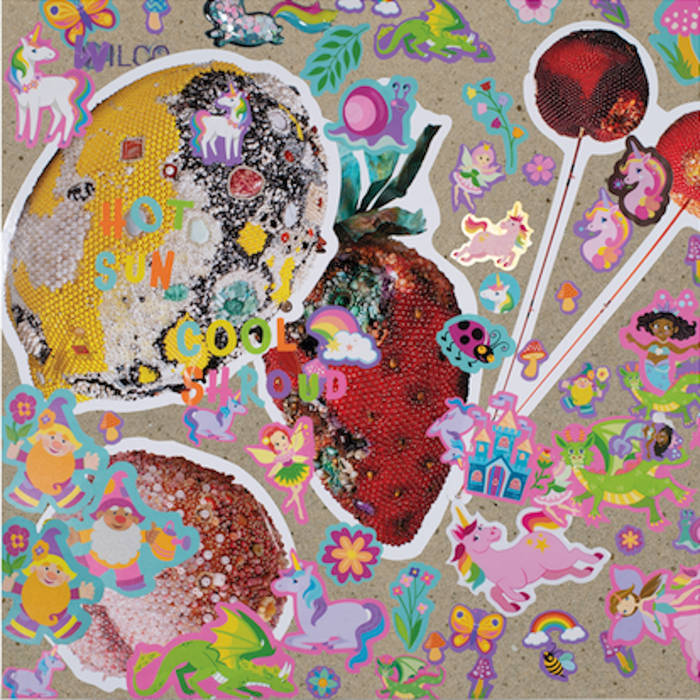
Wilco, Hot Sun Cool Shroud: A EP I missed from the Kings of Indie Dad-Rock, with the impact of an album twice its length; Jeff Tweedy and his long-time partners in chaos hit quick and dirty on six short, sharp tracks. Opener “Hot Sun” is driving yet ambiguous thrash underpinned with regally queasy synth/string pads; “Ice Cream” is a loose soul ballad with distant angel choirs and percussive rumbles; “Annihilation” goes from mumbly to lucid to arrhythmic, while closer “Say You Love Me” is a trademark Wilco eulogy, harnessing stately Beatleisms to preach connection and community. Stir in two instrumentals (the jabbering “Livid” and the bitonal acoustic gallop “Inside the Bell Bones”) and you have another Delayed Favorite. (One, I might add, very reminiscent of the band’s 2004 tour de force A Ghost Is Born, which is reissued in multiple deluxe formats next month.)
No big hoo-hah this year: just a down and dirty list of my favorite releases and reissues of the year, covered in previous Quick Takes or elsewhere on the Web (links are to my original articles)!
Bruce Hornsby, The Way It Is; Scenes from the Southside; Harbor Lights; Here Come the Noisemakers (live); Intersections 1985-2005 (box set); Solo Concerts (live). See my appreciation of Bruce’s career here!
Thanks for your ongoing attention and steadfast support. We at the Rockin’ Republic of Prog appreciate it! Best wishes as we all turn the corner and head into the New Year!
BEAT, Copernicus Center, Chicago, Illinois, Friday, November 1st, 2024
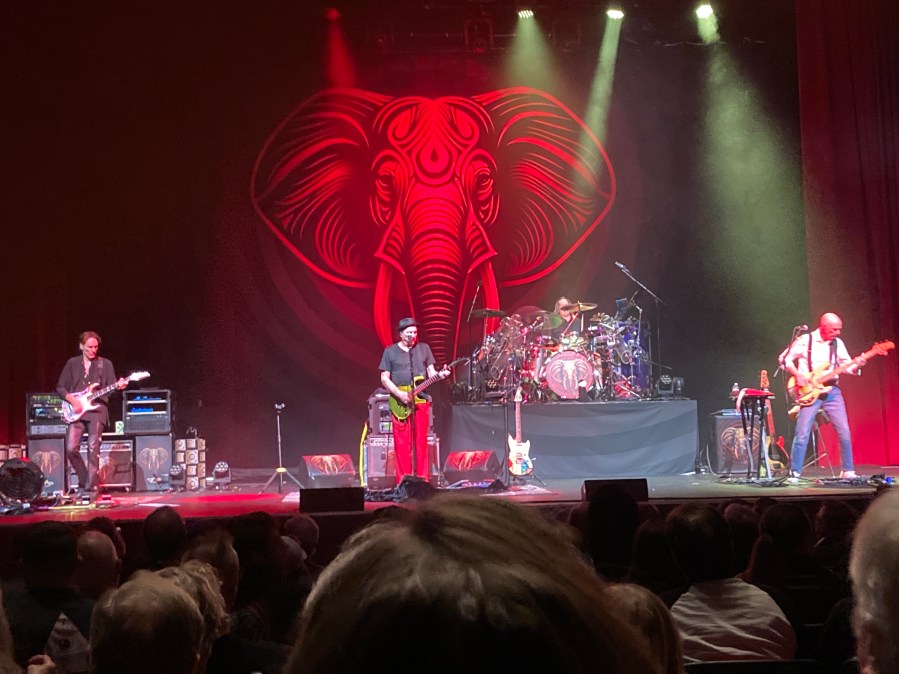
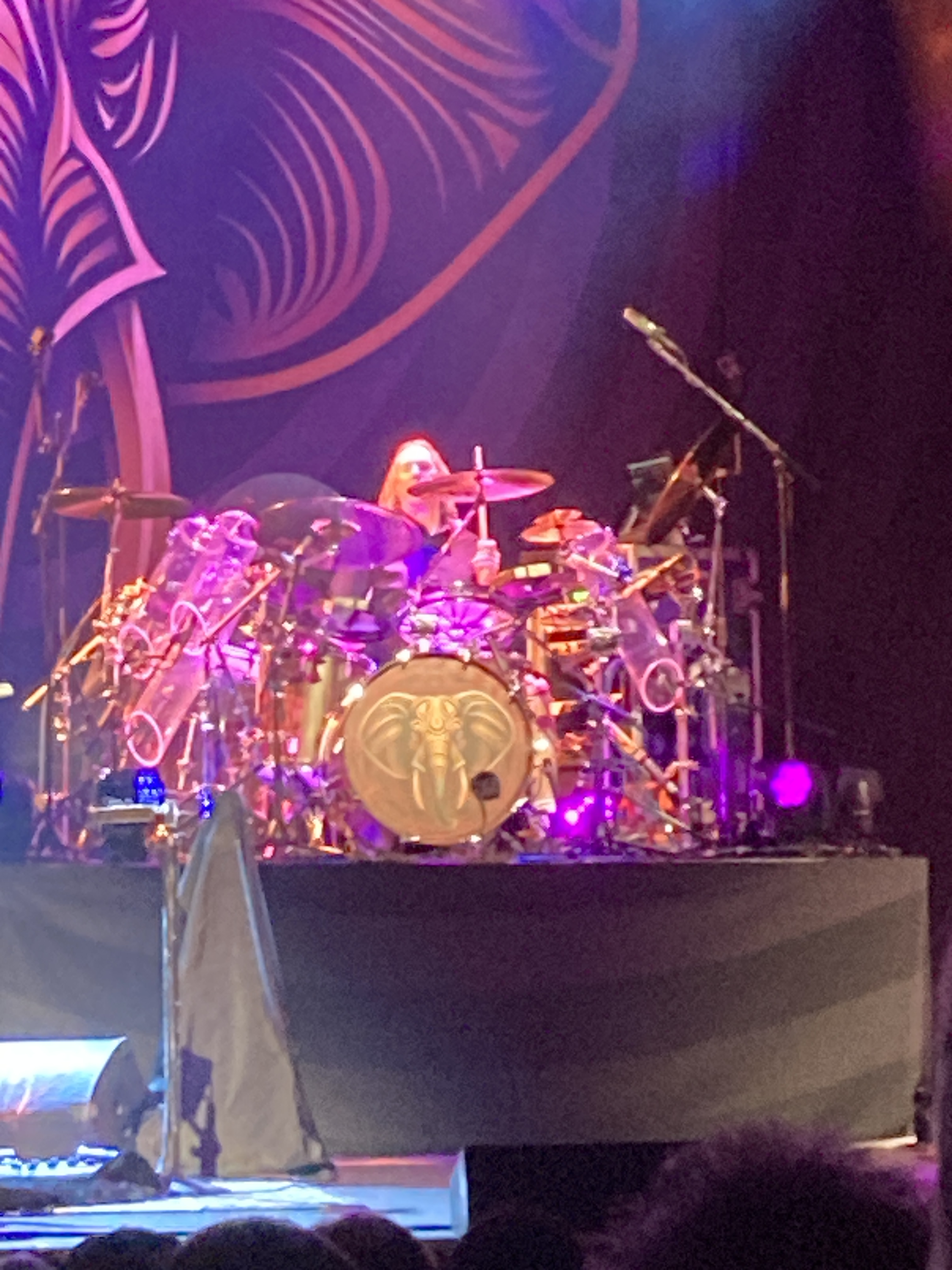
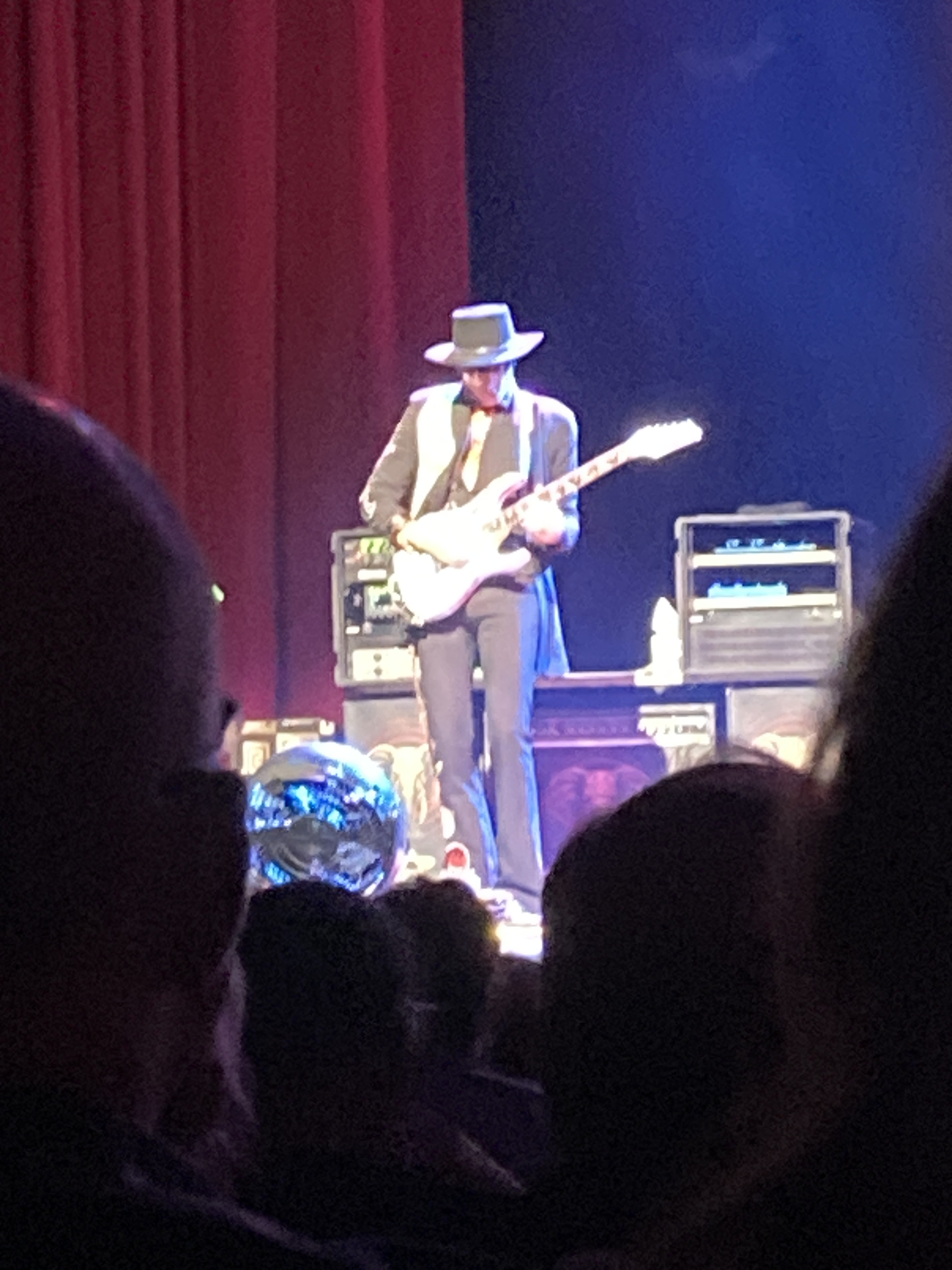
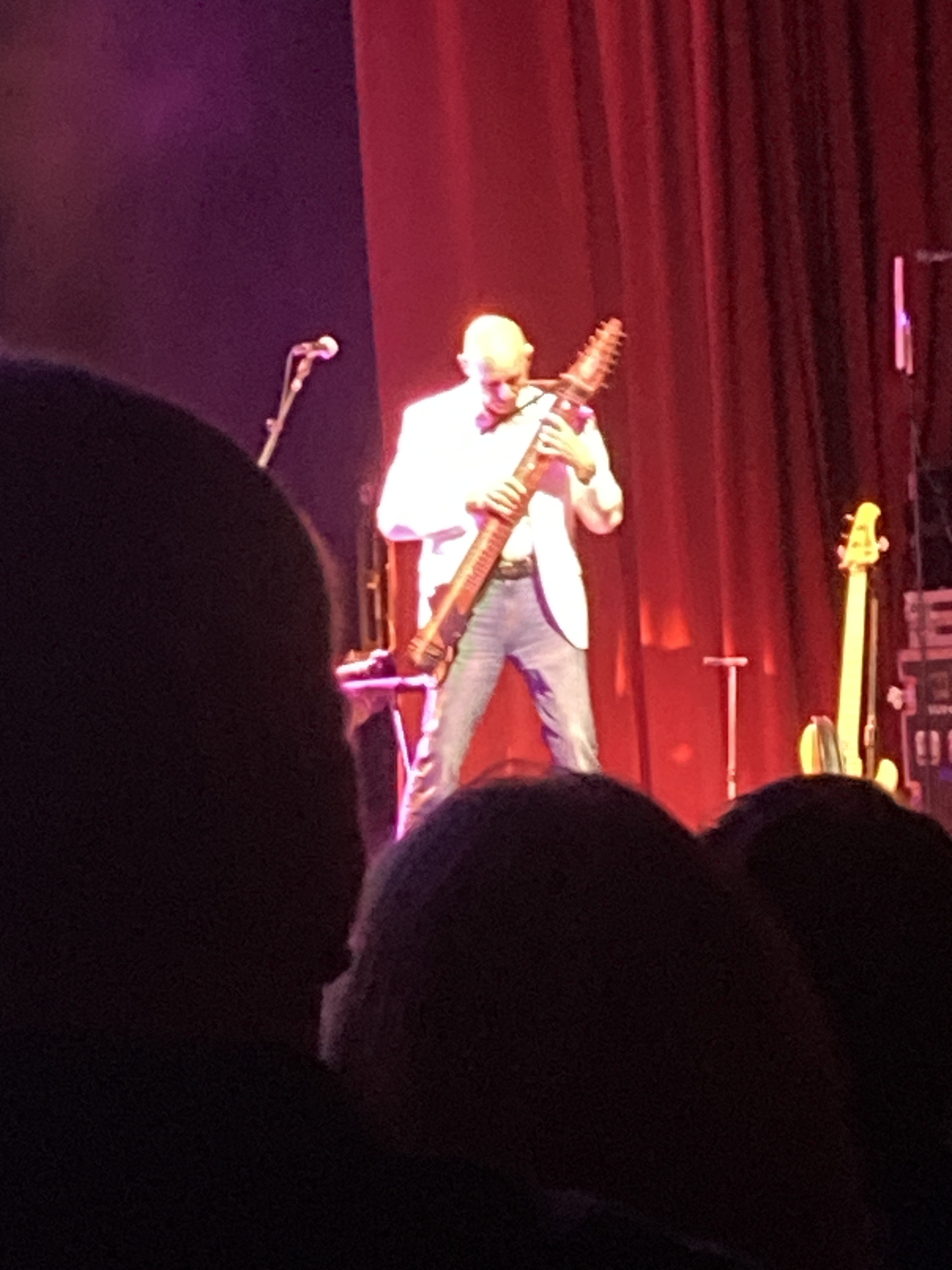
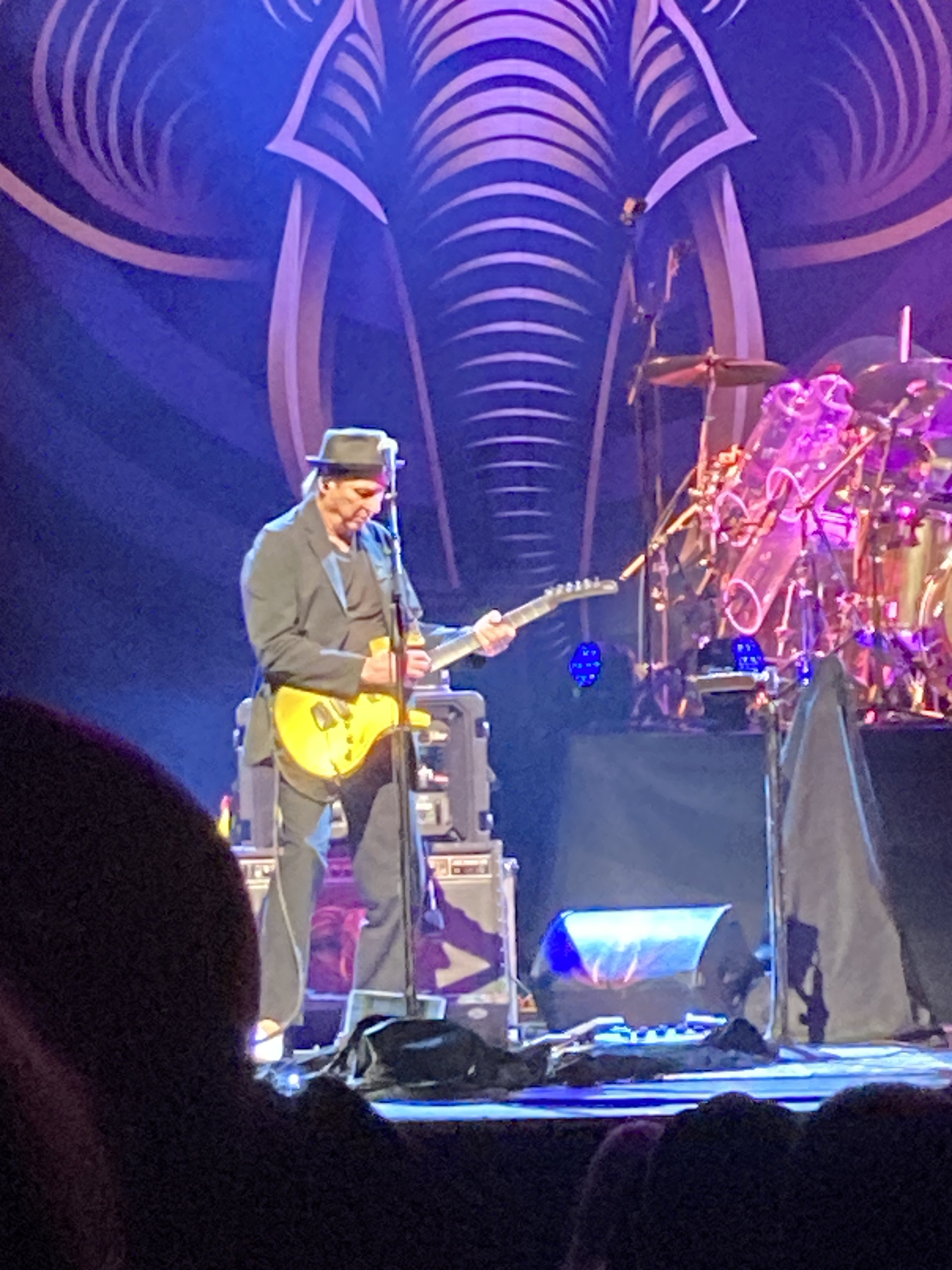
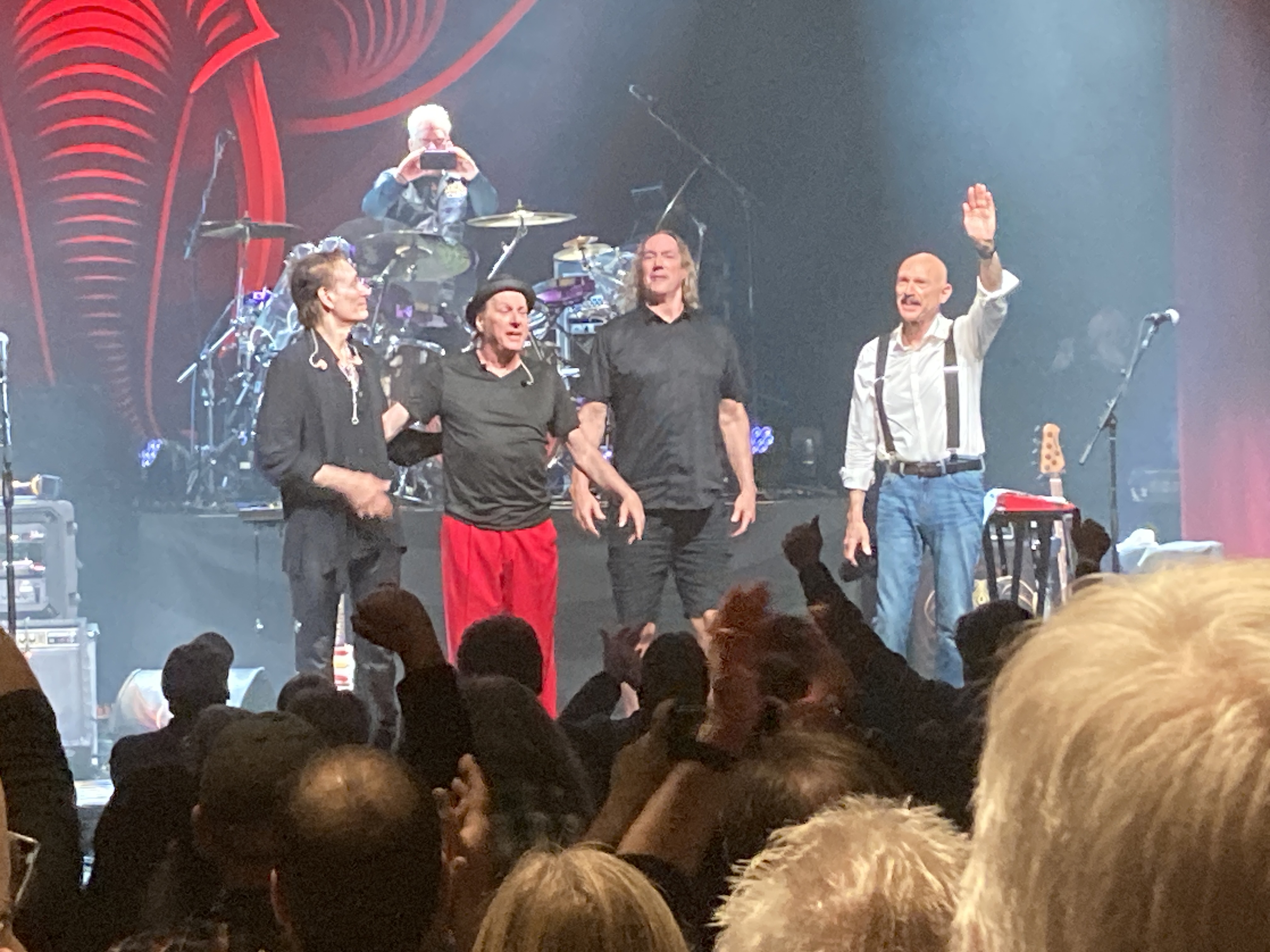
Halfway through a three-month North American tour, Adrian Belew and Tony Levin’s 40th anniversary remount of 1980s King Crimson readily commanded the stage of this vintage Art Deco theater, slamming into the ecstatic audience like a truckful of bricks spontaneously rearranged as abstract sculpture. BEAT’s reinvention of this cutting-edge music offers much more than fresh trim on a classic chassis; with virtuosi Steve Vai and Danny Carey at the stations originally manned by Robert Fripp and Bill Bruford, there was power to spare under the hood, and the edgy thrill of exploration that Belew and Levin’s previous celebration (first known as Two of a Perfect Trio, then as the Crimson ProjeKct) only mustered intermittently back in the early 2010s.
With both Fripp and Bruford retired from Crimson (and publicly supporting this venture), the new recruits leapt into their roles with gleeful abandon. At stage left, Carey straddled his monolithic drum set, cutting loose with both the confident drive he brings to Tool and the innovative riot of percussive colors Bruford brought to bear. The overall effect was devastating: electronic drums, boo-bams, rototoms, and more danced in head-spinning polyrhythmic patterns above rock-solid odd-time grooves. To Carey’s right, Vai’s stage presence couldn’t have been more different than Fripp’s buttoned up demeanor — leaning into the riffs with an easygoing strut, taking the original finger-busting licks to the next level, topping ferocious solos with distinctive, showy flourishes beloved by fans since his days with Frank Zappa. For all its fearsome complexity, the music was remarkably free and exceptionally fiery — to the extent that the newbies even accelerated a bit ahead of Belew and Levin on a few occasions!
But if the Crimson veterans were surprised by occasional mess-ups, they really didn’t seem to mind, grinning and bopping away as they caught up, Carey and Vai decelerated, and everyone locked in to the mesmerizing weave once again. I’d argue that Levin’s role in 80s Crimson was both essential and underrated, and this show offered fresh evidence for my case; alternating between Chapman Stick and bass, he simultaneously dished up both the low-end foundation and the hypnotic rhythm figures that give these pieces shape and harmonic direction. And with the beautiful noise of the other three players to carry him along, Belew was in his element. Duetting with Vai on fiendish bursts of counterpoint, wrestling every possible noise made by animal or power tool from his cubist array of guitars, yelping out proto-rap or firing off riveting arcs of vocal melody, the man was eager and energetic throughout the night, obviously delighted to do his thing, committed to keep the fun going.
When I saw King Crimson live for the first time back in 1984, “fun” would not necessarily have been the descriptor that sprang to mind; Fripp and Bruford were publicly feuding in the music press, Levin had programmed a click track to keep everyone in sync onstage, and Belew was doing tour publicity pretty much on his own. It was no surprise when Fripp declared that innovative incarnation finished at the end of the run, so I’ve always considered the subsequent regroupings across the decades unpredictable bonuses. And in the same way that the “chamber ensemble plus drum corps” Crimson of the 2010s gave Fripp a final run at the band’s entire history with a simpatico crew of colleagues (including Levin), I’d argue that BEAT gives Adrian Belew the version of Crimson that suits him best, focused on the slice of repertoire he values most. Belew, Levin, Vai and Carey are far from uptight or perfectionist, yet they’re unquestionably up to the demands this mighty music presents them, and absolutely dedicated to giving its fans their due. The results in Chicago were every bit as satisfying to me (now a 12-timer in catching KC’s various versions) as they were for long-time fans who’d never got to see the 1980s team in action (like my eloquent concert buddy Cedric Hendrix – check out his take here). If you’re ready to have your face melted, mind blown and heart stirred, catch BEAT while you can!
Musical memoirs embrace many styles and formats, but it’s probably fair to say there has never been a story quite like that of King Crimson alumnus, Jakko M. Jakszyk.
For starters, that’s not his birth name, a fact he is keen to point out from the very beginning and provides a key to the essence of his story.
The book’s overriding theme is his personal quest to establish his true identity against the backdrop of an extraordinary musical career, crowned by fulfilling a personal dream of becoming a member of his teenage heroes, King Crimson.
That he has been able to carve out a successful career as a musician, vocalist, songwriter, composer, documentary maker, producer and sound engineer, as well as one time actor – and once, almost a promising soccer player – is testament to his extraordinary talent, superhuman determination and unwavering tenacity. To write this story is to try and make some sense of it all.
But what is clear is that his existential journey towards finding himself has been the driver for informing a greater part of his creative life.
There are so many facets to his story, but as his “public” name would otherwise suggest, Jakko, a nickname given to him instead of his birthname Michael, of Irish/America parentage, but was adopted by a Polish/French couple when he was a babe in arms whose surname he took.
Norbert, his adopted father, came to England after World War Two. He had been spared action on the Russian front due to an accident which damaged his hand, but ended up fighting with the Allies for the Polish Free Army in Italy. However, his wartime experiences left indelible internal scars. He met his wife Camille when she came to England and worked for an American family close to where he had settled.
Royal Albert Hall
Jakko’s childhood proved difficult and oppressive. His adoptive father was a strict disciplinarian who never really appreciated what Jakko did, even when given the VIP treatment at the prestigious Royal Albert Hall in London to see him perform many years later.
Discovering bands like Henry Cow, Matching Mole and ultimately King Crimson, drew him towards the flame of music and the creative arts when he was still at school. “There was a huge hole inside me; I was just desperately trying to fill it up,” Jakko recalls.
An overheard conversation finally paved the way to him finding his birth mother, an Irish woman, Peggy Curran, a singer in a 50s band, and the reality that his father was in probability a US airman stationed in the UK in the 50s.
As he served his musical apprenticeship in various bands, he finally found his mother, calling her at her then home in Arkansas but from the outset, she would not reveal his father’s identity.
What he did discover then was that she had married again, had three sons, also a daughter Debbie who was Jakko’s full sibling. He and Debbie finally met up in New York in an attempt to put together some more pieces of the very fractured family jigsaw.
His solo career was thwarted several times, promised album releases never materialising. However, when Geffen Records showed an interest in his work, Jakko had a chance to go to LA where he met soon to be lifelong friends, the songwriter, Jon Lind and Larry Williams, sax player with the influential Seawindhorn section, that was featuring on two of his latest solo album’s tracks.
Finally, he met his mother and extended family in Little Rock, Arkansas. It proved a difficult and uncomfortable meeting because of her never-ending manipulation of the truth and her continual self-denial.
Michael Jackson
Other Stateside meetings brought him into contact, accidental or otherwise, with David Bowie, Jeff “Skunk” Baxter and Gene Simmons.
However, it was his encounter with Michael Jackson at Westlake Audio in LA which left, not surprisingly, something of a lasting bizarre impression. Laying down some of the tracks for Bad with Quincy Jones, Jackson told Jakko he liked his shoes, which led into a surreal conversation about shoe shops in London’s famous shopping area, Oxford Street.
Meanwhile, his family situation got even more complicated when he found he had another full brother, Darren, who was living in Florida but they eventually met in England.
On the musical front, Jakko’s star continued to rise when he joined the ranks of the 21st Century SchizoidBand comprised four alumni from King Crimson who made albums and toured This led to him making the highly acclaimed Scarcity of Miracles with Robert Fripp and Mel Collins release in 2011.
An invitation to sing Entangled with Amanda Lehman on Steve Hackett’s Genesis Revisited II thrust him even further in the Prog limelight. Then came the call he had been waiting for all his life – from Fripp, asking him if he would accept the challenge of being Crimson’s second guitarist and lead singer. As his friend Nick Beggs would quip: “Well that’s the longest audition in rock history!”
Joining King Crimson would be the pinnacle in Jakko’s remarkable career. However, his personal situations was far from resolution. His adopted parents both died (and provide the most heart-breaking of reasons for the naming of this book). More revelations from the USA emerged, his mother dying, taking even more secrets with her including the possibility of there being a further offspring
And finally, reaching the age of 64, Jakko learned the identity of his father, but having died in violent circumstances at a very young age, there’s no knowing if he was ever aware of Jakko’s existence after he returned to the States and married his childhood sweetheart.
Genesis
What is more, following the storming of the Capitol Building on 6th January 2021, Facebook posts showed that one of his Arkansas half-brothers is a white supremacist with views that are a total anathema to Jakko and the creative world which he has inhabited most of his life.
This summary only scratches the surface of this remarkable, heart-wrenching and utterly compelling story, which stuns, confounds, delights, astounds, amazes and horrifies in equal measures.
As well as the constant deeply affecting quest for identity, there are plenty of lighter moments too, one of them being a “lost” weekend he spent in Amsterdam with his son Django, which takes father/son bonding to a new “high”!
Who is Jakko Jakszyk? With the constant shifting sands that still underpin his life, he fears he will never ever know. Even at the end of his story, he remarks: “The answers themselves just manifest more questions. And then there are no answers anymore.”





 Progarchy