
From Kevin J. Anderson via Twitter:
To order, please go here: http://www.amazon.com/Clockwork-Lives-Kevin-J-Anderson/dp/1770412948
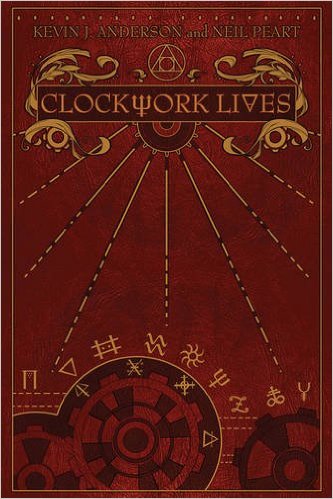

From Kevin J. Anderson via Twitter:
Neil Peart–drummer, writer, lyricist, cultural observer, and Renaissance man–is 63 today. Happy birthday, Professor Peart! The world is so much better because of you.

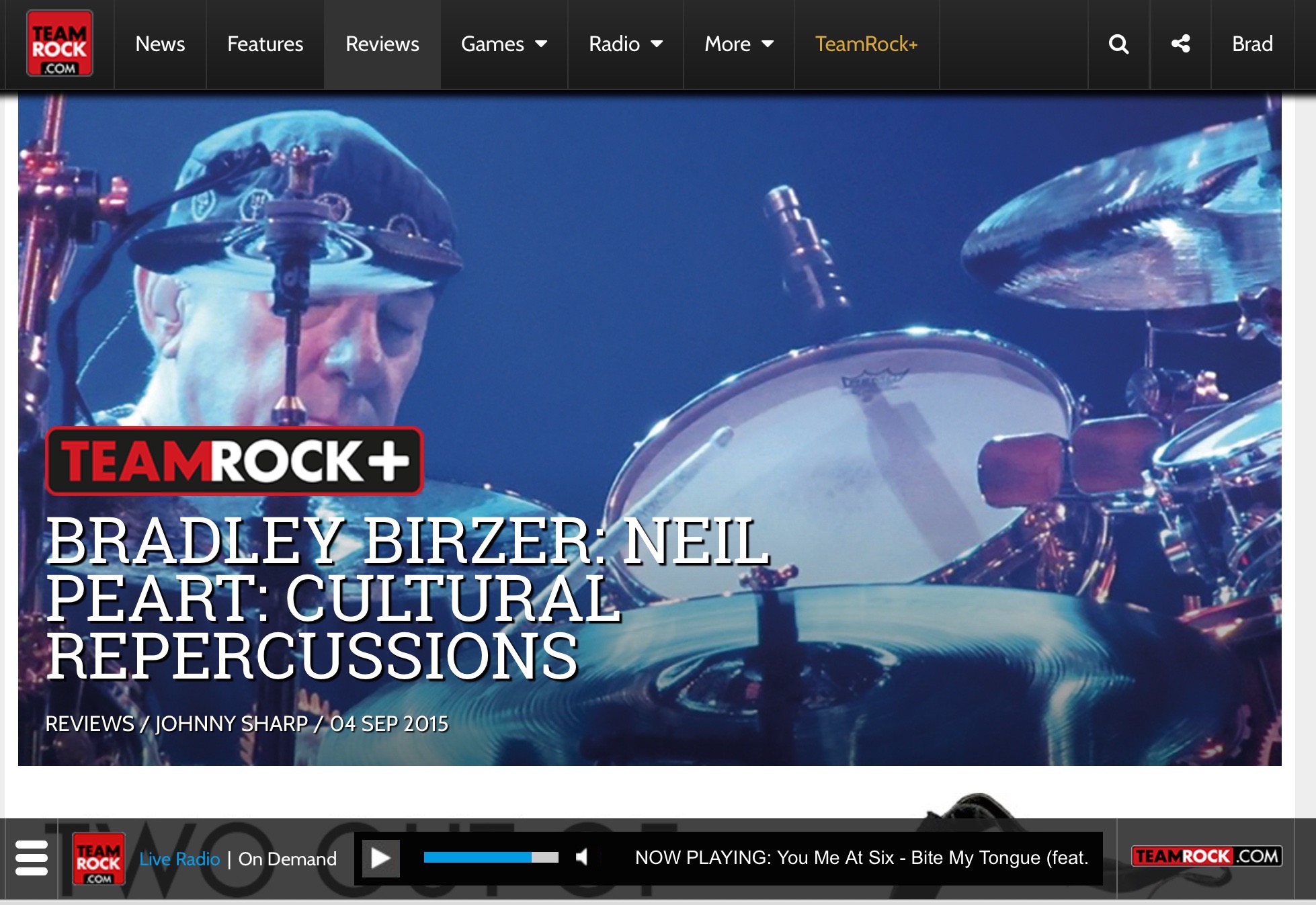
A huge thanks to Johnny Sharp, Jerry Ewing, and all of our friends and allies at teamrock.com. A perceptive review (very perceptive!) of my forthcoming intellectual biography of Neil Peart. Out September 15, 2015, NEIL PEART: CULTURAL REPERCUSSIONS will be available as an ebook and paperback.
While Birzer doesn’t include any first-hand original interviews with his subject or his bandmates, his research is extensive, seeking out insightful quotes and stories from the band’s four-decade existence as he successfully divides their work into distinct eras (Rush 2.0, 2.1, 3.0, etc). No doubt Peart himself would initially scoff at the idea of such an in-depth analysis of his work. But secretly, I think he’ll feel Birzer has done him proud here.
And, best of all, Sharp labels my thesis “over the top.” And, he’s absolutely right. To finish Sharp’s interview, please go here. Link requires free registration to read the full review.
To pre-order the e-book, please go here.
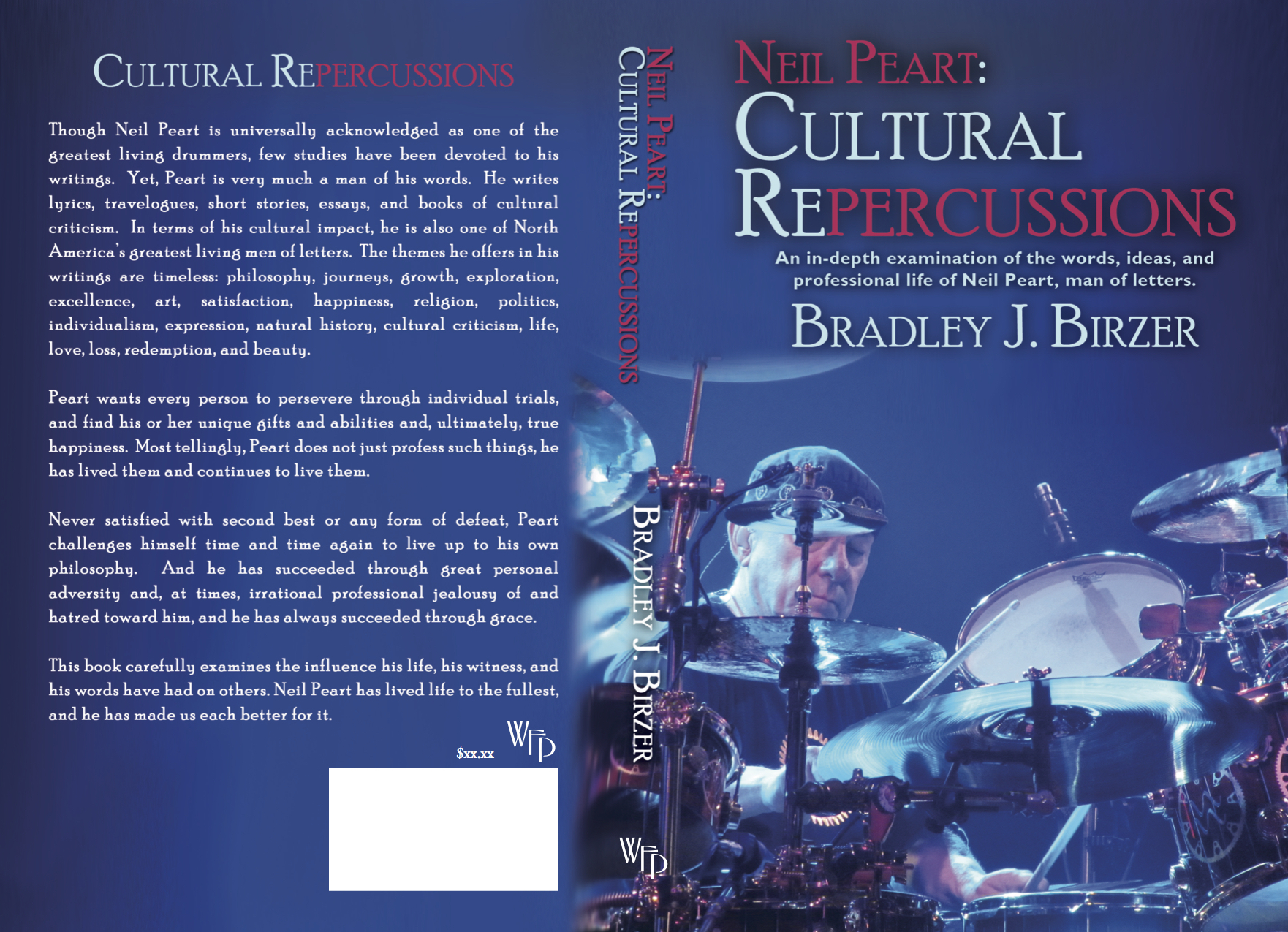
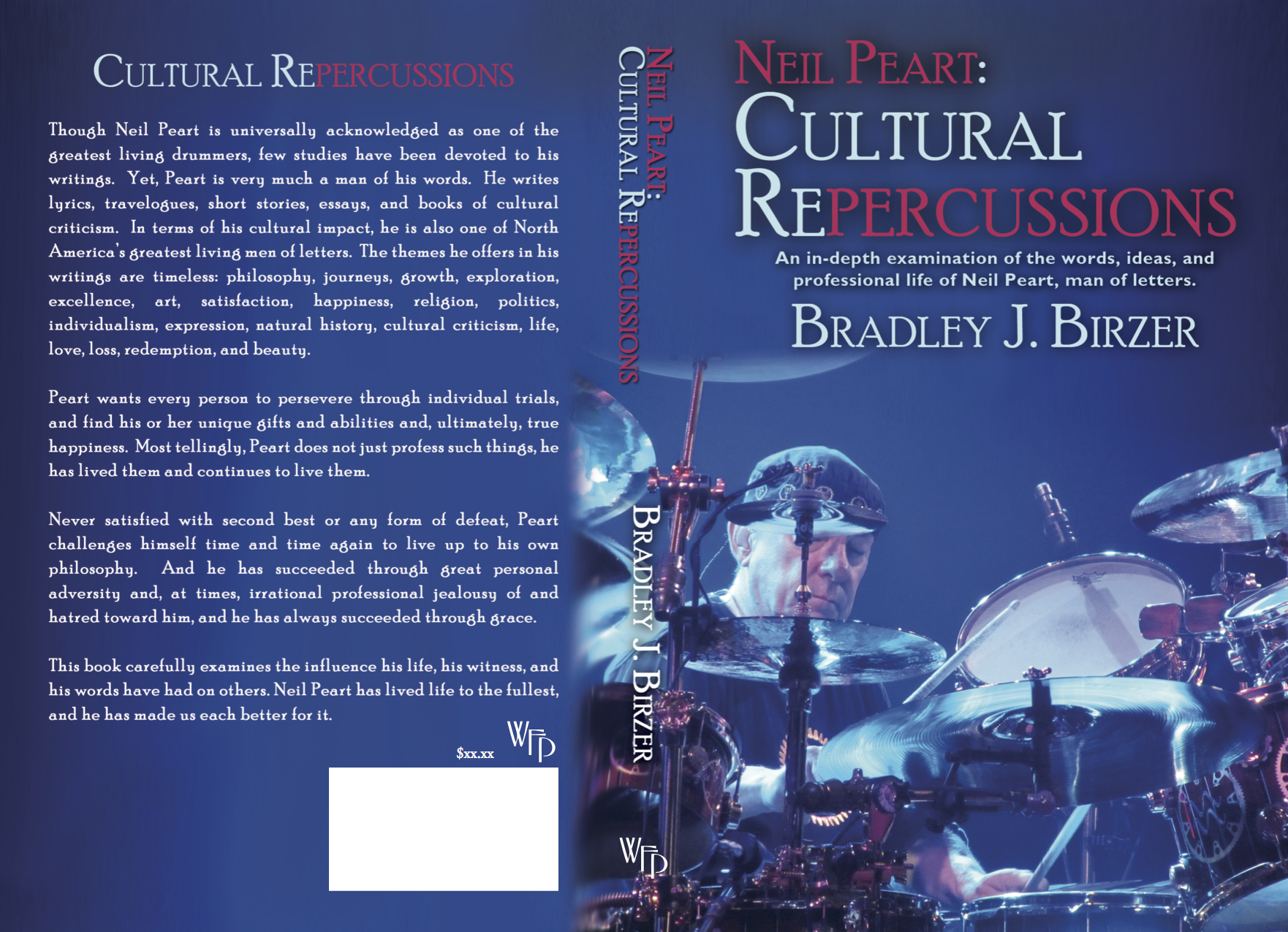
I’m really happy to announce that my biography of Neil Peart, NEIL PEART: CULTURAL (RE)PERCUSSIONS, is now available for pre-order.
Released silmultaneously as a paperback (WordFire Press, $14.99) and an ebook (WordFire/Baen, $5.99) on September 15, the biography considers Peart primarily as an extraordinary writer and author–of lyrics, fiction, and travelogues.
The link to pre-order the ebook is here: http://www.webscription.net/p-2861-cultural-repercussions.aspx
If you like what we’ve accomplished with progarchy, I think you’ll like the bio of Peart. For what it’s worth, I bring fifteen years of writing professional biographies, a decade of reviewing rock and prog rock, and thirty-four years of intense admiration for Neil Peart to the book.

[Please be warned: this is a serious essay with an advertisement at the end—so, don’t feel ripped off!–Brad]

A week ago, I tried to explain—in the first of a multipart series—why I decided to write a book about Neil Peart, lyricist and drummer for Rush. Biographies of rock musicians generally either become fanboy lovefests, People-magazine exposes, or clinical dissections.
I pray and assume I’m guiltless when it comes to the second and third reasons. I’m sure, however, that I will rightly be accused of the first.
The youngest of three boys, growing up in central and western Kansas, I happily had a mother who allowed us to listen to whatever we wanted and read whatever we wanted. Television was never huge in our house, and I’m still rather mystified when peers of my age group quote The Brady Bunch or The Partridge Family. If I had the choice between tv and listening to an album, the album won every time. I don’t remember a time in my life when music wasn’t playing somewhere in the house or in the car. And, it wasn’t just rock. We listened to classical and jazz. Never opera, and I despised musicals and county music. I did come to love opera, but only in my adult years. Almost every room, however, had some form of stereo system, album collection, and headphones. From the age of 10 or so, I could hook up a fairly complicated stereo system, splice speaker wires, etc.
Though my brothers have long given up their love of progressive rock music, they did love it immensely in the early 1970s. My oldest brother is 8 years older, and my older brother five years older. From around 1971 or 1972 (I was born in 1967), I remember Jethro Tull and Yes. Soon, it would be ELO, Kansas, and Genesis, too. Rush, though, I’d never heard—or, at the least, if I had heard them, the band did not make an impression on me until the spring of 1981.
For some reason that I have since long forgotten, I got in trouble in the spring of 1981 while at school Back then, when discipline was still a central part of junior high education, any one of us could get any trouble for almost anything. No one questioned it back then. If the teacher or an administrator decided you were in trouble, you were in trouble. I was a very good student when it came to academics, but I could care less about rules. In fact, I hated them. Regardless, in the spring of 1981, I earned a detention—which meant sitting in the school library around a wooden table with the other kids who had earned detention. That day, it was me, another kid named Brad, and Troy. I’d know each of these guys since first grade, and I’d always been friendly with them. We weren’t, however, close. Troy, if I remember correctly, was wearing a Duke (Genesis) pin on his jacket. Of course, I was immediately taken with it. You know Genesis? I know Genesis! Exactly moments for a 13-year old. It turned out that Brad and Troy knew as much as I did about prog, but they had definitely embraced harder prog, while I had always gone for more symphonic prog.
Have you heard the new Rush yet, one of them asked me? Rush? No, never heard of them. Oh, Brad, you have to listen to Rush. Moving Pictures might be the greatest album ever made.
I’d had a lawn mowing business for several years at that point, and I was rather frugal with my money—except for books, Dungeons and Dragons stuff, and albums. Of course, as soon as I left school that day, I purchased Moving Pictures. I can still remember staring at the album, taking off the cellophane, and removing the vinyl from its sleeve. There was something so utterly magical about dropping the needle on side one of a new album. Drop, crackle, hiss, pop, DUN, Dun, dun, dun “A Modern-day warrior, mean, mean stride”!!!!!! Where on God’s green earth had I ever heard anything so good? At that point in my life, nothing could rival Tom Sawyer. Then, Red Barchetta. Oh yeah, who wouldn’t want to get into a car and drive at outrageous speeds while escaping from authority? Even then, I was rather instinctively libertarian. YYZ reminded me of a lot of jazz my brothers had played me, and I thought every drum crash was the drummer (a guy named Neil Peart, I soon discovered) throwing glass bottles at a wall. Limelight seemed great. Camera Eye was utterly mysterious, especially for someone who had only known the big cities of Denver, Wichita, Dallas, and Kansas City. Witchhunt seemed appropriate, and I thought of the hypocrites I’d known who often acted with outrageous righteousness. Vital Signs seemed the perfect ending, catchy and a bit weird with words I’d never heard before, such as “evelate.”
I can still see my 13-year old self reading the lyrics of Moving Pictures. I read them again. And, I read them again. And, again. And, again.
And, the pictures of the three guys who made up the band? They looked so cool. They didn’t look hippiesh and all wizardy like the Yes guys on Yessongs. No, these three guys looked like they could’ve grown up around the corner from me.
So, there you have it. Neil Peart has been my hero since detention at Liberty Junior High School, Hutchinson, Kansas. He taught me not to be him, but to be myself. Thank you, Brad and Troy. Thank you long forgotten teacher who thought I was a trouble maker. You were probably right. Little did you know, however, that you were the catalyst that lead me to Rush and to Neil Peart. And, here I am, thirty-four years later, and I’ve just written a book on the guy.

[And, here’s the advertisement:]
On September 15, 2015, WordFire Press, founded, owned, and presided over by the incomparable Hugo-nominated science fiction author, Kevin J. Anderson, and his equally amazing wife and famed author, Rececca Moesta, will be publishing my biography, Neil Peart: Cultural (Re)Percussions.
It will be $14.99 for the paperback and $5.99 for the ebook (all formats).
For another 48-hours, however, you can order it as a part of the Humble Bundle Music Book Bundle. For $15, you can get an advanced review copy of NEIL PEART: CULTURAL (RE)PERCUSSIONS as well as a number of other fantastic books, including CLOCKWORK ANGELS: THE NOVEL. And, you even get a preview of the sequel, CLOCKWORK LIVES. It’s well worth it, especially for just $15.
Here’s the link: https://www.humblebundle.com/books
Why Neil Peart?
[Be forewarned, this is a serious essay that leads to an advertisement. Proceed at your own risk!!!!]
A year ago, I had the great privilege of reading a fine history of Rush: Robert Freedman’s RUSH: LIFE LIBERTY AND THE PURSUIT OF EXCELLENCE. It was a very satisfying read, and, as I finished it, I sighed to myself. . . “I wish I’d written this.” I don’t think my reaction was one of hubris, but rather one of joy. I was glad to see Peart taken so seriously at an intellectual level. All too often, even in a culture that can go utterly ga-ga over the most trivial things, Americans still tend to dismiss rock music as a fad or rock musicians as a low form of artist.
For those of us who love prog and art rock, we cringe at such slights, and yet, in our heart of hearts, we’re kind of glad that we are among the few who know—as almost a secret treasure we possess—that good rock as art most certainly does exist. Sure, we’ll argue until we’re blue in the face about what makes art good. But, in the end, we’re somewhat satisfied that we’ve chosen the past least taken.
I’m as guilty of this as anyone, and I know that much of my life, I’ve been a total music snob. Sure, being from Kansas, I can do it with manner and a smile, but I’m still a snob.
When the four editors of progarchy and I started this website, we dedicated ourselves to promoting—as widely as possible—the beauty of music in all of its forms. We’re each music snobs, of course, but we so want to make our snobbery general and widespread. That is, we’d love to have Big Big Train playing on every rock station across North America. Rock music is at a crossroads, and we think we can destroy the mediocrity and corporate vanilla the so prevails and gives rock a bad now. Now, this truly is HUBRIS on our part!
One of the persons I find most intriguing over the last half century is Neil E. Peart. Whether you agree with his political views or hate them, whether you think he’s a god among drummers or just a guy dealing with his ADHD, you have to give Peart credit for making his own way, no matter the cost and no matter the obstacles.
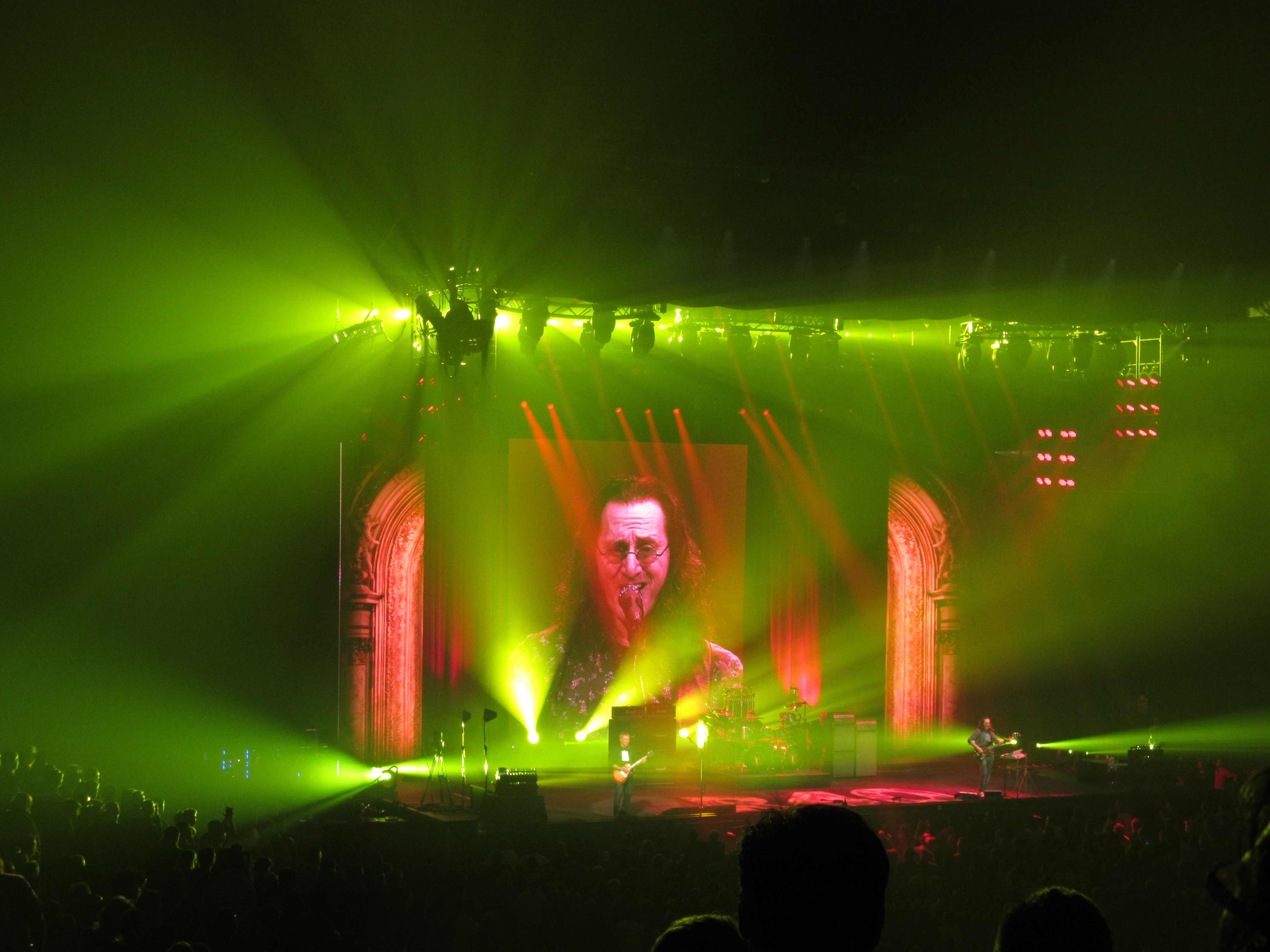
Just a few nights ago, Rush played their final show of R40. The chances are pretty good that that show will be the last normal Rush show ever played. After 41 years of constant success and considered artist endeavors, that’s huge!
[Remember, I warned you above!]
So, why Neil Peart? Well, I try to answer this very question in NEIL PEART: CULTURAL (RE)PERCUSSIONS. The biography comes out officially on September 15 from Kevin J. Anderson’s Word Fire Press. For another 9 days, however, you can get an advanced review copy of the Peart bio for $15 from Humble Bundle.
I’m biased, but I’m really hoping you’ll purchase a copy. I could explain to you that every time you buy a book, you put food on the table for my huge family. But, this isn’t quite true. Still, it would help for the college funds!
Mostly, though, I wrote this book to spread my love of all things Peart.
To be continued. . . .
For two weeks only, you can get an advanced review copy of NEIL PEART: CULTURAL (RE)PERCUSSIONS.

NEIL PEART: CULTURAL (RE)PERCUSSIONS is now available in early form. As an e-book, a part of the Humble Bundle. For two weeks only!
$15 and you get tons of books, including an advanced review copy of the Peart bio.
The final paperback and ebook (all formats) version will be out September 15.
$5.99/ebook
$14.99/paperback
I’m really happy to announce (ok, show off) the cover of my Neil Peart biography, NEIL PEART: CULTURAL REPERCUSSIONS (WordFire Press). It will be available this August in tangible and e-book formats.
Hope you love it!
Yes, I mean Neil Peart. . . but also the guy who makes and controls this puppet! Wow. Just wow.
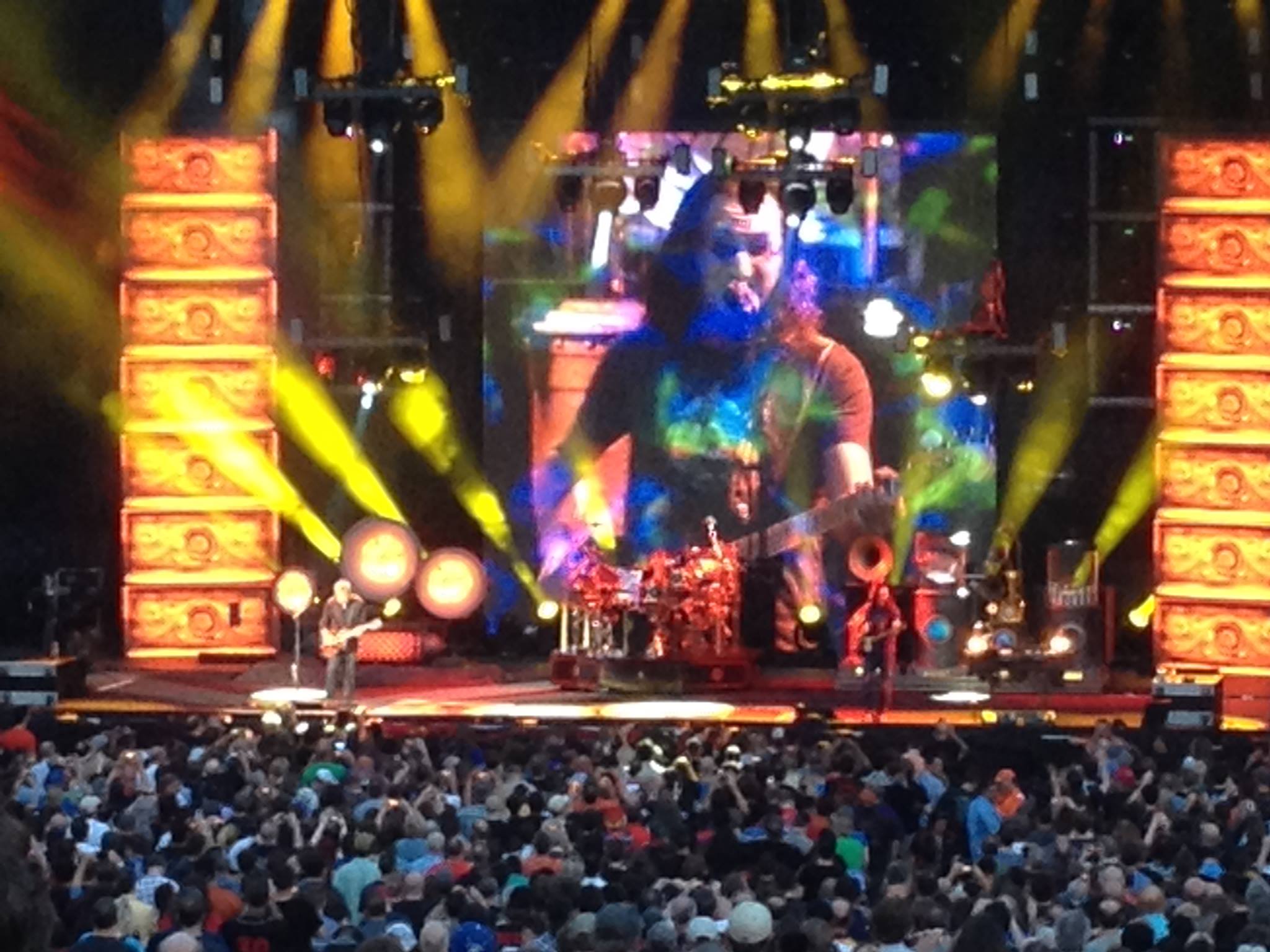 Spoiler Alert: If you are planning on attending an upcoming Rush concert on this tour and don’t want the setlist spoiled for you, then it’s advisable to not read this. But even if somehow the setlist does get spoiled for you? It won’t make any difference. It’s not the surprise of what they are playing on this tour that makes the show great – it’s that they are playing these songs. At that moment, you won’t be caring whether the surprise was spoiled or not, you’ll just be thrilled that you are there as a witness to greatness.
—
During the months from May through September, I usually welcome rain. Anyone who has endured the heat of a few central Texas summers (which start early and last a long time) will understand exactly what I’m talking about. But it’s important to remember the old saying about “be careful what you wish for”. We have received a much greater than normal amount of rain lately, including a torrential downpour the day before the show, and a good soaking rain on the morning after. But for May 16, the weather gods smiled upon us. The clouds did part, and legions of Rush fans were treated – and I do mean treated – to a concert for the ages in the relatively new outdoor venue of the Austin 360 Amphitheater.
In defiance of Albert Einstein, Rush started at the present and took the audience back in time, album by album, dusting off some long unplayed classics along the way. Of their 19 studio albums, 15 were represented in the setlist. Only Test for Echo, Presto, Hold Your Fire, and Power Windows were left unrepresented. Of course, that meant every album from their debut up to and through Grace Under Pressure had at least one song. It also meant that some classic albums, such as 1977’s A Farewell To Kings, had multiple entries in the set. And as the show closed, they even gave us a taste of a song that predates their first album.
Starting out with three songs from Clockwork Angels (The Anarchist, The Wreckers and Headlong Flight), the band then worked backward to Far Cry, The Main Monkey Business, How It Is, Animate, Roll The Bones (with some very entertaining video in the rap section), Between The Wheels, and closed out the first set with Subdivisions. It was a strong first half, and the inclusion of songs like Animate and Roll The Bones (which I had never seen performed live) and How It Is (never performed live before this tour) made it even better. The band was tight and yet having fun as well. But the best was yet to come.
The second half opened with Tom Sawyer (complete with the South Park introductory video), and things just got better from there. The first real stunner of the show came when the introductory synthesizers of The Camera Eye bubbled up from the background noise and led into another gem I had long wanted to see performed in a live setting. And man, did they deliver the goods. As the band played through the portion leading up to the first verse, fellow Progarchist Kevin McCormick turned to me and exclaimed on how “meaty” were the power chords of Alex Lifeson. Indeed, they were, meaty enough to throw on the grill and make a meal. The entire performance of the song was nothing short of scintillating.
Things just got better. After an obligatory (and excellent) rendition of The Spirit of Radio, we were treated to another rarely-performed-live gem: Jacob’s Ladder. After being threatened by the weatherman with real thunderstorms, this was the only one that actually occurred, and it was most welcome. By this point, my fellow concertgoers and I were beside ourselves with joy, showing our appreciation between songs with the same enthusiasm – and loudness – as we all must have at our respective first Rush concerts back in our teenage years.
The next one really threw me for a loop, as the band gave us a live performance of the first part of Hemispheres. Despite standing for the entire show, my jaw momentarily hit the ground when this one started. I was fortunate enough to see Hemisphere played in its entirety at my first Rush show in 1979, but I don’t believe they’ve played any of this epic since then. But on this night they did give us at least a piece of it, and the best part at that.
From there, they moved back to A Farewell To Kings, and gave us some instrumental sections of Hemisphere’s prelude, Cygnux X, Book I, with the song punctuated by a Neil Peart drum solo. Closer to the Heart followed, and after that, another highlight of the show for yours truly, Xanadu. Both Geddy Lee and Alex pulled out the double-neck axes for the performance of this piece, and had the donned their kimonos of the era, I would have sworn it was 1977 all over again. The irony was not lost on me that during a song about the inability to create Heaven on Earth, Rush seemed to do just that.
Following that, we were treated to Parts I, II, IV, and VII of their breakthrough classic, 2112. That led us to the end of the show proper, but there was no question that an encore was coming. As such, they closed out the show with Lakeside Park, Anthem, What You’re Doing, and Working Man – with a snippet of Garden Road thrown in for good measure. The show was over, but the euphoria was not. I cannot speak for the rest of my concert-going entourage, but despite being tired when I arrived home, it was only with great difficulty that I finally fell asleep. I was simply too wired from what I had witnessed – quite simply, the best Rush concert of the six I have been fortunate enough to attend, and one of the best (if not the best) concert of all those I have seen. There is some tough competition from a few Yes shows I have seen, but this one is definitely in the running for my best ever. And as much I have loved Yes for many years, there is no way at this stage that they could put on a show as incredibly fantastic as this.
The Last Man Standing
Of all the progressive rock bands that emerged in the 1970’s commercial heyday of that genre, Rush truly is the last man standing. Yes is still around, but in a diminished form (and I mean no disrespect to current vocalist Jon Davison, who is a great talent). With the split between Ian Anderson and Martin Barre, Jethro Tull is no more. King Crimson s touring under the Mk 7,396 lineup – or is it lineup Mk 7,395 (King Crimson being the one band that could make a current or former Yes member exclaim “damn, that band goes through a lot of personnel changes!). And Genesis is long gone from their glory days of the Gabriel/Hackett era. But last night, here was Rush, still in the same form as they were when “new guy” Peart joined prior to their first US tour, still touring big venues, still putting on not just a concert, but a spectacular multimedia presentation that is beyond the reach of virtually any other prog band currently in existence. This leads me to a few additional thoughts.
Much has been written here at Progarchy and elsewhere regarding the changing of the music business and the effect of the internet on the same. For those of us who love prog, this has mostly been a boon, an incredible boon at that. The current prog scene is alive and very vibrant, matching the glory days of the 1970’s in terms of quality while overwhelming that era in terms of quantity. Back then, one could keep up with the new releases. Nowadays, there are simply too many.
But while the music industry has changed in many ways for the better of us prog fans, one of the few laments I have is that I won’t likely ever get to see many of the current acts I like perform in a live setting. I most definitely will not get to see them put on a show like Rush still does, in a larger venue with the lights and big screen video that enhances the concert-going experience. But rather than dwell on that too much, instead I will choose to be thankful. Thankful that I did get to experience such a thing. Thankful that in a 35 year span within their 40 years plus career, I’ve been lucky enough to have seen Rush six times, and thankful that one of my favorite bands of my youth is still relevant, perhaps even more relevant.
This wasn’t lost on me as I thought about some of my fellow concert goers. The group with whom I attended ranged in age from 15 to 50 (with yours truly being the geezer of that bunch). The two youngest members of the group have not been alive long enough to experience many concerts of this magnitude, and with the change in the music industry, will probably not experience too many more, unless they want to see record company creations like Taylor Swift and Katy Perry. For them, they were fortunate enough that they were able to see this show, and in time, they will realize how lucky they were.
For the older members of the entourage, we are lucky that we have been able to follow Rush for decades, much longer than most bands ever last. We have seen them continue to stay relevant and make music of the highest excellence through shifting musical trends and technological and economic currents that have upended the music business, morphing it into something unimaginable when they first started. Consistency and excellence, fueled by integrity that allowed them to benefit from the old order without being swallowed by it. And for that, they were able to give us, the fans, a career retrospective that will not soon be forgotten, and one that they seemed to enjoy playing as much as we enjoyed witnessing. Just as Geddy thanked us fans before leaving the stage the final time, let me turn around and say Thank YOU, Geddy and Rush. While I don’t like to presumptuously speak for others, this is one time I’m confident I’m speaking for everybody who had the good fortune to be there last night.

Hat tip to Kevin McCormick for the original idea for the above meme 🙂
 Progarchy