

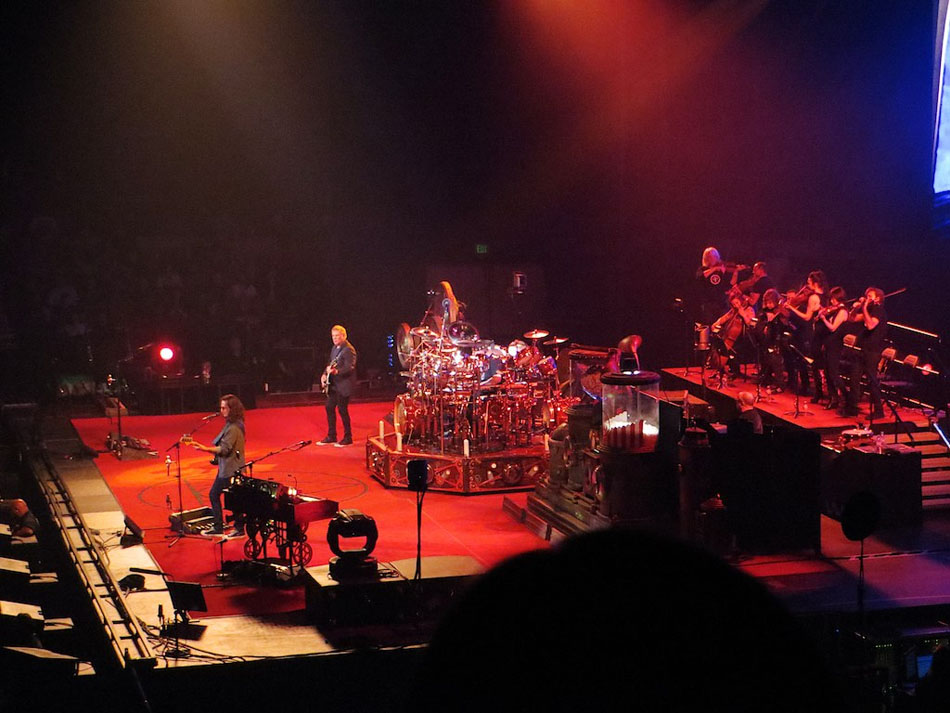
 Just one week after a long-overdue induction into the Rock and Roll Hall of Fame, Rush opened the second leg of their ‘Clockwork Angels’ tour – and fortunately for myself and thousands of other Texans, they did it right here in Austin.
For long-time Rush fans, a Rush concert is more than just an event where we see musicians performing their catalog in a live setting. For us, it is something that gets into us the way dye gets into a shirt and alters its color; something that affects each of us right down to the molecular level. This show certainly did that for me, more for reasons I will get into below.
The steampunk aesthetic of the stage setup was spectacular. It was refreshing to see a big visual presentation to accompany the music, which is a rare thing these days. In contrast to the 70’s, when progressive rock was bigger and had more backing by the record companies, most contemporary prog shows are played in smaller venues without the type of visuals as were present in some of the gargantuan shows of that earlier time (think ‘Yes’ on the ‘Relayer’ tour). Rush is the rare band from that era that can still play large venues with a corresponding stage set and light show that turns the presentation into more of an event than just a live music performance.
After a long break from the road, the band seemed rested, recharged, and ready to go. Some of Rush’s typically humorous opening video greeted the audience when the lights went down, featuring the band’s trademarked slightly bizarre humor. The concert proper then opened with a rousing version of ‘Subdivisions’, followed a number of 80’s works. In the first set, they did three songs from ‘Power Windows’, including ‘The Big Money’, ‘Grand Designs’, and ‘Territories’, while also managing to squeeze in ‘Limelight’, ‘Force Ten’, and ‘The Analog Kid’. After the latter tune, the band moved into the 90’s with ‘Bravado’ and ‘Where’s My Thing’ and then into the 00’s with ‘Far Cry’, which closed out the first set.
After a short break, the band returned to the stage, this time with eight additional musicians collectively known as ‘The Clockwork Angels String Ensemble’. This tour has been the first in which Rush has brought extra musicians on stage, and they were used to good effect here. The string ensemble filled in some spaces while enhancing others, remaining on stage throughout the performance of ‘Clockwork Angels’ and for several songs afterwards, including a blistering performance of ‘YYZ’, which is captured through a smartphone (not mine) here.
Beginning with another entertaining bizarro-humor video (with Neil, Alex, and Geddy playing dwarfs) the second half of the show kicked off with ‘Caravan’, and followed through with most of the songs from ‘Clockwork Angels’. Regrettably missing from that list was ‘BU2B’ and ‘Wish Them Well’, the latter being a favorite of mine not only for the music but for the life lesson within the lyrics. A guitar snafu during ‘The Anarchist’ was a minor hiccup that left Geddy alone without melodic accompaniment for a moment, but Alex and his guitar tech had the presence of mind to quickly swap out instruments. The performance of ‘Clockwork Angels’ concluded with a spectacular performance of ‘The Garden’, the visuals of video working great with the music here.
After concluding ‘Clockwork Angels’, the band went back into the 80’s again, with ‘Manhattan Project’, a short drum solo, ‘Red Sector A’, and ‘YYZ’. The string ensemble exited the stage and the band closed out the set with ‘The Spirit of Radio’. The band returned for an encore including ‘Tom Sawyer’ and ‘2112’ (‘Overture’, ‘The Temples of Syrinx’, and ‘Grand Finale’) before calling it a night for good.
I don’t have much to critique for the show, but I do have to say that the soundman could have done a better job with the mix. It was very bass-heavy, and this caused a bit of muffling of notes, particularly on a few of Alex’s guitar solos. But overall, that wasn’t enough to dampen the experience, which was still overwhelmingly positive.
All in all, an outstanding show, played with the energy and intensity that belied their age.
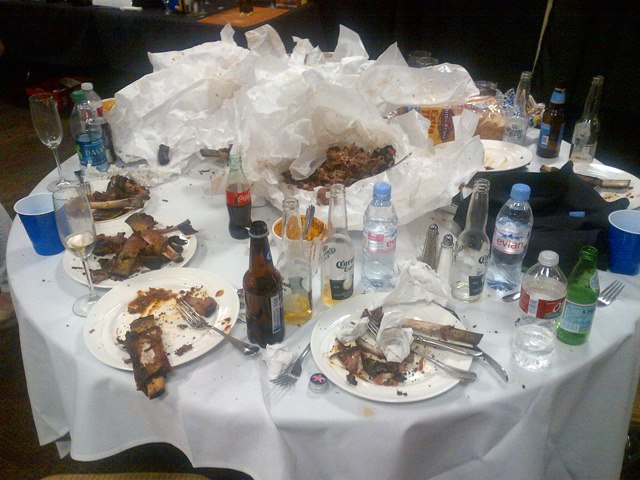 Afterward, according to their Facebook page, Neil, Alex, and Geddy got in touch with their inner cavemen by devouring some Texas barbeque, as shown in the photo. At this point of the review, you’ll have to excuse me while I go off on a tangent, but there is something in that photo that I think I need to address with the band members. Geddy, Alex, Neil – I’m glad you enjoyed your barbeque during your most recent visit to the Republic of Texas. The ribs and brisket are hard to beat. However, I have to say I am a little disturbed in looking at some of the bottles on the table. You three are Canadian boys, and therefore have Canadian genes – which means like other great Canadians, such as Bob and Doug McKenzie, you are drinkers of hearty beer. Thus, seeing several bottles of Corona on the table gives me pause. Corona is more or less a summertime beer – I could give you a pass on this if the gig was an outdoor gig during the sweltering months of July or August. But last night was an unseasonably cool April night, and thus I just cannot understand the Corona. Even more disturbing is what appears to be a bottle of Bud Light on the table. Perhaps one of you reached for a water bottle and didn’t notice the difference? Now, in fairness, toward the upper right corner, it does appear that some redemption is present, as I am about 90% confident that’s a bottle of Shiner Blonde. I’ve compared the portion of the label I can see in the picture to an actual bottle of the same in my refrigerator, and the lack of a bar code on my bottle appears to be the only difference. I’ll do more research of the label tomorrow night as I watch the NFL draft – just to be sure, you know. Nevertheless, Shiner Blonde is a beer befitting of your Canadian DNA, guys, so I would recommend you use that to wash down your next Texas barbeque dinner. Ok, tangent over.
This Rush concert was special in a way that says something both about Rush and their fans alike. Not only was this my fifth Rush show, but it was the fifth different decade in which I had seen them. Previously I had seen them in 1979 (Rupp Arena, Lexington, KY, Hemispheres tour), 1984 (Hampton Coliseum, Hampton VA, Grace Under Pressure tour), 1990 (Charlotte Coliseum, Charlotte, NC, Presto tour) and 2007 (Verizon Wireless Amphitheater, San Antonio, TX, Snakes and Arrows tour). The 70’s, 80’s, 90’s, and 00’s. Now I can add the 10’s. I’m comfortable in saying that I’m not alone among the Rush fan base, and in fact know there are fans that have seen many, many more shows than I have, and moreover, within the same five decades. There are not many bands out there that one can say the same about. There are even fewer (if any bands) that one can say that about while also saying that it was with the same lineup each time. That’s a testimony to their longevity, as well as to the loyalty of the fans that have stuck with them all of these years. As many of you will recognize, the title of this piece is drawn from the lyrics of ‘Marathon’ off of the ‘Power Windows’ album. And those words, written by their philosopher-drummer nearly 30 years ago, appear to be even more true now than when that album was released. Rush, despite some serious ups and downs, has persevered and continued to make great music far beyond the time when most bands lose their creative edge. And fans like myself and countless others, we’ve lived our lives and had our own ups and downs for all of these years, and yet we kept coming back, keep buying the albums, and keep going to the concerts because we appreciate the excellence, the professionalism, the creativity, and the wisdom inherent in the lyrics. That neither Rush nor their fans have burned out, that both have shown the endurance to stick with one another throughout the decades only proves the wisdom of the lyrics from which this review draws its title.
Thanks, guys. Not just for last night’s show. But for everything over all of these years.


 Progarchy