InsideOut Music recently signed John Wesley to its label, and his new album, Disconnect, will be available March 31 in Europe and April 1 in the U.S. I’m not pulling an April Fools’ joke when I say that it is my favorite album of 2014 so far (despite stiff competition from the likes of John “KingBathmat” Bassett, Gazpacho, and Transatlantic).
Who is John Wesley? Hailing from Tampa, Florida, he’s an enormously talented guitarist and vocalist who has toured with Porcupine Tree, Fish, and Steven Wilson. Check out Porcupine Tree’s DVD, Anesthetize, to see how integral he was to their live show. As a matter of fact, after watching that DVD, I wondered why Steven Wilson didn’t go ahead and make Wesley an official member. His guitar playing and vocals added a new and exciting dimension to Wilson’s songs.
Approaching Wesley’s new solo work, I had low expectations – sidemen often fail to carry the load of an entire album. (Tony Levin is my all-time favorite bassist, but his solo stuff just doesn’t do anything for me.) Suffice it to say, from the opening chords of the first track, “Disconnect”, to the spacey fadeout of “Satellite”, this is a jaw-dropping collection of songs. There isn’t a weak track in the whole bunch as Wesley runs through a wide range of styles, all the while rocking like a maniac.
I hear hints of Pink Floyd in the aforementioned “Satellite”, Rush (none other than Alex Lifeson lends a hand on “Once a Warrior”), and Lindsey Buckingham in “Windows”. “Gets You Every Time” is an aural blast of pure joy in the vein of classic Cheap Trick.
The highlight has to be the transcendent and chiming “Mary Will”. In it, Wesley sings like a desperate man clinging to his last hope:
“In the cleansing rain, you stand by her.
In the roses, miracles will occur.
Never to forgive, never yourself,
Not even Mary’s son dared to offer help,
But maybe Mary will stand for you.
Maybe Mary will stand for you.
Maybe Mary will have a word for you”.
A spiraling, yearning, yet perfectly restrained guitar solo brings this brief masterpiece to a close.
John Wesley is a major talent in rock, both as a performer and a songwriter. Kudos to InsideOut Music for making his music available to a larger audience. Disconnect is a must-have if you value passion, brilliance, and depth in your music.
In almost every way, Steven Wilson is widely regarded as the current leader of progressive rock music. It’s a title he claims he did not seek, does not want, and, in fact, fought against time and time again.
Press photo, February 2013.
And yet, he is, for all intents and purposes, “Mr. Prog.” “No discussion on progressive rock is complete without mentioning Steven Wilson,” Tushar Menon has recently and rightly claimed at Rolling Stone (June 24, 2012).
Having turned 46 this year [I’m just two months older than Wilson], Wilson has been writing and producing music for over two decades. Best known in North America for his leadership of the band, Porcupine Tree, Wilson came to the attention of the American and Canadian public through the appreciation offered by North American prog acts, Spock’s Beard, Rush, and, most especially, Dream Theater.
In addition to the thirteen studio albums released under the name of Porcupine Tree, Wilson also has played in No-man, Bass Communion, and, most recently, has released three well-received solo album. Last year, he and Swedish progressive metal legend, Mikael Akerfelt, wrote a brooding folk-prog album under the name of “Storm Corrosion.”
He has also leant his talents–for he is one of the finest audiophiles alive [though, I much prefer the talents of a Rob Aubrey]–to re-mixing a number of classic but often forgotten or misunderstood progressive albums from the 1970s and 1980s, including works by Jethro Tull, Yes, XTC, and King Crimson.
Porcupine Tree music is very very simple. There’s nothing complex about it at all. The complexity is in the production. The complexity is in the way the albums are constructed . . . . And that really is why I have to take issue when people describe us as progressive rock. I don’t think we are a progressive rock band.–Steven Wilson, 1999 interview with dprp.net.
Porcupine Tree albums probably cannot be classified, at least not easily. Beginning as somewhat of a satire on psychedelic music, not too far removed from the fake history of XTC’s alternative ego, The Dukes of Stratosphear, Porcupine Tree invented its own history when Wilson first released music under the name. Since then, Porcupine Tree albums have crossed and fused a number of genres, including space rock, impressionist jazz, hard rock, AOR, New Wave, pop, and metal. Wilson has been open about his influences, and he has prominently noted the work of Talk Talk, Tangerine Dream, Pink Floyd, Rush, The Cure, and a whole slew of others.
What Wilson claims to like most is the creating and maintaining of the “album as an art form, [to] treat the album as a musical journey that tells the story,” rejecting the importance of an individual song. “That’s what I’m all about,” he told a reporter for the Chicago Tribune (April 26, 2010).
In hindsight, he believes that his fear of being labeled “progressive” was simply a fear of being associated with those he considers the wrong type of people (interview with Dave Baird, dprp.net, June 2012)
And, yet, almost and anyone connected in any way with the progressive rock world would immediately identify Wilson as its most prominent face and voice. One insightful English fan of the genre, Lisa Mallen, stated unequivocally, “Steven Wilson is THE most highly regarded person working in the prog industry right now.” Though a long time devotee of progressive rock, Mallen has only recently started listening to Wilson’s music. Wilson is also shaping and defining music in a way that probably only Neil Peart could and did for a generation coming of age in the late 1970s and 1980s. A graduate student in the geographic sciences in Belgium as well as a musician, Nicolas Dewulf, writes, “Steven made me appreciate music in a totally different way, as an art form.” Another long-time prog aficionado, serious thinker, and prolific reader, Swede Tobbe Janson (and fellow progarchist) writes, “I respect SW for being very serious about this wonderful thing called music.” Still, with a mischievous Scandinavian twinkle in his eye, Janson asks, Wilson “is fascinating but sometimes I can wonder: where’s the humour?”
Most recently, Wilson has claimed the golden age of rock music to be 1967 to 1977, the years during which rock realized it could be an art form as high as jazz and classical but before the reactionaries of punk gained an audience through their simple, untrained, and unrestrained anger. “I was born in ’67/The year of Sergeant Pepper and Are You Experienced? It was a suburb of heaven,” Wilson sings in 2009’s “Time Flies.” Wilson’s dates are probably more symbolic than literal. For example, he cites “Pet Sounds” (1966) and “Hemispheres” (1978) as essential albums in rock.
For his part, Wilson believes it critical to maintain his independence as much as possible. “The moment you have a fan base, is the moment you start to lose a little bit of your freedom. The greatest thing of all is to make music without having a fan base because [it’s] the most pure form of creation.” (interview with Menon, Rolling Stone India, June 24, 2102) Reading Wilson’s words, it’s difficult not to think of a younger Neil Peart writing the lyrics of Anthem (1975). As Wilson recently told Menon, “For me, it’s still about being very selfish and doing what I want to do.”
Wilson even refuses to read reviews of his music, and he asks those around him (including his manager) not even to hint to him what been written, good or bad. Wilson admits to becoming just as upset by good reviews as by bad, as he thinks even the good reviewers rarely understand him. With the good reviews, Wilson especially despises when the reviewer “compare[s] you to somebody that you don’t like.” Further, Wilson claims, he’s a “kind of idiot-savant” and “I think I’m incapable of making records [ ] for anyone else than myself.” (interview with Dave Baird, dprp.net, June 2012).
Wilson has proclaimed repeatedly that he is a “control freak,” and, frankly, it would be difficult for anyone to listen to any of his music without realizing the perfectionist side of him immediately. It’s one of the greatest joys of listening to his music. It’s never flawed in anyway. Indeed, if there is a flaw in Wilson’s music, it comes with fatigue of immersing oneself in such perfection.
As Canadian classical philosopher and fellow progarchist, Chris Morrissey, has so aptly described it, “His use of 5.1 mixes perhaps shows us the way forward for prog’s future. The beauty and complexity of prog music seems to demand the sort of treatment that Steven Wilson has shown us it deserves.”
None of this, however, should suggest that Wilson is without his critics. An American mathematician and highly-skilled artist of wood and glass, Thaddeus Wert (another progarchist!), offers an appreciative but equally objective appraisal of Wilson’s works: he “seduces the listener with beautiful music, but there is often an undercurrent of menace and despair in his lyrics that can be disturbing.”
Wert is correct. One of the most jarring aspects of any Steven Wilson song is its gorgeous construction on top of very dark subjects and lyrics. In interviews, he claims to give as much attention and detail to his lyrics as he does to the beauty and perfection of the music. “I try to make the lyrics have some depth, yes, I mean I don’t want the lyrics to be trivial” (interview with Brent Mital, Facebook Exclusive, April 28, 2010). His lyrics deal with drug (illicit and prescription) use, cults, the banality of modernity, commercialism (Wilson believes “Thatcherism” accelerated the western drive toward hollow materialism), serial killing, death in an automobile, and mass conformity.
Porcupine Tree, Fear of a Blank Planet (2007). One of the best prog rock albums ever made.
Widely regarded as his best work, Porcupine Tree’s 2007 “Fear of a Blank Planet” offers one of the most interesting critiques of modern and post-modern culture in the world of art today. Based on Bret Easton Ellis’s novel, Lunar Park, the album explores the banal world of the “terminally bored” and features the disturbing front cover of a teenager, zombified by the glow of the T.V. Screen. Wilson’s album is effective and artful social criticism of the best kind. Even the EP released shortly after Fear of a Blank Planet, “Nil Recurring” offers some of the most interesting rock music ever produced.
Outside of being labeled and “forced” to conform to the expectations of fans, Wilson’s greatest fear comes from the irrationality and demands of religious belief, as he sees it. In his lyrics and in interviews, Wilson speaks at length about his opposition to religion. “Anything to do with organized religion really makes me really f***in’ angry.” Even non-cultish ones are “living a lie, but, you know, ok, if it makes them happy, that’s fine” (Interview with Mital, FB Exclusive, April 28, 2010). One can probably safely assume that Wilson has never read Augustine, Aquinas, More, Bellermine, or Chesterton. Would they still appear so bloody stupid if he had?
Usually far more articulate than this, Wilson expresses his greatest Bono-esque opposition to televangelists who use faith to create power and promote self-aggrandizement. In the same interview, Wilson states that Christians of all kinds must find the need to divorce his lyrics from his music if they’re to appreciate his work. “I’m sure we have fans that are Christians and . . . . [in original] I know we do, you know. That’s not something lyrically I think they could ever find sympathy with or I could, but musically they must love the music” (Interview with Mital, FB Exclusive, April 28, 2010).
An “artsy” scene from a Storm Corrosion video.
Wilson’s most blatant statement of skepticism comes from the video for a single from his Storm Corrosion album, “Drag Ropes.” Stunningly beautiful and haunting gothic folk prog–akin to some of the earliest work of The Cure–drones, while stained glass images of Tim Burton-eque creatures defy the Catholic Church and embrace some form of paganism. A Catholic priest, under the bloody image of a Crucifix, laughs diabolically as a pagan is dragged to the gallows. Paradoxically, not only is the art and animation of the video utterly dependent upon the iconography of the Christian tradition, but the music also carries with it an intense if elegiac and funerary high-church quality.
Whether Wilson recognizes this explicitly or not, he’s correct about what a Christian might find appealing about his music. Whether he’s writing a solo work or working in Porcupine Tree, No-man, or Storm Corrosion, his music exudes the liturgical despite what genre he employs on any given song or album. Consciously or not, it’s almost certainly one of the qualities that most draws listeners to Wilson’s vast corpus of work. Liturgy predates Christianity, of course. It dates back to the public performances of the polis of ancient Greece, a way to incorporate all through art and performance into a community. Every person–no matter his or her race, ethnicity, or religious (or lack thereof)–desires to be a part of such a thing. It’s worth remembering that we define a sociopath precisely as this because he or she refuses to be a part of community.
As is clear from the Storm Corrosion video, Wilson does not understand the mass of Christians (at least Catholic and Eastern Orthodox ones) and their desires or their serious failings. In this, he’s not much different from the rest of the modern world, and probably few serious Christians will get upset with the attempt to upset them. Christians have endured far, far worse than Wilson’s video, and, of course, sadly, they’ve dealt out far worse than the priest of Storm Corrosion’s imagination.
Theology aside, if there’s one essential thing missing in Wilson’s art, it’s his inability to present something in a truly organic form. One sees this most readily when comparing his work to that of other progressive greats (though, to be fair (well, honest) to Wilson, he’s claimed that there really is no competition within progressive rock; of course, he’s completely wrong). His most Talk Talk-eque song, for example, is his two-minute “The Yellow Windows of the Evening Train” (2009). In almost every way, with one vital exception, it could have appeared on Talk Talk’s 1991 masterpiece, “Laughing Stock.” Porcupine Tree’s most Rush-eque song is the 17-minute masterpiece, “Anestheize” (2007). Each song, though, remains an abstraction, a stunning mimicry. As great as each song is, each is missing the very soul that made Talk Talk and makes Rush so good. And, this despite the fact that Rush’s Alex Lifeson performs the guitar solo on “Anethetize.” It might, interestingly enough, be Lifeson’s best solo, ever.
Compared to other prog greats of this generation, Wilson’s music seems impoverished. Not because it’s not great, but because it lacks a sense of the human and of the humane. Even at his best, Wilson remains abstract and disconnected. When one hears the music of much of the last two decades, one feels the very depth of the soul and being that each of these groups/artists brings to the art. Five minutes of listening to Big Big Train, Matt Stevens, The Tangent, or Cosmograf makes me realize how human and humane these artists are. They give their very selves to their art. Listening to Wilson, as much as I appreciate the precision put into the music, the lyrics, and, especially, the audio quality, I can’t help but think he’s reading a treatise from the most rational person of the 18th century. Where are the kids? Where are the relationships? Where are the foibles? Where is the greatness?
What hit me hardest came not with Storm Corrosion, with its blatant anti-Christian posturing, but with Wilson’s third solo album, The Raven That Refused to Sing, released this year.
“Steven Wilson” by the very talented Anne-Catherine de Froidmont.
From Jerry Ewing to Greg Spawton to Harry Blackburn to Richard Thresh to Anne-Catherine de Froidmont to a number of other folks I respect immensely, The Raven has received almost nothing but praise.
For me, though, it’s almost 55 minutes of parody—cold, perfect, distant, abstract. From the opening few lines and minutes of the album, I thought, “This is simply Andy Tillison’s work without the humor, the warmth, the depth, the breadth, or the sharp-witted intelligence.” I thought this on my first listen, and I thought this on my most recent listen (today). I certainly don’t want to put Tillison in a bad spot, and I don’t want to praise one while knocking down the other. But, the comparison between Wilson and Tillison, I think, is a fair one. Listen to the 55 minutes of The Raven (2013) and the 60 minutes of The World That We Drive Through (2004). While it’s not a note for note similarity, it’s clear that Wilson has found his style (compare The Raven to his first two solo albums) in what Tillison has so wonderfully cultivated over the last decade.
I have absolutely nothing against honoring or borrowing from the greats. But, it does rankle a bit thinking about the genius who has spent most of his career separating himself from his brethren while the thinking of the other genius who has struggled so seriously in the very name of his brethren.
Honor should go where honor should go. Really, who deserves to be Mr. Prog?
Please don’t get me wrong. I’m a fan of Steven Wilson. I own everything he’s produced (even the more obscure stuff from early in his career), and I almost certainly will continue to do so. But, his own self-admitted quirks will always keep me at a distance. And, from what I’ve read from him, he’s perfectly fine with this. In fact, he’ll almost certainly never even know this article existed.
“The World That We Drive Through” by The Tangent, 2004. Cover art by Ed Unitsky.
For those about to read, this is a summary of my visit to the Night of the Prog festival in Loreley, Germany on 13th and 14th July 2013. It’s quite long and is effectively in three parts…The Journey and Site; Day 1 and Day 2. I hope you enjoy it.
Introduction
Since I got back ‘into’ music about 10 years ago I’ve always had an urge to spread my wings, venture outside our ‘Green and Pleasant Land’ and travel to a European festival. The opportunity arose when I saw the initial line-up of Night of the Prog (8) and this was reinforced with the late addition of Amplifier (a personal favourite). The line-up announced was an unusual mix, with the classic Canterbury sound of Caravan sharing the stage with young post-rock upstarts Maybeshewill. The biggest name in Prog, Steve Wilson may have been headlining on Day 1 but we had Prog Death Metal giants Opeth from Sweden finishing proceedings on Day 2, preceded by metal specialist Devin Townsend. This interesting combination had, according to organiser Win, not helped with ticket sales. Certainly the festival was not replete with Classic Prog artists and for those who weren’t aware of the line-up, here it is:
Day 1Day 2
Sanguine Hum Anima Mundi
Sound of Contact Maybeshewill
The Pineapple Thief Anglagard
Crippled Black Phoenix Amplifier
Magma Caravan
Steve Wilson The Devin Townsend Project
. Opeth
On day 1 we had the complex Prog sound of Sanguine Hum; the contemporary, slightly ‘commercial’ Sound of Contact; the power pop-prog of The Pineapple Thief; the ‘blended’ rock mix of CBP; Magma’s own unique ‘Zeul’ genre and the dark vision of Steve Wilson.
On day 2 Anima Mundi would kick things off with some symphonic prog; Maybeshewill would follow up with instrumental, guitar laden post-rock; Anglagard would make a rare appearance to grace us with their angular but beautifully haunting sound. Amplifier would rock us out with their heavy, spacey vision; Caravan would share their classic, playful Canterbury sound. I’m sure the DTP would try to blow our eardrums with his wall of sound metal and Opeth would hopefully surprise us with a curious mix of death metal growling (the old stuff) and the newer, more standard prog vibe.
To me a perfect mix with something for everyone. And for those ‘one dimensionauts’ (?) an opportunity to broaden their listening habits and possibly ‘acquire the taste’ for other genres.
The ‘Trip’
We left early on Friday 12th knowing the 475 mile trip would take most of the day. With all our victuals safely onboard my German car we arrived without incident at Folkestone to catch ‘Le Shuttle’. Why we were singled out for a drug inspection is beyond me. We were on a road trip, no other type. No drugs detected we safely embarked on the train and proceeded without incident to France. Trusting in Ms Sat Nav we drove through the flatlands of northern France and Belgium, passing Dunkirk and the fields of Flanders, the scene of so much carnage in two World Wars. Passing Brussels to the north and joining the A314, the Sat Nav perked up and said ‘Follow this road FOR A LONG WAY’. Yes indeed and we finally entered Germany. If I thought there was one country with a hassle free road system it would be this country famed for its efficiency. Unfortunately due to incessant road works and traffic jams we crawled into Koblenz. My co-driver was literally ‘Sleeping in Traffic’ as I listened to my favourite 35 minute track!
Everything in Germany appears big, large-scale. From the monstrous power stations we passed to the sheer scale of the river and other valleys spanned by hugely impressive engineering feats of construction. The countryside in this part of Germany is detritus fee and all the cars seem clean and new. There’s a sense of opulence. I lost count of how many large, black Mercedes passed us by effortlessly.
As we approached Koblenz the Sat Nav came into its own as we traversed a myriad of A and B roads until we found ourselves on the East bank of the Rhine (and that’s very important to get right travelling to Loreley). We climbed up the heights enveloping the river before the road bent down towards the river bank. A ten mile drive along the winding Rhine, resplendent in sunshine, we passed numerous charming villages at each bend.
Arriving at St Goarshausen, the village below the Loreley heights, we abruptly stopped and were ensnared in the ‘Muse’ traffic. The world-famous band was playing the venue that very night. There is only one way up to Loreley and we snaked our way up the steep road in a file of traffic and finally arrived at the world famous site at around 1900 hours. A long journey completed we were in definite need of succour.
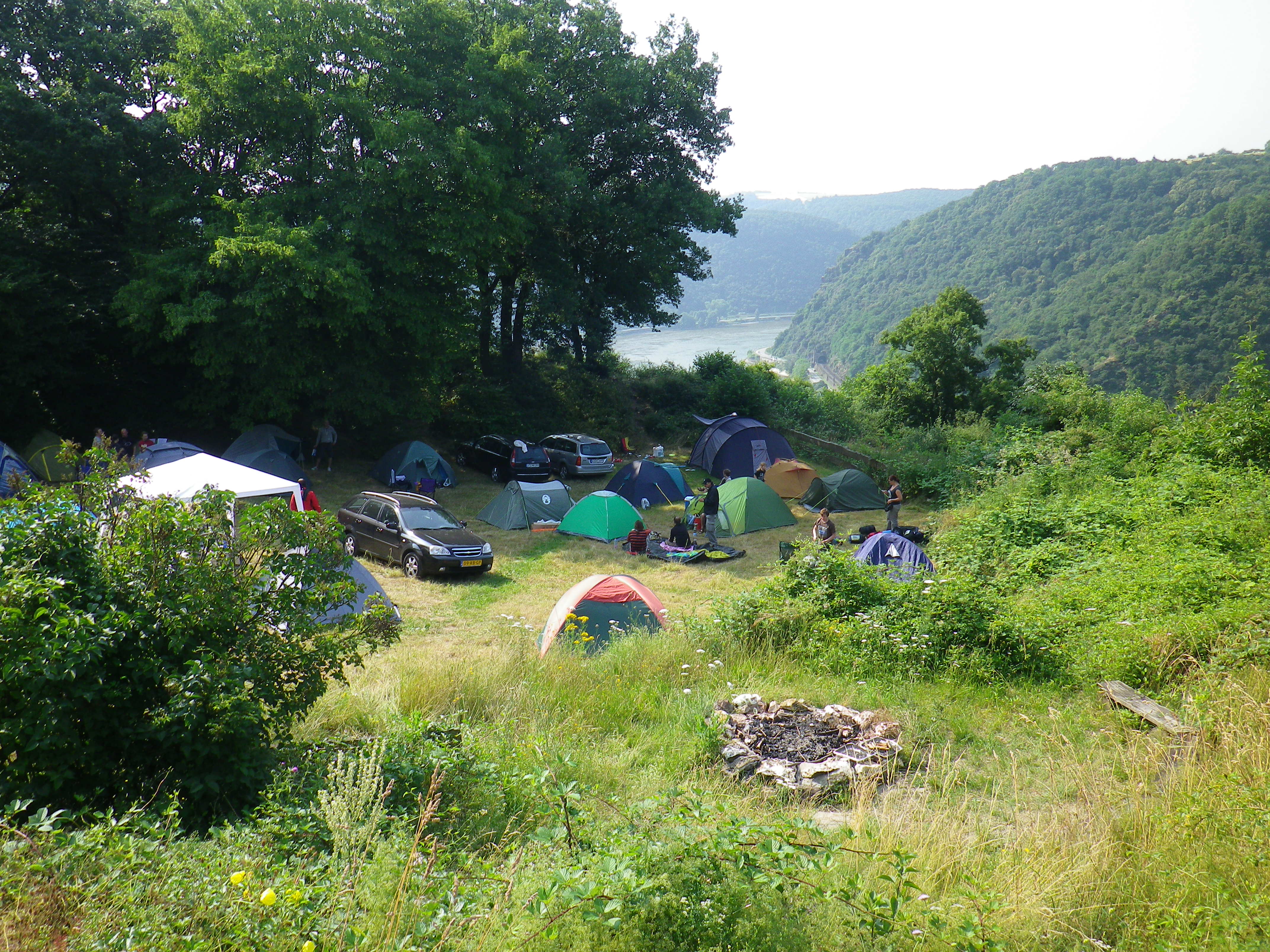
The Campsite
The fact that we were only aware of Muse’s presence shortly before the event meant we didn’t have tickets and this was a major bummer. Muse gets a lot of bad press from Prog fans but I have a great admiration for them both as musicians and for their somewhat bombastic rock.
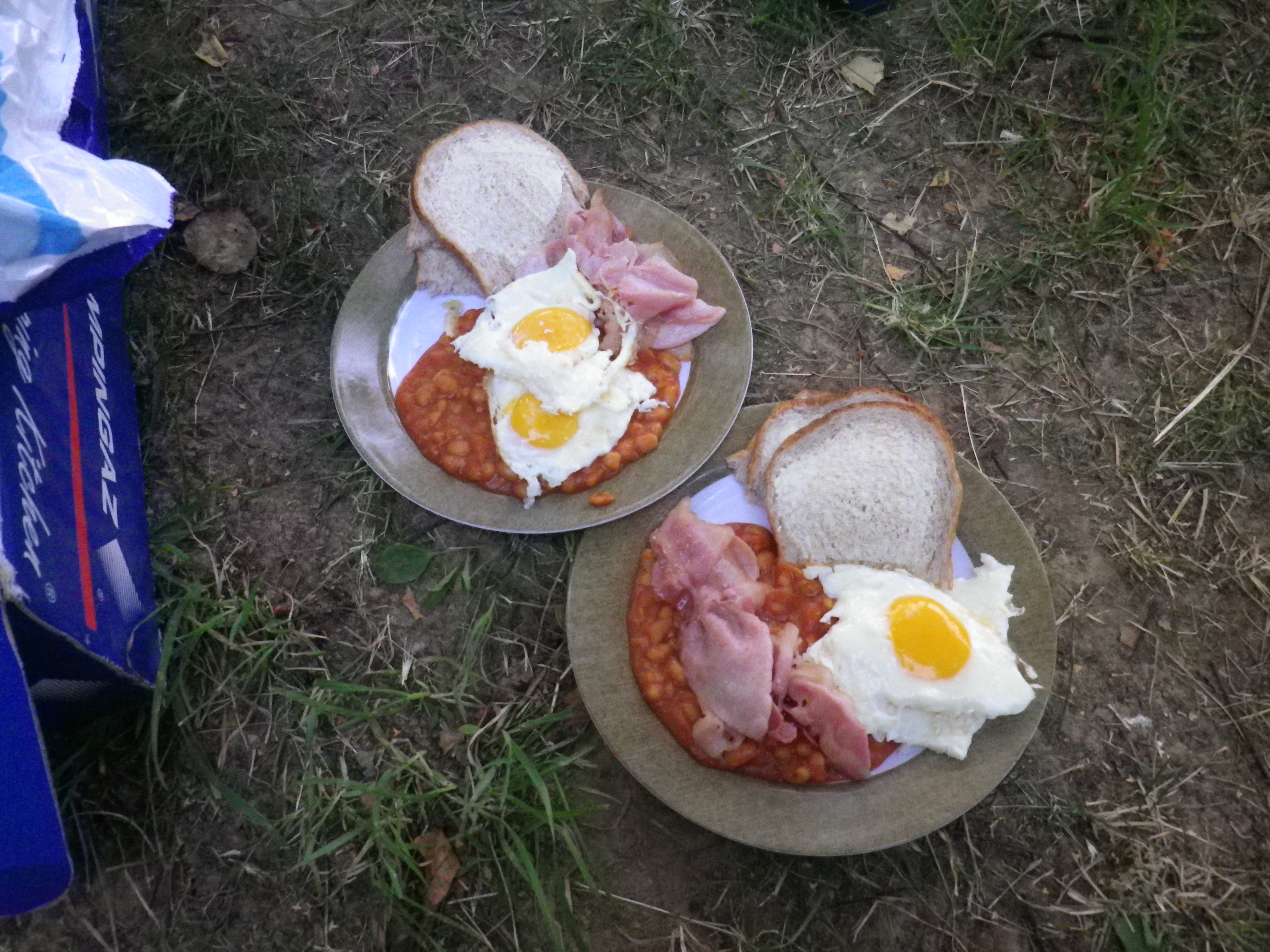
By the time we had erected our tent and had a bite to eat (a very late full English breakfast) the site had exploded into the shuddering power of Muse’s stadium rock.
The campsite was only about 300 metres from the Amphitheatre and the acoustics are such that you almost feel you are sat watching with the paying fans. So we heard Muse perform a greatest hits collection, with a fantastic cover version of Man with a Harmonica from Sergio Leone’s Once Upon a Time in the West as an intro to Knights of Cydonia. Listening to this immense soundtrack to this classic Spaghetti Western is recommended.
Muse finished around 2300 hours and this was followed by chaotic scenes as cars, vans and tour buses tried to leave through the one narrow exit. Although I was tired, sleep was impossible so I texted Nic Dewulf, a fellow Big Big Train fan from Belgium, and we met up on the campsite. We had a good Prog chinwag with Nic and his friends. Nic is keeping the flag flying amongst the youth of today (he’s only 23…a prog babe in arms!).
The returning Muse fans were a little ‘wired’ and this coupled with Prog fans excited with the prospect of a superb weekend in glorious weather, led to a barmy late evening. However, somehow I managed to dose off only to be woken up to what seemed to be Symphonic Prog to the left of me and a Metalfest to the right of me. I have to say that in a masochistic way I enjoyed the surprisingly melodious power of a German baritone accompanied by two tenors singing an unrepeatable (i.e. very rude) chorus from a metal song I knew but just couldn’t place. Glorious stuff!
I eventually returned to slumber, awoke early at 0645 and had an early shower and shave. Generally I found the facilities pretty good at the campsite but there did seem to be a lack of toilet paper (always a camping essential) and there’s little room for modesty as the main shower block was unisex! A nice English cup of tea was imbibed followed by another as I seem to need a couple to get me going in the morning nowadays. This restored me to a semblance of health and my invigorated body felt capable of enjoying the Day 1 festivities.
The Loreley site
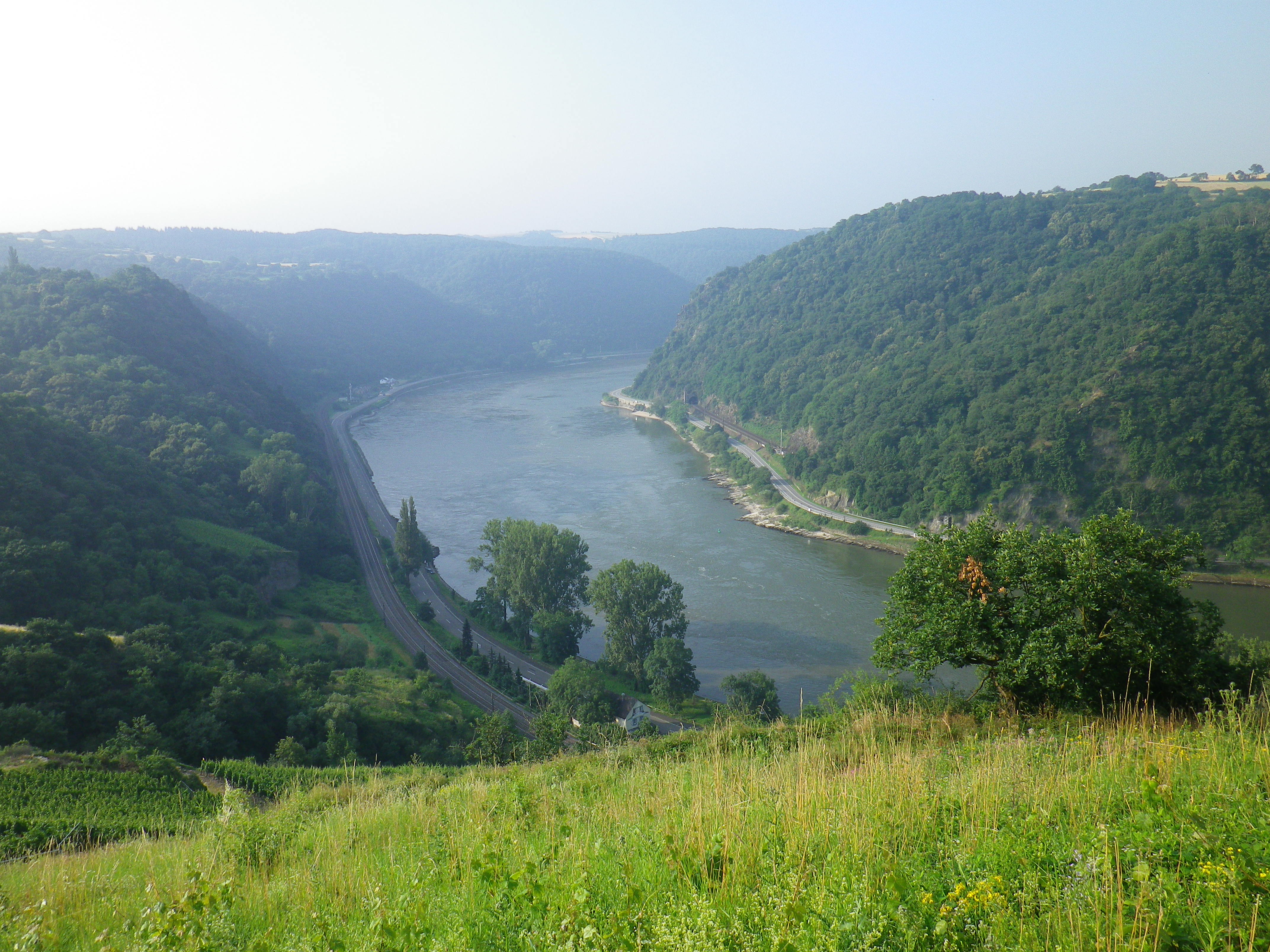
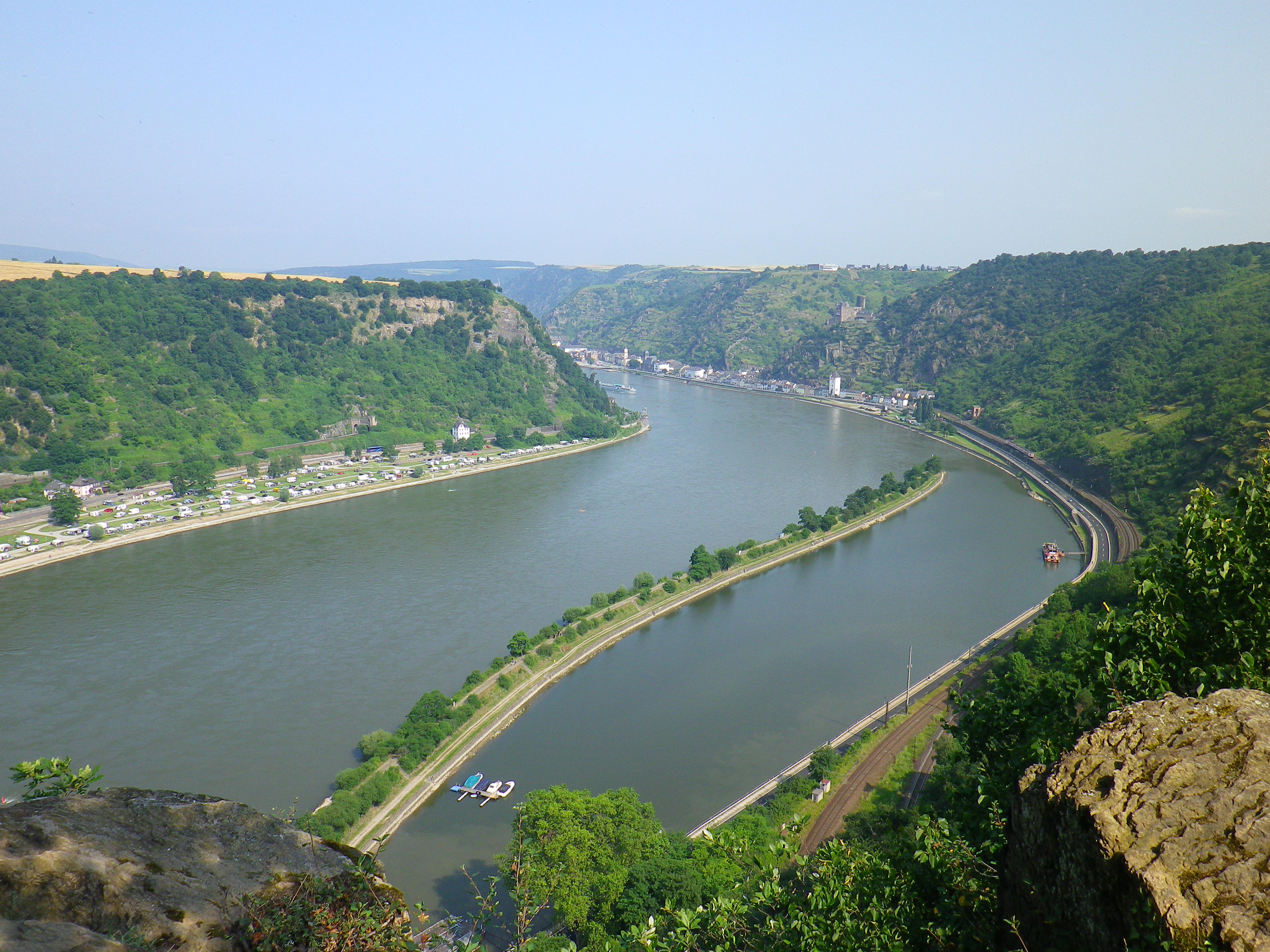
It was a beautiful morning and with proceedings not commencing until 1400 hours we decided to enjoy the world famous views. Loreley is part of a UNESCO World Heritage Site situated on the east bank of the Rhine at a sharp bend in the river. The natural cliff face is approximately 120 metres high and the sheer drop has little protection with only a few nominated viewpoints having railings. The campsite is literally on the edge of the cliff face.
The vista is stunning, clearly displaying the natural beauty of this part of the Rhine, which is a walkers’ paradise. Roads run along the edge of both sides of the river as the Rhine cuts through the natural gorge in the countryside. To the north there are beautiful views of picture postcard towns, villages and castles flanking the river. The river traffic is frequent with many huge long barges carrying various trade cargoes and sightseeing boats traversing their course. The river is fairly narrow at this point and navigation is difficult. I have attached some pictures but they cannot do justice to the impressive beauty of this area of the Rhine.
DAY 1 – The Bands
The venue itself was built in the 1930s as a Nazi ‘Thingplatze’ to host cultural events and can hold a maximum of 18,000 with 5,000 seats. Over the next two days the number of attendees was slightly disappointing with perhaps 3000-4000 people enjoying the music. From the back the Amphitheatre slopes quite steeply with the grassy banks offering shade for the weary festival goer. There were the usual official merchandise tents together with CD and vinyl stalls offering the best of European Prog music. Beer and even a cocktail tent provided refreshment. Food stalls mainly provided local cuisine with varieties of ‘Wurst’ on offer.
The stone, semi-circular seating provided both an excellent view and sore bottoms, with various innovative ways being used to provide a comfortable perch.
Sanguine Hum
First up were Sanguine Hum who have been receiving critical acclaim for their last two albums Diving Bell and The Weight of the World, the latter being played in its entirety (I think). This was the second time I have seen them and I would like to report I really like them but I’m still undecided! Their music is full of complex time signatures and lacks the sort of fluidity I like. Joff Winks’ vocals are light and a touch fragile at times. Technically demanding to play with intricate arrangements, it’s clever, inventive music that the band delivers with aplomb but whilst it’s interesting contemporary progressive music, it doesn’t press enough of my musical buttons…at the moment. I need to spend a little more time listening to their recordings, methinks.
In terms of the set, it’s always difficult being the first band and I felt they were slightly in awe of the surroundings. I think Joff Winks, who is obviously a modest chap, seemed almost apologetic to be on stage and could try to engage a bit more with the audience.
Sound of Contact
The brainchild of David Kerzner and Simon Collins (yes Phil is his dad!), Sound of Contact have been kicking up a bit of a storm with their new concept album, Dimensionaut. Once again, my second live listen, the band commenced with a short instrumental number and followed up with three tracks that I would consider almost ‘commercial’ in sound and structure (God forbid!). Simon Collins sounds very similar to his father, with similar looks and mannerisms to boot. A little AOR for my taste, particularly Pale Blue Dot, but nonetheless engaging. They finished with Mobius Slip, a classic long ‘proggy’ track with the middle section reminding me of Porcupine Tree in their heavier period. They are newcomers and I’m sure their sound will develop (and become more progressive?). They performed confidently live and were better than when I saw them at the Garage in London recently supporting Spocks Beard. Good luck to them on their extensive European and North American tour.
The Pineapple Thief
Third up was Bruce Soord’s vehicle, The Pineapple Thief, who were determined to add some more energy into proceedings. The crowd were, like me, beginning to flag in the heat. Bruce Soord has been around a long time and is beginning to receive the acclaim he deserves. I was interested to see how they would perform in a venue that for them was seriously large. I saw them last year at the tiny Barfly club in Camden and you could hardly swing a cat in there.
The latest output Someone Here is Missing and All the Wars is Prog-pop with simple repetitive riffs and this provided the bulk of the set. The band displayed a lot of energy on stage and the crowd responded with chorus singing, clapping in 6/8 time and some dodgy ‘swaying’ at times (or were these people hallucinating as the heat radiated off the stone seating!). I’m a great fan of TPTs output over the years and they delivered an invigorating set that revitalised me. A well deserved standing ovation and the first encore.
Crippled Black Phoenix
A sort of UK supergroup, CPB released their first album in 2006 and has gone through numerous line-up changes over the years. Their sound combines elements of heavy/blues based rock, post-rock and at times a ‘stoner’ sound and they mix instrumental only with standard verse, chorus tracks. I thought they were a little slow to get going at first but when they did they totally commanded the stage and produced a killer set. I particularly liked their cover of ‘Of a Lifetime’ by Journey but that was on the ‘softer’ side of things. I own a couple of their albums, one of which is quite mellow, but live, with the luxury of 7 members and notably 3 guitarists, they produced a much heavier, very powerful, almost ‘wall of sound’. It was slow, head-banging stuff to me. They finished incredibly strongly and literally rocked the amphitheatre down, receiving a prolonged standing ovation as they brought the set to a dramatic, stunning conclusion with the anthemic ‘Burnt Reynolds’. Definitely a band I would see again and one I recommend as a live act. I was so impressed I went to the ‘merch’ desk and bought one of their albums on vinyl.
Magma
Magma are the vision of Christian Vander and have been granted their own musical genre called ‘Zeuhl’ and sing in their own made-up language ‘Kobaian’. Heralding from the classic era of Prog in the 70s they sound absolutely nothing like their contemporaries. Magma deliver a truly unique musical sound, with a classical music structure, dominated by repetitive chanting. I was really looking forward to hearing them after being left intrigued by their classic ‘Mekanik Destruktiw Kommandoh’ (MDK) on vinyl recently (essential preparation I was told!). This album is part 1 of their cult sci-fi trilogy.
Let’s be honest here, the music is bizarre and you have to be a little bit weird, perhaps even insane to like this stuff. However as I can stomach, and at times like, acts such as Captain Beefhart, Zappa , Mr Bungle and The Residents I am probably ‘certified’ myself.
The set commenced with a track from a new but as yet unreleased album which was driven along nicely with a single pulse-like bass line and was even a little funky at times. Was Mr Vander going a bit soft in his old age? Certainly not, as the set took us into increasingly darker and bizarre territory, exposing us to tribal themes and culminated in the whole of MDK itself. The chanting, both unrelenting and severe, was delivered by three accomplished singers (one man, two women). It’s somewhat like Carmina Burana on drugs. The language itself sounds very Germanic and quite harsh to my ear. The music is multi-layered with a strong drum (at times tribal) and bass line throughout. Everything is quite repetitive, particularly the vocal chanting that as it increases in intensity has a hypnotic, even trance-like quality. At times I felt like a drug-induced disciple of Dionysus being whipped into a frenzied state of heightened self-awareness (it was NOT sexual ecstasy!) And, before you ask, I hadn’t imbibed in anything more than a few weak German beers.
One has to admire Mr Vander for maintaining his vision and there is no doubt that all the musicians are talented but it’s a difficult listen and comes over as quite awkward, even uncomfortable at times. If you haven’t heard Magma then I think it’s fair to say you will not have heard anything like it before…well I haven’t that’s for sure.
However, in a strangely masochistic way I actually enjoyed
it. I’ve always been intrigued by challenging music that break boundaries. It speaks volumes for Magma’s reputation that a lot of the other musicians (notably Steven Wilson and Opeth’s Mikael Akerfeldt) watched the set alongside the audience.
Steven Wilson
So we came to the headline act, the Prog God himself, Mr Steven Wilson, who was the main attraction to all the attendees I had spoken to. I had already seen the show in London earlier in the year and I know of no-one who wasn’t blown away by that evening, even some of the SW sceptics. The Raven That Refused To Sing is SW’s latest solo offering and he had assembled an array of amazing talent to support him (I won’t repeat them here). The new album shows that SW is quite willing to tinker with his previous winning formula as TRTRTS has a much more jazzy edge to it. I’m a great admirer of most of SW’s work from the early ‘psychedelic’ phase of Porcupine Tree through the ‘heavier’ years to the darker social commentary of his later work. I’m presuming most people at Loreley had not seen the show before. I was hoping for a little variation from the London set but there were only marginal changes. Basically he played the whole of TRTRTS and finished with the old Porcupine Tree favourite Radioactive Toy.
So how good was it? Technically it was almost flawless, like listening to CD quality on a high-spec hi-fi system. The show is a stunning audio and visual experience. The videos are superb, although rather unsettling, but that’s not surprising considering the album’s supernatural themes. But I was slightly disappointed with the lack of interaction with the crowd. The man himself delivered a few quips and witticisms but there was little ‘on-stage’ involvement from the rest of the band who just seemed to ‘get on with it’. There is no doubt in my mind that SW is a real ‘mover and shaker’ in the Prog world and his latest offering is a ‘tour de force’ (especially live). But for me the second offering was a little bit flat compared to my first experience. I like the uncertainties surrounding a live setting with the possibility of hearing a slightly different interpretation of songs but it seemed all very calculated to me. Having said this, the crowd absolutely loved it and they were right to do so.
A great finish to Day 1 with events closing at 1245 in the morning.
Day 2
Oh dear, that pork burger and spicy fries backfired on me the next morning. Even a quick walk, a caffeine fix and shower wouldn’t do the trick so I lay on my carry mat feeling a tad sorry for myself until gone 11am. With events commencing at midday on Sunday, 7 bands performing and a 2300 hours curfew, I shook myself out of my self-induced stupor and arrived shortly after Anima Mundi had started the festivities on day 2.
Anima Mundi
Now these guys (and gals) hail from Cuba and have being trawling a lonely furrow in their home country since for over ten years. I had purchased their latest CD titled ‘The Way’ following a taster on ‘The Prog Dog’ show, hosted by the incorrigible Geoff Banks and Jon Patrick. Anima Mundi means ‘spirit of the world’ and hailing from Cuba they evidenced the growing cosmopolitan reach of progressive music. A five piece with extra percussion and clarinet at times, they deliver a neo symphonic rock full of swathing synth and melody. They clearly loved having the opportunity to expose their craft to a wider audience and played with a refreshing passion and energy. I only recognised the last track, ‘Cosmic Man’ from ‘The Way’ but thoroughly enjoyed the whole set which was significantly heavier and rockier than I had heard on cd. A great start to the day.
Maybeshewill
I think a few eyebrows were raised when MSW were announced as an act as they are a young band delivering purely instrumental post-rock with some limited vocal sampling. Certainly their youthful looks and general attire appeared slightly out of place in the surroundings and, occasionally, they looked slightly uncomfortable. Their sound is quite straightforward with two guitars pounding out short, punchy power riffs and these dominate at the expense of the keyboards, although there were a few nice soft, usually ‘intro’, keyboard passages. Many of the riffs were very catchy, if a bit ‘samey’ and I found myself foot-tapping along. I’m a great post-rock fan with one of my favourite bands in any genre being Mogwai and I also get absorbed into the darker themes produced by Godspeed You! Black Emperor and This Will Destroy You.
I felt that the crowd reaction, who did their best to warm to these youngsters put before them, was not helped by the polite but very taciturn nature of the lead singer. I know it’s the ‘done thing’ for youngsters to be a lit bit distant from the older generation (believe me – I have kids of 18 and 20) but music should, and indeed does, help to break down age barriers. So a piece of advice to the band, if I may be so bold… us old-timers are an accommodating, tolerant bunch and more engagement would help your performance and enhance our enjoyment. Overall , I’m glad they were invited as variety in festivals is important.
Anglagard
I think there was a huge expectation surrounding Anglagard’s appearance. Legendary in prog-circles, particularly in Scandinavia, a cult band who released two acclaimed albums in the early ‘90s before breaking up. A hugely long hiatus was broken with one of my favourite albums of last year, Viljans Oga.
Anglagard produce beautifully constructed pastoral yet angular music with an eerie, mystical feel, redolent of the deep, dark forests of their native Sweden, full of the supernatural.
The band took a long time setting up and this was understandable considering the scarcity of their live performances. They opened with a specially arranged piece, typical of their canon. What a stark contrast between the complexity of Anglagard and the simplicity of Maybeshewill (and that’s not a criticism of ‘simple’).
The live performance lost none of the immense beauty of their haunting music. Truly sublime with excellent performances by all members of the band. The mesmeric flute playing was a highlight for me.
Amplifier
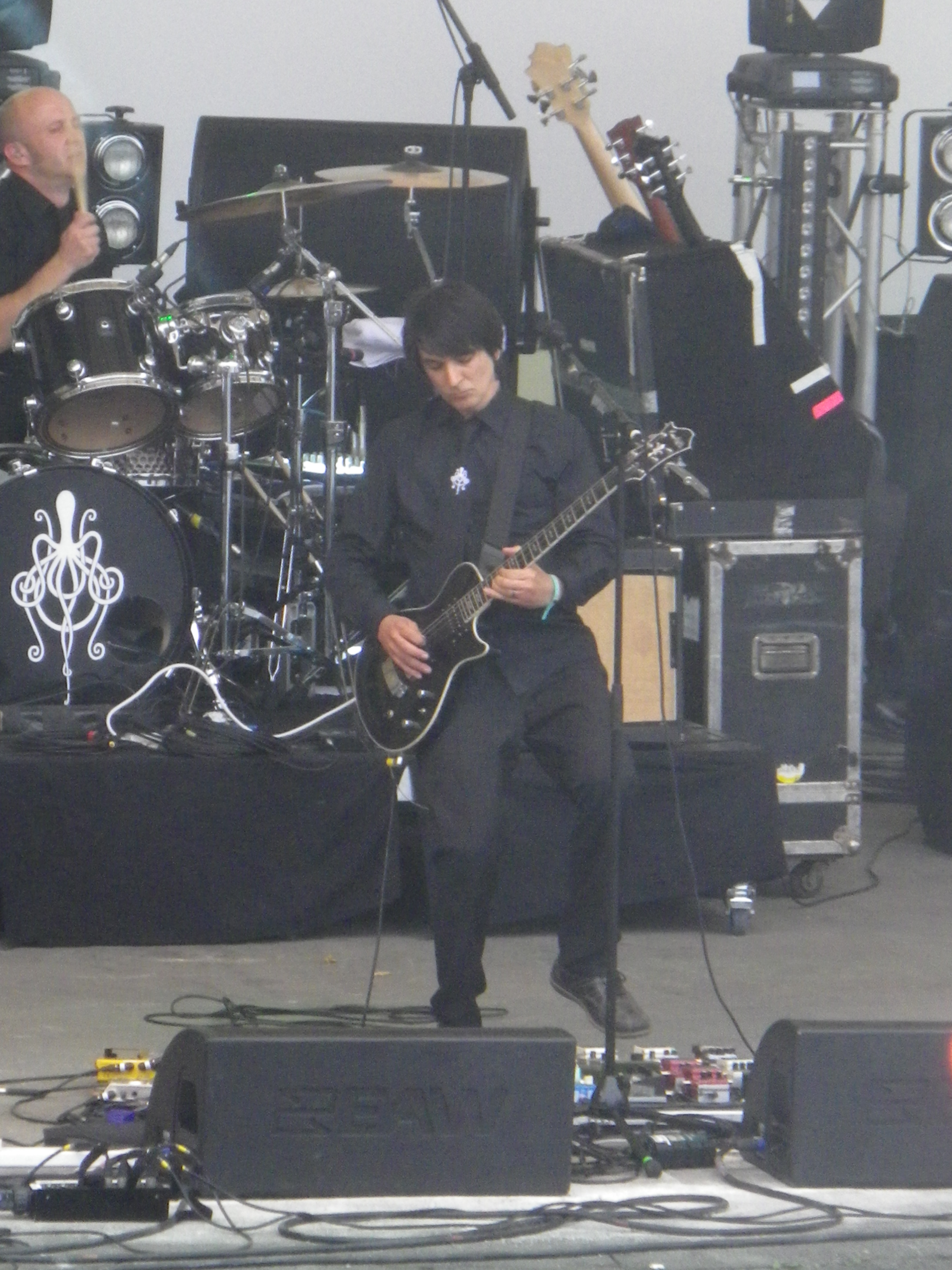
The creation of Sel Balamir, Amplifier are another band who have been around for a fair while and are now getting deserved attention. Their latest offering, the mellower ‘Echo Street’ has been nominated as Album of the Year in the Classic Prog Awards. The band came to my notice after they released (through their own endeavours after four years of hard toil) the two hour concept album, The Octopus, in 2011. The Octopus literally takes you on a trip ‘to another dimension’.
This was my fourth live gig in less than two years, so yes I like them! Amplifier gig extensively throughout Europe and are definitely more popular here than in the UK.
Sel Balamir in full flow
Amplifier deliver Space Rock full of heavy effects-laden guitar riffs and solos. What I’ve always liked about Amplifier’s sound is the heavy driving bass and rhythm guitar coupled with some intricate, subtle lead guitar. This combination produces a huge soundscape that fills my head in a spectacular way. However this is a difficult combination to crack when the volume of all instruments is set at LOUD. I’ve yet to hear them actually nail it totally in a live setting and a combination of sound problems, coupled with the introduction of a third guitar player and a bass on LOUD PLUS, totally drowned out all the subtlety. I’m not a fan of the third guitar and I’ve heard them better with only two. But who am I to judge.
They started with Spaceman from their recent Sunriders EP, followed by the brilliantly riffy, if slightly repetitive and overlong, The Wheel, from Echo Street. They continued with numerous fans’ favourites such as Interglacial Spell, The Wave and Interstellar (what a track that is!), all from The Octopus. As the festival was running behind schedule they had to foreshorten their appearance and finished with the anthemic Airborne from their eponymous first album. Amplifier always give it their all and are dedicated to all that is The Octopus (why always the black shirts and special logo ties?). I’m a stickler for sound so overall I was a bit disappointed but I recommend them live if you like your music at the heavier, spacey end of the prog spectrum.
Caravan
No sound problems for these old warriors of the Canterbury scene. It was pure plug and play. A greatest hits was delivered with classic tracks from For Girls who Grow Plump in the Night (Memory Lain, Hugh/Headloss, The Dog The Dog He’s At It Again) and from In The Land Of Grey and Pink we had Golf Girl and the classic Nine Feet Underground.
Consummate professionals, they know how to work an audience with plenty of witty banter and the entertainment included skilful playing of spoons and washboard! Always playful but with some clever social comment, I’m never sure whether to take them seriously and how can one with some of the most politically incorrect album and song titles ever put to paper. Ten out of ten; superb entertainment and the crowd loved them.
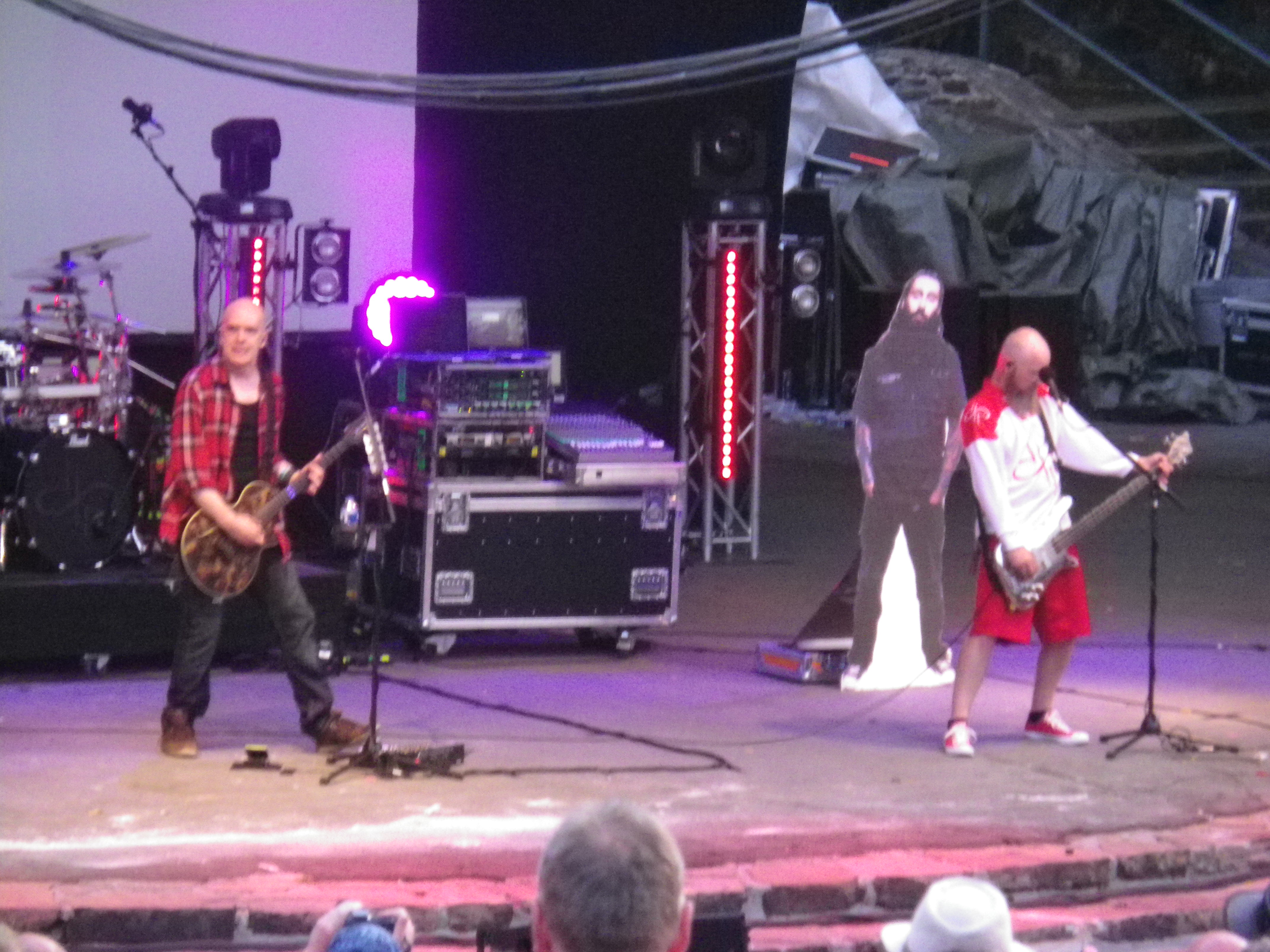
Devin Townsend Project
I know little or nothing about Mr Townsend and I missed part of the set to ’freshen up’ after another eight hours of hot sun, beer and loud music. When I returned I noticed the following:
The band produced a huge sound for a three piece
There was a cardboard cut-out of a band member on stage
As a lead guitarist and vocalist, Devin Townsend didn’t seem to take himself too seriously and worked the crowd well.
The sound was hard rock and metal; unfortunately the band were missing a guitarist (or was it a keyboard player?) and a huge amount of backing tapes were being used to the extent I didn’t know what was live and what was pre-recorded. Good fun but not really my cup of tea.
Opeth
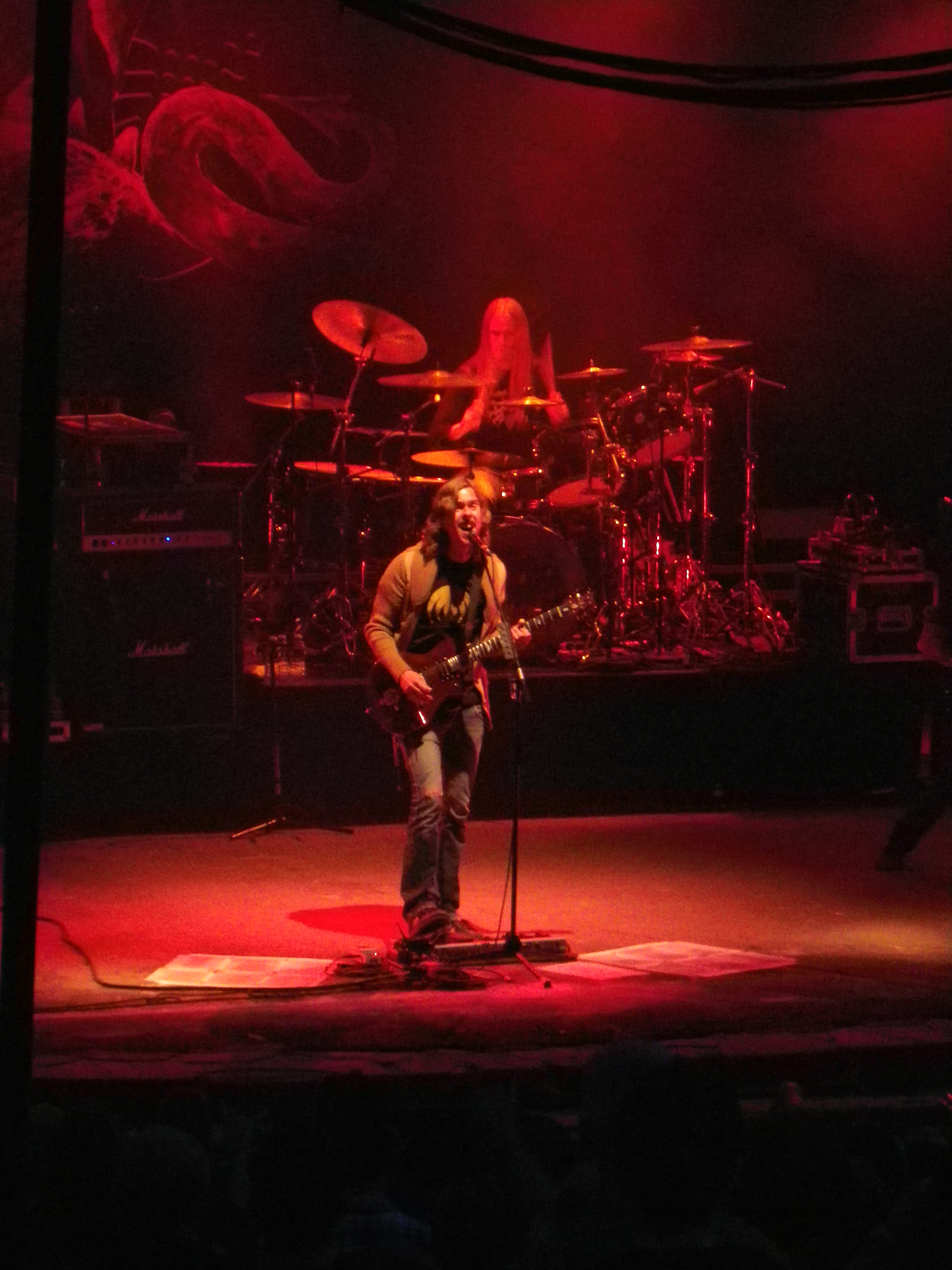
To conclude proceedings we had Opeth. Now I like heavy rock but i’m not a death metal fan. I had been recommended the band’s last offering ‘Heritage’ which is a big departure for Opeth, leading them into more mainstream Prog territory (and apparently took a lot of their diehard fans well outside their comfort zone). Band leader Mikael Akerfeldt, on guitar and lead vocals was quick to point out that he understood that there were fans from both ‘camps’ and therefore the set would be a mix of old and new. So we could expect some death metal growling but no apologies would be offered. Mr Akerfeldt introduced each track with wit and intelligence and this was appreciated by all concerned.
Starting with ‘The Devil’s Orchard’ from Heritage, an excellent track with a jazz fusion vibe but a dark edge, the tone was immediately changed as the band hammered out a classic death metal track from Ghost Reveries titled Ghost of Perdition. As the set continued I was intrigued by the juxtaposition of light and subtle with abrupt changes to intensely heavy within each death metal track. And it worked very well to my ears.
I was truly impressed with the quality of musicianship and the eclectic mix of death metal, prog rock, psychedelic and even folk music. Opeth delivered tracks with Oriental influences and Spanish guitar. And Mikael Akerfeldt has a tremendously versatile voice.
Opeth have obviously experimented throughout their career that spans over 20 years and 10 albums and the variety put together for this set was both inspirational and a triumph. I’m certain to re-visit some of their older stuff and would love a DVD of their performance to close Night of the Prog.
Final thoughts
So we came to the end of proceedings at 2300 hours on Sunday evening. Night of the Prog 8 had been a superb event, providing me with a perfect mix of old and new; heavy and light; simple and complex.
Highlights for me were numerous. Crippled Black Phoenix seemed infinitely better live than on cd. It was a privilege to see rare appearances from Magma and Anglagard. Witnessing the simplicity of Caravan in a world full of complex sound effects and large show pyrotechnics was refreshing. And finally the surprisingly enjoyable Opeth.
A huge thanks to Win for continuing to organise it. I doubt if any music festival is situated in such beautiful surroundings and the weather was perfect. Thanks also to Nigel Barham for being subtlety cajoled into accepting my invitation. And it was great to actually meet up with some Facebook friends in person.
Roll-on next year. If Win is reading this my request would be Big Big Train, Echolyn, Beardfish, Motorpsycho, Kraan and a re-formed Oceansize!
Here’s hoping 🙂
Oh, and finally a few tips if you are planning to go:-
Bring a cushion as those stone seats don’t half give one a sore a*se.
Take time out to view the stunning landscape
Ignore the rules about bringing food and drink into the event…food selection is limited and you need plenty of water AND ‘security’ seemed happy to allow stuff through.
For me, the album does what prog does best, with that characteristically proggy ability to immerse the listener in a cosmic philosophical meditation.
To give another example: One of my absolutely favorite tracks from Big Big Train, “The Wide Open Sea,” does this sort of musical meditation stunningly well.
So, to encounter in Dimensionaut an album-length, equally successful exercise in that kind of philosophical and spiritual meditation, is a real thrill. And it’s an even more remarkable achievement if we consider that Dimensionaut is the equivalent of a vinyl double album.
Here is how I would slice it up for a deluxe vinyl gatefold edition:
SIDE 1:
01. Sound Of Contact (02:05)
02. Cosmic Distance Ladder (04:43)
03. Pale Blue Dot (04:44)
04. I Am Dimensionaut (06:25)
SIDE 2:
05. Not Coming Down (06:01)
06. Remote View (03:54)
07. Beyond Illumination (05:53)
[featuring Hannah Stobart]
SIDE 3:
08. Only Breathing Out (05:57)
09. Realm Of In-Organic Beings (02:52)
10. Closer To You (05:05)
11. Omega Point (06:30)
SIDE 4:
12. Möbius Slip (19:36)
I – In The Difference Engine
II – Perihelion Continuum
III – Salvation Found
IV – All Worlds All Times
If people approach Dimensionaut with an open mind, they will have to admit that this double album is an incredible achievement. Amazingly, it is prog that is accessible to everyone, and yet it does not shatter its integrity with any compromises.
All the negative reviews that I have read, and any reservations that I have heard expressed, stem simply from invidious comparisons, which are completely unfair.
Rather, if you clear your headspace of all preconceptions and genealogical obsessions, and just enter into the spirit of the music, the musical conclusion is inescapable:
With Dimensionaut, the Spirit ever lingers… undemanding contact in your happy solitude!
(I append below an interesting video in which Simon Collins and Dave Kerzner talk about the album’s story concept. They affirm that the musical journey explores not just dimensions of science fiction and romance, but most especially a serious spiritual dimension.)
“I think it’s slightly more complex with Porcupine Tree, which can’t really happen without me instigating it and being the main writer and director of that situation — so, that’s more problematic,” Wilson added. “I don’t have time in my life to do that, and what I’m doing now. So, I guess I have made the decision, right now, to concentrate on the solo career. But that’s not to say that the band has broken up or anything like that. It’s always conceivable that we could get back together in a year or five years, or 10 years. I really can’t say. There are no plans at the moment.”
Steven Wilson’s journey as a solo artist from debut Insurgentes to his new release The Raven That Refused To Sing (And Other Stories) has been a fascinating one. That first album has dark introspection and desolate beauty in equal measure. Follow-up Grace For Drowning is a different beast, with more shades of light and dark to it and with a more expansive and organic feel. Raven puts that work into context as a transitional piece, for here Wilson’s vision seems, at last, to be fully realised.
The influences that shaped Grace – the improvisational aspects of jazz, and Wilson’s involvement in remixing King Crimson’s early work – are once again evident, but this release can boast greater coherence than Grace, due in part to its unifying ‘ghost stories’ theme. It also benefits from a rather different approach to production. Wilson is settled and comfortable enough with this group of musicians to gamble on live recording in preference to meticulous overdubbing, emulating the methods used on those 1970s prog masterpieces that he has been remixing so successfully. The gamble has paid off and the music frequently builds to a thrilling intensity as the players feed off of each other. Having the legendary Alan Parsons at the controls is the icing on the cake, guaranteeing a recording of superb quality.
Luminol kicks off proceedings in a suitably explosive manner, with frenetic bass and percussion plus vocal harmonies that call to mind Tempus Fugit from the 1980 Yes album Drama. The pace and energy are high in the early and closing stages of this twelve-minute piece, with all players getting the chance to show what they can do, but it is perhaps Adam Holzman’s piano during the quieter middle section that impresses most.
The album really pivots around the twin epics of The Holy Drinker and The Watchmaker. Both are as good as anything Wilson has ever done. Drinker is moody, powerful and intense, the perfect showcase for the staggering virtuosity of the musicians that he has assembled as his band. Theo Travis particularly shines here. Watchmaker is more delicate in tone and really quite beautiful for the opening four minutes before opening out into some spectacular interplay between Guthrie Govan’s guitar and Travis’ saxophone. Piano, vocals and bass all take their turn at the front of the sound stage before a closing section laden with heavy power chords.
There are nods to Wilson’s other projects. Drive Home feels almost like a Porcupine Tree song before it expands into a closing section with a stunning Guthrie Govan guitar solo that quite simply takes the breath away. The title track is sparse, mysterious and moving; it probably wouldn’t look out of place on Wilson’s recent Storm Corrosion collaboration with Opeth’s Mikael Åkerfeldt.
Signify is an important album in the long and varied history of Steven Wilson and Porcupine Tree. The first PT album, On the Sunday of Life (1991), is a tongue-in-cheek solo Wilson tribute to British psychedelic rock in the vein of XTC’s Dukes of Stratosphear. Up the Downstair (1993) and Voyage 34 (1993) were also done primarily by Wilson alone, and are literal acid-rock albums.
The Sky Moves Sideways (1994) introduces the first real band that operated under the moniker of Porcupine Tree: Wilson on guitars and keyboards, Richard Barbieri on synthesizers, Colin Edwin on bass, and Chris Maitland on percussion. Stylistically, the album is heavily indebted to classic Pink Floyd. While an enjoyable listen, it doesn’t break any new ground. It’s also easy to forget that the group Wilson had formed with Tim Bowness, No-Man, was actually more popular than PT during this period.
Which brings us to 1996, and Signify. Musically, it is a giant leap. Wilson, Barbieri, Edwin, and Maitland are working together as a seamless unit. There are lots of instrumental passages, and Barbieri’s electronic atmospheres are integral to the overall feel of the music. Beginning with the first track “Bornlivedie” and continuing throughout the album, Wilson juxtaposes samples of happy-sounding radio announcers, televangelists, and other snippets of spoken word with beautiful yet foreboding music.
Porcupine Tree’s new live album, “Octane Twisted” arrived in the mail today. It comes in several configurations – the one I ordered is a 2-cd and single dvd set of their April 30, 2010 concert in Chicago.
The first disc is a complete presentation of their 2010 album, “The Incident”. It’s an excellent performance, with the highlights being the Animals-era Floydian song “Time Flies”, and the album closer, “I Drive the Hearse”.
Because they perform the entire album without breaks, the audience is pretty much taken out of the picture. While watching the dvd of the show, it’s clear there is incredible chemistry between the band members, but I didn’t get much sense of rapport with the crowd. Gavin Harrison once more demonstrates he is one of the greats of prog percussion. He deserves to be mentioned in the same breath with Neil Peart and Nick D’Virgilio. Richard Barbieri is a master at creating evocative atmospherics, and Colin Edwin makes playing complicated bass runs look effortless. Once again, John Wesley joins the core PT members to play guitar and vocals.
Steven Wilson is the main attraction, and he doesn’t disappoint – playing both electric and acoustic guitar, and some piano. He pulls off some excellent solos in “The Incident”, “Time Flies”, and “Octane Twisted”. And, of course, he’s barefoot throughout the concert!
Disc 2 contains the rest of the Chicago concert, as well as three songs from an October 14 London show. The other Chicago songs are “Hatesong” (probably my least favorite PT song), “Russia On Ice/The Pills I’m Taking” (“Russia On Ice” drags, but “The Pills I’m Taking” picks up the pace nicely), “Stars Die” (from the early days!), and “Bonnie the Cat” from The Incident (odd choice for a concert closer). The London songs are “Even Less” (a perennial favorite, but this performance is a little lackluster), “Dislocated Day”, and “Arriving Somewhere But Not Here” (a really good rendition of a beautiful song).
Overall, this a fine performance, and you get a lot of music for your money. “The Incident” is not one of my favorite Porcupine Tree albums, though, so unless you like it a lot, you could probably give this one a pass. I was very disappointed that the dvd is just the basics: no special features, and it only offers 2.1 audio, not a 5.1 mix. Also, the editing was much too jumpy for my tastes; the camera rarely stayed on one angle for more than 3 seconds, and I would have preferred to have longer shots of the entire band playing.
If you are trying to decide which dvd of Porcupine Tree to buy, I highly recommend “Anesthetize”. It’s an incredibly energetic performance of an excellent album, “Fear of a Blank Planet”. “Arriving Somewhere” is also very, very good, and features music primarily from “Deadwing” and “In Absentia”.
One of my favorite labels in the current prog scene is Kscope Music. Its first release was The Pineapple Thief’s Tightly Unwound in 2008, and it has rapidly become a force to be reckoned with. Steven Wilson has released all of his solo work on Kscope, as well as Porcupine Tree’s The Incident, and several PT reissues.
Everything Kscope does is top-notch, both musically and visually. They favor quality over quantity, and as a result, prog fans eagerly anticipate their releases. Their site is one of the most informative on the web, incorporating minisites for new and upcoming releases, music videos, artist’s tour dates, Soundcloud samples, Twitter feeds, desktop and mobile wallpapers, and a monthly podcast.
They have put together an impressive stable of artists, promoting what they call “post-progressive” music. Here’s a quick rundown of my favorites (in alphabetical order):
Anathema began as a very dark and heavy metal band, but now they are full of light and beauty. Their songs grapple with issues of life, mortality, and spirituality. Here’s a sample from their latest album, Weather Systems:
Engineers are what would happen if Pink Floyd and Crosby, Stills, & Nash decided to team up with My Bloody Valentine. Lush vocal harmonies on a bed of multilayered guitars. Gorgeous stuff, in my opinion. Here’s a link to an audio stream of their album In Praise Of More.
Gazpachoare from Norway, and, like Anathema, they aren’t afraid to tackle serious topics in their music. Here’s the video to “What Did I Do”, a song about P.G. Wodehouse’s being accused of treason after he made some naïve German radio broadcasts during WWII:
Lunatic Soulis essentially a solo project of Mariusz Duda, bassist for the excellent Polish prog-metal band Riverside. Their two albums tell the story of a soul in limbo who is given a choice of returning as a reincarnated person with no memory of his past life and loves, or keeping his memories and remaining a shade (at least that’s what I think it’s about!). There is a third Lunatic Soul album consisting of instrumental tracks based on the first two albums’ songs. Duda’s music is mostly acoustic, very melodic, and has a world music feel. Here’s a sampler:
North Atlantic Oscillation is a duo from Scotland. Their latest album, Fog Electric, is one of my top 5 albums of 2012. Imagine Beach Boys mashed up with shoegazers. Here’s a montage from the album:
As I mentioned earlier, both Porcupine Tree and Steven Wilson’s solo music are now on Kscope. I love his work, and if you’re reading this blog, I probably can’t add anything to what you already about him!
Finally, we have The Pineapple Thief. Bruce Soord has been making wonderful music for more than ten years. As I wrote in a review of their album Variations on A Dream, “Depending on your listening temperament, his songs can either be maddeningly long and repetitious or seductively beautiful. I fall into the latter camp, and it might be because I enjoy the music of Philip Glass, Arvo Part, and Steve Reich – minimalist composers who write tonal pieces that rely upon a lot of repetition.”
Here’s “Last Man Standing” from their recently released album All The Wars:
Kscope is a label that is creating its own distinctive style, like ECM and Blue Note did with jazz, and 4AD did with, well, whatever you want to call 4AD’s music in the ’80s. By taking full advantage of social media, Kscope is spreading the word about post-progressive music worldwide.


 InsideOut Music recently signed John Wesley to its label, and his new album, Disconnect, will be available March 31 in Europe and April 1 in the U.S. I’m not pulling an April Fools’ joke when I say that it is my favorite album of 2014 so far (despite stiff competition from the likes of John “KingBathmat” Bassett, Gazpacho, and Transatlantic).





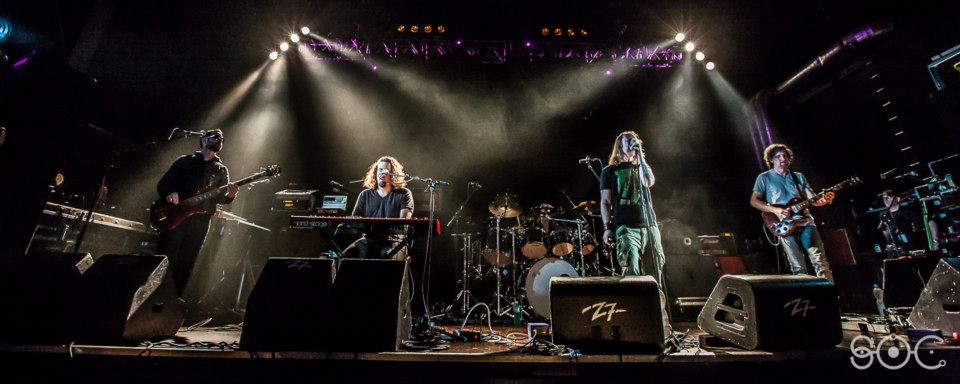
 Prog Magazine has just reported
 Steven Wilson’s journey as a solo artist from debut Insurgentes to his new release The Raven That Refused To Sing (And Other Stories) has been a fascinating one. That first album has dark introspection and desolate beauty in equal measure. Follow-up Grace For Drowning is a different beast, with more shades of light and dark to it and with a more expansive and organic feel. Raven puts that work into context as a transitional piece, for here Wilson’s vision seems, at last, to be fully realised.

 Progarchy