
The young pianist Eldar Djangirov (website) has already released several exceptional albums, featuring a wealth of stunning virtuosity and musicality. Dave Brubeck, who knew a thing or two about jazz piano, called him a “genius”, which gives you a sense of his talents. His early albums were sometimes criticized (and fairly so) for being heavy on flash and flair and light on interpretive depth and emotional resonance. But his work has matured with each release and I think his new album, “Breakthrough”, is his finest work yet. And I was pleasantly surprised to see that he took a page from the great Brad Mehldau and performs a Radiohead tune, the lovely “Morning Bell”. Here it is:
Tag: radiohead
NME: 20 Facts about Radiohead’s Ok, Computer
 Can it really be 15 years? A whole 15 years since Hanson’s ‘Mmmbop’ was No.1? June 1997 was quite the month for seismic rock masterpieces chronicling our millennial woes and sticky fears, and Radiohead’s ‘OK Computer’ was right there in the claustrophobic thick of it. To toast its birthday (16 June), here are 20 things you might not know about it.
To keep reading, click here. Full article at NME by Matthew Horton.
Like Radiohead? Like jazz?
 Then you don’t want to miss what I think is the best jazz album of Radiohead songs to be had: “Tribute to Radiohead” (2010) by Amnesiac Quartet. Don’t let the pedestrian title fool you: this is not muzak or some sort of cash-in project. Led by pianist Sebastien Paindestre, the French quartet also includes soprano saxophonist Fabrice Theuillon, bassist Joachim Florent, and drummer Antoine Paganotti. There are just five songs—”Everything in its Right Place”, “Morning Bell”, “A Wolf at the Door”, “Sail to the Moon”, “I Might Be Wrong”—but each is, I think, a perfect interpretation of the original tune, equally languid and intense.
Three things stand out. First, the use of soprano saxophone is inspired, as it has a yearning tone, occasionally agitated rhythm, and acrobatic runs that are very Thom Yorke-like (I don’t know that a tenor sax would have been nearly as effective). Secondly, the attention to detail is wonderful: the drums and bass present a whirling complexity and propulsive energy that constantly move and coil and dash around behind Theuillon’s wonderful lines, and the electric piano brings a welcome warmth to the proceedings. Finally, this is very much a band effort, focused on the songs, not simply using them as vehicles for solos. It succeeds fabulously. As John Barron notes in his AllAboutJazz.com review, “With a tight ensemble sound and exceptional soloing, Amnesiac Quartet maintains the inherent beauty heard in the music of Radiohead while tapping into seemingly unlimited potential for future improvisers interested in unique source material.” Here is the band in 2007, playing “I Might Be Wrong”:
Mini-review: Radiohead, “Kid A”
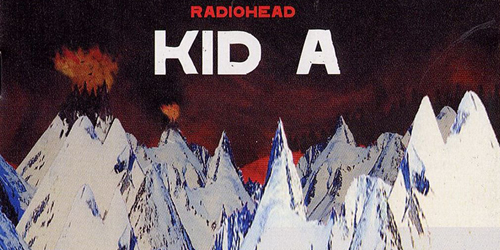 Radiohead, Kid A (2000). While I don’t worship at the altar of Radiohead or Thom Yorke, I very much appreciate them. While Ok, Computer did a wonderful job of bringing a 1990s feel to 70s Alan Parsons and other proggish-bands of the mid 1970s, Kid A offered something radically new and mesmerizing in the world of music. Intense lyrics about the problems of post modernity and scientism only add to the haunted and haunting quality of the album. Though Ok, Computer has better moments, punctuating the imitative proginess of two decades earlier, Kid A has no flaws as it explores a fascinating new realm of bleak soundscapes. The lyrics of Kid A, however, remain unimportant, ultimately, as Thom Yorke’s voice serves as another instrument on the album. The producer, Nigel Godrich, deserves credit for being an equal member of the band. The opening track, “Everything in its right place,” sums up the production, the album, and its place in history. A masterpiece.
A Pilgrim’s Prog-ress
I balked for a few moments at the temptation of writing an indulgent, long, complex, and idiosyncratic post about my journey to and into prog, and then realized: hey, this is Progarchy.com! If I cannot string together tenuously-related, semi-mystical concepts and conceits imbued with mythical overtones, quasi-autobiographical meta-narratives, and intertwining (and purposely confusing) philosophical musings here, then what’s the point of this wonderful blog? (No need to answer that, as I’m already soloing on my inner Moog without regard for the boring 4/4 time signature others might wish to force upon me.) Actually, much of what follows was already presented in a long-ish comment I left on a previous post below. But Brad, as he often does, inspired me to do more, even at the risk of embarrassing the shy and retiring Olson clan. So here goes.
I was oddly oblivious to most music until my early teens. This was due in part to being raised in a Fundamentalist home and church, both of which largely frowned on rock music as the rhythmic spawn of the devil, meant to corrupt good morals and encourage bad haircuts. Yes, the stereotypes do hold, at least to some degree. I heard a lot of church music (classic Protestant hymns, some of them very good) and mostly bland to bad contemporary Christian music. Then, around the age of fourteen or so, I started listening to the radio (one station, weak signal) and began to slowly accumulate a few tapes. My road to prog went through AOR acts such as Journey, REO Speedwagon, Loverboy, Foreigner, and Styx, with a helping of popular mid-80s albums by ELO, Elton John, Toto, and Queen. I found the standard rock of the day (including some of the stuff above) to be rather dull; I was fascinated by the more extended songs of Elton (the early 1970s albums especially), Queen, Asia, and the Moody Blues. I’m happy to say I was hooked on “Bohemian Rhapsody” long before “Wayne’s World” re-presented it to my generation. Also, I thought the usual popular, party music about sex, drugs, and rock ‘n’ roll was mostly shallow, even if occasionally diverting. Which is another way of saying I secretly listened to my share of Van Halen while playing some laughable air guitar (oh, wait, all air guitar is laughable). I did not, however, ever party. Seriously.
Around 1985 or so, I bought a copy of “The Best of Kansas”. That opened the door to prog. There was something about the mixture of Livgren’s lead guitar, Steinhardt’s violin, and Steve Walsh’s amazing voice, along with lyrics soaked in spiritual longing and Americana, that grabbed me by the scrawny neck. Over the next three or four years, I ended up collecting everything by Kansas, Kerry Livgren (solo and with AD), and Steve Morse (solo, Dixie Dregs, etc.). My favorite Kansas albums are “Song for America” and “In the Spirit of Things”, although they weren’t the chart-toppers that “Point of Know Return” and “Leftoverture” were. I also went on a serious Moody Blues binge, focusing on the early stuff, prior to their more pop-oriented work of the mid-’80s. Then I really got into Yes (both Rabin-era and the early classic albums with Howe), Rush, and Pink Floyd; in fact, while in Bible college (1989-91), I freaked out some of my more staid classmates with my obsessive interest in Pink Floyd, Queen, Queenrÿche, and King’s X (and, yes, I also listened to Petra, David Meece, White Heart, White Cross, Russ Taff, and Margaret Becker). King’s X was a major revelation, especially the brilliant, crunching, melodic beauty of “faith hope love”, which was a masterful blend of hard rock, metal, prog, blues, and Beatle-esque harmonies. And I recall very clearly driving across the Montana plains to school in Saskatchewan, blaring “Fly By Night” and other brilliant Rush tunes. Ah, to be young again.
A quick aside here, in the spirit of musical indulgence: while in high school, I also developed a semi-secret soft spot for country artists such as Johnny Cash, Johnny Horton, and Jim Reeves. And two composers: Mozart and Brahms. I tried to get into opera (our family doctor, who owned a massive classical collection, gave it his best shot), but couldn’t get there. I would try again in the late 1990s, failing again. And at one point I must have listened to Eric Clapton’s 1989 comeback album, “Journeyman”, about a thousand times. Go figure, as it’s the only Clapton album I’ve ever fixated on. Okay, back to prog.
In my early-to-mid twenties (1989-1995), I launched into Van Morrison, Seal, Jeff Buckley, Radiohead, and jazz, five of my big musical loves ever since (I’ll eventually write some disturbingly long posts about each, I hope). My interest in prog advanced in fits and starts. Yes was a constant, as I worked through most of the band’s catalog, with excursions into solo projects by Jon Anderson, Trevor Rabin, Rick Wakeman, Bill Bruford, and Steve Howe. The next big breakthrough was Dream Theater in the late 1990s, followed by Spock’s Beard, then Porcupine Tree and a bunch of others. Then, around 2004, I “discovered” Frank Sinatra, which led to the purchase of about 1,000 Sinatra tunes (favorite album: “In the Wee Small Hours”). I mention Sinatra because I have the semi-crazy idea of writing a blog titled, “Sinatra: Grandfather of Prog?”, that will either get me ejected from Progarchy, or enshrined in the Progarchy Hall of Fame.
I fully agree with Brad: we are living in a new, golden age of prog. There is such a stunning array of prog and prog-ish music to be had, I’ve long given up hope of keeping abreast of it all. Current favorites, in addition to the already mentioned acts, include Pain of Salvation, Threshold, Riverside, Muse, Animals As Leaders, Big Big Train, Anathema, Devin Townsend, Three, Astra, Blackfield, The Pineapple Thief, King Crimson, Headspace, and Mars Volta. But there are still huge holes in my prog knowledge and experience. I’m making prog-ress, but the road continues to rise and wind ahead. Which is exciting, as it means there is more to discover and hear.
 Progarchy