Seasons, Jimi Hendrix, and the Virgin: Jammin’ in the Kingdom with Chris Cornell

And I’m lost, behind
The words I’ll never find
And I’m left behind
As seasons roll on by

Thus far, 2017 has been a rather amazing year when it comes to rock and prog.  PROG magazine is back and better than ever.  Thank the Good Lord for Jerry Ewing.

The music releases–already and forthcoming–this year are nothing less than stunning.  Big Big Train has released the finest of the band’s career, and The Tangent’s new release has yet to come.  Steven Wilson is coming out with a progressive pop album, and newspaperflyhunting and Bjorn Riis have, as with BBT, released the best thing either’s written and done, thus far in their respective careers.  There’s a new Anathema that is pretty good, and Steve Hogarth seems, at the moment, unstoppable with Marillion as well as with Isildur’s Bane.

Now I want to fly above the storm
But you can’t grow feathers in the rain
And the naked floor is cold as hell
This naked floor reminds me
Oh the naked floor reminds me

As I type this (having just returned from a conference on libertarian thought in 1840’s France), I have just received in the mail two grand packages.  The first I opened is Steven Wilson’s remix of Jethro Tull’s SONGS FROM THE WOODS.  The second is Aryeon’s signed five-disk ear-book, THE SOURCE.  Honestly, I’m not sure how to react with anything that would be regarded as decorous.  I’m a 13-year old boy, at the moment, just having had my first listen of MOVING PICTURES.

Holy schnikees.

Continue reading “Seasons, Jimi Hendrix, and the Virgin: Jammin’ in the Kingdom with Chris Cornell”

Rock is NOT Dead

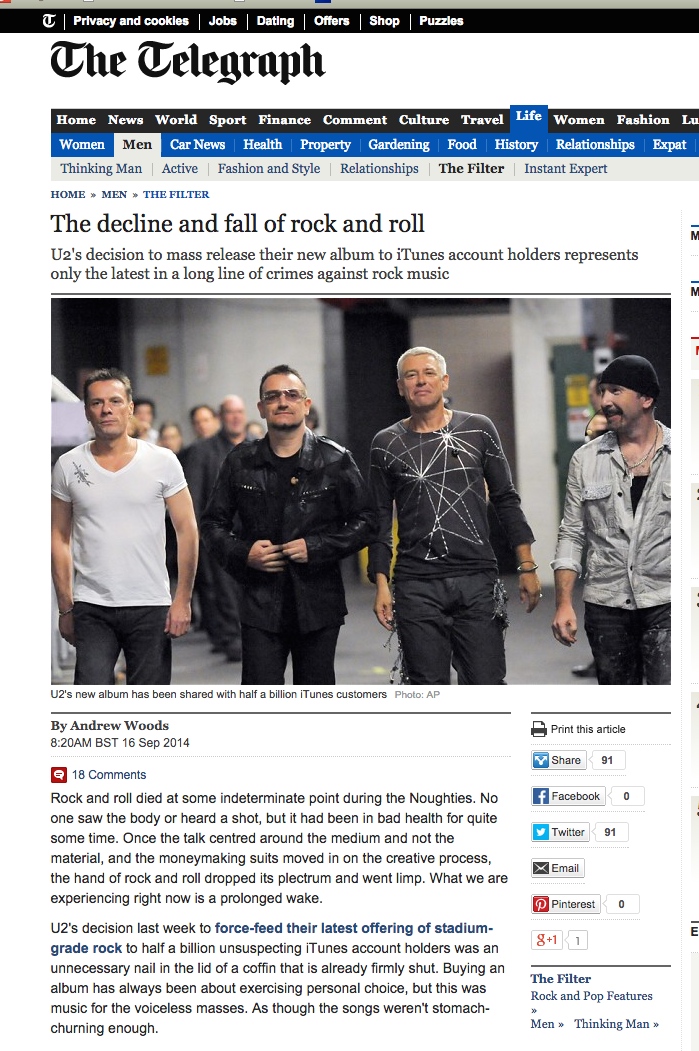
Screen Shot 2014-09-16 at 7.28.05 PMI must admit, I’m so utterly frustrated by all of the “Rock is dead” doomsayers over the past week that I’d like to wretch (or, retch–you know, either way).  Really big time.

Here’s the latest complaint–from the London Telegraph of all things (isn’t this supposed to be one of the respectable papers, or am I confusing it with the Daily Mail?)–to follow laments from CLASSIC ROCK mag earlier this year, a member of KISS who seems to resent much of life, and every single human who has decided to hate U2: http://www.telegraph.co.uk/men/the-filter/11089923/The-decline-and-fall-of-rock-and-roll.html

[A quick side note.  You have Apple and you don’t like U2?  Easy–hit the image of the album and drag it to your trash.  Your Mac will then ask you if you would like to delete or hide.  Deleting it actually deletes it.  No offensive U2 ever need show up in your library again, and you will have accomplished this is far less time than it took for the album to download to your computer.  In fact, it will take you less time to delete the album forever from your personal space than it will for you to write a comment on the web or even an article for a respectable English newspaper about how much you dislike U2, Bono, Apple, Catholics, Apple pies, Irishmen, or whatever your current dislike is.]

I have no idea if I’m using this term correctly, as I’m not English.  But, my first thought is: what a wanker that Telegraph writer must be.  Did I use the term correctly?  What say you, Mr. Andrew Woods?  Here in the British colony of the United States, we’d just call you a prig.

Of course corporations try to conform us.  They give us lots of good stuff, but they also make the world a lot less interesting. They want us as consumers, and consumers are much easier to manipulate when only the same tepid and pallid mush is being served.  Is the Telegraph suddenly a not-for-profit paper?

The next time a corporation tries to sell you something, just walk away.  It’s really not that hard.  Turn away from the offensive thing and move in the other direction.

Growing up in Kansas, I knew next to nothing about NME.  What I did know: NME looked like a bunch of quasi-trash porn that wealthy children in Kansas City might purchase out of boredom.  I didn’t pay attention to it or to Rolling Stone.  When Rush came out with a new album, I bought it.  When Tears for Fears came out with a new album, I bought it.  When Kate Bush came out with a new album, I bought it.  When Talk Talk came out with a new album, I often bought two copies, one as backup.  I didn’t look to NME or Rolling Stone or whatever rag was available at the time telling me what to think and wear and write and read.  I worked very, very hard for my music collection.  Sure, I made a few missteps, such as once purchasing a Howard Jones album.  But, I also collected a lot of great music, much of which I treasure to this very day.

What many music journalists, record labels, and professional wankers have yet to figure out is that the market for art is now as decentralized as humanly possible.  The internet gives us as much space to be excellent as it does to be mediocre.

Some of the music being made right–including and especially the vast majority of music we have the privilege of reviewing at progarchy–is some of the best rock music ever made.  Here and now.  Not merely there and yesterday.  Here and now.  Right here, right now.  Rock is so far from being dead that I can barely keep up with so many enticing, interesting, and dramatic releases.

The author of the Telegraph piece can’t see beyond the very corporations he so hates and, thus, he becomes a conformist in his own cry against conformity.  Face it, Mr. Andrew Telegraph, you are the establishment.  And, from what I can tell, you always have been–especially when you read magazines such as NME, then or now.

One last thought.  I really don’t care if U2 recorded forty-five minutes of The Edge working in his back garden.  Any group of artists who can write and record October have earned a position of respect in the world.  I, for one, will give them the benefit of the doubt, and presume good (and, yes, profit-seeking) motives on the parts of Mr. Bono and Mr. Cook.

On Mr. Andrew Woods?  The jury is still out.

[P.S.  I’m glad Mr. Woods mentioned his daughter.  My thirteen-year old daughter can name every member of Rush, Big Big Train, and The Tangent, and she knows almost every lyric written by FROST*.  Care to compete?]

Overly impressed with its own puerile histrionics

Stephen H. Webb has some interesting remarks in his review of Christopher Partridge’s book, The Lyre of Orpheus:

Partridge seems hardly aware of how pathetic it is that heavy metal has devolving into specialized sub-genres like death, thrash, sludge, and drone, each with their own code of conduct and their own lines of fashion accessories.

Without Christianity, rock’s agitations become spume and splutter, which suggests that rock cannot be essentially transgressive. Transgression is always derivative, secondary, reactive, and thus essentially conservative, secretly in service to the hegemonic order it seeks to overthrow. Dissonance is dependent on the natural appeal of harmony, just as Satan’s activities are possible only due to God’s providential permission. That is why rock, when it tries to be overtly blasphemous, ends up being overly impressed with its own puerile histrionics.

Rock is a threat to Christianity not because it is essentially transgressive, but because it too often acquiesces to modernity’s distancing of art from truth. The result is a mindless numbing of the emotions …

The honesty of rock is in its vocal yearning, not its electric thrashing. The alternative to transgression is transcendence, not docile submission to social order. Rock was born out of blues, folk and Gospel, not sexual aggression and gender bending. There is nothing inevitable about rock’s demise, although it might take a miracle for rock to rediscover its voice.

Does rock and roll have philosophical ties to ancient truths?

Mark Judge reflects on rock and roll:

But then, what is rock and roll? I would argue that we don’t know, and that not knowing is part of what gives the art form its mysticism and power.

Ironically, there is now an entire rock and roll industry that is very insistent that we know what rock and roll is. From the Chuck Berry to the Beatles, punk to hip-hop, rock is about rebelling against societal norms. But what about artists like Adele, U2, Coldplay, and Lykke Li, who seem to not only want to break new sonic ground but reexamine and even reinforce ancient truths about love, death, human nature, and God? Are they iconoclasts? Or are they rediscovering the truth of things, a truth that is not contradicted by the religious establishments that pop music is supposedly meant to dismantle?

Rock critics don’t like to think about those questions, because it may mean questioning their own dogma.

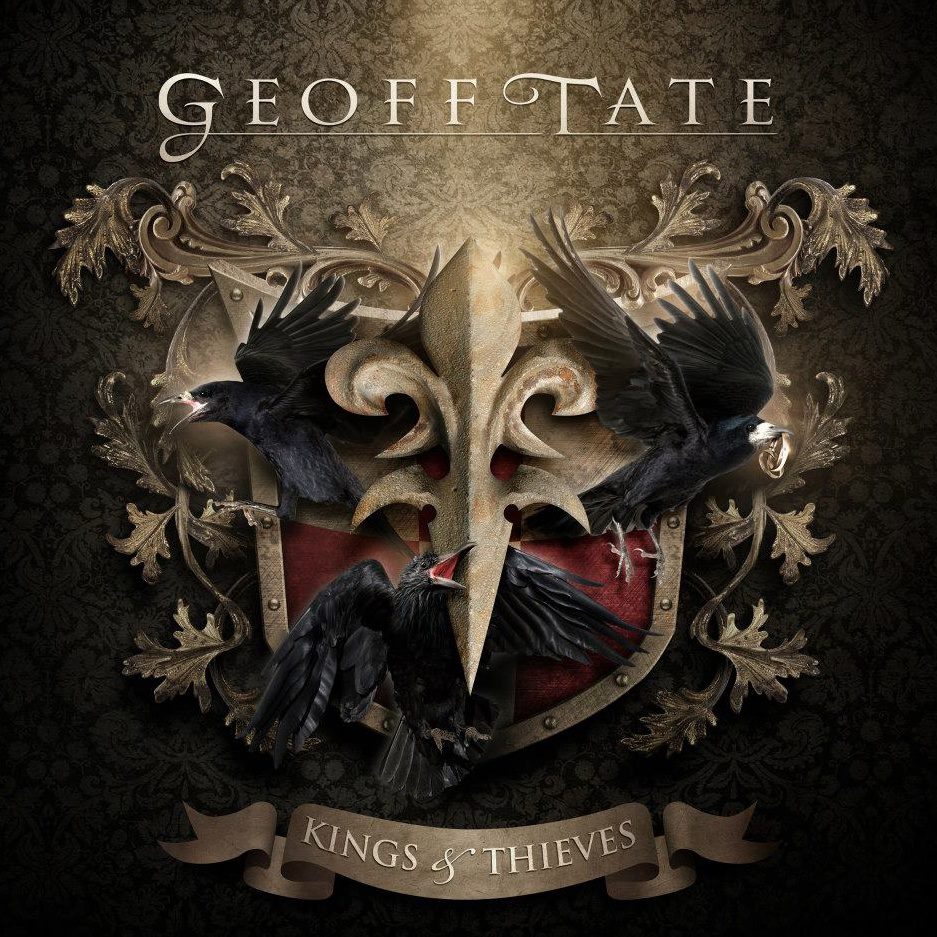
Kings and Thieves / Geoff Tate – Review

Kings and Thieves / Geoff Tate – Review

(Insideout Records, available Tuesday, November 6, 2012)

Received wisdom from the now far-distant era of grunge has things playing out thus: hair metal, riding high through the 80s in various forms, from NWOBHM to G’n’R, was coffin-ed by Nirvana and their Seattle brethren, who brought the music back to rock basics in 1991 with a DIY ethic and no-frills aesthetic.  But like a lot of stories that have been settled on for historical convenience, the Grunge-Killed-the-Metal-Star fable is over-weighted by victim and victor alike.  Hair metal had been killing itself slowly starting about the time of Aerosmith’s remarkable reinvention as an AOR band, blazing a suspect trail based on power balladry that had a lot of us ready to impale ourselves on our air guitars.  Add to this that grunge, if not so-called, had been healthy and growing for years in bands like Husker Du and Pixies.

I think if grunge, as made popular by Nirvana’s pop nugget Nevermind, did anything for metal it was to make it healthier in the long run, and Geoff Tate’s album, which is a solid rock record, is a good case in point.  I’m not going to pretend to know a lot about him, as my familiarity with his band Queensryche pretty much begins and ends with “Silent Lucidity” — one of the aforementioned power ballads that chased me, screaming, to the edges of mainstream metal in the late 80s — but I’m impressed with this record, and have probably missed out on more than I’d like to admit.  Technically gifted vocalists like Tate have a natural advantage in hard rock, where the bar can sometimes be very high (Paul Rodgers, Rob Halford, David Coverdale, Chris Cornell, Ronnie James Dio), and with a good lyric and a good riff can continue to make great records for years.

That’s certainly the case with Kings and Thieves’ opener, “She Slipped Away,” complete with a classic rocking opening progression reminiscent of the Eagles’ “Chug All Night,” an anthemic chorus, really nice guitar soloing, and a well worn, but true, take on relationships and highways.  Here and in other tracks (“In the Dirt,” particularly) I’m also struck by a real Peter Murphy-ish sound, part of which is Tate’s vocal tone, but also in the song structures, which want to tend toward pop even as they’re definitely coming out of metal (in Murphy’s case, goth).  It’s as if there’s a desire for rebirth or newness, and even when this fails, as it does in the playa’ attempt of “The Way I Roll” (the man’s no Eminem or Kid Rock, and he shouldn’t feel he needs to be) I have to admire that he’s going after it.

The low-end grind of “Take a Bullet” and “In the Dirt” makes for awesome, straight-up hard rock perfect for the open highway.  Tate knows how to make his voice match a lyric and a lick, and carries it off even when he’s lyrically pushing things a bit (“She’s got moves like I’ve never seen, rides me hard like an exercise machine” … really? Smell the Glove, anyone?).  This record is like all those hard rock albums that came out on the various Columbia subsidiaries of the 70s — it’s like a Nugent record, where you’d get a handful of duff tracks but the rest rocks out enough to make you want to flash the horns, and between it and the next record you’d get enough great tracks for your one-band mixtape.

For those wanting a return to 80s power glory, look no further than “Tomorrow,” with its Kashmir-ish break and vocal choruses of “Tomorrow starts today…sometimes love is not enough….”  This is a bow to fans from back in the day, but Tate can really pull it off, convincingly and refreshingly.  Kashmir, interestingly, is referenced again in the next song, as “Evil” recycles another part of that indefatigable Zep riff, but it’s hard to care, because Tate really brings it to the mic.  “Dark Money,” with its stab at privilege and eco-political power, is an odd moment, not terribly well-matched by the absolute rock star howl that Tate can whip up (kind of like if Ian Gillan led Deep Purple through a ditty about the gas crisis of the 1970s).  “Glory Days” may suffer from the same problem, but again, is buoyed by Tate’s delivery and a crack band, which is really together throughout the album.  It’s a guitars and drums forward record, live sounding, with a rumbling bass lending metal grind to the tunes.  Pianos and synths illuminate when necessary, and keep me thinking, this is a really tastefully produced rock record that fans of classic Queensryche and hard rock in the new millenium can enjoy.

The last two tracks, “Change” and “Waiting,” make well-chosen closers, bringing it down a bit, showing how Tate and company influenced the metal side of grunge (Pearl Jam or Alice in Chains would be at home here), and making me appreciate how much classic metal and hard rock really benefited from the shifts that happened a generation ago.

Craig Breaden, November 2012