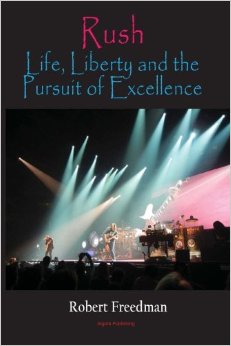
A month or so ago, I wrote a very long, very personal review of Rob Freedman’s excellent book, Rush: Life, Liberty, and the Pursuit of Excellence, entitled “The Saving Grace of Neil Peart.” In it, I offered almost nothing but praise for Freedman. But, I had two criticisms. The first was that he gave too much time and attention to Peart’s critics, and the second was that I felt Freedman should have discussed stoicism. There’s no need to go into the second criticism, but here’s what I wrote in the first:
As a lover of Rush, I have a few (very few) quibbles with Freedman’s take. Mostly, from my not so humble perspective, Freedman gives way too much space to such charlatans as Barry Miles of the English New Music Express who claimed Rush promoted neo-fascism in the late 1970s. Freedman, while disagreeing with Miles, bends over backwards defending Miles’s point of view, as it did carry immense weight in the 1970s and wounded the band deeply. From my perspective, there is no excuse for Miles. He maliciously manipulated and twisted the words of Peart—using his lyrics and a personal interview—which were as deeply anti-fascistic as one could possibly imagine (paeans to creativity and individualism) and caused unnecessary damage to the reputation of three men, two of whom who had parents who had survived the horrors of the twentieth-century ideologues, as noted above. Miles’s take on Rush is simply inexcusable and no amount of justification explains his wickedness and cthluthic insensibilities toward three great artists. Dante best understood where such “men” spent eternity.
So, reading back over this, maybe I owe two apologies to Freedman. First, what a goofy thing I wrote when I started my criticism with “As a lover of Rush. . .” Of course, I love Rush. But, then, so does Freedman!
Second, I’ve spent the last week reading every review of/article on Rush from 1974 to 1981—thanks to the Mighty Eric Hansen at http://2112.net/powerwindows/transcripts/Transcripts.htm. And, now, having read every review in chronological order, I see exactly why Freedman gave as much attention to Peart’s critics as he did.
Rob, my apologies to you. You were and are absolutely correct in the manner you dealt with the criticisms.
To New Music Express and Rolling Stone: I lift my hands to you. And, each hand has one finger held high. Just in case this is too subtle for your soulless, corporate, tapioca conformist brains. . . it’s the middle one.
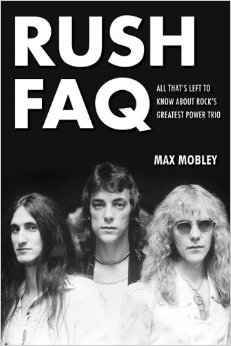
Who wouldn’t love this cover? Holy schnikees, it’s gorgeous. Admittedly, I’m a rather huge fan of Jerry Ewing. But, he’s outdone himself with this one. I’m drooling. . . .
Don’t let the title–which has to be one of the worst titles in book publishing history–fool you. RUSH FAQ is an excellent book.
It’s not just one of the best books on Rush I’ve ever read (and I’ve pretty much read them all), it’s, simply put, a great book. Insightful, factual, captivating. Mobley can write like no one’s business. He’s a huge Rush fan, but he allows this aspect to become playful part of the book. I’m always a huge fan of good writing–whether it’s Dante or about the latest software upgrade for the Mac. This is excellent writing. And, frankly, it’s the equivalent in the book world of what BEYOND THE LIGHTED STAGE is in the movie world.
Why the title of the book? Not a clue. I ordered this assuming it would be a reference book, and I had almost no hope that I would enjoy it. What a happy shock I got when the UPS man delivered it. RUSH FAQ is so far from a reference book. . . it’s a great series of coherent essays. Love it.
I’ll write a real review soon. But, for now, order the book and enjoy.
The book: Max Mobley, RUSH FAQ: ALL THAT’S LEFT TO KNOW (Milwaukee, WI: Backbeat Books, 2014.)
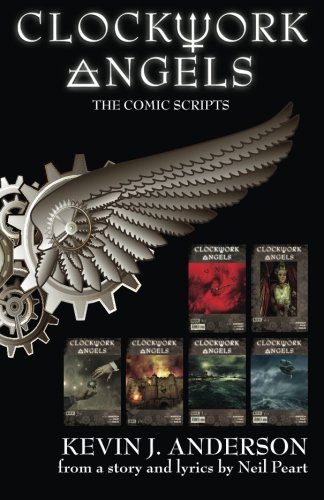
A review of Kevin J. Anderson, CLOCKWORK ANGELS: THE COMIC SCRIPTS (Monument, CO: Wordfire Press, 2014); from a story and lyrics by Neil Peart.
Birzer rating: 10/10.
From WordFire Press (December 2014).
Two things need to be stated before I even get into the heart of this review. Well, ok, let me put this in active form, before my students yell “foul!” I, Brad, need to state two things before getting into this review.
First, one could write a long and interesting article just about the convoluted and circuitous publishing history of CLOCKWORK ANGELS. And, why not? What a fascinating history. In the beginning, CLOCKWORK ANGELS was an album by Rush (remember, though, the first two songs came out almost two full years before the album itself).
Then, it was a best-selling novel by Kevin J. Anderson and Neil Peart.
Then, it was a huge worldwide rock concert tour, a live album, and a live concert DVD.
Then, it came out from BOOM! Studios in comic book form, illustrated by the extremely talented Nick Robles, over six issues. These six issues, of course, will be released in graphic-novel form in the spring (April 2015) with, I’m guessing, an intro or conclusion by Peart.
Now, however, CLOCKWORK ANGELS has come out from Anderson’s WordFire Press as THE COMIC SCRIPTS.
Soon, there will be a sequel, CLOCKWORK LIVES, which Anderson has only recently happily finished with the equally happy blessing of Neil Peart.
It’s possible the whole cycle might start over with the sequel.
And, if Rob Freedman is correct, CLOCKWORK ANGELS will probably grab the fancy of some Hollywood producer, direct, and acting talent, and it will be made into a major motion picture. If so—and, let’s pray this happens—the script is completely written, the scenes already storyboarded by Anderson, a true master of the art.
Second caveat. It’s no secret—at least to readers of progarchy—that I’ve been following the career of Neil Peart very closely since the spring of 1981. Since the age of 13, Peart has been as much a part of my life as has Ray Bradbury, J.R.R. Tolkien, Mark Twain, T.S. Eliot, and the list could go on.
Sci-fi demigod, Kevin J. Anderson.
Since some time in the early 1990s, however, I can also state the same about Kevin J. Anderson. Among modern science-fiction writers, the only other person I’ve followed as closely is J. Michael Straczynski. I’m absolutely fascinated by their writings as well as the trajectory of their careers. Each is a expert of his craft and an imaginative perfectionist. Each is also very much in-tune with his audience and the possibilities the internet presents. And, as probably well known, each has advanced the cause of progressive rock in a variety of ways. Straczynski had done so by promoting the career of Christopher Franke and Anderson by writing with Peart, producing the story and lyrics (along with his wife) for Roswell Six, and through a myriad of other ways. Each, also, fully embraces the comic and graphic novel worlds. Straczynski tends toward horror and the gnostic, and Anderson tends toward science fiction and the mythic, but, otherwise, the two have a great deal in common.
So, these two caveats stated, let’s get back to Anderson’s latest, THE COMIC SCRIPTS.
Even from a cursory examination of Peart’s song lyrics, the story of CLOCKWORK ANGELS seems a nicely updated version of 1978’s HEMISPHERES. There’s the side of order, and there’s the side of chaos. The hero, choosing not to embrace either extreme, finds a via media, making his own path and his own choices. He finds, in reality, that his choices are limited, however, but choice does exist. So, free will exists, but it does so only within certain bounds.
Anderson’s novel offers a wondrous exploration of Peart’s universe. Employing the literary devices of utopia and dystopia, Anderson, a sci-fi demigod, gives the story a much needed and beautifully executed Tolkien-esque and Chestertonian fairy-tale ethos and atmosphere. We discover why the Clockmaker craves surety and the Anarchist disorder. We also discover why Owen must reject both and become, for all intents and purposes, the everyman version of Cygnus.
Not limited to lyrics for twelve songs merely, Anderson explores, lulls, mulls, and lingers. With his deft hand, the world of Owen and the CLOCKWORK ANGELS becomes rich, full, and tangible. Though many have labeled this world as Steampunk—a label neither Anderson nor Peart would deny—it is much more than Steampunk as well. The pastoral quality of parts is truly pastoral and adds the Tolkienian fantastic to it all. Indeed, Anderson’s best writing—while always superb—truly shines when he is detailing the cultures that arise in distant and rural landscapes.
Equally important, though, is that Anderson is not only a great friend of Peart’s, he’s also a huge fan of Rush (and Hugh Syme). These loves show in almost every word and on every page of CLOCKWORK ANGELS. For those of us obsessed with Rush, Anderson ably rewards the reader, throwing into his novel (and the comics, and, thus, THE COMIC SCRIPTS) Easter eggs galore.
What surprises me most about THE COMIC SCRIPTS, however, is how utterly and brilliantly visual Anderson’s imagination is. Frankly, after having read much of his science fiction and some of his detective fiction, I really have no right to be surprised by any of this! Anderson is a genius at nearly every level, but he is especially excellent in and at creating a MYTHOS around, behind, and near every one of his novels. There’s a reason major international serials praised his own renditions of the XFILES as some of the best sci-fi of the 1990s. Sure, the XFILES was a great TV show. But, Anderson’s skill made the characters and the MYTHOS a thousand times better. I suppose my surprise at Anderson’s ability to visualize and imagine is, if anything, an indication of my own lack of imagination.
Looking at THE COMIC SCRIPTS, one readily sees that Anderson anticipated and then directed every single panel of the comics. He describes the emotions on the faces as well as the technology that will (certainly) jolt the reader into a sort of glee. Anderson presents every aspect of the CLOCKWORK world in all of its alchemical madness and glory.
By describing every thing visually, Anderson paints an interesting portrait of this world that could tease the Rush fan and the sci-fi/fantasy reader without end. Some day, lit crit folks will have a field day deconstructing all of this. For example, per both Peart’s and Anderson’s desires, the reader never actually sees the faces of the angels. This must be left to the individual mystery and imagination. Or, one sees that the symbol of the order-loving Clockmaker is a beehive and honeybee. The beehive looks suspiciously like the symbol of Utah, the Mormons, and the former State/Empire of Deseret. Is this intentional? I don’t know.
Or, how about the description of our hero, Owen? He is truly everyman—“He is non-ethnically specific,” Anderson explains. He “should have darker/olive skin, dark eyes, dark hair.” Anderson describes the cities of his world as Manhattan with a twist of old Berlin with a huge touch of the art deco. Could this be Gotham? Metropolis? Dark City? Of course.
Ok, but what surprises me most? That Hollywood hasn’t snatched up Anderson in a major way. Holy Moses, this guy can think, he can write, and he can imagine.
So, should you buy this latest offering from Anderson?
Do you like Rush? Yes.
Do you like science fiction? Yes.
Do you like intelligence and imagination in your fiction? Yes.
Do you like the visual arts? Yes.
For me, THE COMIC SCRIPTS is another brilliant exploration of the CLOCKWORK world. But, even if you’d never heard of Rush or even if you’ve never read the novel or the comics, this is still well worth owning. Anderson’s writing is so good, and his visual imagination is so fascinating, that THE COMIC SCRIPTS could easily (and does) stand on its own as a screenplay or as an actual stage play.
Let us count the ways. . . . From the University of Notre Dame Observer, April 23, 1981, pg. 11. My apologies for the quality–it’s from a microfilm machine. A review of MOVING PICTURES.
Review: Rush, R40: The Completist/OCD Set (Anthem, 2014).
Birzer Rating: 10/10
R40, Anthem Records, 2014.
I had a very good and hearty chuckle when I saw that Bestbuy and the official Rush website offered not just R40— a 10-disc set of every Rush concert DVD released over the past decade+—but actually offered a “Completist” set.
The Completist set provides not just the 10 discs, but an extra disc containing roughly another hour-plus of video.The non-Completist version already includes over two hours of never-before-seen video.But, what self-respecting Neil Peart fan or Rush fan would not be a Completist.To be a Rush fan is to be a Completist!Being OCD comes easily for us Rush fans.
So, of course, I gritted my teeth and started exploring my local Bestbuys.20 years ago, I loved Bestbuy.Now, I find it suffocating.But, it was worth it.The Bestbuy website claims that R40 Completist set can only be purchased in the stores, not through the website.Exploring a bit further, I found that the Bestbuy website won’t indicate which stores actually have the Completist edition.For more than a few moments, I’d assumed Bestbuy had already sold out of it.And, perhaps playing up on this belief, a number of editions have appeared on Ebay (and other sites) asking for double and some even triple and quadruple what the Bestbuy price is. Sheesh. Uncool, folks.
Again, gritting my teeth, I started to explore the Bestbuys across the Colorado Front Range.I came very close to giving up.The young guys working at the various Colorado Bestbuys had no idea what I was asking for.Rush?Rush Limbaugh.He has concerts?Dear God, no!Even when they looked it up on the website (I assume they’re privy to one the public isn’t), they couldn’t find it.No, sorry, we don’t have that in our “media warehouse.”Will you get it in?I don’t think so.
Sigh.
How could I satisfy that perfectionist/OCD nature that has plagued me since 1967???Heck, Rush is only seven years younger than I am!
Then, after debating whether or not to try one last Bestbuy, I decided to give it a go.I was tired, disbelieving, and ready to get home.But, there was the Bestbuy, off to my left.I even had to swerve into the exit lane, as I couldn’t quite decide whether to try it or not.
After entering the store, itself overlooking I25, I looked in the music section.Nothing.I looked in movies.Nothing.
Holiday crowds swirled around me, each with that hungry desperate Holiday look, and insanely bad music blared from the store speakers.And, then, perhaps guided by a Clockwork Angel, I looked on the floor—a jumble of non-reshelved releases—ready to be stepped on.
And, lo and behold, there it was.Huge, gleaming, calling to me—the R40 completist set.I scooped it up (there were actually two copies, but I decided not to be greedy), and saw that the price was even cheaper than what the official Bestbuy price was supposed to be.I honestly don’t think these folks know what they have.And, of course, I bought a copy.
And, now, what do I think?Holy Moses.This is great stuff.Yes, of course, I already have most of what’s being offered.But, that which I don’t (or didn’t) have— is simply stunning.I’d expected DVD-size packaging.No, how could I forget?This is Rush.They don’t do anything halfway.The book is actually a full-size hardback book of the highest quality.Printing, paper, everything—a gorgeously crafted piece of art.It even smells good.
After a nice introduction by one of Rush’s chosen and favorite writers, Martin Popoff, the book presents a series of full-page concert photos.After two decades or more of just looking at CD and DVD booklets, the full-size photos just pop out of the book. A flashback to days of immense vinyl collections. I love the photos.And, they really do justice to the the three members of Rush. Geddy at Red Rocks, Alex in full working-man rock mode, and Neil as a G-Nome.Most importantly, the Rush monkey from Time Machine makes an appearance. Geddy-monkey never fails to get a laugh out of the whole Birzer family, especially Harry, age 9.And, our chosen family anthem, appropriately enough, is “The Main Monkey Business.”
After roughly fifty pages of photos, the book presents all 10 main DVDs in very high-quality cardboard.Indeed, the quality is so high, I have to be careful taking the DVDs out of their firm and tight sleeves.Very good for the long run.I was a little surprised that the bonus DVD—“Rush, R40 Completist”—had just been placed in a plain white envelope, stuck haphazardly in the book.I’ll have to pay special attention to this one so as not to lose it.Not very Rush-like, but still, overall, an excellent package and worth this one defect.
Rather than describe all of the content, I’ve scanned the content page—complete with the Completist add-ons. See below.
Is the set cheap?No.Is it of good quality?Except for the Completist DVD in the white envelope, of the highest quality.Am I sad to have paid so much for what I already (mostly) own?Absolutely not.Some of the best money I’ve ever spent.I’ll have this set, a thing of beauty until I die. Then, a little monkey Birzer will get it.







 Progarchy