The Saving Grace of Neil Peart

In part, a review of Rob Freedman, Rush: Life, Liberty, and the Pursuit of Excellence (Algora, 2014).

N.B. This post should be approached with caution.  It is at least PG-13, if not NC17.  Not for language, but for personal revelation and content.  Additionally, I’ve written about one or two of these things before, especially about Peart as a big brother.  Please don’t fear thinking—“hey, I’ve read this before.”  But, even the few things I’ve mentioned before are here rewritten.  Final note: for an exploration of Peart’s Stoicism, see Erik Heter’s excellent piece on the subject, here at progarchy.com.

Neil-Peart.jpg-3642
Neil Peart, ca. 1987.

***

As I’ve mentioned before in these pages and elsewhere, few persons, thinkers, or artists have shaped my own view of the world as strongly as has Neil Peart, Canadian drummer, lyricist, writer, and all-around Renaissance man.  I’ve never met him, but I’ve read all of his words and listened to all of his songs.  I’ve been following this man since the spring of 1981 when two fellow inmates of seventh-grade detention explained to me the “awesomeness” of Rush.  My compatriots, Troy and Brad (a different Brad), were right.  Thank God I got caught for doing some thing bad that day.  Whatever I did, my punishment (detention) led to a whole new world for me, one that would more than once save my life.

Having grown up in a family that cherished music of all types, I was already a fan of mixing classical, jazz, and rock.  Rush’s music, as it turned out, did this as well as any band.

While the music captivated me, the lyrics set me free.  I say this with no hyperbole.  I really have no idea how I would have made it out of high school and through the dysfunctional (my step father is serving a 13-year term in prison, if this gives you an idea how nasty the home was) home life without Peart.  I certainly loved my mom and two older brothers, but life, frankly, was hell.

I know that Peart feels very uncomfortable when his fan project themselves on him, or imagine him to be something he is not.  At age 13, I knew absolutely nothing about the man as man, only as drummer and lyricist.  Thus, even in 1981, I absorbed his lyrics, not directly his personality.  Though, I’m sure many of Peart’s words reflect his personality as much as they reflect his intellect.

Rush gave me so much of what I needed in my teen years.  At 13, I had completely rejected the notion of a benevolent God.  He existed, I was fairly sure, but He was a puppet master of the worst sort, a manipulative, Machiavellian tyrant who found glee in abuse and exploitation.  As a kid, I was bright and restless, and I resented all forms of authority, sometimes with violent intent.  Still, as we all do, I needed something greater than myself, a thing to cherish and to hold, a thing to believe in.

I immersed myself in science fiction, fantasy, and rock music.  Not a tv watcher in the least, I would put the headphones on, turns off the lights in my bedroom, lock the door, and immerse myself in the musical stories of Genesis, the Moody Blues, ELO, ELP, Alan Parsons, Yes, Jethro Tull, Pink Floyd, and, especially, Rush.  I could leave the horrors of my house for roughly 44 minutes at a time.

Scratch, scratch, side one.  Zip, turn.  Scratch, scratch, side two.

Rock music was the sanctuary of my world.  But, not just any rock.  ZZ Top and REO Speedwagon might be fun when out on a drive, but I needed a work of art that demanded full immersion.  I needed prog.  I was not only safe in these rhythmic worlds, I was intellectually and spiritually alive, exploring innumerable realms.  Pure, unadulterated escape.  But, escape into a maze of wonders.

The first time I heard the lyrics (at age 13, the spring of 1981) to “Tom Sawyer,” I knew Rush was MY band.  It seemed as though Peart was talking specifically to me, Bradley Joseph Birzer.  That’s right.  To 13-year old Brad in Hutchinson, Kansas.  Peart was 15 years older than I, and he must have gone through the same things I had.  Or so I thought.  Again, I knew him only through his lyrics.  But, did I ever cherish those lyrics.  I lingered over each word, contemplated not just the ideas, but the very structures of lyrics as a whole.

Though his mind is not for rent

Don’t put him down as arrogant

His reserve a quiet defense

Riding out the day’s events

No, his mind is not for rent to any God or Government

Always hopeful, yet discontent [corrected from my original typos]

He knows changes aren’t permanent, but change is

Though I’ve never given any aspect of my life to the Government (nor do I have plans to do so), I long ago surrendered much of myself to the Second Person of the Most Blessed Trinity and to His Mother.  While I’m no modern Tom Sawyer at age 47, I still find the above lyrics rather comforting.  And, I do so in a way that is far beyond mere nostalgia.

Armed with Peart’s words and convictions, I could convince myself to walk to Liberty Junior High and, more importantly, to traverse its halls without thinking myself the most objectified piece of meat in the history of the world.  Maybe, just maybe, I could transcend, sidestep, or walk directly through what was happening back at home.  I could still walk with dignity through the groves of the academy, though my step father had done everything short of killing me back while in our house.

[N.B. This is the PG13 part of the essay]  And, given all that was going on with my step father, the thought of killing myself crossed my mind many, many times in junior high and high school.  I had become rather obsessed with the notion, and the idea of a righteous suicide, an escape from on purposeless life hanged tenebrous across my soul.  After all, if I only existed to be exploited, to be a means to end, what purpose did life have.

What stopped me from ending it all?  I’m still not sure, though such desires seemed to fade away rather quickly when I escaped our house on Virginia Court in Kansas and began college in northern Indiana.  Not surprisingly, my first real friendship in college—one I cherish and hold to this day—came from a mutual interest in all things Rush.  In fact, if anything, my friend (who also writes for this site) was an even bigger Rush fan than myself!  I’d never met such a person.

Regardless, from age 13 to 18, I can say with absolute certainty that some good people, some good books, and some good music saved my life, more than once.  Neil Peart’s words of integrity and individualism and intellectual curiosity stood at the front and center of that hope.

Perhaps even more importantly to me than Moving Pictures (“Tom Sawyer,” quoted above) were Peart’s lyrics for the next Rush album, Signals.  On the opening track, a song about resisting conformity, Peart wrote:

Growing up, it all seemed so one-sided

Opinions all provided, the future predecided

Detached and subdivided in the mass production zone

No where is the dreamer or misfit so alone

There are those who sell their dreams for small desires

And lose their race to rats

Even at 14, I knew I would not be one who sold my dreams for small desires.  I wanted to be a writer—in whatever field I found myself—and I would do what it took to make it through the horrible home years to see my books on the shelves of a libraries and a bookstores.  Resist and renew.  Renew and resist.  Again, such allowed me to escape the abyss of self annihilation.

Indeed, outside of family members (though, in my imagination, I often think of Peart as one of my older brothers—you know; he was the brilliant one with the goofy but cool friends, the guys who did their own thing regardless of what anyone thought).  From any objective standpoint, as I look back over almost five decades of life, I can claim that Peart would rank with St. Augustine, St. Francis, John Adams, T.S. Eliot, Willa Cather, Ray Bradbury, Russell Kirk, and J.R.R. Tolkien as those I would like to claim as having saved me and shaped me.  If I actually live up to the example of any of these folks, however, is a different question . . .

I also like to say that Peart would have been a great big brother not just because he was his own person, but, most importantly, because he introduced me as well as an entire generation of North Americans (mostly males) to the ideas of Heraclitus, Plato, Aristotle, Sophocles, Cicero, Seneca, Petrarch, Erasmus, Voltaire, Adam Smith, Mark Twain, Ernest Hemingway, John Dos Passos, T.S. Eliot, J.R.R. Tolkien, and others.

During my junior year of high school, I wrote an essay on the meaning of Huck Finn and Tom Sawyer, based on Peart’s interpretation.  I earned some form of an A.  In one of my core humanities courses, while at the University of Notre Dame, I wrote my major sophomore humanities term paper about the cultural criticisms of Neil Peart as found in his lyrics to the 1984 album, Grace Under Pressure.  Again, I received an A.

I’m not alone in this love of Rush.  The band is, of course, one of the highest selling rock acts of all time, and they are just now crossing the line into their fortieth anniversary.  Arguably, no other band has had as loyal a following as had Rush.  Thousands and thousands of men (and some women) faithfully attend sold-out concerts throughout North and South America to this day.  This is especially true of North American men, ages 35 to 65.  Now, as is obvious at concerts, an entirely new generation of Rush fans is emerging, the children of the original set.

Telling, critics have almost always despised Rush, seeing them as having betrayed the blues-based tradition of much of rock, exchanging it for a European (and directly African rather than African-American) tradition of long form, complexity, and bizarrely shifting time signatures.  Such a direction and style became unbearable for the nasty writers of the largest music magazines.  They have felt and expressed almost nothing but disdain for such an “intellectually-pretentious band,” especially a band that has openly challenged the conformist ideologues of the Left while embracing art and excellence in all of its forms.  Elitist rags such as the horrid Rolling Stone and equally horrid NME have time and time again dismissed Rush as nothing but smug middle-class rightists.

That so many have hated them so powerfully has only added to my attraction to the band, especially those who came of age in 1980s, despising the conformist hippies who wanted to mould my generation in their deformed image.  Rolling Stone and NME spoke for the oppressive leftist elite, and many of my generation happily made rude gestures toward their offices and their offal.  I had no love of the ideologues of the right, either.  But, they weren’t controlling the schools in the 1980s.  Their leftist idiotic counterparts were in charge.  They had no desire for excellence.  They demanded conformity and mediocrity.

[The best visual representation of this widespread if ultimately ineffective student revolt in the 1980s can be found in “The Breakfast Club” by John Hughes (RIP).]

To make it even more real for me, the parents of Geddy Lee, the lead singer and bassist of Rush, had survived the Polish holocaust camps, and the parents of Alex Lifeson, the lead guitarist of the band, had escaped from the Yugoslavian gulag.  Peart came from a Canadian farming community, his father an entrepreneur.  No prima donnas were these men.  They understood suffering, yet they chose to rise above it.  And, of course, this makes the British music press even more reprehensible for labeling the members of Rush as rightest or fascist.  Again, I offer the most dignified description for Rolling Stone and NME possible: “ideological fools and tools.”

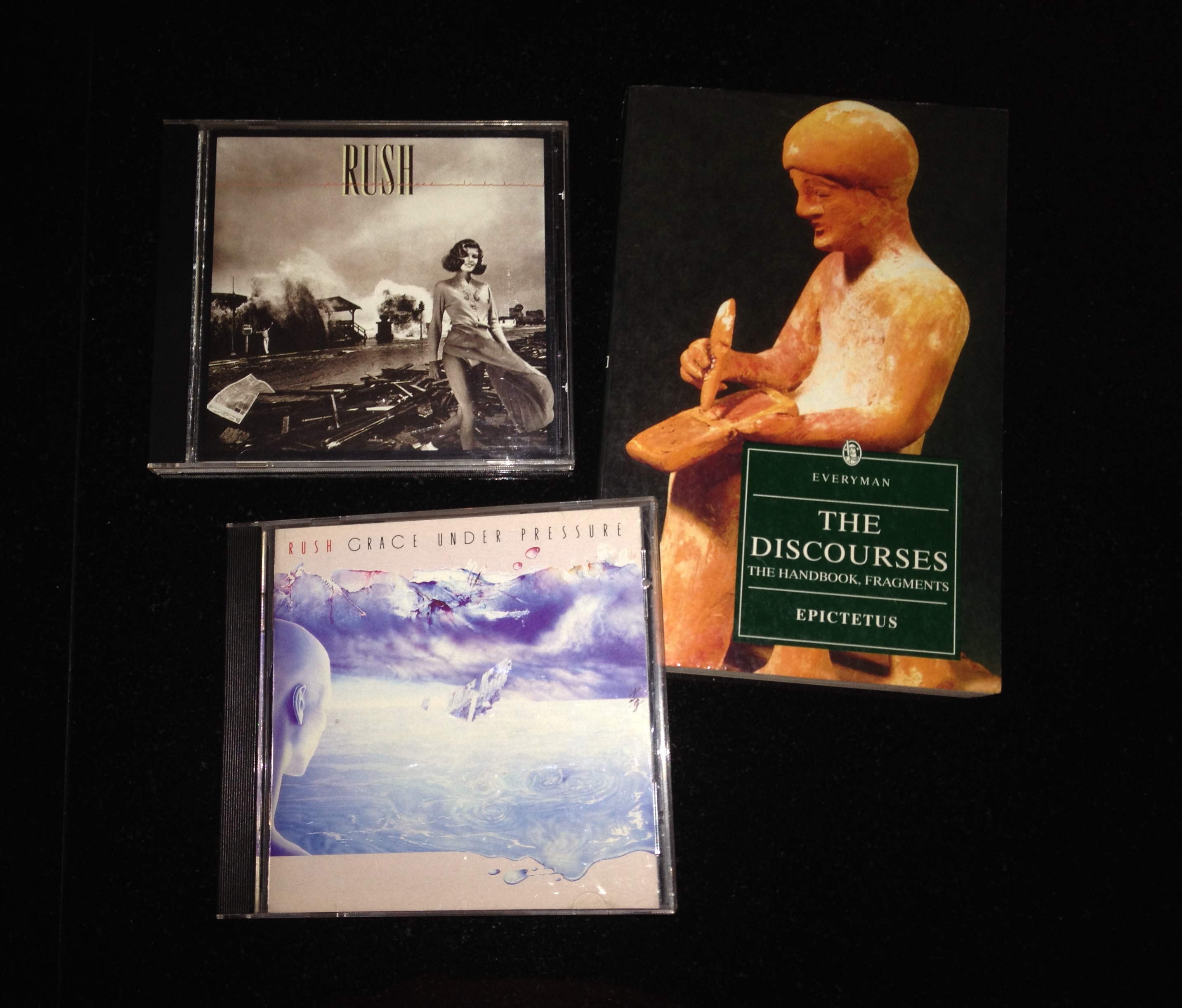
At age 13, I stared and stared at this image.  I loved the look of each of the guys.  They couldn't be more interesting to me.
At age 13, I stared and stared at this image. I loved the look of each of the guys. They couldn’t be more interesting to me.

Enter Rob Freedman

In his outstanding 2014 book, Rush: Life, Liberty, and the Pursuit of Happiness (Algora Press), author, philosopher, and media specialist Rob Freedman has attempted to explain not just Peart’s popularity among his multitude of fans—some of the most dedicated in the music world—but also the Canuck drummer’s actual set of ideas and explored beliefs in his books and lyrics.  Not surprisingly, Freedman finds the Canadian a man deeply rooted in the western tradition, specifically in the traditions of western humanism and individualism.

As Freedman notes, one can find three themes in all of Peart’s lyrics: individualism; classical liberalism; and humanism.  It’s worth observing that Freedman has formal training in academic philosophy, and this shows in his penetrating discussion of the music as well as the words of Rush.
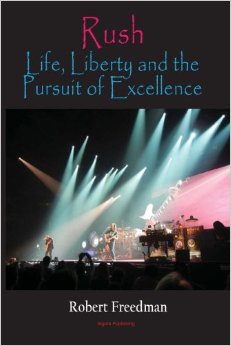
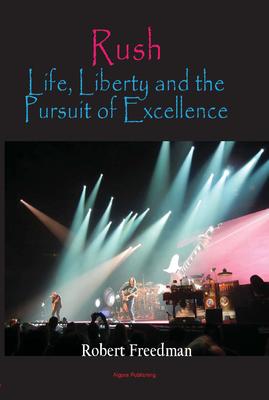
Cover of Rob Freedman, Rush: Life, Liberty, and the Pursuit of Excellence (2014).  A must own.
Cover of Rob Freedman, Rush: Life, Liberty, and the Pursuit of Excellence (2014). A must own.

Relying on interviews with the band, the music journalism (much of it bogus and elitist idiocy) of the last forty years, and actually serious works of Rush criticism, such as that done admirably by Steve Horwitz in Rush and Philosophy (Open Court, 2011), Freedman offers not so much a biography of the band, but rather a map of their intellectual influences and expressions.  Freedman possesses a great wit in his writing, and the book—relatively short at 164 pages—flows and flows, time standing still until the reader reaches the end.  For all intents and purposes, Freedman’s book serves as an intellectual thriller, a page turner.

As a lover of Rush, I have a few (very few) quibbles with Freedman’s take.  Mostly, from my not so humble perspective, Freedman gives way too much space to such charlatans as Barry Miles of the English New Music Express who claimed Rush promoted neo-fascism in the late 1970s.  Freedman, while disagreeing with Miles, bends over backwards defending Miles’s point of view, as it did carry immense weight in the 1970s and wounded the band deeply.  From my perspective, there is no excuse for Miles.  He maliciously manipulated and twisted the words of Peart—using his lyrics and a personal interview—which were as deeply anti-fascistic as one could possibly imagine (paeans to creativity and individualism) and caused unnecessary damage to the reputation of three men, two of whom who had parents who had survived the horrors of the twentieth-century ideologues, as noted above.  Miles’s take on Rush is simply inexcusable and no amount of justification explains his wickedness and cthluthic insensibilities toward three great artists.  Dante best understood where such “men” spent eternity.

Author Rob Freedman.

I also believe that Freedman underplays the role of Stoicism in his book.  The venerable philosophy barely receives a mention.  Yet, in almost every way, Peart is a full-blown Stoic.  In his own life as well as his own actions, Peart has sought nothing but excellence as conformable to the eternal laws of nature.  This is the Stoicism of the pagans, admittedly, and not of the Jews or Christians, but it is Stoicism nonetheless.  Freedman rightly notes that Plato and, especially, Aristotle influenced Peart.  But, so did Zeno, Virgil, Cicero, and Seneca.  This comes across best in Peart’s lyrics for “Natural Science” (early Rush), “Prime Mover” (middle Rush), and in “The Way the Wind Blows” (recent Rush).  In each of these songs, Peart presents a view of the world with resignation, recognizing that whatever his flaws, man perseveres.  Erik Heter and I have each attempted to explore this aspect of Peart’s writings at progarchy.  Heter has been quite successful at it.

As the risk of sounding cocky, I offer what I hope is high praise for Freedman.  I wish I’d written this book.

Peart as Real Man

Neil-Peart later
Neil Peart, ca. 2008.

In the late 1990s, Peart experienced immense tragedy.  A horrible set of events ended the life of his daughter and, quickly after, his wife.  Devastated, Peart got on his motorcycle (he’s an avid cyclist and motorcyclist) and rode throughout the entirety of North America for a year.  It was his year in the desert, so to speak.

Then, in 2002, Rush re-emerged and released its rockingly powerful album, Vapor Trails.  The men were the same men (kind of), but the band was not the same band.  This twenty-first century Rush, for all intents and purposes, is Rush 2.0.  This is a much more mature as well as a much more righteously angry and yet also playful Rush.  This is a Rush that has nothing to prove except to themselves.  The last albums—Vapor Trails (2002); Snakes and Arrows (2007); and Clockwork Angels (2012)—have not only been among the best in the huge Rush catalogue, but they are some of the best albums made in the last sixty years.  They soar with confidence, and they promote what Rush has always done best: excellence, art, creativity, distrust of authority, and dignity of the human person.

Peart is not quite the hard-core libertarian of his youth.  In his most recent book, Far and Near, he explains,

The great Western writer Edward Abbey’s suggestion was to catch them [illegal immigrants], give them guns and ammunition, and send them back to fix the things that made them leave.  But Edward Abbey was a conservative pragmatist, and I am a bleeding-heart libertarian==who also happens to be fond of Latin Americans.  The ‘libertarian’ in me thinks people should be able to go where they want to go, and the ‘bleeding heart’ doesn’t want them to suffer needlessly” [Far and Near, 58]

If he has lost any of his former political fervor, he’s lost none of his zest for life and for art.  “My first principle of art is ‘Art is the telling of stories.’  What might be called the First Amendment is ‘Art must transcend its subject’.” [Far and Near, 88]

These twenty-first century albums speak to me at age 47 as much as the early albums spoke to me at age 13.  I’ve grown up, and so has Rush.  Interestingly, this doesn’t make their early albums seem childish, only less wise.

After my wife and I lost our own daughter, Cecilia Rose, I wrote a long letter to Neil Peart, telling him how much the events of his life—no matter how tragic—had shaped my own response to life.  I included a copy of my biography of J.R.R. Tolkien.  Mr. Peart sent me back an autographed postcard as thanks.

I framed it, and it will be, until the end of my days, one of my greatest possessions.

After all, Neil Peart has not just told me about the good life, creativity, and integrity, he has shown me through his successes and his tragedies—and thousands and thousands of others—that each life holds a purpose beyond our own limited understandings.  As with all things, Peart takes what life has given and explodes it to the level of revelation.

Heavy Metal Stoicism — @Philosopher70 @RushTheBand @RushisaBand

Gregory Sadler, The Heavy Metal Philosopher, is doing one video per day about Stoicism during the course of Stoic Week 2014 (Nov 24–30).

Perhaps Neil Peart got you interested in the subject. If so, you may decide whether you wish to investigate further.

But even if you choose not to decide, you still have made a choice

Boom! Making Clockwork Angels Even Better.

Clockwork Angels by Neil Peart, Kevin J. Anderson, and Nick Robles (Six-issue comic series from Boom! Studios, 2013-2014).

A sample page from the comic series, Clockwork Angels.  The reds and blues are brilliant, as are the emotions depicted.  Art by Nick Robles.
A sample page from the comic series, Clockwork Angels. The reds and blues are brilliant, as are the emotions depicted. Art by Nick Robles.

By any reckoning, Clockwork Angels has done rather well. It is a prog-rock album, a concert, a live concert album and video, a novel, an audiobook, and now a six-book comic series from the relatively young publisher, Boom! Studios. Soon, I’m sure, Boom! will collect these six issues into a graphic novel, perhaps with a new introduction by Peart.

As the great Rob Freedman has argued at his website, Rush Vault, it could readily become a movie or a tv-series. Maybe even complete with action figures. No, I’m not exaggerating, and I’m not being sarcastic. Clockwork Angels has done very well, and I couldn’t be happier for Peart.

The novel, co-authored by Kevin J. Anderson and Neil Peart is, in and of itself, quite stunning. At essence, the story is little different than the one Peart told with Hemispheres. Chaos and order vie for power, with the individual—armed with integrity, intelligence, and creativity—making his own path. Yet, Peart and Anderson have made this story as fresh as fresh can be by adopting the form of a fairy-tale. It’s a rather Chestertonian and Tolkienian fairy tale at that. Peart even inserts himself (but, not by name) as the grandfather-narrator, well pleased with his children and grandchildren.

Adorned with color prints by Hugh Syme and printed on the highest quality of paper, the ECW novel is a wonderful thing to hold and behold.

clockworkangels_01_PRESS-4At the time that Rush began to plan the tour for the album, Peart stated in no uncertain terms that certain aspects of the story could not be produced visually, as he hoped to keep them in the imagination. In particular, he was talking about the actual Clockwork Angels. Far better to leave them to the individual imagination than to the visual artists. Additionally, they needed to remain in an aura of mystery.

I must admit, when I first heard that the story would be produced in comic book form, I was apprehensive. I have nothing against comics and graphics novels. Indeed, I think the work of such giants as Frank Miller and Alan Moore probably inspired and certainly anticipated the iPads and other tablets we know all wield—a perfect blending of word and image. But, I wondered, wow could Peart’s desire be adhered to, when transferring the story to a visual medium. Would the art do justice to the story, or would it simply detract? I realize I’m in the minority in this view, but I firmly believe that Peter Jackson has come close to destroying the beauty and integrity of Tolkien’s world. Tolkien’s world is too strong to be destroyed by such technological mimicry, but still. . . I didn’t want Boom! to do the same thing to Peart’s work.

Now that all six issues have appeared, I can render judgment. The artist, Nick Robles, has done admirable work. True to the fairy-like intent of the story, Robles presents all of his images as something between a water-color painting and modern (think Jim Lee of DC) superhero art.

clockworkangels_01_PRESS-7While Robles attempts to illustrate the Clockwork Angels, he does so in a way to minimize the destruction of imagination. Various lights and shadows, thankfully, obscure the more mysterious parts. Equally important, Robles not only draws the human face beautifully, rendering each with personality, light, and emotion, but his coloring makes some of the expressions jump off the page. His reds and blues are especially good. In other words, Robles really does augment the word with image, and I found myself appreciating this story in different ways than I had the original album and novel.

Robles and Boom! have done something I didn’t expect: they’ve made a brilliant story even better. Or least, they made me look at it in a very new way. What’s not to love? Gorgeous art; Peartian wisdom; and a story that mixes the best of Chesterton, Tolkien, and Ray Bradbury.

For ordering information, go here: Boom! Studios.

Foo Fighters, Sonic Highways ♫♫♫♫♪

Foo Fighters, Sonic Highways

Progarchist Rating: 9/10 ♫♫♫♫♪

This album is pure rock and roll at its finest. You won’t find anything prog here other than the epic orchestrated finale to “I Am a River,” but then again the musicianship and songwriting is operating at such a high level that it is hard to deny it the moniker of “prog,” if by such you mean simply something like: “excellence in all its many forms.” Enjoy the adrenaline-fueled journey here, through eight glorious tracks, and pick your favorites. I am partial to the album opener, “Something From Nothing,” perhaps because the title is a nice echo of Rush, and also because there is even a little riff within it that makes me think of Rush’s “Stick It Out,” but in fact the track hits its stride when it gets its very own groove on. Listen to it and you’ll know what I mean. Other favorites are the resplendent “Congregation” and the heartening “God as My Witness” and the acrobatically nimble “In the Clear.” With rock like this, you can become a believer. Classic at birth, the lost art of the rock album is born again.

Neil Peart of RUSH: ½ Hour Interview with George Stroumboulopoulos

The Strombo Show welcomes Neil Peart, drummer and lyricist of RUSH, for a rare and intimate conversation from George’s home.

Long lost RUSH — I’ve Been Runnin’ (Laura Secord Secondary School 1974)

UPDATE: Watch the video HERE.

From Radio.com and their interview with Alex Lifeson:

The thing that Rush fans are probably going to be most excited about is the footage from the 1974 show at the Laura Secord Secondary School. What do you remember about that performance?  Oh my god, that was such a long time ago. I can vaguely remember it, I remember being on the stage in that auditorium in that school, and how all of the kids were sitting in their seats — no one was standing! —  and it was a little uncomfortable. But it’s a good example of the band we were at that time playing bars and high schools. What goes through your mind when you watch the footage of you and Geddy performing with John Rutsey?  Um, it’s funny. The things that I really noticed about it — this might be odd — is that we played so fast, all the time. I do recall playing everything quickly. We used to have a mono tape recorder that we used to record some shows. In fact, I might even have some of those old tapes lying around somewhere, from earlier in the ’70s. Great! Stuff for the next box set! [Laughs] Of course! But we were 19 years old, 20 years old: how quickly it all goes by. For decades, Geddy has been the guy to speak to the audience at your shows, but he doesn’t do it a lot. After watching some of the footage from that performance, I realized that addressing the crowd used to be John’s role, and he seemed to enjoy it. Yeah, very much so. He had a very witty sense of humor, and he had such balls. He would talk to the audience and say stuff; sometimes, I thought he’d get us killed. He was comfortable talking to people, and being that guy, whereas Geddy really wasn’t, and I’m not even sure he is that comfortable with it today. But John, he would tell stories, and tell jokes, he would pick someone from the audience and do running jokes with that person all night. He was really great at that. It was fun: those days were really fun with him. We were with him for six years. You know, John sang one or two songs… I think. He really didn’t have a singing voice, it was like a Bob Dylan-ish monotone. But there were a couple of songs that he sang, and he and I also did some backing vocals. His on-stage mic wasn’t just reserved for talking. Tell me about the song “I’ve Been Runnin’”; not only had I never heard it, I’d never heard of it. John wrote the lyrics back then. Geddy and I would generally write the music. Sometimes we would have band rehearsals and it would be all three of us, but it was always difficult to work out songs like that. It was easier for us to work on the music together and then teach it to John and go from there. We still do that with Neil [Peart], in fact. John did write the lyrics in those days for the most part. It was so weird when he didn’t want us to use his lyrics on the first album when we started to record it. It was a very strange time for us, just before he left the band. But to be honest with you, I’d totally forgotten about “I’ve Been Runnin’” until I saw it come up for this box set. That one was really lost to me. But it was a shuffle-y, Delta bluesy kind of song that we were inspired by via Led Zeppelin. A lot of people think of Rush as a hard rock/progressive rock hybrid. But at that point, Rush was a garage rock band. I don’t think that our quote-unquote “progressive” influences came in until Neil joined the band. Geddy and I were both leaning towards that kind of music, we loved what Yes was doing, and Jethro Tull, and of course we were big Pink Floyd fans. But John was a strong influence in the band and he was a real basic rocker. That was part of the reason for him leaving. There were other reasons: his health. But really when it came right down to it, he was a sort of Bad Company kind of rocker, and Ged and I want to move into something that was a bit meatier in terms of arrangements and performance. Do you remember anything about “The Loser”? That’s the other original song from that set that never made it to an album. I’d have to listen to it again! We did have a song… it was one of the first songs we wrote. It could be that song. If it is that song, we would have wrote it back in 1968. Again, it was very basic and very straight ahead rock. You guys never really did “box sets,” because you never really had any “unreleased material.” But is there the potential for a collection of early unreleased stuff from the John Rutsey era? There’s never any extra stuff, we only record what we need for the album. From that early period, there might be some tapes lying around, but I can’t imagine what sort of shape they’re in, 40 plus years later. Now I have them in storage, and I want to review them, but in the past there weren’t any kind of live performances. Actually, there was one from a high school, we recorded on both sides of the reel. Well, y’know, it was mono! And it was basically one mic in the middle of the stage. I remember listening to that over and over; it was probably recorded in 1971. But unfortunately, I don’t know what happened to that tape. We never thought about hanging on to that stuff back then. You think of something new and you say, “Forget about that old crap.”

RUSH and the Western Tradition

Freedman's book on the meaning of Rush.  I've loving this book--BB
Freedman’s book on the meaning of Rush. I’m loving this book–BB

Rush’s lyrics over the decades put its point of view firmly in the great Western intellectual tradition of Aristotle, John Locke, and Adam Smith. So when you listen to the band’s 165 original compositions, you’re hearing the same ideas that animated Thomas Paine and Thomas Jefferson—only a lot louder.

–Rob Freedman, RUSH: LIFE, LIBERTY, AND THE PURSUIT OF EXCELLENCE, 2014

The Stoic Wisdom of Neil Peart

Seneca. Epictetus. Marcus Aurelius. Neil Peart.Rush Discourses

(This is where you do a double take).

No, that wasn’t a misprint.

Rush lyrics (penned almost entirely by Peart from their second album onward) cover a lot of ground. Individual songs meditate on the dreariness of the suburbs, the balance between heart and mind, the individual vs. the collective, intolerance, the perils of fame, nationalism, the tensions of art vs. commerce and so forth.   When you step back a bit to take a wider view, themes that stretch across a number of songs or even albums begin to emerge. Among those that emerge over the course of Rush’s output are themes of Stoicism. So let me just proclaim that Neil Peart is a Stoic and that Stoicism is a significant component in his philosophical approach to life itself.

I should probably give a brief primer on Stoicism here, and will do so with a bit of trepidation, as there are several other contributors to this site whose knowledge of this school of thought and philosophy (or any philosophy) vastly exceeds my own.

The Stoic school of thought originated with Zeno of Citium, who began teaching it in Athens around 300 B.C. It was later adopted by the Romans, including the famous three listed above. A fundamental tenet of Stoicism is to live in agreement with nature, i.e. “the way things are.” Another one is to learn to distinguish between those things which are under one’s control and those things that are not – and to not worry about the latter. A exceptionally difficult goal to attain to be sure, but one well worth striving for. Contrary to popular opinion, Stoicism does not teach the suppression of emotions, but rather that emotions are instinctive reactions to events, while our judgments of the same can either arouse or cool those emotions. Balance is key.

So how does all this tie in with Rush lyrics? Let’s take a look.

Continue reading “The Stoic Wisdom of Neil Peart”

The Philosophy of Rush

I am curious to see how Robert Freedman explains “Aristotelian individualism” in his book, Rush: Life, Liberty, and the Pursuit of Excellence (Algora, 2014).

Tibor Machan’s Classical Individualism: The Supreme Importance of Each Human Being, Studies in Social and Political Thought (New York: Routledge, 1998) discusses it in the following way, as recounted by Irfan Khawaja:

Machan distinguishes between two brands of individualism, Aristotelian and Hobbesian. Hobbesian individualism, on his account, is the problematic form, characterized by nominalism about universals, subjectivism about value, and atomism about human nature. Aristotelian individualism is the “classical” and defensible form, characterized by conceptualism about universals, objectivism about value, and what we might call biosocial essentialism (my term) about human nature. On this latter Aristotelian or classical view of individualism, Aristotelian individuals ought to be the primary unit of analysis in normative theory, and the primary concern of a legitimate social system. Each of us ought to strive, as Aristotelian individuals, to regard the pursuit of our own happiness as our overriding moral obligation. A just social order would respect that obligation by protecting the conditions that facilitated its optimal pursuit by each of us. Machan argues that the anti-individualists mentioned above are successful in their attacks on Hobbesian individualism, but fail to distinguish between it and Aristotelian individualism, which they leave entirely unscathed in their criticisms. (For a concise statement of Aristotelian individualism, see CI p. 170).

Among the criticisms Machan works to overcome in CI is the objection that the very idea of “Aristotelian individualism” is incoherent. Aristotle, after all, is well known for his dictum that “man is by nature a political animal.” Anti-individualists have often used this Aristotelian thesis to argue against individualism as follows:

1. Aristotle was correct to argue that humans are by nature political animals;

2. But individualism denies this Aristotelian truth;

3. Hence, individualism is false.

The argument raises a dilemma for Machan: if classical individualism is Aristotelian, it can’t be genuinely individualistic; but if it’s really individualistic, it can’t be genuinely Aristotelian. So, the criticism goes, Machan must choose between his commitments to Aristotelianism and to individualism.

Machan, however, believes that he can have both Aristotelianism and individualism simultaneously. Granting the existence of contrary evidence, he isolates a solid core of textual evidence for a form of individualism in Aristotle and generally in the Aristotelian tradition. The plausibility of Machan’s argument derives from the fact that individualism is in fact a pervasive theme in several important elements of Aristotle’s philosophy. Thus some support for individualism comes from Aristotle’s metaphysics of entities which, to quote Eduard Zeller, makes “the Individual…the primary reality” in Aristotle’s ontology, and gives it “first claim on recognition” (CI, p. 175). Some of it comes from Aristotle’s theory of action, which is the locus classicus of the agent-causal theory of free will that Machan defends elsewhere in the book. Some of it comes from Aristotle’s theory of value, which makes an individual organism’s flourishing that organism’s ultimate end, and the source of the norms that guide its life. Some of it comes from Aristotle’s theory of practical reasoning and virtue, which places a high premium on ordering one’s life by one’s own rational choices. Some of it even comes from the most anti-individualist part of Aristotle’s philosophy, his politics. In a justly-celebrated study, Fred D. Miller Jr. has recently argued that Aristotle’s political theory gives a central place to individual rights and a “moderately individualistic” theory of the common good.[21] Machan usefully points to similarities between this Aristotelian conception of individualism and various historical influences on contemporary life, from Christian and Islamic theology, to classical liberalism, to the thought of the American Founders, to the writings of Ayn Rand (CI, Preface, chs. 1, 14, 15).

One of the virtues of Machan’s discussion is that he manages to maintain a healthy sense of perspective on the texts, making a good case for Aristotelian individualism while acknowledging the existence of other ways of reading the texts, and some texts that contradict his interpretation. The purpose of appealing to the texts is to identify two forms of individualism at a fairly high level of generality, and the evidence that Machan cites is more or less sufficient for this task. In this respect, Machan’s approach differs drastically from that of some of his critics (e.g., John Gray) whose modus operandi consists in making bold, unsupported, and occasionally downright wild assertions about the relationship between Aristotle and individualism. A close reading of the Preface, and of chapters 1, 4, 14, and 15 of CI should give such critics pause, and give others a lot to think about.

Having made the case for the coherence of an Aristotelian form of individualism, however, it’s a separate task to make that case relevant to contemporary life. Aristotle lived nearly 2400 years ago in a slave-owning, deeply misogynistic society, and explicitly deprecated the value of productive work. In fact, Aristotle’s view of productive work—that it is a morally inferior task performed by morally inferior people whose products can be expropriated at will (cf. Politics 1254a4-8)—is not only the antithesis of Machan’s individualism, but is arguably one of the sources of opposition to it. Historically, Aristotle’s conception of productive work was invoked to justify the slave trade; today, it remains entrenched in the views of those advocates of redistribution who believe that “the needy” have de facto property rights in the labor and talents of “the able.”[22] Drawing on Locke and the other classical liberals, Machan works to detach these Aristotelian prejudices from Aristotle’s more fundamental claims (e.g., those mentioned above), and then connects those fundamental claims with an essentially Lockean politics. One of the best results of this approach is Machan’s treatment of the so-called “tragedy of the commons,” which he renames the moral tragedy of the commons, and conceptualizes in a way that is both clearer and deeper than that of its “original” author, Garrett Hardin (CI, p. 49). The idea of a moral tragedy of the commons has deep roots in Aristotle’s critique of Platonic communism, and in Locke’s theory of property; Machan redeploys the concept to offer cogent criticisms of redistribution and environmentalism that maintain continuity with the Aristotelian and Lockean arguments (CI, chs. 5, 10, 11, 12, passim).

Yes — Talk (1994) ★★★★★

Yes - Talk

Let me write from experience about what it is to be a Yes fan. Sometimes, “Yes Derangement Syndrome” (YDS) can take hold.

This happens when a new Yes album comes out and it’s like your beloved spouse coming home with a wildly different pair of glasses, or a radically different hairdo, or a crazily different wardrobe theme. Your first reaction is you know you don’t like it. But this reaction is way more emotional than rational, and it’s almost entirely subjective in that it is mostly founded on very deep mental patterns of subjectively-cultivated habituation. You have created a vast mental universe of inner love, and suddenly reality is asking you to consider radically new data.

It’s been really interesting to read about the reactions of Brad and Erik, both today and back in the day, to Yes’ Talk. For me this is one of my Top Ten Yes Albums, but it took me a long time to assign it that five-star ranking.

Incidentally, I challenge all Progarchists to list their Top Ten Yes Albums, an exercise like the Top Ten Rush ranking we did recently. Yes has 20 studio albums (I am counting Keystudio as one), or 21 if you want to include Anderson, Bruford, Wakeman, Howe (ABWH) — as I do. So, it’s an interesting mental exercise to divide the oeuvre into two playlists: a Top Ten and a Bottom Ten.

However that may be, let me tell you about my three cases of YDS.

The first was Talk. I remember when I first bought this CD. I listened to it once, found myself hating everything except “The Calling,” and then used the excuse that its bundled software didn’t work on my Windows PC (anybody remember that?) as the way for me to return it to the record store and to get my money back! Yep, I got my money back. Only years later, upon hearing “The Calling” again (an overwhelming nostalgic experience which instantly melted my heart), did I break down and buy the whole album once again. After many listens, I now really love everything about it and rank it in the upper echelon. But note my initial crazy reaction. I mean, how many albums have you ever tried to return to the record store in your life?! And, how many did you succeed in getting your money back for?!?! I marched this one back without even making a cassette recording of it. Crazy! YDS, indeed.

The second case of YDS was when ABWH came out. After three listens, I launched into a vicious diatribe against it that melted the ears of my Yes-loving best friend. I still remember his face. He was visibly wincing at my hatred for the album. Then, weeks later, I had completely reversed my opinion about the album, and I endlessly praised it to him. To the skies. He looked at me like I was a crazy person; I remember that look too. Sound familiar? Yes, fans, we may call it YDS. Thank God there was no bundled software on this CD, otherwise the record store may have seen me arguing on a technicality again.

“We don’t accept returns of opened products.”

“But I haven’t been able to open it. The software won’t launch properly on my PC. So, virtually, it hasn’t been opened.”

The third case of YDS is with the new Heaven & Earth. We know what that looks like, and it ain’t pretty. I had an extreme critical reaction to this disc, but over time I have to admit that it is steadily ascending in my mental universe. So far it’s gone from one star to four stars in my hidden mind drive. Who knows where it will stop? More on that later. But the point is this: I have learned from my previous two cases of YDS. And I have wisely resolved not to repeat it a third time.

So, back to Talk. There is much to love about this album, infused as it is with so much Rabin-era goodness. Like all the best Yes, it is magically positive and spiritually uplifting. The opening track is pure awesomeness, and I love how Erik describes it as a perfect meld of 90125 and the 70s.

But I don’t want to go over every track in detail right now, because I think it is more important to answer the five YDS-tinged complaints from Brad. Let me conclude with my rejoinders to his all-too-familiar YDS insanity:

1. The title is brilliant. 90125 is inarguably one of the stupidest titles ever, but Talk is most definitely wonderful. Like the band’s name, it is one syllable. Perfect. Further, it subtly references a subsection of the epic track “Endless Dream.” So, it pulls the listener into acquiring a deeper familiarity with, and appreciation of, the hidden dimensions of the album. It invites the prospective listener into the magical depths of prog. And what will the listener find in this magical place? Only one of Jon’s most beautiful Yes melodies ever. So, I refute this first point by directing you to the epic “Endless Dream,” beginning at 3:48 with all its titular glory.

2. I love the colors on the cover. It’s a beautiful spectrum, symbolic of the dazzling musical palette of the inimitable Yes. The point that it looks like emergent writing seems to be lost on the haters who liken it to a child’s scrawl. Obviously, that is the entirely deliberate point of the art design. It depicts the beginning stages of the acquisition of linguistic communication. The emergence of the Word is pregnant with all the possibilities of communicative color. The album title is thus iconically represented in this picture and it all ties in perfectly with the first words of the album:

Feel the calling of a miracle

In the presence of the word

The awakening of communication in a child’s word and in the non-verbal space of music is invoked by the album image. So, I slay the objection by replying with the opening lines of “The Calling.”

3. YDS can fixate on entire albums, or it can suddenly scapegoat a single song. There’s no arguing with such craziness. I can only say that I really love the two tracks Brad excoriates. They are excellent and I can’t comprehend the haters, except to say that I have been there once too. I even got my money back! But now, I have seen the light.

For what it’s worth, if I had to scapegoat a least favorite track on Talk, it would be the loopy “Where Will You Be.” However, I would rather choose to view it in context instead, as a refreshing pause before the epic finale track.

4. The album integration is cohesive as it is, pace YDS. The favorite fantasy that a Yes fan can indulge in is: “How I could make this awesome album even more awesome.” (Another guitar lick in this empty space here. A little more cowbell there. And so on.) It’s crazy! Give it up! In this case, the YDS fantasy is simply fueled by Yes’ own auto-suggestion in the third line of the opening track, “The Calling”:

Now we hold the right to rearrange

Yeah, sure you do. And you have the right to return your album too. Whatever! Let it be, my friend.

5. Create your own playlist if you want to monkey with track order. Or do a remix or mashup with 90125 if you are serious about the fevered suggestions you make. But the album is awesome as it stands, no matter how many imaginary universes we can conceive of where it qualitatively “goes to 11” and is “just that much” better.

Talk begins with all guns blazing (“The Calling”) and ends with an epic assault of sonic awesomeness (“Endless Dream”). A strong beginning and a strong ending! Totally brilliant — and a contrast with 90125, I would opine, which I always thought kind of peters out with its last two or three tracks. (“Two Hearts”? If you want to be a hater, throw your “sap” and “boredom” here! But then you may as well as give up on Jon Anderson entirely.)

Hey, these are my favorite kinds of arguments. Arguments reserved for we few, we happy few, we band of brothers. He that wigs out today on Yes with me shall be my brother, be his criticism n’er so vile!