
Mini-Review: The Pineapple Thief’s 137

Continuing its series of top-quality reissues of The Pineapple Thief’s back catalog, Kscope Music has just released their sophomore effort, One Three Seven. It’s a surprisingly mature and accomplished set of songs. Bruce Soord’s vocals are reminiscent of Thom Yorke’s, but distinctive enough to not be derivative. The first track, “Lay On The Tracks” and the sixth, “Ster”, are among the poppiest songs he’s ever written. “Perpetual Night Shift” features a laconic melody with a droning bass line. I like it a lot. “Kid Chameleon” was included on the 2009 compilation 3000 Days, and it is outstanding. In it, Soord channels David Gilmour for an exquisite guitar solo that perfectly complements a memorable song. “Release the Tether” is an instrumental raveup that is relentless in its drive.

There isn’t a single clunker among the thirteen tracks, but the highlight is the nearly twelve-minute track, “pvs”, which begins with a beautiful acoustic setting, transforms into Led Zep heaviness, and ends with a classically styled piano/cello/guitar coda.

Originally performed, recorded, and mixed by Soord between June 2000 and March 2001, 137 is fascinating to listen to as a document of him developing his minimalist technique of composition. My initial impression is one of immediacy – Soord is a man with something to prove, and he isn’t afraid to get in your face, both musically and lyrically. The album features some of his most aggressive guitar work, along with lyrics like this:

it’s taking a while he said

keep shouting at the wall

never get out, he said

unless you take the fall

taking too long, i said

i cannot climb this wall

it’s taking too long, i said

watch me as i fall….

If you’ve not heard The Pineapple Thief, 137 is an excellent entry point. It nicely balances Bruce Soord’s deft pop touch with his heavier side. Having a length of more than 70 minutes, this is a lot of music to absorb, but it never drags. And hey, you have to admire a band that uses a Fermat spiral for the cover art!
Schnikees: The Reasoned Thief!

frontpage_newlogoI guess I’m a little behind on prog news.  This was announced a few weeks ago–The Reasoning will be working with Bruce Soord of The Pineapple Thief on the next album.  Wonderful news.

For the first time we’ll be bringing in an outside producer, too: we’re honoured to welcome the wonderful Bruce Soord on board. The band are full of excitement and enthusiasm right now about getting firmly stuck into this new piece of work.

For the full article at PROG, go here–http://www.progrockmag.com/news/bruce-soord-to-produce-the-reasoning/

What a solid collaboration–one for the ages.

A Potpourri of Pineapple Treats

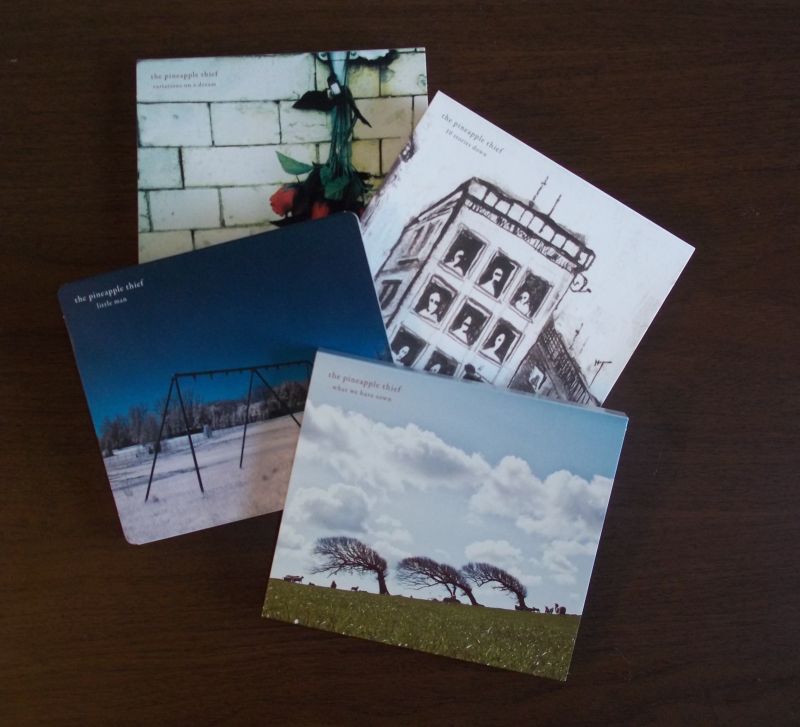
Kscope Music has been reissuing The Pineapple Thief’s albums beginning with their third, Variations on a Dream. With the recent release of their sixth, What We Have Sown, a wonderful back catalog is now available to those of us who missed them the first time around.

I happen to love Bruce Soord’s music, but there might be a “sameness” to it that can be frustrating to some prog fans. Soord’s compositional technique is very minimalist (in the same sense Philip Glass, Steve Reich, and Arvo Part are minimalist). For example, the song “Vapour Trails”, from Variations on a Dream, is nine minutes long, and the entire lyrics consist of

we’re flying too low/we’re flying too low/and trying to go far/but finding it hard/we’ve got your vapour trails to follow/you home/we’ve got your vapour trails to follow/we’re flying too fast/we’re flying too fast/and finding it won’t last/but something will pass…/we’ve got your vapour trails to follow/you home

As the words are repeated over and over, they become part of the overall sound of the song, and small variations in the melody have a much greater impact. It takes patience to listen to a typical Pineapple Thief song, but it is definitely rewarding. Every song creates a sense of time being suspended, as endless permutations of the basic melody are worked out. Perhaps Soord is the Bach of prog, and his songs are fugues!

If you’ve never heard anything by The Pineapple Thief, a good place to start is the two-disc compilation, 3000 Days. Variations on a Dream (probably my favorite, with the amazing mini-suite “Part Zero”)  is Pineapple Thief at their most Radiohead-like. 10 Stories Down is more acoustic and lighter in feel.  Little Man is a heartbreakingly beautiful account of Soord’s loss of a child at birth.

What We Have Sown was initially released as a quickly-recorded farewell work for the Cyclops label just before The Pineapple Thief began its relationship with Kscope. Recorded in 8 days, it is a wonderful collection that features one of Soord’s finest songs, the 27-minute “What Have We Sown?” as well as the sinuous, Middle Eastern-flavored “Well, I Think That’s What You Said”. Kscope has tacked on two bonus tracks, making it an even better package than the original.

As a matter of fact, Kscope has done an excellent job with all four reissues. They come in attractive slipcases, and all have updated artwork. Variations on a Dream and 10 Stories Down each include a bonus disc of music that was originally given away in limited editions.

The Pineapple Thief represent a more contemplative side of prog, and based upon their latest release, All The Wars, they are still exploring new and exciting musical territory.

Label Spotlight: Kscope Music

One of my favorite labels in the current prog scene is Kscope Music. Its first release was The Pineapple Thief’s Tightly Unwound in 2008, and it has rapidly become a force to be reckoned with. Steven Wilson has released all of his solo work on Kscope, as well as Porcupine Tree’s The Incident, and several PT reissues.

Everything Kscope does is top-notch, both musically and visually. They favor quality over quantity, and as a result, prog fans eagerly anticipate their releases. Their site is one of the most informative on the web, incorporating minisites for new and upcoming releases, music videos, artist’s tour dates, Soundcloud samples, Twitter feeds, desktop and mobile wallpapers, and a monthly podcast.

They have put together an impressive stable of artists, promoting what they call “post-progressive” music. Here’s a quick rundown of my favorites (in alphabetical order):

Anathema began as a very dark and heavy metal band, but now they are full of light and beauty. Their songs grapple with issues of life, mortality, and spirituality. Here’s a sample from their latest album, Weather Systems:

Engineers are what would happen if Pink Floyd and Crosby, Stills, & Nash decided to team up with My Bloody Valentine. Lush vocal harmonies on a bed of multilayered guitars. Gorgeous stuff, in my opinion. Here’s a link to an audio stream of their album In Praise Of More.

Gazpacho are from Norway, and, like Anathema, they aren’t afraid to tackle serious topics in their music. Here’s the video to “What Did I Do”, a song about P.G. Wodehouse’s being accused of treason after he made some naïve German radio broadcasts during WWII:

Lunatic Soul is essentially a solo project of Mariusz Duda, bassist for the excellent Polish prog-metal band Riverside. Their two albums tell the story of a soul in limbo who is given a choice of returning as a reincarnated person with no memory of his past life and loves, or keeping his memories and remaining a shade (at least that’s what I think it’s about!). There is a third Lunatic Soul album consisting of instrumental tracks based on the first two albums’ songs. Duda’s music is mostly acoustic, very melodic, and has a world music feel. Here’s a sampler:

North Atlantic Oscillation is a duo from Scotland. Their latest album, Fog Electric, is one of my top 5 albums of 2012. Imagine Beach Boys mashed up with shoegazers. Here’s a montage from the album:

As I mentioned earlier, both Porcupine Tree and Steven Wilson’s solo music are now on Kscope. I love his work, and if you’re reading this blog, I probably can’t add anything to what you already about him!

Finally, we have The Pineapple Thief. Bruce Soord has been making wonderful music for more than ten years. As I wrote in a review of their album Variations on A Dream, “Depending on your listening temperament, his songs can either be maddeningly long and repetitious or seductively beautiful. I fall into the latter camp, and it might be because I enjoy the music of Philip Glass, Arvo Part, and Steve Reich – minimalist composers who write tonal pieces that rely upon a lot of repetition.”

Here’s “Last Man Standing” from their recently released album All The Wars:

Kscope is a label that is creating its own distinctive style, like ECM and Blue Note did with jazz, and 4AD did with, well, whatever you want to call 4AD’s music in the ’80s. By taking full advantage of social media, Kscope is spreading the word about post-progressive music worldwide.