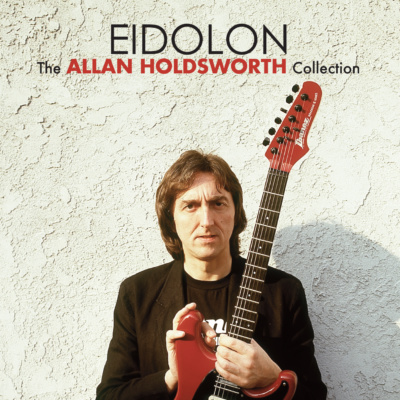
It took me a while to get my hands on a copy of the late Allan Holdsworth’s new compilation, Eidolon. It was well worth the wait.
What strikes me on the second listen to Eidolon is the seemingly endless flow of melody Holdsworth tapped. Despite his stunning contributions to the first U.K. album, it’s clear in retrospect that the man wasn’t comfortable in a highly structured musical environment. Like his hero John Coltrane, Holdsworth was much happier stating the tune at the start, in bebop head style, then seeing where he could travel with it.
Taking on the basic materials of scales and arpeggios from oblique directions, chaining them together into lightning fast, super-dense sheets of sound, slowing or stopping dead on a sustained note or an unexpected harmonic twist at just the right moment, all somehow connected to the chord changes he floated above — this is what Holdsworth brought to the Tony Williams Lifetime and Soft Machine, what he developed further in Bill Bruford’s band (before and after U.K.), and what he spent the rest of his life exploring. From the evidence here, he never ran out of new territory to pioneer; minds were duly blown, and hearts were duly moved.
Despite the admiration and support of more famous shredders like Eddie Van Halen and Joe Satriani, Allan Holdsworth never broke through to wide acclaim. But Eidolon leads me to believe that the gift of music — especially of melody — always brought him joy. Kudos to Manifesto Records for their re-release of all of Holdsworth’s albums (compiled as The Man Who Changed Guitar Forever) and this excellent compilation — which you can check out below.
My introduction to jazz was through Weather Report in the late ‘70s, and I couldn’t have made a more fortunate choice. Led by Josef Zawinul on keyboards and Wayne Shorter on saxophone, my love for that group’s music opened the door for me to the mother lode of jazz: Miles Davis.
Miles’ 1969 album, In a Silent Way, is a cornerstone of progressive music. Consider this – it contains just three songs: “Shhh/Peaceful” (18:16), “In a Silent Way” (4:11), and “It’s About That Time” (11:27). These songs don’t follow any typical structure; they are mostly jams, albeit within a strictly controlled atmosphere. Hearing the album gives the listener a sense of time being suspended, while gifted musicians at the top of their game improvise with each other. Also, as with many prog classics, the studio was an integral part of the finished result.
In 1969, Miles’ group was in transition. Pianist Herbie Hancock was itching to go solo, drummer Tony Williams was starting up his fusion band Lifetime, and bassist Ron Carter was tired of touring. Miles recruited British bassist Dave Holland for the sessions, guitarist John McLaughlin, and electric pianist Chick Corea. At the last minute, he invited keyboardist Josef Zawinul to join them. So the sessions began with a unique lineup never before seen in jazz: three keyboards (Hancock, Corea, and Zawinul), bass (Holland), electric guitar (McLaughlin), soprano sax (Shorter), drums (Williams), and trumpet (Davis). Teo Macero, Miles’ long-time producer, was again at the controls.
Apparently there was very little actual composition written out beforehand. However, that doesn’t mean the songs are aimless noodling. Tony Williams is a master of restraint, playing a steady pulse on his cymbals almost the entire album. Here is how Ian Carr, in his biography of Miles Davis, describes the music:
There is great delicacy and finesse in the solos, great subtlety in the keyboards (everybody is listening to everyone else), and the music is pervaded by Miles Davis’ unique atmosphere of buoyant though melancholy reflection. Perhaps paradoxically, the total impression is powerful and seductive because the steady time with its occasional pauses (as if the music were actually breathing) creates the non-western climate of timelessness – and in a sense, it is music which should be inhabited rather than merely listened to.
Some of Miles’ greatest solos are in these sessions, as well as Wayne Shorter’s. By this time, they had played together so long they seemed to be one mind with their improvised interplay. When the sessions were over, they had about two hours of material. Teo Macero had learned to just let the tapes roll as soon as Miles began, and not stop until everyone quit.
Macero used editing to cut and paste together the final album, and he deserves most of the credit for making it such a satisfying listen. In “Shhh/Peaceful”, he includes a trumpet solo at 1:35 that states the theme, then he lets everyone trade solos for the next twelve minutes. At 13:31, he brings back the same solo to close out the piece.
“In A Silent Way”, which opens side two, begins with John McLaughlin alone on guitar. Miles famously suggested to McLaughlin that he “Play it like you don’t know how to play guitar”, and the result is a beautiful and simple tune that is charming yet challenging to listen to. It then segues immediately into “It’s About That Time”. Again, Tony Williams sets up a steady pulse over which the others can vamp and solo. Holland plays a repeated riff on bass that slowly builds tension while McLaughlin, Shorter, Corea, and Davis take turns soloing. The keyboards and guitar join Holland playing the bass riff until finally, at 9:00, Tony cuts loose and flails away on the drums while Miles solos. Then the exact same take of “In A Silent Way” that began the side brings the listener back to earth. No one had used tape editing in such a radical fashion before, but Macero makes it work.
It would be hard to overstate the influence In A Silent Way has had on music. Pink Floyd, Frank Zappa, King Crimson, Brian Eno, Joni Mitchell – all display hints of this music. Talk Talk’s Spirit Of Eden is heavily indebted to it, as well as a lot of Steven Wilson’s latest work (Grace For Drowning and Storm Corrosion). Practically anything that has “space” in it can trace its roots to this album.
Once again, Miles proved himself to be a visionary artist, building the bridge between traditional jazz and the newborn genre that would soon be known as progressive rock.


 Progarchy