Over at In The Studio.net, there is an interview with Yes on the occasion of the 40th anniversary of Close to the Edge. It’s about 20 minutes long and well worth a listen. Hat tip to Paul Watson who previously posted about this on the BBT Facebook page.
On YouTube, I stumbled across an interview with Neal Peart regarding Clockwork Angels, and thought it would be a good companion to the post below regarding the same album. Its about 43 minutes in length, but like almost any interview with Peart, you can be sure it’s interesting.
Ten years ago, my wife and I had the pleasure of spending a day in Belize as part of a week-long Caribbean cruise. Our tour guide, oddly enough, was from Germany; he and his family had moved to Belize some twenty years prior. I’ve never been a tour guide, but I assume it must be challenging in many ways: dealing with difficult and clueless tourists, recounting the same information again and again, trying to find the right combination of being informative and entertaining, and being the leader of the tour while not making the tour about yourself, but about the country, the culture, and the sites. This tour guide was exceptional: he was informative and detailed without being obsessive about every nook and cranny; he had a passion for his adopted homeland but also a knowing sense of objectivity; he mixed together trivia and humor and history with ease; he helped us experience Belize with the knowledge that we were in capable hands. It made for a delightful day.
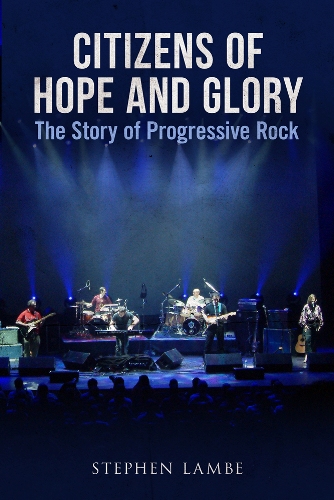
Stephen Lambe, author of the recently published book, Citizens of Hope and Glory: The Story of Progressive Rock, reminds me of that tour guide. Now fifty years old, Lambe is something of a late-comer to prog, although he states so with a certain British dryness. He begins with with a wink and wry sigh: “To my constant irritation, I missed it. I was born in 1962, so by the time I had had my Prog epiphany in 1978 it was all over.” Only two sentences in and you have a nice phrase to insert into your next musical conversation: “Prog epiphany”. Lambe recounts how hearing the 1971 Yes album, Fragile, “blew my mind”; that was in 1978, as punk was rudely clawing and pawing its way onto the musical throne, albeit briefly.
And so the tour begins, with Lambe making it quite clear from the start what he hopes to accomplish—and what he will not try to do, for this or that good reason. It’s a small thing, but also significant. Having written a couple of books myself (and trying to finish a couple more at the moment), I think certain books—especially non-fiction works intended to educate and inform on a particular topic—should state from the start what they will and will not do. Lambe’s book is the third book I’ve bought that is dedicated solely to prog music. And, without naming the other two, I’ll simply note that this is the first of the three to be straight up about what the reader will find between the covers. (The other two are collections of essays, and are more academic in tone; they are mixed bags at best.)
What parameters does Lambe set? First, he focuses mostly on “symphonic” prog groups, with some mention of progressive metal, electronic music, and certain pop/rock groups, such as Talk Talk, XTC, Kate Bush, Tears for Fears, Elbow, and Radiohead, that have embraced many elements of prog without themselves being or becoming prog. Secondly, Lambe uses almost no quotes from either musicians or other publications. “I have chosen”, he states, “to make this book a personal history … in the hope that my experience and opinions will strike a chord with other fans of the genre. This book contains fact and opinion. … In the end this is a history of Progressive Rock filtered through my own tastes and experiences and I hope it is all the better for that.”
Some readers might be put off by such a statement, and I can appreciate their concerns. Lambe the tourist guide has spent over thirty years living in the land of Prog, and he has definite opinions about the sights and sounds therein. Personally, I like the approach. It reminds me of the similar tack taken by the exceptional American music critic, Will Friedwald (just a year old than Lambe, by the way), whose books on Sinatra and other popular and jazz singers from the early and mid-twentieth century are opinionated, informative, occasional quirky, often humorous, and never dull. Granted, Lambe is not the writer Friedwald is—but few people are. But Lambe, like Friedwald, is both knowledgeable and reasonable; he has his preferences, but he never pontificates, lambasts, or chides. On the contrary, he is agreeably positive; his occasional criticisms are almost always along the lines of noting that Album B is simply not quite as good as Album A by the same artist—and here are some reasons why.
Third, Lambe points out that since he is English, he tends to focus on artists from the UK, especially when he writes about the 1970s. Fair enough, especially since England in the 1970s was the center of the prog universe. The book is a chronological history; it does not try to be cute and jump around needlessly. Over the course of the book’s ten chapters, Lambe highlights about sixty essential prog albums, what he calls “pivotal albums”. These are not necessarily the “best” prog albums, he takes pains to note, but are a good, solid start to any prog library. Groups that receive substantial attention from the ’70s include Yes, Genesis, King Crimson, Gentle Giant, and Emerson, Lake and Palmer. Later groups include Marillion, The Enid, Twelfth Night, Rush, Magnum, Dream Theater, and Porcupine Tree, among many others. Due attention is given to American and European bands, including groups from Poland, Italy, and Germany.
Lambe is at his best when he makes connections, highlights influences, shares his personal experiences, and places bands and albums within both immediate and larger contexts. Here is a good example of his approach, about halfway into the book, in the chapter, “The 1980s: A Short-Lived Revival”:
Much more of a surprise than the last gasp of Yes was the seemingly sudden emergence of King Crimson. Towards the end of the 1970s, Robert Fripp had been increasingly active. This included an excellent solo album, Exposure, and work with Daryll Hall, Peter Gabriel and his own band, The League of Gentlemen. Working largely in the USA, he had managed to re-invent himself as a pioneer of the New Wave rather than a Progressive Rock dinosaur. In 1980, he set about forming a new band.
This time, Fripp had a different style of music in mind, something informed by the post-punk pop of Talking Heads (from which band he stole innovative guitarist and vocalist Adrian Belew), the intricate minimalism of Steve Reich and the rhythmic complexity of the old King Crimson. With a rhythm section comprising Tony Levin (on bass and the strange Chapman Stick) and Bill Bruford (drums), the band began rehearsing in Britain before taking a short set on tour in small British venues. I caught this tour at Keele University and was very impressed, although despite playing Crimson classics ‘Red’ and ‘Larks Tongues in Aspic’, they had less an hour’s worth of material. They were called Disciples at that point, although it was no surprise when they changed their name to King Crimson.
The resultant album, with its striking, minimalist cover, is a masterwork. It mixes Talking Heads-style vocals and song structures with a Prog style that few people had heard before. Belew sounds like he is having a whale of a time, his vocals clearly heavily influenced by David Byrne of his former band, but his melodic sense superbly utilized. His inventive guitar playing dips in and out of Fripp’s more intricate patterns. Bruford and Levin sound like they were born to play this music, with Levin’s intricate and inventive Chapman Stick work particularly impressive. But Fripp was the boss, and his remarkable guitar patterns are what make Discipline so memorable.
Of the ten chapters, six are devoted to history, groups, and albums; the other four are about the important relationship between technology and prog, the various aspects of live performances, prog art and design, and the content of prog lyrics. I would have preferred, if push came to shove, for the latter four to have been grouped together as the second part of the book rather than be dispersed among the historical chapters, where they break up the narrative flow. As it was, I skimmed some of those four chapters; however, I’ve no doubt they will prove informative to readers interested in those specific topics, especially musicians, producers, and others actually involved in creating music. The Epilogue, “Darlings of the Press at Last?”, notes that “Progressive Rock is a specialist genre once again, with an aging audience. However, the success of Porcupine Tree, Dream Theater and Elbow should give us all hope. Wherever there are people are willing to put in a little work to get more than a catchy tune and a trite lyric out of music, then Progressive Rock, in some form, has some hope for survival.” I suspect that most of the contributors and readers of Progarchy.com agree completely.
Lambe’s book is, I think, a near perfect introduction to progressive rock for nearly anyone interested in the topic. Passionate, obsessive prog fans who have spent years reading and collecting and communicating may find it a bit “101” at times. But even they will likely appreciate how Lambe has put together a cohesive narrative that makes many connections and fills in many holes without losing sight of the forest for the trees. This is a tour worthy taking, with a very adept and enjoyable tour guide. Highly recommended.
I’ve been buried with real work and real reality, but I do have grand designs for review posts of the new Soundgarden CD, “King Animal”, which released today, and Stephen Lambe’s book, Citizens of Hope and Glory: The Story of Progressive Rock, which I’ve almost completed reading (very short review: 4.5 stars out of 5, recommended). In the meantime, in my unrelenting quest to show the many wonderful connections between prog and jazz, here are three covers of prog classics, performed by the trio, Bad Plus (band site).
For those who aren’t familiar with Bad Plus, the trio—Reid Anderson, Ethan Iverson and David King—has made its name by being, in two word, distinctive and controversial. Part of their distinct (and controversial, to some) approach has been to cover tunes that aren’t a part of the usual jazz canon. For example, have you heard many true jazz covers of ABBA’s “Knowing Me, Knowing You”, Heart’s “Barracuda” (with singer, Wendy Lewis), or Black Sabbath’s “Iron Man”? No, I didn’t think so. And those covers, in my opinion, are excellent; they not only get your attention but they reveal aspects and possibilities in the original songs that weren’t obvious before. And it is done with a winning mixture of intensity, fabulous interplay, respect for the material, sly humor, and some “out there” moments. The Guardian puts it well when it describes the trio in this way: “If the Coen Brothers put together a jazz trio, perhaps it would be like this, the comic and the dramatic rolled together.”
And how about the fact the trio titled its 2007 album, “Prog”? Fabulous! Here, then, are Bad Plus covers of Rush’s “Tom Sawyer”, Pink Floyd’s “Comfortably Numb”, and Yes’s “Long Distance Runaround”:
Yesterday I downloaded Stephen Lambe’s book, Citizens of Hope and Glory: The Story of Progressive Rock (2011), and am now about three chapters into it. Lamb is, according to his book’s site, a “co-promoter of the Summers End Progressive Rock festival since 2006” who is “also heavily involved with contemporary progressive rock band Magenta.” I’ve enjoyed the book so far; Lambe’s approach is a good mixture of the personal and the journalistic; the book strikes me as a fine introduction to prog music history for folks who are new to the topic but also an engaging guide for those who know prog fairly well (I’m somewhere in-between!). I appreciate that Lambe, in his introduction, explains what his book will and will not attempt to do (for example, his focus is on symphonic prog, with less material on other forms of prog). He is clearly both a huge fan of prog as well as a thoughtful musical critic. Anyhow, I will likely post a more formal review once I’ve finished the book.
In a section titled, “Yes—The Most Inventive Covers Band in the World”, Lambe provides some background to the legendary band’s formation: “Jon Anderson and Chris Squire met for the first time at La Chasse, a drinking club not far from the famous Marquee club, which was much frequented by musicians. … Their vision was that this was to be a rock band with an emphasis less on hit singles than on ambitious, sophisticate arrangements, great harmonies and high-quality players.” And then, in discussing the first Yes album—”Yes”, fittingly—Lambe writes of how the “band began playing radical rearrangements of other people’s songs, gradually combined with their own material … This include covers of ‘I See You’ by the Byrds and the Lennon/McCartney song ‘Every Little Thing’. Musically, it includes plenty of hints at the band to follow. … Closing track ‘Survival’ is marvellous, perhaps the first genuine Progressive Rock track.”
Which meant I had to download the album, which I’m embarrassed to say, I’d never heard before (shame!). It’s great stuff, more raw than the later Yes material, but with a really obvious jazz vibe, thanks for Bruford’s fabulous drumming. That said, what do you think? Is “Survival” perhaps the first genuine prog rock track?
I balked for a few moments at the temptation of writing an indulgent, long, complex, and idiosyncratic post about my journey to and into prog, and then realized: hey, this is Progarchy.com! If I cannot string together tenuously-related, semi-mystical concepts and conceits imbued with mythical overtones, quasi-autobiographical meta-narratives, and intertwining (and purposely confusing) philosophical musings here, then what’s the point of this wonderful blog? (No need to answer that, as I’m already soloing on my inner Moog without regard for the boring 4/4 time signature others might wish to force upon me.) Actually, much of what follows was already presented in a long-ish comment I left on a previous post below. But Brad, as he often does, inspired me to do more, even at the risk of embarrassing the shy and retiring Olson clan. So here goes.
I was oddly oblivious to most music until my early teens. This was due in part to being raised in a Fundamentalist home and church, both of which largely frowned on rock music as the rhythmic spawn of the devil, meant to corrupt good morals and encourage bad haircuts. Yes, the stereotypes do hold, at least to some degree. I heard a lot of church music (classic Protestant hymns, some of them very good) and mostly bland to bad contemporary Christian music. Then, around the age of fourteen or so, I started listening to the radio (one station, weak signal) and began to slowly accumulate a few tapes. My road to prog went through AOR acts such as Journey, REO Speedwagon, Loverboy, Foreigner, and Styx, with a helping of popular mid-80s albums by ELO, Elton John, Toto, and Queen. I found the standard rock of the day (including some of the stuff above) to be rather dull; I was fascinated by the more extended songs of Elton (the early 1970s albums especially), Queen, Asia, and the Moody Blues. I’m happy to say I was hooked on “Bohemian Rhapsody” long before “Wayne’s World” re-presented it to my generation. Also, I thought the usual popular, party music about sex, drugs, and rock ‘n’ roll was mostly shallow, even if occasionally diverting. Which is another way of saying I secretly listened to my share of Van Halen while playing some laughable air guitar (oh, wait, all air guitar is laughable). I did not, however, ever party. Seriously.
Around 1985 or so, I bought a copy of “The Best of Kansas”. That opened the door to prog. There was something about the mixture of Livgren’s lead guitar, Steinhardt’s violin, and Steve Walsh’s amazing voice, along with lyrics soaked in spiritual longing and Americana, that grabbed me by the scrawny neck. Over the next three or four years, I ended up collecting everything by Kansas, Kerry Livgren (solo and with AD), and Steve Morse (solo, Dixie Dregs, etc.). My favorite Kansas albums are “Song for America” and “In the Spirit of Things”, although they weren’t the chart-toppers that “Point of Know Return” and “Leftoverture” were. I also went on a serious Moody Blues binge, focusing on the early stuff, prior to their more pop-oriented work of the mid-’80s. Then I really got into Yes (both Rabin-era and the early classic albums with Howe), Rush, and Pink Floyd; in fact, while in Bible college (1989-91), I freaked out some of my more staid classmates with my obsessive interest in Pink Floyd, Queen, Queenrÿche, and King’s X (and, yes, I also listened to Petra, David Meece, White Heart, White Cross, Russ Taff, and Margaret Becker). King’s X was a major revelation, especially the brilliant, crunching, melodic beauty of “faith hope love”, which was a masterful blend of hard rock, metal, prog, blues, and Beatle-esque harmonies. And I recall very clearly driving across the Montana plains to school in Saskatchewan, blaring “Fly By Night” and other brilliant Rush tunes. Ah, to be young again.
A quick aside here, in the spirit of musical indulgence: while in high school, I also developed a semi-secret soft spot for country artists such as Johnny Cash, Johnny Horton, and Jim Reeves. And two composers: Mozart and Brahms. I tried to get into opera (our family doctor, who owned a massive classical collection, gave it his best shot), but couldn’t get there. I would try again in the late 1990s, failing again. And at one point I must have listened to Eric Clapton’s 1989 comeback album, “Journeyman”, about a thousand times. Go figure, as it’s the only Clapton album I’ve ever fixated on. Okay, back to prog.
In my early-to-mid twenties (1989-1995), I launched into Van Morrison, Seal, Jeff Buckley, Radiohead, and jazz, five of my big musical loves ever since (I’ll eventually write some disturbingly long posts about each, I hope). My interest in prog advanced in fits and starts. Yes was a constant, as I worked through most of the band’s catalog, with excursions into solo projects by Jon Anderson, Trevor Rabin, Rick Wakeman, Bill Bruford, and Steve Howe. The next big breakthrough was Dream Theater in the late 1990s, followed by Spock’s Beard, then Porcupine Tree and a bunch of others. Then, around 2004, I “discovered” Frank Sinatra, which led to the purchase of about 1,000 Sinatra tunes (favorite album: “In the Wee Small Hours”). I mention Sinatra because I have the semi-crazy idea of writing a blog titled, “Sinatra: Grandfather of Prog?”, that will either get me ejected from Progarchy, or enshrined in the Progarchy Hall of Fame.
I fully agree with Brad: we are living in a new, golden age of prog. There is such a stunning array of prog and prog-ish music to be had, I’ve long given up hope of keeping abreast of it all. Current favorites, in addition to the already mentioned acts, include Pain of Salvation, Threshold, Riverside, Muse, Animals As Leaders, Big Big Train, Anathema, Devin Townsend, Three, Astra, Blackfield, The Pineapple Thief, King Crimson, Headspace, and Mars Volta. But there are still huge holes in my prog knowledge and experience. I’m making prog-ress, but the road continues to rise and wind ahead. Which is exciting, as it means there is more to discover and hear.
A few days ago, Progarchist and classical philosopher Chris Morrissey asked about our first introductions to music.
The youngest of three boys, born in the summer of love (September 6, 1967—only 3 months and five days after the release of “Sgt. Pepper’s Lonely Hearts Club Band” by the Beatles), and coming of age in the late 1970s and early 1980s, I grew up on progressive rock: Yes, Kansas, Genesis, and the Moody Blues. We faithfully shunned the 3-minute pop format and we sought mightily the 20- and 30-minute epics of European (usually liturgically derived) symphonic music with rock instrumentation and bizarre time signatures.
I remember hearing lots of longish, prog songs as early as 1971 or 1972. Though I’ve never played an instrument with any degree of passion, I’m assured by my mom and two older brothers that I was obsessed with music even as a toddler. Somehow, I figured out how to crawl out of my crib and down the stairs to the family stereo. Even as a one-year old, I would wake the entire household up, blaring the Banana Splits or Snoopy and the Red Baron at 3 in the morning.
My first great awakening came, though, from seeing the sleeves of YesSongs. I spent hours trying to figure out how the animals made it from one floating island to the next. And, I’ll never forget the first time I played side one of YesSongs—I was overwhelmed by the depth and complexity of it.
As is now well recognized, the prog lyrics as well as the cover art tended to be fantastic, pretentious, overblown, and theological. There have even been some interesting scholarly articles about progressive rock thriving in the western and midwestern states of America, mostly among middle-class, conservative kids. And, of course, we, with great confidence, derided disco and top-40 music through junior high, high school, and college. Disco and top-40 music, as we understood it, were decadent and vacuous. As far as we were concerned, progressive rock artists (and some New Wavers) were the only real musicians outside of the classical and jazz world.
In many ways, progressive rock helped define my own childhood and teenage years. I will never forget seeing abolitionist John Brown on the cover of a 1974 Kansas album (it sparked all kinds of historical questions re: Kansas, abolitionism, and the American Civil War); hearing Pink Floyd’s “The Wall” at the University of Notre Dame in the fall of 1979; being introduced to Rush’s 1981 “Moving Pictures” in the Liberty Junior High School library in Hutchinson, Kansas; or listening to Yes’s “Fragile” over and over again and trying to figure out the “deep” meaning of the lyrics. In high school, I worked as on overnight D.J. at a local rock station (KWHK), which doesn’t exist anymore. And, while in college at Notre Dame, I had a Friday-night progressive rock show (WSND) my junior and senior years, often playing two hour blocks of Rush or other groups.
As powerful as any of the albums just mentioned, though, was my first listen to Talk Talk’s Colour of Spring in the spring of 1987 and, even more so, my first listen to Talk Talk’s Spirit of Eden in September 1988.
My comrade in arms in college was the singer of the most popular band on campus, St. Paul and the Martyrs. They even opened for Phish when Phish played on campus, spring 1990. The leader singer, Kevin McCormick, even became my oldest son’s godfather! Now, he’s a well-known classical guitarist and even a Progarchist.
But, I’ll never forget the two of us listening to Spirit of Eden for the first time. We were just stunned and in complete silence as we explored every note and every silence of the album.
Having turned 13 in the autumn of 1980, I also, of course, grew up with New Wave: Thomas Dolby, Kate Bush, The Police, The Cure, Oingo Boingo, XTC, Siouxie and the Banshees, and Echo and the Bunnymen. Over the Wall!
Our local Kansas radio station—KWHK—had briefly been formatted for New Wave, so I was able to get every new album sent by the record labels. The one that hit me hardest was XTC’s Skylarking.
My college radio show at Notre Dame focused on progressive rock, as mentioned above, but I threw in a lot of New Wave. New Wave just seemed the more radio-friendly version of progressive rock. And, by the early 1980s, progressive rock seemed to have run its course. Could Asia really claim to be the successor of Yes? Or, could Genesis without Peter Gabriel or Steve Hackett really be Genesis? We answered with a resounding “no.” That left us with New Wave.
After all, in 1990, we still had a few years before Dream Theater and Spock’s Beard re-introduced—in the states—a new wave of Progressive Rock.
A quarter of a century later, I realize that music took on religious significance for me and my friends. Those who embraced disco, pop, or top 40 music were heretics, and we supporters of progressive rock were the orthodox.
***
A year or so ago, some former students asked me to write about my listening tastes in the 1980s. Here’s what I wrote for them:
High School was a long time ago for me, but I still remember it well. During the summers, I had one of the best jobs in the world–I was a DJ at our local AM-station, KWHK. Not only did I DJ, but I also got to write and produce commercials, and I served as a liaison between the sheriff’s department and the National Weather Service. I grew up in central Kansas, so we had tornados and tornado warnings quite frequently. Great job. I’ve also been into collecting music (mostly progressive and alternative rock, some jazz, and a bit of classical) since second grade. I started young, and, for better or worse, I’ve never stopped. My kids (13 and under) can name bassists, singers, and drummers of the major progressive bands. And, yes, I’m proud of them.
Freshman year of high school, 1982-1983. It was freshman year that I really discovered New Wave. I had been listening, almost exclusively, to progressive rock and what’s now called classic rock during the 1970s and earliest part of the 1980s. The father of a friend of mine owned a record store, and we were introduced to all kinds of music through the store in 9th grade. In particular, I listened to Thomas Dolby’s Golden Age of Wireless (favorite song: One of Our Submarines is Missing). I had this on one side of a tape and ABC’s The Lexicon of Love (favorite song: 4 Ever 2 Gether). Also lots of U2’s War (favorite song: Sunday Bloody Sunday). Progressive Rock was never far from my heart, and I listened to Rush’s Signals (favorite song: Subdivisions) pretty much non-stop, Peter Gabriel’s IV (favorite song: Lay Your Hands on Me), and Roxy Music’s Avalon (favorite song: Take a Chance with Me).
Sophomore year of high school, 1983-1984. This was a huge year for music. Genesis released their self-titled album (favorite song: Home by the Sea, Parts I and II); the Police released Synchronicity (favorite song: Synchronicity II); and Yes released 90125 (favorite song: Cinema).
Junior year, 1984-1985. Rush’s Grace under Pressure (favorite song: Between the Wheels) dominated every other album that year. Frankly, this was THE album. If I had to name a favorite album of high school, this would be it. My sophomore year in college, I wrote a paper using only the lyrics from the album. I even got an A. I also listened a lot to The Smiths’ Hatful of Hollow (favorite song: Please, Please, Please), Oingo Boingo’s Dead Man’s Party (favorite song: same as title), and Thomas Dolby’s second album, The Flat Earth (Favorite song: same as title).
Senior year, 1985-1986. Another great year for music, but mostly for former proggers going pop. Albums that year included, at the top of the list: Sting, Dream of the Blue Turtles (favorite song: Fortress Around Your Heart), Peter Gabriel, So (favorite song: In Yours Eyes), Tears for Fears, Songs from the Big Chair (favorite song: Broken), and XTC, Skylarking (favorite song: The Man Who Sailed Around His Soul). The other album I played constantly was the soundtrack to To Live and Die in LA (a pop band, Wang Chung, playing a very proggy style). Lots of Kate Bush, Hounds of Love, too (favorite song: Hello Earth).
It wasn’t until my freshman year (1986-1987) of college that I really got into Talk Talk, the Cure, and Echo and the Bunnymen. I also really liked Blancmange (kind of a really smart Talking Heads) and New Model Army and a few others. That year, U2 released “The Joshua Tree.” I’ll never forget sitting in the car with a friend, being about 1/2 through the album and just breaking down (not something I did very often) because of the beautiful intensity of the album. Crazy. At the time, I was horrified by RATTLE AND HUM. Now, I think The Joshua Tree as a whole is really good, not brilliant. Side two, maybe, is brilliant. Side one has a brilliant moment–bullet the blue sky. And, RATTLE AND HUM seems better than it did to me then.
In high school, I also remember listening to some A-ha, B-Movie, b-52s, Erasure, Depeche Mode, and Communards. I don’t think I would’ve chosen to listen to these groups, but they would’ve been pretty hard to escape then. I would’ve always preferred something prog–unless we were dancing. Had an all night party at my house once my senior year when my mom was out of town. Late, late into the evening, a group of us were trying to analyze a 1977 Genesis concert we’d taped off of PBS! I’ll never forget that night. Lots of analyzing Pink Floyd, too.
Coralspin, “Honey and Lava,” (Altrospire, 2012). New on the prog scene, Coralspin hails from England. Much of the music on this excellent release has the feel of something Trevor Horn or Trevor Rabin might have produced around the time of Yes’s 1984 MTV masterpiece, “90125.” Certainly, Coralspin has its roots in the early to mid 1980s, especially with its big guitars and its big keyboards. Whether one likes the music of Horn or Rabin or not, no one could honestly dispute the audiophile proclivities of each man. The same can be written of Coralspin’s Blake McQueen. The production of this album is simply stunning–this hit me from the first moment I put it in my cd player, and it continues to impress me with each listening. It’s not just the keyboards and guitars that stand out , no matter how much they predominate on most of tracks. The bass and the drums are crisp, offering this album a much more punctuated and professional feel than some of its 80s ancestors. Indeed, I wish Horn and Rabin would’ve mixed Chris Squire’s bass at this level on 90125. Amazingly enough, almost all of Honey and Lava was recorded in McQueen’s home, and he later mixed and engineered it. He’s, simply put, a master audiophile, in the same league with Steven Wilson or Rob Aubrey. The lyrics on this album are wonderful as well–mythic, pointed, hard, soft. Everything has its place, and its place is very good. If I were forced to make a comparison (and, as far as I know, I’m doing this out of my own free will), I would compare Coralspin to The Reasoning. There’s the obvious fact that the lead singers of each are women, but the comparison between the two is much, much deeper than what some silly academic might have pronounced twenty years ago as worthy of revelation. The structures of the songs–as approached by Matt Cohen and Blake McQueen–have a definite similarity. Both love mythic lyrics as well, and each wisely uses the voice not only to convey the meaning of the lyrics but also to convey the meaning of the very music itself. For what it’s worth, I’m a very proud owner of Honey and Lava, and I eagerly await the follow up.




 Progarchy